
 Pottery Date Night
 Bring All Your Friends Free Week
 Give a Month of Pottery
 Private Pottery Parties

 The Welcome Booklet
 Your First Ten Sessions
 The Pottery Process
 Finding the Studio
 Your Classes Never Expire
 The Four Tables
 Who’s Who
 The Rewards Program
 Flux Glazes
 The Calculators
 Kiln Tracker
 Holiday Kiln Deadlines

 Beginner’s Tool Set
 Fingernail Clippers
 Mayco Clay Mender
 Epoxy for Kintsugi
 Applicator Bottles
 Large Bead Rack
 Raku Workshop
 Nighttime Raku
 Horsehair and Feather Raku
 The Clay Hole T-Shirt
 Embroidered Crewneck
 Zip-Up Hoodie
 Pre-Made Bisqueware
 Glaze Catchers
 Kiln Cookies
 Clay Cubby Rental
 The Glaze Bible, Printed
 The Book of Molds, Printed
 Printable Pottery Guides
 Free Printable Trackers
 Gifts for Potters
 Christmas Pottery Ideas
 Mother’s Day Gift Ideas
 Pottery Date Night
 Studio Calendar
 2027 Studio Events
 What Should I Do Today?
 How to Throw on the Pottery Wheel
 How to Make a Pinch Pot
 How to Tap Center a Pot
 The Five Stages of Clay
 Is Pottery Hard to Learn?
 Pottery Wheel Practice Drills
 20 Easy Hand-Building Projects
 Everything That Sounds Wrong

 A Beautiful Piece, Every Time
 Slab Roller Tips
 Any Dish as a Slump Mold
 Slab Roller & Slab Mold Certification
 The Pottery Skill Tree
 Clay & Pottery Calculators
 Logging Your Pottery and Glazes
 The Pottery Dictionary
 Why Did My Pottery Do That?
 The Pottery Cone Chart
 Pottery Myths, Fact-Checked
 Is Handmade Pottery Food Safe?
 Incredible Ceramic Artist Videos
 How Dan Throws Giant Pots
 How to Dry Your Pottery
 The Pottery Wheel Introduction
 Pottery by Zodiac Sign
 Personality and the Pottery Wheel
 Pottery for Engineers
 ADHD, Hyperfocus, and Never Running Out
 Hobbies for Burnout
 Screen-Free Hobbies for Adults
 Every Addiction I Ever Had Lost to Art
 Functional Pottery Is Engineering
 How Do We Compare?
 Pottery Classes by City
 Every Pottery Studio in Utah
 Pottery in Draper
 Featured Members
 The Signature Wall
 Making Friends as an Adult Is Brutal
 The Clay Hole Commandments
 2027 Pottery Contests
 2027 Studio Parties
 Gallery Night

 Scream It Into the Void
 Destroy the Glaze Wall
 Daily Affirmation Cards
 Everything That Can Go Wrong
 Subscribe to Our Newsletters
 Contact The Clay Hole
 Corporate Team Building

 Glaze Combinations
 Glazes We Do Not Carry
 Making Glaze Test Tiles
 The Mega Glaze Tool
 How to Use the Mega Glaze Tool

 Glaze Brushing Techniques
 How to Use Underglaze
 How to Use Dipping Glazes
 Glaze Problems, Causes and Fixes
 The Dipping Glaze Guide

 Making a Glaze Catcher
 Fused or Sharp After Firing
 The Signature Wall
 His Viral Videos
 His Own Ceramics
 Meet Mud
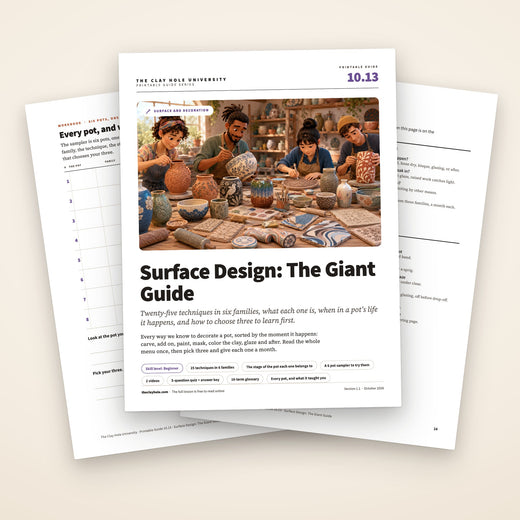
Twenty-five ways to make a pot say something.
The form is the body. The surface is the voice. And the voice has more range than most potters ever explore, because nobody ever hands you the full menu: everything you can carve, stamp, trail, inlay, paint, mask, wedge, layer, and gild onto clay, organized so you can actually find your way.
Everything you can carve, trail, paint, mask, wedge, and layer onto a pot, condensed to six families, one sampler checklist, and one video. The full twenty-five-technique menu is one toggle away.
This page is that menu. Twenty-five techniques in six families, each with what it is, when in the pot’s life it happens, and a link to the full lesson wherever we have one. You will not try them all this year. You are going to want to.
The six families of surface design
Every technique on this page belongs to one of six families, sorted by when it happens and whether it cuts in, sits on, or soaks in:
- Carve and impress. Stamps, rollers, carving, sgraffito: draw by subtraction and let glaze pool in the valleys. Window: wet to leather hard.
- Add on. Sprigs, trailed slip, sculpted relief: draw by addition and let the surface catch light. Window: wet to leather hard.
- Slip and underglaze. Engobes, underglaze painting, mishima inlay, oxide washes, terra sigillata: color that becomes the skin. Window: leather hard to bone dry, then bisque.
- Resists. Wax, latex, tape, paper, stencils: protect what stays clean and decorate everything else. Crisp edges without a steady hand.
- Colored clay. Nerikomi, neriage, agateware: wedge the color into the clay so the pattern runs all the way through.
- Glaze and after. Layered glazes, transfers, decals, lusters (those two need their own extra firing, so ask first): the late-game moves at glazing and beyond.
The plan: run the six-family sampler below, then give your three favorite techniques a month of repetition each. Want the full twenty-five-door menu, each with its stage window, and a lesson link wherever we have one? The Comprehensive Version above is exactly that.
How to choose from twenty-five doors
A menu this long causes two injuries: paralysis, and the sampler platter where a potter tries everything once and learns nothing deep. Both have the same cure. Ask three questions of any technique:
Every technique has a window in the pot’s life, wet, leather hard, bone dry, bisque, at glazing, or after the glaze fire, and the window decides your studio schedule more than your taste does.
Carved lines catch glaze and shadow. Raised additions catch light and thumbs. Colored slips and washes become the skin itself.
Some techniques are texture-first and let one glaze do the talking. Others are drawing and painting by other means.
Then commit like this: pick three techniques from three different families, and give each one an entire month of repetition. Three is enough variety to keep the studio fun. A month each is enough depth for the technique to stop fighting you and start speaking. The sampler checklist near the bottom of this page will hold you to it. Everything between here and there is the menu itself. Each family notes its stage window up front.
Carve and impress: drawing with subtraction
The oldest family on the menu: press in, cut away, and let the clay itself hold the image. Texture-first techniques, and the ones a single good glaze flatters most, because glaze pools dark in every valley you give it.
Carving and incising
Cutting relief and drawing fine lines directly into leather-hard clay, from bold facets of shadow to hairline botanical sketches. The gateway drug of this whole family. Full lesson .
Sgraffito
Coat leather-hard clay in a contrasting slip or underglaze, then scratch your drawing through it so the body shows in every line. Crisp, graphic, endlessly personal. Full lesson .
Chattering
Let a springy trimming tool bounce against a spinning leather-hard pot and it leaves a rhythmic, mechanical ripple no hand could draw on purpose. Controlled accident at its most satisfying.
Faceting
Slice flat planes down the side of a thick-walled pot with a wire or blade, turning a round form into cut gemstone geometry. Five seconds of courage per facet.
Stamping and rollers
Press repeatable pattern into soft or leather-hard clay with stamps and texture rollers, from a single maker’s mark to full-wrap wallpaper. Full lesson .
Rope and found textures
Cord rolled across a wall, lace pressed into a slab, leaves, bark, doilies, the bottom of a sneaker: the world is a texture library and clay remembers everything. Full lesson .
This family alone could fill a year. When you want the firehose version, our forty ways to add texture page is exactly what it sounds like.
Add on: drawing with addition
The mirror family: instead of cutting in, you build up, and the surface starts catching light and fingertips. Raised work loves a glaze that breaks thin over high points.
Sprigging
Small pressed relief ornaments, leaves, medallions, tiny beasts, slipped onto the pot like jewelry. The technique behind Wedgwood’s famous blue-and-white ware, and much easier than it looks. Full lesson .
Slip trailing
Piping lines and dots of thick slip from a squeeze bottle, cake decorating with a kiln at the end. Raised drawing, tactile as braille, spectacular under a breaking glaze.
Relief and applique
Hand-modeled additions, coils, cutouts, sculpted forms, scored and slipped onto the wall. Where pots start becoming sculpture without giving up their day job.
Slip and underglaze: painting in clay’s native language
Color that becomes part of the skin instead of a coat over it. This is one of the two biggest families on the menu, and the one where potters who miss drawing and painting feel most at home. The studio’s wall of 150-plus underglazes is this family’s paintbox.
Engobes
Colored clay slips that go on bisque here, or at leather hard when you plan to carve through them, fired into a permanent second skin. A workhorse of decorated pottery. Full lesson .
Underglaze painting
Illustration-grade color that stays exactly where you put it, brushed like gouache on leather-hard or bone dry clay, then bisque fired and sealed under a clear glaze. Watercolor washes to comic-book flats, kept to small pieces: under six inches is open, and anything bigger needs a main instructor’s yes first.
Mishima
Slip inlay: carve fine lines, flood them with contrasting slip, scrape the surface clean, and the drawing remains, sunken and razor sharp. Meditative to do, jeweled to look at. Full lesson .
Oxide and carbonate washes
Thin metal washes brushed over texture and wiped back, so every carved valley holds pigment and every high point breaks clean. The antiquing trick that makes texture read from across a room. Full lesson .
Mason stains
Kiln-stable commercial colorants that tint slips and clay bodies to a predictable swatch. Check the jar’s note for which glazes a color survives. Dry powder needs a fitted N95 or better, and stained clay never goes into the studio reclaim. Full lesson .
Terra sigillata and burnishing
An ultra-refined slip polished to a soft sheen, the finish on pots from ancient Greece to modern pit fires, no glaze required. Clay’s own satin. Our bisque softens the sheen and our glaze firing takes it off, so it suits decorative pieces, never food or drink. Read the lesson before you start. Full lesson .
Resists: designing with what you protect
The sneaky family. Instead of applying the design, you shield it: whatever you mask stays clean while slip, underglaze, or glaze covers everything else. Crisp edges without a steady hand, and the fastest route to bold two-tone pots.
Wax and latex resist
Brush on liquid wax or peelable latex, decorate over it, and the covered clay refuses everything. Wax burns away in the fire. Latex peels off like a tiny victory. Full lesson .
Tape and paper resist
Sharp geometry from tape, organic shapes from damp paper cutouts pressed to the wall: decorate, peel, gasp. The most beginner-proof crisp line in ceramics. Full lesson .
Stencils
Cut or found screens held against the surface while color goes over the top, for repeatable motifs, lettering, and patterns bigger than a stamp could carry. Reusable, shareable, addictive.
Colored clay: when the decoration is the material
The deepest cut on the menu: color wedged into the clay itself before any pot exists, so the pattern runs all the way through like letters through seaside candy. Slice it, and the design is already there.
Nerikomi
Stack and slice stained clays into millefiori loaves, then build with the patterned slabs: geometry, florals, and optical mischief baked into the wall itself. Full lesson .
Neriage
Throw with layered colored clays on the wheel and let the spin twist them into strata and spirals no two pots ever repeat. Full lesson .
Agateware and marbling
Partially wedge two clays that shrink alike and every pot comes out veined like stone, marbled like paper, unrepeatable on purpose. The lowest-effort entry to this whole family.
Glaze and after: the late-game moves
Everything that happens once the pot is bisque or beyond: the glaze itself as a design tool, and the small luxurious world of decorating on top of finished glaze.
Glaze layering
Overlapping glazes so they melt into each other, breaking, pooling, and doing things neither would do alone. Our glaze finder is the map to the studio’s 650-plus brush-ons, and the pairings that work live on our layering glazes page .
Transfers and screen printing
Print a design in underglaze onto paper (or push it through a screen), then press it onto the clay: crisp repeatable imagery, lettering, and pattern at print-shop precision. A monoprint off paper needs a quick word with a main instructor first, and we do not stock transfers or screens.
Decals
Ceramic images applied to already-glazed ware and fixed in an extra, cooler firing: photographs, vintage florals, and jokes that stay put on the shelf. Hand wash only.
Lusters and overglaze
Real metallic and iridescent finishes, gold accents, mother-of-pearl shimmer, painted onto fired glaze and set in another low, careful firing. The jewelry counter of ceramics. Each extra firing is arranged with Dan, the general manager or the studio manager before you plan the project. Hand wash only, and keep it off rims and inside surfaces.

The six-family sampler
The cure for menu paralysis: taste every family once, deeply enough to know which three deserve their month. One pot per family, tapped off as you go. The list remembers your progress on this device.
Two videos worth your evening
One video worth your evening
One wide tour: a slide talk on common decoration methods, with pictures of finished pieces. A pictured overview, not a demonstration. Reading gave you the map. This is the fastest way to see which families call your name.
A directory this size wants one wide tour and one deep dive, so that is exactly what we picked: a slide overview of common decoration methods, and a step by step underglaze demo for family three. A note on why the page is mostly words anyway: video shows you what each technique looks like happening. Reading is what hands you the whole map, the stage windows, and the plan. Watch to fall in love, read to choose.
The ones we get asked at the studio
Twenty-five options is too many. Where do I actually start?
With the boring-sounding answer that works: run the six-family sampler above, then give your three favorites a month each. If you want a single first door, take stamping or tape resist. Both deliver a professional-looking result on the first try, which buys the patience the deeper techniques will ask of you later.
Can I combine techniques on one pot?
You should. The best surfaces are usually stacks. Texture plus an oxide wash plus a quiet glaze is a classic three-layer chord, and sgraffito over an engobe under a clear is another. The one guardrail: make each layer answer the same design idea. Five techniques shouting different things is a talent show. Two or three agreeing is a voice. Our design page helps with the same instinct: one strong idea per pot.
Do all of these work with the studio’s firings?
Almost everything on this page rides our normal bisque and cone 5½ glaze firings. Two things do not. A burnished or terra sigillata sheen does not survive our glaze firing, and our burnishing lesson explains why. Decals, lusters, and overglaze need an additional cooler firing after the glaze fire in the small kiln, and each project is arranged with Dan, the general manager or the studio manager before you plan one.
What is the difference between slip, engobe, and underglaze?
They are three points on one family line: slip is liquid clay, an engobe is a slip refined and fluxed to behave over a wider window, and underglaze is the fully commercialized great-grandchild, engineered to brush like paint and stay put. The practical rule: the further down that line you go, the more predictable the color. The whole story is on our engobes page .
Where this leads next
Almost the whole menu is under one roof
Almost every family on this page is practiced daily at The Clay Hole: the underglaze wall, 650-plus brush-on glazes, 7 dipping buckets, hundreds of slab molds, the stamps, the rollers, and a room full of people mid-experiment. A membership gets you 29 wheels, the classes, and the kilns that finish it all. Green, Yellow, Purple or Black, whichever fits how often you can get here.
Every video on this page belongs to the person who made it, and none of them are ours. We link them because they are excellent. The player and its cookies wait until you press play. The only thing that loads while you read is each video’s still frame.
Which version would you like to print?
Videos come out as a labeled box with the title and channel to search for, since paper does not play them.