
 Pottery Date Night
 Bring All Your Friends Free Week
 Give a Month of Pottery
 Private Pottery Parties

 The Welcome Booklet
 Your First Ten Sessions
 The Pottery Process
 Finding the Studio
 Your Classes Never Expire
 The Four Tables
 Who’s Who
 The Rewards Program
 Flux Glazes
 The Calculators
 Kiln Tracker
 Holiday Kiln Deadlines

 Beginner’s Tool Set
 Fingernail Clippers
 Mayco Clay Mender
 Epoxy for Kintsugi
 Applicator Bottles
 Large Bead Rack
 Raku Workshop
 Nighttime Raku
 Horsehair and Feather Raku
 The Clay Hole T-Shirt
 Embroidered Crewneck
 Zip-Up Hoodie
 Pre-Made Bisqueware
 Glaze Catchers
 Kiln Cookies
 Clay Cubby Rental
 The Glaze Bible, Printed
 The Book of Molds, Printed
 Printable Pottery Guides
 Free Printable Trackers
 Gifts for Potters
 Christmas Pottery Ideas
 Mother’s Day Gift Ideas
 Pottery Date Night
 Studio Calendar
 2027 Studio Events
 What Should I Do Today?
 How to Throw on the Pottery Wheel
 How to Make a Pinch Pot
 How to Tap Center a Pot
 The Five Stages of Clay
 Is Pottery Hard to Learn?
 Pottery Wheel Practice Drills
 20 Easy Hand-Building Projects
 Everything That Sounds Wrong

 A Beautiful Piece, Every Time
 Slab Roller Tips
 Any Dish as a Slump Mold
 Slab Roller & Slab Mold Certification
 The Pottery Skill Tree
 Clay & Pottery Calculators
 Logging Your Pottery and Glazes
 The Pottery Dictionary
 Why Did My Pottery Do That?
 The Pottery Cone Chart
 Pottery Myths, Fact-Checked
 Is Handmade Pottery Food Safe?
 Incredible Ceramic Artist Videos
 How Dan Throws Giant Pots
 How to Dry Your Pottery
 The Pottery Wheel Introduction
 Pottery by Zodiac Sign
 Personality and the Pottery Wheel
 Pottery for Engineers
 ADHD, Hyperfocus, and Never Running Out
 Hobbies for Burnout
 Screen-Free Hobbies for Adults
 Every Addiction I Ever Had Lost to Art
 Functional Pottery Is Engineering
 How Do We Compare?
 Pottery Classes by City
 Every Pottery Studio in Utah
 Pottery in Draper
 Featured Members
 The Signature Wall
 Making Friends as an Adult Is Brutal
 The Clay Hole Commandments
 2027 Pottery Contests
 2027 Studio Parties
 Gallery Night

 Scream It Into the Void
 Destroy the Glaze Wall
 Daily Affirmation Cards
 Everything That Can Go Wrong
 Subscribe to Our Newsletters
 Contact The Clay Hole
 Corporate Team Building

 Glaze Combinations
 Glazes We Do Not Carry
 Making Glaze Test Tiles
 The Mega Glaze Tool
 How to Use the Mega Glaze Tool

 Glaze Brushing Techniques
 How to Use Underglaze
 How to Use Dipping Glazes
 Glaze Problems, Causes and Fixes
 The Dipping Glaze Guide

 Making a Glaze Catcher
 Fused or Sharp After Firing
 The Signature Wall
 His Viral Videos
 His Own Ceramics
 Meet Mud
Electives · The vocabulary problem
Every word in this building is completely innocent. Not one of them sounds like it.
Last Tuesday I watched an instructor lean over the wedging table and tell four brand new members, in the most sincere voice I have ever heard, that the trick is to get your whole body over it and really push down with your hips. Nobody moved. One guy found something fascinating on the floor. And she kept going, because she was right, and because that is genuinely how you wedge clay.

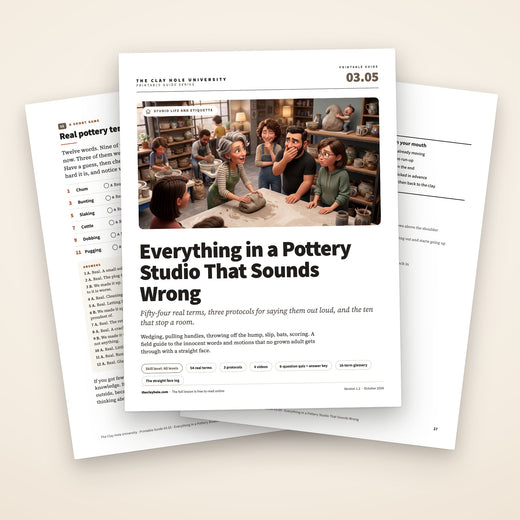
So here is a field guide to the innocent words and motions that no grown adult gets through with a straight face. Fifty-four real terms with their real definitions, three protocols for saying the worst of them out loud, eleven sentences a professional said in this building last month, a labeled diagram of a pot, and the ten that stop a room, ranked. Nothing on this page is dirty. That is the entire problem.
This is the short version: the protocol, one of the three worked all the way through, the sentences, and the worst ten, ranked. The full field guide, the pot diagram and the part where I explain that none of this is our fault are in the comprehensive version.
A confession, up front
I did not want to write this page.
I argued about it. I said this studio has a whole library of lessons on things that will actually make somebody a better potter, and that this would be the one people send each other. I was told that was the point. So here we are.
Here is what changed my mind. I have watched hundreds of people walk into a pottery studio for the first time, and almost every one of them arrives braced. They are about to be bad at something in front of strangers, with their hands, while sitting on a stool that is too low. That is a genuinely uncomfortable thing to volunteer for.
And then somebody says score it and slip it and the whole room goes.
Four seconds. Everybody looks at everybody else. Somebody snorts. And for those four seconds not one person in that room is worried about their pot. I have never given a correction that did as much good as that.
So no, we are not fixing the words. There is nothing to fix. Every term on this page is the accurate one, most of them are older than the country, and the reason they land the way they do has nothing to do with pottery and everything to do with the fact that you and I are both twelve.
What is actually on this page
Fifty-four real terms with their real definitions. Three protocols for getting through the worst of them in front of a room. A diagram of a pot with every part named the way potters have named them for about three thousand years. A game where you guess which words we made up. And a ranked list, worst last.
The whole thing
The words are innocent. You are not. Neither am I. Say it faster and keep your hands on the clay.
Every term in a pottery studio is the accurate one, and most of them were named centuries ago by people in sheds who had no idea what they were doing to us. You will be told to pull a handle, open the clay, collar it in, score and slip it, give the bucket a good long stir, and get your weight over it and push down with your hips. All six of those are correct instructions and none of them can be reworded without making them worse. The protocol below is four rules that work. Below that is the same thing done at full length on the single hardest one, then the sentences, then the ranked ten. If you want the whole field guide, the diagram and the etymology, the comprehensive version is one tap up.
Start here
The Straight Face Protocol.
Four rules. I have been failing to use them since long before this studio existed, and they still work better than anything else I have tried.
- 1Normal speed.Slowing down is a confession. The word does not get safer if you approach it carefully, it gets louder. Say it at exactly the pace of the words on either side of it and it passes through the room like traffic.
- 2Hands on the clay.This is the whole defense. A person with wet hands moving clay is demonstrating a technique. A person standing there with dry hands who has just said that out loud is a suspect. Get your hands in before your mouth starts.
- 3Never add anything.No if you know what I mean. No and I mean that technically. Nobody knew what you meant. They had a fifty-fifty chance and you resolved it for them, out loud, in front of witnesses.
- 4If somebody laughs, laugh.Then go back to the clay. The one thing that turns four seconds of giggling into an actual problem is a grown adult refusing to acknowledge that anything happened.
Field guide, part one
The wheel and the trimming bench.
Eighteen terms. Every definition is the real one. The line at the bottom of each card is what the room does.
Protocol one
How to demonstrate pulling a handle to four adults without making eye contact with any of them.
This is the hardest ninety seconds in the building, and it happens several times a week. Every step below is also correct technique, which is the part that makes it unfair.
- 1Announce it while you are still walking.Distance is your friend. A term delivered from six feet away and moving is half the term it would have been at the bench. By the time you arrive it is already old news.
- 2Wet hands first, every time.Wet hands are a costume. Wet hands say professional. Dry hands say a man who has walked over here specifically to say that. This is also real technique: a dry hand on a wet cone of clay tears it on the first pass.
- 3Pick your fixed point in advance.The far wall. The glaze shelf. Mud is excellent at this and has never once made it weird. What you do not do is look up mid-pull to see how everyone is holding together, because now you know, and now they know you know.
- 4Do not narrate the grip.Thumb on top, two fingers underneath, and pull is a complete instruction. Everything you were about to add after the word pull is not needed by anybody and will not survive the room.
- 5Finish it. All the way.The single worst thing available to you is stopping halfway to check how it is going. Nobody is going to answer that question. Also, a handle abandoned mid-pull is a lumpy handle, so the coward’s move is also the wrong move.
- 6Hang it to stiffen and walk away with no summary.There is no summary. There has never been a summary. A summary is a second run at the same words with none of the protection of doing something with your hands.
The actual technique, minus the panic, is in our handle lesson, which is a real lesson about handles and was not named for this page.
Field guide, part two
The wedging table and the slab bench.
Eighteen more. This section contains the single worst instruction in the building, and it is the correct instruction, and there is no alternative.
Protocol two
How to ask a grown adult how many fingers they have inside a pot, which is a question you will genuinely need to ask.
It matters. Two fingers inside and one knuckle outside is a completely different wall thickness from a whole flat hand, and I cannot see through the pot to check.
- 1Ask about the wall, not the hand.How thick is the wall down at the bottom gets you the exact same information and costs you nothing. This is step one because it is the answer, and the other four steps exist for the times you forget.
- 2If you must ask directly, lead with the number.Are you at two, or three? A sentence that opens with a numeral is a sentence about arithmetic. Nobody has ever blushed at arithmetic.
- 3Never say in there.In there has no defenders. In there has never had a good night. In the pot is four extra letters and it buys you the whole evening.
- 4Do not point.I am not going to explain this one.
- 5If the answer is “all of them,” move on.A flat hand inside means the wall is far too thick and the pot has stopped being the interesting thing in the conversation for everybody present. Hand them a rib. Talk about the rib. The rib is safe.
Field guide, part three
The glaze room and the kiln room.
The last eighteen. Somewhere around 1890 a person sat down and named every single way a fired pot can go wrong, and cards six through eleven are what they came up with.
Protocol three
How to tell a room full of adults to give the bucket a good long stir.
This one cannot be avoided, cannot be shortened, and has to be said before every single glaze session. An unstirred bucket ruins the piece and the piece is usually somebody’s favorite one.
- 1Say mix instead.It is slightly less accurate and dramatically shorter. Ninety percent of the time it does the job and nobody looks at anybody.
- 2If you say the long one, say it as one word.Momentum is everything. A sentence delivered as a single unbroken sound is a sentence nobody has time to take apart.
- 3Attach a number to it.Two minutes turns an instruction into a specification. Specifications are boring. Boring is the entire goal here, and two minutes also happens to be about right.
- 4Point at the bucket while you say it.A pointed-at object becomes a technical object. This is the one situation where pointing helps, and it is the exact opposite of protocol two, and I do not make the rules.
- 5Do not add “really get right down to the bottom.”It is correct. It is necessary. The heavy material genuinely does sit on the bottom of the bucket and a stir that does not reach it has done nothing at all. It is also the end of your class, and everyone will remember it, and one of them will bring it up at the holiday party.
The part that is not an accident
A pot has a body, and potters named every part of it on purpose.
Everything else on this page is a coincidence of English. This one is not. These words were chosen, deliberately, by people who were quite consciously making bodies out of clay.

- 1The lipThe very top edge. On a mug it is the only part of the pot that has to be good at its job every single morning.
- 2The neckWhere the form narrows above the shoulder. Wide neck, easy to reach into. Narrow neck, harder to make and harder to glaze.
- 3The shoulderWhere the pot stops going outward and starts going up. The hardest curve on the whole form to get right.
- 4The bellyThe widest part, where all the volume lives. A pot with no belly reads as a tube.
- 5The waistWhere the form draws back in on the way down to the base.
- 6The footWhat it stands on. Trimmed last, glazed never, and the first thing another potter will pick the pot up to look at.
And there is more of it
A lidded form also has a gallery, which is the little inner ledge the lid sits down on. A pouring form has a throat. Some old texts give a jar a hip. Every one of those words is standard, every one of them is in the books, and not one of them is a joke. Greek potters were describing amphorae this way about three thousand years ago. They were making bodies and they said so.
So half of this page is an accident of English and the other half is a group of humans, across every continent, independently deciding that the thing they had just made looked like a person.
No commentary required
Eleven sentences said out loud in this building last month.
Seven sentences said out loud in this building last month.
By professionals. To adults. On purpose. Every one of them is an instruction, every one of them is correct, and not one of them can be reworded without becoming a worse instruction.
- 1“You have to keep it wet the whole time or it will tear.”
- 2“Two fingers inside, one outside, and squeeze.”
- 3“Do not be scared to really get in there.”
- 4“Just let it come up on its own. If you force it, it will collapse.”
- 5“Get your weight over it and push down with your hips.”
- 6“How many fingers do you have in there?”
- 7“Score it, slip it, and hold it there until it grabs.”
- 8“Slow down. You are going way too fast for how wet that is.”
- 9“Is it hard yet? Give it another hour and check it again.”
- 10“You are gripping way too tight. Loosen up and it will go.”
- 11“It is too dry. Put more slip on it and work it in.”
That is the whole page, really. I could stop here.
A short game
Real pottery term, or did we make it up?
Twelve words. Nine of them are in a ceramics textbook right now. Three of them we invented at this desk this afternoon. Have a guess, then tap to find out, and notice how hard it is, and notice why.
If you got fewer than nine, that is not a failure of your general knowledge. It is the point. There is no way to tell these apart from the outside, because the real ones were named by people who were not thinking about you.
The rankings
The worst ten, ranked by how long the room goes quiet.
The worst ten, ranked. Worst last.
Fifty-four candidates, one list. Counting down, so the last one is the champion.
Counting down. Every one of these is a real instruction that gets said here weekly.
In our defense
None of this is our fault, and I can prove it.
Start with the biggest one. Throwing. The pot is not thrown anywhere. Nothing is launched. Nobody has ever thrown a pot in the sense you are picturing, and every beginner asks about it in week one.
The word comes from Old English, thrawan, which meant to twist or to turn. It is the same root that gives us a thread with a twist in it. The wheel turns, the clay twists, and the word simply sat there for a thousand years while the rest of English wandered off and gave throw a completely different job. We inherited the wreckage.
Almost everything else is workshop English, which is worse than academic English because nobody was watching. Somebody in a shed looked at a thing, named it after what it looked like or what it did, and told an apprentice. That apprentice told an apprentice. Repeat for about nine hundred years without one single person in that chain pausing to ask how any of it would sound in a mixed room full of adults in 2026.
That is how you get a plug called a bung and a fault called dunting and a small solid lump called a chum. Nobody was being funny. Being funny would have required imagining you.
And then there is the body vocabulary, which is the opposite. The lip, the neck, the shoulder, the belly, the waist, the foot. Those were not accidents and they were not workshop shorthand. Greek potters, Korean potters, English potters, all of them separately arrived at the same idea, which is that the object in front of them had a shape like a person and the fastest way to talk about it was to say so.
So the split is this
About half this page is an accident of one language drifting for a millennium. The other half is thousands of years of people all over the world deciding, independently and on purpose, that a pot is a body. Only one of those halves is funny, and it is not the one you would guess.
Watch it happen
Four potters. Four straight faces. Zero awareness.
One video, fifty-seven seconds, and it is the whole page.
None of these people work here or know we exist. The first one is a national broadcaster putting the entire thesis of this page in a headline, and the other three are professionals saying every term on this list out loud without a flicker. Still frames load while you read; the player and its cookies wait until you press play.
A national broadcaster put the whole thesis of this page in a headline. The other three videos are in the comprehensive version.
How it works here
What actually happens in this building.
This page is written for potters anywhere. Here is where our studio stands on it, including the part that is not funny.
We are not changing the words
Every term on this page is the accurate one. If we invented polite substitutes you would learn the wrong vocabulary, and then be lost in every other studio, every book and every video you ever open. That is a real cost and it buys nothing.
Your instructor is not doing it on purpose
By the four hundredth time somebody says score and slip it has stopped being a phrase and become a noise. Give them a year and it will happen to you too. That is not a warning, it is a promise.
Laughing is completely fine
Nobody is in trouble. Nobody is going to be looked at. The only actual rule is that you laugh and then go back to your pot, because a handle sitting too long is a handle you have to pull again.
There is a line, and it is a clear one
Finding a word funny is not the same as using a word to make somebody uncomfortable on purpose. The first one is most of this page. The second one is a completely different thing, we can tell the difference, and it gets handled quietly and immediately.
Younger members are here too
Kids and teenagers are in this studio most nights. They find exactly the same words funny that you do, they recover from it faster than you do, and none of the terminology is a problem for any of them. It never has been.
Skill level
There is not one. This is an elective and it teaches you nothing you can put in a kiln. If you want the lesson that made you click, many of the terms on this page link out to a real one, and the related lessons at the bottom are all genuine.
Questions people actually ask
Mostly asked quietly, at the end of class.
Am I allowed to laugh?
Yes. Everybody does. The instructor standing in front of you laughed at the same word once and now says it forty times a night without hearing it, and they remember what the first week was like.
Is my instructor saying these things on purpose?
Almost never. Repetition kills a word completely. After a few hundred times, score and slip stops being a phrase and turns into a single sound that means put glue on it. Occasionally somebody has a moment of clarity mid-sentence, and you can see it land on their face, and that is worth watching for.
Did you make any of these terms up?
Three, in the game above, and every one of them is labeled as ours the moment you tap it. Everything in the three field guide sections is a real term with its real definition, and most of them are older than the United States.
Why is it called throwing if you do not throw anything?
Old English, thrawan, meaning to twist or to turn. The wheel turns and the clay twists. The word kept its original job while the rest of English gave throw a new one, and now every beginner asks this in week one.
My kid is in a class. Is any of this a problem?
No. Younger members are in this studio most nights and the vocabulary has never once been an issue. They think it is funny, exactly the way you do, and then they get back to their pot considerably faster than the adults manage to.
What is genuinely the worst one?
The ranked list above says throwing off the hump, and by room reaction that is correct. My personal vote goes to the wedging instruction, because it is the only entry where the accurate technique also physically requires you to say the word hips.
Can a person get through a whole class without laughing?
Some can. I have never met the same one twice.
Is there a polite version of any of this?
Not one that survives contact with the work. Every substitute we have ever tried is either longer, less accurate, or teaches somebody the wrong thing. The correct instruction is the correct instruction, and the protocols on this page are the answer instead.
Related lessons
Six real lessons. We did not name any of them for this page.
Three real lessons. We did not name them for this page.
Each of these existed before this page did, was written by somebody trying to be helpful, and is genuinely about the thing in the title.

About the reluctant author
Dan Pearce
Founder of The Clay Hole · Draper, Utah · Would like it on the record that he suggested a different page
Dan Pearce is an author, artist, and the founder of The Clay Hole in Draper, Utah. He spent a decade as one of the most-read bloggers in the world, has published six books, built an audience of more than three million people, and put every dollar of Dan Pearce Ceramics into building a ten thousand square foot studio from nothing. He would like the record to show that not one minute of any of that was preparation for spending a Tuesday afternoon typing the word bung eleven times.
He argued against this page. He pointed out that this studio has a whole library of lessons on things that will genuinely make somebody a better potter, and that this would be the one people send each other at eleven at night. He was told that was the point. He wrote it anyway, and then he went back and alphabetized the glaze faults, which is how you know he made his peace with it.
He was right about the sending, by the way. He is fine. Please stop forwarding him the wedging one.
One last thing, and I mean it
A pottery studio is one of the last rooms where adults are bad at something together, on purpose, in front of witnesses.
That is a hard thing to sign up for. People arrive braced for it. And then somebody says score it and slip it and the entire room breaks, and for about four seconds not one person in there is thinking about how their pot looks compared to everybody else’s.
I have watched those four seconds do more for a nervous beginner than any correction I have ever given one. So the vocabulary stays exactly as it is, and I will keep saying all of it out loud, badly, for the rest of my life.
People arrive braced. Then somebody says score it and slip it, the room breaks, and for four seconds nobody is worried about their pot. That is worth more than any correction I have ever given. The field guide, the diagram and the etymology are in the comprehensive version at the top.
Now go pull a handle.
Written for potters everywhere. Every term on this page is real and every definition is the correct one, which remains the entire problem.
Which version would you like to print?
Both print clean, with the videos turned into labeled boxes you can search for later.