
 Pottery Date Night
 Bring All Your Friends Free Week
 Give a Month of Pottery
 Private Pottery Parties

 The Welcome Booklet
 Your First Ten Sessions
 The Pottery Process
 Finding the Studio
 Your Classes Never Expire
 The Four Tables
 Who’s Who
 The Rewards Program
 Flux Glazes
 The Calculators
 Kiln Tracker
 Holiday Kiln Deadlines

 Beginner’s Tool Set
 Fingernail Clippers
 Mayco Clay Mender
 Epoxy for Kintsugi
 Applicator Bottles
 Large Bead Rack
 Raku Workshop
 Nighttime Raku
 Horsehair and Feather Raku
 The Clay Hole T-Shirt
 Embroidered Crewneck
 Zip-Up Hoodie
 Pre-Made Bisqueware
 Glaze Catchers
 Kiln Cookies
 Clay Cubby Rental
 The Glaze Bible, Printed
 The Book of Molds, Printed
 Printable Pottery Guides
 Free Printable Trackers
 Gifts for Potters
 Christmas Pottery Ideas
 Mother’s Day Gift Ideas
 Pottery Date Night
 Studio Calendar
 2027 Studio Events
 What Should I Do Today?
 How to Throw on the Pottery Wheel
 How to Make a Pinch Pot
 How to Tap Center a Pot
 The Five Stages of Clay
 Is Pottery Hard to Learn?
 Pottery Wheel Practice Drills
 20 Easy Hand-Building Projects
 Everything That Sounds Wrong

 A Beautiful Piece, Every Time
 Slab Roller Tips
 Any Dish as a Slump Mold
 Slab Roller & Slab Mold Certification
 The Pottery Skill Tree
 Clay & Pottery Calculators
 Logging Your Pottery and Glazes
 The Pottery Dictionary
 Why Did My Pottery Do That?
 The Pottery Cone Chart
 Pottery Myths, Fact-Checked
 Is Handmade Pottery Food Safe?
 Incredible Ceramic Artist Videos
 How Dan Throws Giant Pots
 How to Dry Your Pottery
 The Pottery Wheel Introduction
 Pottery by Zodiac Sign
 Personality and the Pottery Wheel
 Pottery for Engineers
 ADHD, Hyperfocus, and Never Running Out
 Hobbies for Burnout
 Screen-Free Hobbies for Adults
 Every Addiction I Ever Had Lost to Art
 Functional Pottery Is Engineering
 How Do We Compare?
 Pottery Classes by City
 Every Pottery Studio in Utah
 Pottery in Draper
 Featured Members
 The Signature Wall
 Making Friends as an Adult Is Brutal
 The Clay Hole Commandments
 2027 Pottery Contests
 2027 Studio Parties
 Gallery Night

 Scream It Into the Void
 Destroy the Glaze Wall
 Daily Affirmation Cards
 Everything That Can Go Wrong
 Subscribe to Our Newsletters
 Contact The Clay Hole
 Corporate Team Building

 Glaze Combinations
 Glazes We Do Not Carry
 Making Glaze Test Tiles
 The Mega Glaze Tool
 How to Use the Mega Glaze Tool

 Glaze Brushing Techniques
 How to Use Underglaze
 How to Use Dipping Glazes
 Glaze Problems, Causes and Fixes
 The Dipping Glaze Guide

 Making a Glaze Catcher
 Fused or Sharp After Firing
 The Signature Wall
 His Viral Videos
 His Own Ceramics
 Meet Mud
Surface and decoration · Using mason stains
One jar of powder colors clay, slip, engobe or glaze.
A stain is color that has already been fired, so it does the same thing every time, although the powder looks different from the fired color. The percentage changes for each thing it goes into, the note on the jar decides which glaze it survives in, and a test tile decides everything else.
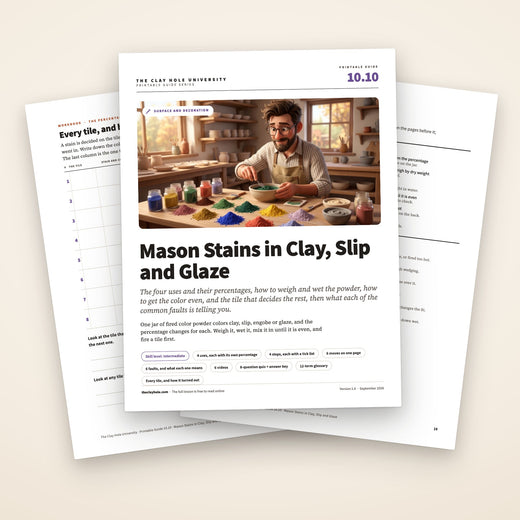
Four steps with a tick list at each: the four uses and their percentages, weighing and wetting, wedging or sieving until it is even, and the test tile. Six fixes, six videos, and the safety rule that opens every jar.
This is the short version: the four percentages, the mask, the paste, the sieve and the tile, each with a tick list. The chemistry, the food-safety notes and the questions are in the comprehensive version.

Read it, then watch it
Why this is written down and filmed, both.
Stains are a table of percentages with a compatibility note attached, and tables are what a page is for. Five to ten in clay, five to fifteen in slip, two to ten in glaze, a wash at half stain and half flux. Nobody remembers those from a video. What a page cannot show is a paste being wedged into clay until the streaks vanish, or a sieve being worked, and those are the videos. Six of them, because stains have four uses and a compatibility note that catches people out.
Use both, in this order
Read the percentages and the compatibility note for your color. Watch the use you want. Mix a test tile before a pot, every time, with the tick list open.
The whole idea
One jar of fired pigment, four percentages, one test tile.
A stain is color that has already been fired, so it is predictable, although the powder looks different from the fired color. Five to ten percent colors a clay body, five to fifteen a slip or engobe, two to ten a glaze, half stain and half flux, thinned with water, makes a wash. Wet the powder first, sieve or wedge it in, read the note on the jar, fire a tile before a pot. Mask on whenever the jar is open.
The five-minute version
The whole technique in six moves.
If you already mix slips or glazes and you just want the shape of it, this is the shape of it. Everything below is these six moves, slowed down and with the places they fail marked.
Before you open the jar
What you need on the bench.
Six things, and the respirator is not optional. The sieve is the one people skip and then wonder about the speckles.
A jar of stain, a scale, a fitted respirator and gloves, an 80 mesh sieve, the clay, slip or glaze it is going into, and test tiles.
Step one
Decide what the stain is going into, and read the note on the jar.
One powder, four jobs, four percentages. Into a clay body it colors the clay through. Into a slip or an engobe it colors a coating. Into a glaze it colors the glass. With water it is a wash for wiping into texture. The percentage is different for each.
Clay body
Of the dry clay weight, up to fifteen for weak colors. The color runs through the pot, shows on every trimmed edge and every carved line, and cannot wear off, because it is in the clay and not on it. Past fifteen the clay goes short and cracks. Strong stains, cobalt blues and blacks, want the low end.
Slip and engobe
Of the dry weight of the slip. The cheapest way to a whole range of colors from one bucket of slip and a few jars, and the way to match a color to your own clay body. A bottled underglaze is the same idea with much less clay and much more pigment, plus a binder so it brushes well. Our engobes lesson is the coating side.
Glaze
Of the dry glaze weight, most colors between two and six. Stain stiffens a glaze, so the top of the range changes the fit. The base glaze has to suit the stain: read the compatibility note first.
Wash
Equal parts stain and a flux such as a frit by dry weight, thinned with water until it looks like watercolor, about two and a half times the dry weight in milliliters. Brushed on and wiped back so only the texture keeps it. A clear over the top on anything that touches food. Our wipe-away lesson is the method.
Then the note on the jar, which is the part beginners skip and regret. Chrome-tin pinks and maroons need calcium in the glaze and die with zinc. Some blues and greens are happy anywhere. Encapsulated reds, oranges and yellows fade if fired past their limit. The supplier’s chart lists a compatibility note for every color, and a stain in the wrong base fires out to gray.
Step two
Mask on. Weigh it dry, then wet it to a paste.
The jar does not open without a mask. Stain is ground metal oxide that has been fired until the metals and minerals react into a crystal, then ground again, safer than raw oxide and still not for lungs. A fitted respirator (an N95 at the very least, a half mask with P100 filters for mixing powder), gloves, a damp towel under the scale, never at a shared table.
Weigh by dry weight. For clay, that means the dry weight of the clay, which for soft clay from the bag is roughly three quarters of what the scale says; for a pound of soft clay, about a twelve ounce dry weight, so ten percent is a little over an ounce of stain. For slip and glaze, weigh the dry materials before the water goes in, or work from the recipe. Write the numbers down; you will want to repeat the good one.
Then wet it. About its own weight in water, stirred into the weighed powder until it is a smooth paste with no dry pockets. Dry stain dropped into wet clay or slip clumps, and every clump is a speck on the pot. The paste is the whole difference between an even color and a marbled one.
Step three
Mix it in until it is even. Wedge, or sieve.
Stain does not dissolve. It has to be spread. Into clay: spread the paste on softened clay, fold it in, wedge far longer than feels necessary, then cut the lump in half and look. Streaks mean more wedging. Into slip, engobe or glaze: stir the paste in, then sieve through 80 mesh, glaze twice.
A marbled lump is not a failure if you wanted marbled clay, and some potters stop wedging on purpose at the streaky stage. For an even body, keep going. Stained clay is also a good candidate for a second wedge the next day, after it has rested and evened out its moisture. Our wedging lesson is the method.
Keep stained clay separate from everything: its own bag, its own name, and never the studio reclaim. A scrap of cobalt-stained clay in the studio reclaim is a blue speck in somebody else’s bowl months later. Stained slip and glaze go in labeled containers with the percentage and the base written on the lid.
Step four
Fire a tile before a pot. Then use it.
The tile is the recipe. One test tile per color per base, fired at cone 5½ under the glaze you mean to use, with the percentage and the base written on the back in underglaze. A stained body wants a tile with a carved line and a clear over half of it. A stained slip wants a tile of your clay with the slip on it. A stained glaze wants the glaze on the clay it will live on.
Then use it the way the tile told you. A stained body throws, hand-builds and trims like the clay it came from and shows its color on every cut edge, which is why potters carve it. A stained slip or engobe goes on leather hard for a surface that fires like clay, or bisque for engobe, and takes sgraffito beautifully. A stained glaze is a glaze, with the fit the tile showed. A wash wipes into texture and wants a clear over it on anything that touches food.
Food safety follows the glaze, not the stain: a stained body or a wash under a clear glaze that the Food Safe Lookup clears for food is as safe as that glaze, so check the clear you pick there. Bare stained clay or a bare wash does not go on a food surface. The reds, oranges and the Mango that hold cadmium inside a zircon shell stay off food surfaces unless the finished piece has been tested. When in doubt, a coat of clear, which is the answer to most glaze questions.
Watch it done
Now watch six videos on using one jar four ways.
Watch this one, then go read the note on the jar.
None of these videos are ours. Between them they cover what a stain is against an oxide, stain into clay twice, stain as a wash, stained slip against bought underglaze, and what a stain is and what it colors. Nothing but the still frame loads until you press play.
Seventeen minutes on glazing with oxides and stains, starting with how the two differ. The other five videos are in the comprehensive version.
When it goes wrong
Six ways it goes wrong, and what to do about each.
The three failures that happen on the first tile.
Pick the one that looks like your tile. The first three are chemistry and mixing. The last three are percentage, fit and your lungs.
The color fired out or went muddy
The stain met a glaze it is not compatible with, or too little went in, or it was fired past its limit. Chrome-tin pinks die without calcium and with zinc; some yellows and oranges are encapsulated and fade if overfired; a stain at two percent in a glaze is a tint, not a color.
Read the note on the jar or the supplier’s chart before choosing a base. Use the middle of the percentage range, not the bottom. Test on a tile at cone 5½ before a pot.
A faded pot is a pale pot. On the next tile, raise the percentage toward the top of the range, or change the base glaze, one variable at a time.
Speckles, streaks or marbling where you wanted an even color
Dry stain went into wet clay or slip without being wetted first, so it clumped, or the clay was not wedged enough to distribute it. Stain does not dissolve; it has to be spread.
Wet the stain to a paste with a little water first, work the paste into soft clay, and wedge far longer than feels necessary. For slip, sieve the mix through an 80 mesh sieve.
If it is still soft, keep wedging. If it is fired, you have marbled clay, which some people pay for. Cut the clay in half to see if it is even before you commit it to a pot.
The color bled or blurred into the glaze over it
A stain wash was put on too thick, or the glaze over it was too thin, or the stain is a strong colorant like a cobalt blue that moves in a melt.
Wash thin, wiped back so only the texture holds it. A full coat of clear over the top. Fire a tile of the wash under the glaze you mean to use.
Fired is fired, and a soft bleed under a clear often reads as depth. The next one is thinner.
The stained clay is short, cracks when bent, and dusts
Too much stain. Stain is a ground, fired pigment with no plasticity, and past about fifteen percent a clay body stops being clay.
Five to ten percent by dry weight for most colors, fifteen for the weak ones, never more. Color the surface with a stained slip or engobe instead and leave the body alone.
Wedge in plain clay to bring the percentage down. If it is already a pot, it is a fragile pot.
A glaze with stain in it crawled, crazed or went matte
A lot of any powder added to a glaze changes the glaze. Stain is a refractory powder; enough of it stiffens the melt, and some stains pull the glaze off the pot in a crawl. A changed fit can also craze it.
Stay at ten percent or under in glaze, most colors want two to six. Sieve the mix. Test on a tile, both the color and the fit, before it goes near a pot.
A crawled test tile is a cheap lesson. A crawled pot is a cheap lesson with a pot attached.
You breathed it
Stain powder is metal oxides and minerals fired until they react into a crystal, then finely ground. It is safer than raw oxides and still not for lungs. Cobalt, chrome and nickel stains are the ones to respect most.
A fitted N95 or better whenever the jar is open, and a half mask with P100 filters for mixing powder. Weigh over a damp paper towel. Wet it before mixing. Wipe the bench down wet. Never at a shared table.
Close the jar, wipe everything down wet, and keep the respirator on until the powder is wet and the bench is wiped down.
How it works here
At The Clay Hole, we sell the stains, and the reclaim is still sacred.
This page is written for potters everywhere. A few things are specific to our building.
Three things to know here
We stock 32 mason stains and sell them by the 25 grams on the mason stains page. They get paid for first and weighed out by the owner or the main hand building instructor. Coloring a batch of our clay with one is fine. Anything you bring in yourself still has to be cleared with the studio team before it goes into a kiln. Mix away from the shared tables with a fitted N95 or better on, and keep stained clay in its own bag. It never goes in the studio reclaim.
We stock these
We keep 32 mason stains and sell them by the 25 grams. Pick a color on the mason stains page, pay for it, and the owner or the main hand building instructor weighs it out. We still do not stock oxides or washes, and anything you bring in yourself has to be cleared with the studio team before it goes into a kiln, which is the rule for every outside material. The 150+ underglazes on the wall are mostly pigment with a little clay and flux, for the days you would rather buy one ready to go.
Coloring our clay
Stain wedged into clay from our shelves is still our clay, and it is welcome in the kilns once the studio team knows. Outside clay is not, stained or otherwise. Mix it away from the shared tables with a fitted N95 or better on, over a damp towel, and wipe down wet.
The reclaim
Stained clay never goes into the studio reclaim. A scrap of cobalt clay in the communal bucket is a blue speck in somebody else’s bowl months later. Your own bag, your own name, your own scraps taken home or binned. Wash and rinse water from stain work goes in its own bucket, never down the sink, so ask the studio team where the clear water goes.
Glaze and firing
The glaze wall needs the free brush-on glaze and underglaze certification. A stained slip made from our clay is fine once the studio team knows, but the only engobes approved here are the Mayco ones, so a homemade engobe is not. Any stained slip or wash is bisque fired before a glaze touches it, because unfired color lifts into the shared jars. A stained slip or wash under one of our clears fires with everything else at cone 5½. Bisque is cone 05 and free. For the glaze firing, several small tiles that fit on one 6 inch kiln cookie, a quarter inch apart and 125 cubic inches or less in total, pay as one piece. Every tile goes on a kiln cookie, and staff load every kiln here.
Questions people actually ask
The ones that come up every week.
What is a Mason stain?
A coloring pigment made by firing metal oxides with other minerals until they react into a crystal, then grinding it to a fine powder. Because it has already been fired, the color is stable and predictable, although the powder in the jar looks different from the fired color, which is why a tile comes first. Raw oxides are cheaper and wilder; stains are what you use when you want to know what you are getting. Mason is one brand; other suppliers make equivalents and the numbers cross-reference.
How much goes in?
Into a clay body, five to ten percent of the dry clay weight, up to fifteen for weak colors. Into a slip or engobe, five to fifteen percent of the dry weight. Into a glaze, two to ten percent, most colors between two and six. As a wash, equal parts stain and flux by dry weight, thinned with water until it looks like watercolor. Every one of those is a starting point for a test tile, not a recipe.
Why do some stains die in some glazes?
Chemistry. Chrome-tin pinks and maroons need calcium in the glaze and are killed by zinc. Some blues and greens are fine in almost anything. Encapsulated reds, oranges and yellows fade if fired hot. The jar or the supplier’s chart carries a compatibility note for every color; read it before choosing a base glaze, and test.
Is stained clay food safe?
A stained clay body under a fitted, fired clear glaze that the Food Safe Lookup clears for food is as safe as the glaze over it. Bare stained clay or a bare wash does not go on a food surface, so the answer is a coat of clear. Chrome, cobalt and the cadmium reds, oranges and Mango especially want covering and testing.
Stained slip or bought underglaze?
A bottled underglaze is the same idea with much less clay and much more pigment, plus a binder so it brushes well. Making your own is cheaper per pot, lets you match a color to your clay, and gives you a range of tints from one jar and a bucket of slip. Buying it is faster and it brushes better. The Nu Kua video on this page compares the two, and our wall has 150+ underglazes for the days you would rather buy.
Can I color clay at The Clay Hole?
We stock 32 mason stains and sell them by the 25 grams. They are paid for first and weighed out by the owner or the main hand building instructor. Coloring a batch of our clay with one is fine so far as the clay is ours, and anything you bring in yourself still has to be cleared with the studio team before it goes into a kiln. Weigh and mix it away from the shared tables with a fitted N95 or better on, and wipe everything down wet.
How do I keep the color even?
Wet the powder to a paste before it meets clay or slip. Into clay, knead the paste into softened clay and wedge far more than feels necessary, then cut the lump in half and look. Into slip, mix and then sieve through 80 mesh. Into glaze, sieve twice. Uneven stain is almost always dry powder that clumped.
Related lessons
Seven places to go from here.
Four to go to next.
A stain is a colorant. These are the things it colors, the tools that spread it, and the page where you buy one.
That is the whole technique
Pick the use. Read the jar. Mask on. Paste, then sieve or wedge. Tile before pot.
Your first stained clay will be marbled because you stopped wedging when your arms got tired, and your first stained glaze will be paler than the jar. That is normal, and the tiles will tell you which. One jar of a good blue and a bucket of slip is a whole range of tints, and the tile drawer is where they live.
If you want the chemistry, the food-safety notes, the dry-weight arithmetic and the answers to the questions everybody asks, switch to the comprehensive version at the top. Otherwise, go read the note on the jar.
Written for potters everywhere. Where our studio does things differently, the page says so.
Which version would you like to print?
Both print clean, with the videos turned into labeled boxes you can search for later.