
 Pottery Date Night
 Bring All Your Friends Free Week
 Give a Month of Pottery
 Private Pottery Parties

 The Welcome Booklet
 Your First Ten Sessions
 The Pottery Process
 Finding the Studio
 Your Classes Never Expire
 The Four Tables
 Who’s Who
 The Rewards Program
 Flux Glazes
 The Calculators
 Kiln Tracker
 Holiday Kiln Deadlines

 Beginner’s Tool Set
 Fingernail Clippers
 Mayco Clay Mender
 Epoxy for Kintsugi
 Applicator Bottles
 Large Bead Rack
 Raku Workshop
 Nighttime Raku
 Horsehair and Feather Raku
 The Clay Hole T-Shirt
 Embroidered Crewneck
 Zip-Up Hoodie
 Pre-Made Bisqueware
 Glaze Catchers
 Kiln Cookies
 Clay Cubby Rental
 The Glaze Bible, Printed
 The Book of Molds, Printed
 Printable Pottery Guides
 Free Printable Trackers
 Gifts for Potters
 Christmas Pottery Ideas
 Mother’s Day Gift Ideas
 Pottery Date Night
 Studio Calendar
 2027 Studio Events
 What Should I Do Today?
 How to Throw on the Pottery Wheel
 How to Make a Pinch Pot
 How to Tap Center a Pot
 The Five Stages of Clay
 Is Pottery Hard to Learn?
 Pottery Wheel Practice Drills
 20 Easy Hand-Building Projects
 Everything That Sounds Wrong

 A Beautiful Piece, Every Time
 Slab Roller Tips
 Any Dish as a Slump Mold
 Slab Roller & Slab Mold Certification
 The Pottery Skill Tree
 Clay & Pottery Calculators
 Logging Your Pottery and Glazes
 The Pottery Dictionary
 Why Did My Pottery Do That?
 The Pottery Cone Chart
 Pottery Myths, Fact-Checked
 Is Handmade Pottery Food Safe?
 Incredible Ceramic Artist Videos
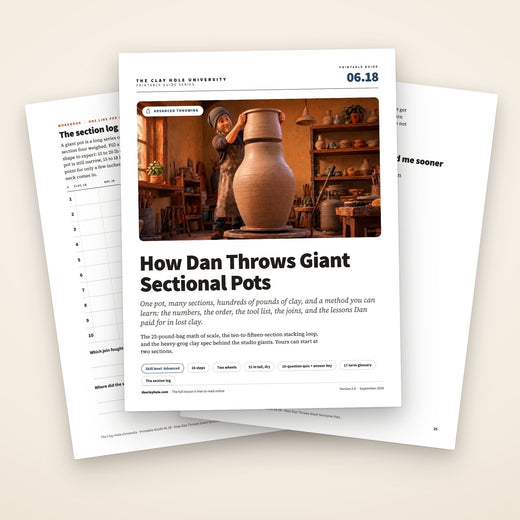
 How Dan Throws Giant Pots
 How to Dry Your Pottery
 The Pottery Wheel Introduction
 Pottery by Zodiac Sign
 Personality and the Pottery Wheel
 Pottery for Engineers
 ADHD, Hyperfocus, and Never Running Out
 Hobbies for Burnout
 Screen-Free Hobbies for Adults
 Every Addiction I Ever Had Lost to Art
 Functional Pottery Is Engineering
 How Do We Compare?
 Pottery Classes by City
 Every Pottery Studio in Utah
 Pottery in Draper
 Featured Members
 The Signature Wall
 Making Friends as an Adult Is Brutal
 The Clay Hole Commandments
 2027 Pottery Contests
 2027 Studio Parties
 Gallery Night

 Scream It Into the Void
 Destroy the Glaze Wall
 Daily Affirmation Cards
 Everything That Can Go Wrong
 Subscribe to Our Newsletters
 Contact The Clay Hole
 Corporate Team Building

 Glaze Combinations
 Glazes We Do Not Carry
 Making Glaze Test Tiles
 The Mega Glaze Tool
 How to Use the Mega Glaze Tool

 Glaze Brushing Techniques
 How to Use Underglaze
 How to Use Dipping Glazes
 Glaze Problems, Causes and Fixes
 The Dipping Glaze Guide

 Making a Glaze Catcher
 Fused or Sharp After Firing
 The Signature Wall
 His Viral Videos
 His Own Ceramics
 Meet Mud
How I throw, combine, and build giant pots.
My section-by-section method for building truly giant wheel-thrown pottery. The numbers, the order, the tool list, the joins, and the lessons I paid for in lost clay. What I cannot give you on a webpage is the feel of it. That part you earn at the wheel, one section at a time.
The short version of my section-by-section method. Enough to get you moving, not enough to make you good at it. The full version is one tap away, and I mean it when I say read that one before you touch the clay.
 Dan Pearce
Founder of The Clay Hole · His Full Process
Dan Pearce
Founder of The Clay Hole · His Full Process
- 1 Read this first
- 2 How giant
- 3 Skill check
- 4 The clay
- 5 Tools
- 6 Clay calculator
- 7 The process
- 8 Photos
- 9 Drying
- 10 Hard lessons
- 1 The short version
- 2 Read this first
- 3 Tools
- 4 Clay calculator
- 5 The process
- 6 Drying
- 7 Hard lessons

The short version, with a warning attached
Read this before you skip the long one
This is the nutshell version. If you are going to attempt this, I highly recommend following the full version instead. I wrote that one to keep you from losing a hundred pounds of clay, a weekend, and a chunk of your lower back. But hey. Your life, your choice.
The whole method in eight lines
- Draw the exact pot first. The real profile, not a vague idea of big vase.
- Throw a serious base on wheel one, 15 to 20 pounds or more, ¾ inch walls, drainage hole now if it lives outside.
- Throw every new section on wheel two, opened all the way down to the bat, so it can be flipped and joined by its open edge.
- Match the open edge to the top of the pot within a millimeter or two, after a quick blast with the small torch.
- Bevel, score, paper slip, then flip the whole bat over and land the section slowly, touching but not sealing, checking the overhang all the way around. Once it grabs, wire the bat off.
- Blend two sections into one wall: cross-hatch, rib, light pulls, bigger pulls back to ¾ inch, then every rib you own until the seam is gone.
- Set it with the weed torch, flame moving, a few seconds per spot, only until the wall can hold what comes next.
- Repeat. Wider until the shoulder, then narrower to the rim. Less clay up top. Do not rush the neck. Then rib the whole thing until it looks like one pot.
Below: the safety note, the tool checklist, the clay calculator, the process in twelve steps with the numbers left in, and the three mistakes that end a first attempt. The full 26 steps, the photos, and the rest of my hard lessons are one toggle away.
Read this part first. All of it.
Making giant pots is not a cheap form of pottery, and I am not going to give you the cheapest possible way to do it. I am going to give you the way I do it, because I want to do it well.
Also, I am starting with this instead of ending with it: do this at your own risk. My method uses a huge amount of clay, very heavy equipment, open flame, tall work, and pots that can weigh hundreds of pounds. It can be dangerous, hazardous, and perilous. Yes, those are three words for the same thing. I want all three on the record. I am not responsible for what you decide to do after reading how I do it.
Glad we got that out of the way.
Now the fun part.
I can give you the method, the numbers, the order, the things I learned the hard way, and the things I wish somebody had told me sooner. What I cannot give you on a webpage is the feel of it. Nothing beats learning this hands-on. You are going to make mistakes. You are going to lose giant amounts of clay and giant amounts of time. Your body is going to feel it in places you did not know pottery could reach.
I highly recommend taking a workshop from someone who teaches this before you decide that today is the day you throw a five-foot pot. But, you do you. I learned from the great Stephen Procter in Vermont, and a lot of the foundation of what I do started with what I learned from him.
If this seems too intense, it might be
If the tool list below makes you want to lie down, I recommend learning the onggi method instead. It is how Korea has built giant fermentation jars for a very long time. Coils, paddles, patience, no torches, no bats to flip. It is a beautiful way to get big, and it is a lot easier on the body.
How giant are we talking?
As big as your wheel can handle. As big as your bats can handle. As big as you can physically build. As big as you can move. And, ultimately, as big as you can fit in your kiln.
wide, bone dry. With my large bell lift kiln, that is the practical limit on width.
tall, bone dry. That is a pretty big pot. It does not feel that way for long.
Naturally, after making one at basically my maximum size, my first thought was, “Cool. Now how do I get a bigger kiln so I can make a bigger one?” These things are addicting. I am not going to pretend otherwise.
I am intentionally not giving instructions for moving finished giant pots. That is one of those things every potter has to solve for their own studio, equipment, floor, kiln, helpers, and risk tolerance. Plan it before you make the pot. But figure out the actual moving system for yourself.
This is not a beginner project
I am assuming you already know how to wedge big, center big, open big, throw big, reclaim failed clay, deal with a ridiculous amount of slip, and keep good form when the clay stops feeling friendly.
I would not recommend trying this method unless you can comfortably throw at least 15 to 18 pounds at a time with a high success rate and good control. Many of my sections are 20 to 25 pounds. Doing that once is one thing. Doing it again and again while building a pot that gets taller, heavier, wetter, and less forgiving is something else entirely.
Build the skill first. Build the stamina second. Then be ready for a very fun battle between you and a stupid amount of clay.
The numbers I keep coming back to
- 15 to 18 lb thrown comfortably before you attempt this, minimum
- 15 lb base section at least, preferably 20 or more
- About 12 lb for the early narrow section
- 15 to 18 lb for the larger sections, commonly
- A whole 25 lb bag for the widest sections, sometimes, for only a few inches of height
- ¾ inch target wall thickness throughout
- 250 lb wheel capacity minimum, 300 or more preferred
- Two wheels. One holds the pot. One throws the sections.
Choose your clay carefully
Your clay has a lot more responsibility here than it does in a normal bowl. It has to hold itself together while carrying an immense amount of wet clay above it. If the finished pot is going outdoors, it also has to stand up to weather and seasonal temperature swings. And after all that, it still has to look the way you want it to look, glazed or naked.
For this kind of work, I want three things from a clay body.
Heavy grog or sand
Tooth is the skeleton. It stiffens the wet wall so each section can stand under the next, and it forgives the uneven drying a huge form invites. Smooth bodies lie down on the job.
2 percent absorption or less
For anything living outdoors. Water that soaks into a porous pot freezes, expands, and splits it. Check the fired absorption on the spec sheet before you commit a hundred pounds to it.
A surface I actually like
Finished, glazed or bare. A giant pot is a giant surface, and you are going to be looking at it for a long time.
For mid-range work, which I fire at cone 5½, I use Half & Half. For cone 10, I use Soldate 60 or Cone 10 Half & Half. Those are my choices, not the only choices. Plenty of other companies make clay bodies that can work beautifully for giant pots.
Deep breath. It is a long list.
Getting all of this together is the longest part of the written instructions, and it is not close. Once you start building, you do not want to discover that the tool you need is six feet away, buried under something, or does not exist.
Gather every one of these before you wedge the first bag. Tap items off as you go.
Tap an item to check it off. This list remembers itself on this device, so you can close the page and come back to it.
Planning, wheels, and bats
0 of 3- A drawing of the exact shape the finished pot will become Do not skip this. Once a giant pot wanders into no-man’s-land, getting it back under control is hard.
- Two pottery wheels rated for at least 250 lb I prefer 300 lb or more. One wheel holds the growing giant pot. The second wheel is where every new section gets thrown.
- Bats in several sizes: 12, 14, 16, 18, 21, and 24 inch Find them or make them. Always make sure the bat is solid on the pins and does not move. A bat that shifts under 25 pounds of clay is a bad afternoon.
Torches and fire safety
0 of 3- One propane weed torch with at least a 5 gallon propane tank
- Two or three full 16 oz propane cylinders with a small torch-gun attachment
- Fire extinguishers close enough to grab immediately You are using flame around wooden bats. I have never had a bat catch fire. I have definitely roasted a few.
Throwing, shaping, and measuring
0 of 9- A ridiculous assortment of ribs Small to giant, soft to firm, every useful profile you own. I can easily use 20 to 30 different ribs on one pot.
- Large, medium, and small sponges
- Needle tools
- Clay trimming tools in all shapes and sizes I mean all shapes and sizes.
- Anything you want for texture or surface character
- Water buckets
- Flexible metal rulers in 24, 36, and 48 inch lengths They are floppy. That is what we want.
- One rigid wooden yardstick It is rigid. That is what we want.
- Optional but useful: outside and inside calipers in roughly 8, 10, 12, 16, and 24 inch sizes
Joining and reaching
0 of 3- About a gallon of fresh paper slip Mine is animal bedding, slip, and slip water blended through many full cycles in a food processor. There are lots of ways to make paper slip. The important part is having plenty of it, because my joins depend on it. One warning: mine gets brutally stinky after a day or two. I add a small amount of bleach to keep it fresh while I am building, then I toss the batch when the pot is done.
- A pottery wire tool with at least 24 inches of wire
- A 32 inch grabber or reacher tool You will drop tools and scraps into the pot. At some point you will be way deeper than armpit-deep trying to retrieve them. Good luck without one.
Moisture control, cleanup, and drying
0 of 6- Lots of clean wet rags
- Lots of clean dry rags
- Three lightweight, highly absorbent beach towels Your emergency moisture-reset system for when the pot gets too dry while you are still working on it.
- Large disposable painter’s plastic for wrapping the pot tightly between work sessions
- Optional: extra painter’s plastic for the entire splash zone, including under the wheel Giant pottery is spectacularly messy.
- Two extra-high-thread-count cotton bed sheets, king size for the biggest pots These are for the final slow dry after construction.
Getting your body to the pot
0 of 4- Several stools at different heights So you can change your working level fast without thinking about it.
- One small step stool
- One large step stool or step ladder For when the pot reaches the “why is this taller than me?” stage.
- Bib-style rain pants Trust me. You are going to be soaked. A normal pottery apron is adorable but wildly underqualified for this job.
How much clay does this thing take?
A rough estimate from the pot’s average width, its wet height, my ¾ inch wall, and the sad reality that up to 30 percent of your clay ends up as slip, trimmings, standing water, and sections you cut off in disgust. Slide the numbers around. Then buy more than it says.
Average width, wet height, ¾ inch walls, up to 30 percent loss. Buy more than it says.
Section by section. Wider, wider, wider. Then narrower.
You are going to build one pot out of a series of separate wheel-thrown sections. The growing pot stays on one wheel. Every new section is thrown on the second wheel, opened all the way to the bat, shaped to the exact diameter and direction you need, lightly torched as needed to control saturation, then flipped upside down while it is still attached to its bat. That upside-down section gets lowered onto the top of the giant pot, joined with a beveled, scored, paper-slip seam, blended until it behaves like one continuous wall, and then set to the right firmness before you do it all again.
Section by section. Wider, wider, wider. Then, after the shoulder, narrower, narrower, narrower. Eventually you finish the rim, step back, look at the thing, and wonder how you got yourself into this awesomeness.
Also, fair warning: this process creates a shocking number of “that is a tomorrow problem” problems.
I have included what I have
I did not originally plan to turn my giant-pot making into a step-by-step tutorial, so I did not stop at every stage and take perfect instructional photos. When you are this deep into a giant pot, photos become an afterthought. Then a regret.
You are an advanced potter if you are trying this, so use the photos to study the shapes, the joins, the body positions, the tools, and the stages, and fill in the visual gaps yourself. In some of them you will also see my son Noah, who helps me with these pots, and Josie, my employee and assistant, who jumps in from time to time.
All 26 steps, the way I actually do it
The process in twelve steps
Read the whole thing once before you start. Then keep it open on a phone in a plastic bag, because you will not remember step 18 while your hands are inside a 40 pound section.
The loop, compressed. Twelve steps that stand in for twenty-six, with the numbers that matter left in.
Get the plan on paper
-
Draw the pot before you touch the clay
Start with the exact silhouette you want. I do not mean a vague idea of “big vase.” Draw the actual profile. Where does it widen? How quickly? Where is the shoulder? How narrow is the neck? How tall do you want the final rim?
You are about to make a long series of small decisions that compound into one giant form. Your drawing keeps those decisions pointed in the same direction.
Section one carries everything above it
-
Throw a serious base
Throw a solid, well-formed base using at least 15 pounds of clay. I prefer 20 pounds or more, because this first section has to give you both a substantial floor and substantial walls.
Keep the walls around ¾ inch thick. Every instinct you have from normal throwing will tell you to go thinner, thinner, thinner. Ignore that instinct. Giant pots need real structure from the ground up.
The angle of this first wall matters enormously, because it establishes where the rest of the form is headed. Use your long flexible metal rulers against the wall to visually extend that angle upward. Ask yourself: if I continue on this line, where will the pot be 10 inches from now? Twenty inches? Will I hit the width I want too fast? Too slowly?
Do that again and again until the base is clearly pointing toward the form on your drawing.
-
Add the drainage hole now if the pot will live outside
If this is going to be an outdoor pot, cut the drainage hole into the center of the base now . Later, when the pot is four feet tall, is not the moment you want to remember that the bottom needs a hole.
The drainage hole also keeps collected water from sitting inside and freezing, which can split an outdoor pot.

This is what the base section should look like: a substantial floor, walls around ¾ inch, the first angle already pointing where the drawing says to go, and the drainage hole cut now, while I can still reach it. -
Let the base firm up
For my first base section, I usually prefer to let it air-dry for an hour or two instead of torching it right away. I am in the Utah desert, so my clay firms up faster than it would in a humid studio.
Your timing will be different. If humidity is not your friend, use the torch. I personally torch every section after this first one.
The firmness you are chasing
When a new section is ready to be attached, the top section already on the giant pot should be firm enough that you can grab it and it can hold the weight you are about to add, but it should still have a little bend and life in it. Too soft and the pot can collapse. Too dry and the clay will not want to blend. This exact window is everything.
Where the method stops looking like normal throwing
-
Throw the second section
Because the pot is still relatively narrow, I usually stay around 12 pounds for the second section.
I cannot tell you exactly how many minutes should pass between sections, because I do not know your climate, your clay, your studio, or how fast you throw 12 to 25 pounds of clay. Learn the feel of the section already on the pot. That feel matters more than a timer.
-
Open all the way to the bat
This is one of the biggest differences between these sections and a normal pot. The new section needs to open all the way down to the bat, because the section will eventually be flipped over and attached by what is currently its top. There is no floor. It is a ring.
This is also, for me, the physically nastiest part of the whole process. Heavy grog or sand plus a massive lump of clay plus your fingertips trying to get all the way to the bat is not a spa day.
A normal opening technique can turn into an exhausting fight when you are moving this much clay. The clay simply does not want to move off the bat.
-
Use the opening method I learned from Stephen
The method Stephen showed me is my favorite. I believe he called it “mining,” but I cannot remember that name with enough confidence to swear to it.
First, make the initial opening all the way down to the bat and open it enough that you can get your full hand inside. Then work your hand underneath the clay, moving outward toward the inner edge of what will become the wall. You are basically creating a shelf of clay that is resting on your hand.
Do not go too far. If you mine all the way through the outer edge, congratulations, you have detached your entire section from the bat.
Once I am at the inner edge, I lift that whole mass of clay upward in one committed movement. The bottom becomes the wall almost instantly. It takes practice, but once it clicks, it is slick .
I put roughly half an inch or more of water into the opened cavity while I do this. It lubricates the movement and it is easier on my hands. The second that base becomes walls, I remove the standing water.
-
Throw the section in the direction the pot is going
This is the part that feels backward until your brain adjusts to the fact that the whole section is about to be flipped upside down.
Remember which end is which. The open edge, the top of the section while it sits on the second wheel, is the end that joins the pot. The clay at the bat becomes the new top of the pot after the flip.
So while you are still building outward toward the shoulder, the clay at the bat needs to be wider than the open edge. Upright on wheel two, the section narrows as it rises. That looks wrong. It looks like it is going the opposite direction from the pot. Flip it over and it becomes right, because the wide end lands on top and keeps the pot growing outward.
Once you pass the shoulder and start building inward, reverse it: the bat end narrower than the open edge, so the section flares as it rises upright, and closes in after the flip.
Do not accidentally throw a straight cylinder. Do not let the wall taper the wrong way. Follow your drawing and remember which end is about to become the bottom.
-
Pull the wall to about ¾ inch and dial in the diameter
Pull the new section until it is roughly the same ¾ inch wall thickness as the pot you are building.
Then bring the open edge of the new section close to the exact diameter of the current top of the giant pot. At first, I leave it a tiny bit bigger.
Why bigger? Because the new section has been saturated with water from centering, opening, mining, and throwing. I give it a very quick blast with the small torch just to take some of that saturation out. That little bit of heat shrinks the diameter slightly.
Do not cook it. I still want this section to feel very close to freshly thrown clay, just not freshly thrown clay that has been drowning in water.
-
Match the two diameters almost perfectly
After that light desaturation, measure again. The open edge of the new section needs to match the current top of the giant pot within a millimeter or two.
This is not the part where “close enough” is close enough. The cleaner the diameter match, the easier the landing and the stronger and cleaner the join.
Two sections become one wall
-
Bevel the top of the giant pot
Move back to the growing pot. Take your long wire tool and, with confidence, cut a strong 45 degree bevel around the top edge of the previous section.
I want a real bevel here, not a shy little haircut. You are creating more joining surface and giving the two sections room to become one.
-
Score and paper-slip both sides
Score the entire beveled edge. I like a serrated rib for this.
Immediately apply a generous amount of paper slip over the scored surface.
Then go back to the new section and score its matching edge too.
-
Flip the entire new section upside down and land it
Pick up the bat with the new section still attached. If you kept enough clay at the bat and did not trim away the clay skirt that is holding everything in place, the section should stay stuck to the bat when you flip the whole thing upside down.
Lower it onto the pot slowly. This is one of the places where an assistant is incredibly useful, because they can watch the alignment from angles you cannot see.
Do not dump the full weight onto the pot immediately. Set it down lightly enough that it is touching but not fully sealing. Feel around the entire circumference. Make sure one side is not hanging over more than another. Make sure the bat is level. Make sure the section is centered.
Once it is where you want it, add a little pressure and let the two sections begin to fuse.
-
Wire the bat off
Give the section a minute to grab. Once it has sealed itself to the pot and is clearly not going anywhere, take the long wire tool and cut between the bat and the clay skirt, keeping the wire pulled tight and flat against the bat. Lift the bat straight up and off. It should come away clean.
Whatever skirt clay comes with it goes back in the bag for the next section. Now the new section is open on top, and you can get at both sides of the seam.
-
Clean up the paper slip that squeezes out
A lot of paper slip is going to squeeze out, inside and outside. That is fine. Rib it away and put it back in the paper-slip bucket. Waste nothing. That bucket has a short and smelly life.
-
Turn two sections into one wall
This is where the written tutorial can only take you so far. Blending a giant seam is feel, timing, touch, pressure, rib choice, wheel speed, and a lot of stubborn patience.
My sequence looks like this:
- Cross-hatch through both sides of the seam so the clay from the lower section and the clay from the upper section are physically chopped into one another.
- Use firm ribs to press and smooth the seam. It will still look rough. That is okay. At this stage you are creating unity, not beauty.
- Make very light pulls from the lower section up into the new section. Move clay upward a little at a time. Sometimes you will need to push some back down.
- Once the wall starts feeling uniform, make bigger pulls and re-establish the roughly ¾ inch thickness all the way through the join. I often gain a couple inches of height during this stage.
- Slow the wheel down and use whatever ribs, blocks, trimmers, patches, scrapers, and tiny corrections the wall needs until the seam disappears into the form.
This part will fight you. It will bulge where you want it to indent and indent where you want it to bulge. A weird spot will appear out of nowhere and suddenly become the only thing you can see. Keep working it. Change ribs. Add clay if you need a patch. Scrape clay away if you have too much. Pull again if the wall needs it. Keep checking the angle against your drawing.
Do not rush the joins. A careful join makes the rest of the pot easier. A lazy join will haunt you for the next three feet.
-
Set the join with the weed torch
Once the section is blended and the form is close to where you want it, use the large weed torch to set the clay.
I keep the flame moving and only spend a few seconds in any one spot. The goal is not to make the clay dry. The goal is to move it into the firmness window where it can hold what comes next.
Repeat, with the numbers changing as the pot changes
-
Throw the next section and do it again
For the third section and beyond, I usually move into 15 to 18 pounds, then larger amounts as the diameter grows. You will also graduate from smaller bats to larger bats.
Use the smallest bat that safely fits the section. Smaller bats are simply easier to handle, flip, and control.
-
From the third section on, firm the main pot before every new attachment
This is the major change after the first two sections.
Before I bevel, score, slip, and attach the next section, I use the large weed torch inside and outside the top of the main pot until that last attached section has reached the exact firmness I described earlier.
Not softer. Not drier. That sweet spot where the wall is strong and grabbable but still has enough give to blend.
Attach too early and the added weight can collapse the pot. Attach too late and the seam becomes miserable or impossible to blend. Timing is everything.
-
Keep building outward until you hit the shoulder
Repeat the process section by section. Follow your drawing. Keep using the long rulers to project the wall angle. Keep checking diameter. Keep checking wall thickness.
As the pot widens, each section can eat an absurd amount of clay while giving you very little height. At the widest parts of my pots, I can throw an entire 25 pound bag and gain only a few inches. A few. Inches.
-
Then reverse the geometry and build inward
Once you reach the widest point, the whole logic reverses. Each new section now needs to move the silhouette inward toward the neck and rim.
This is where your original drawing becomes even more important. It is very easy to get excited by a shape that looks cool in the moment and accidentally build yourself into a neck that is too narrow, too wide, too early, or simply not where you meant to go.
-
Use less clay when the pot gets narrow
A narrower neck needs much less clay than the giant belly. Around 12 pounds can sometimes give me 6 to 8 inches of height in a skinny section.
Do not get greedy just because the section suddenly feels easier. Too much clay high on the pot means too much weight, too much wall to move, and too much temptation to chase height faster than the clay wants to go.
The top, the rim, and the last honest look
-
If you hate a section, cut it off before you fully set it
One of the beautiful things about this method is that a bad section does not automatically mean a bad pot.
If the angle is wrong, the shape wandered, the join is ugly, or you simply do not like what you did, you can cut the top section off and try again, as long as you have not already heavily set that area with the big torch.
-
Do not rush the top
This is a trap. The pot finally starts narrowing. The sections get lighter. Throwing them feels easier. You can see the finish line. Your brain says, “We can speed this up now.”
No. You cannot.
Three-quarter-inch clay does not suddenly become interested in your schedule because you are excited. Rush the neck and you will pay for it.
-
Finish the rim
When you reach the final section, slow down. Shape the rim. Compress it. Refine it. Make it look intentional.
Congrats. Your giant pot is formed.
-
Now make the whole thing look like one pot
Rib it. Rib it again. Then rib it some more.
Find the divots. Find the almost-invisible bulges. Look for the little flat spots your eyes keep skipping over. Trim where you need to trim. Patch where you need to patch. Add texture or character if that is where the piece wants to go.
Perfect is an illusion, especially at this scale. But you can get it beautifully, satisfyingly, maddeningly close.
-
Draw the exact pot
The real profile. Where it widens, where the shoulder is, how narrow the neck, how tall the rim. Every decision below points at this drawing.
-
Throw a serious base
At least 15 pounds, preferably 20 or more. Walls around ¾ inch. Use a long flexible ruler against the wall to project the angle upward until the base clearly points at the drawing. Cut the drainage hole now if the pot will live outside.
This is what the base section should look like: a substantial floor, walls around ¾ inch, the first angle already pointing where the drawing says to go, and the drainage hole cut now, while I can still reach it. -
Let the base firm up
An hour or two of air in a dry climate, or the torch in a wet one. You want it firm enough to grab and hold weight, with a little bend still in it. Too soft collapses. Too dry will not blend. That window is everything.
-
Throw the next section on wheel two, open all the way to the bat
About 12 pounds for the second section. No floor. It is a ring. Open down to the bat, work your hand under the clay toward the wall, and lift the whole mass into a wall in one committed movement. A little standing water helps the move. Remove it the second the base becomes wall.
-
Throw it in the direction the pot is going, then match the diameter
The open edge joins the pot. The bat end becomes the new top. Building outward: bat end wider than the open edge. Building inward, after the shoulder: bat end narrower. Pull the wall to ¾ inch, leave the open edge a hair big, give it a quick blast with the small torch, then match it to the top of the pot within a millimeter or two.
-
Bevel, score, and paper slip
A strong 45 degree bevel around the top of the pot with the wire tool. Score it with a serrated rib. Generous paper slip. Score the new section’s edge too.
-
Flip the bat and land the section
Keep the clay skirt at the bat so the section stays stuck when you flip. Lower it slowly, touching but not sealing. Check the overhang all the way around, the bat level, the section centered. Then add a little pressure. Once it has grabbed, wire between the bat and the clay skirt, tight against the bat, and lift the bat off. Rib off the slip that squeezes out and put it back in the bucket.
-
Blend two sections into one wall
Cross-hatch through the seam. Firm ribs to press it. Light pulls from the lower section up into the new one. Then bigger pulls back to ¾ inch through the join. Then every rib you own until the seam disappears. Do not rush this. A lazy join haunts the next three feet.
-
Set it with the weed torch
Flame moving, a few seconds per spot, inside and out. Not dry. Firm enough to hold what comes next. From the third section on, torch the top of the pot to that firmness before every attachment.
-
Keep going outward, then reverse at the shoulder
15 to 18 pounds and up as the pot widens. At the widest, a whole 25 pound bag buys a few inches. Smallest bat that safely fits. After the shoulder, every section moves the silhouette inward, and a narrow neck wants 12 pounds, not 25.
-
Do not rush the top, and cut off what you hate
A section you dislike can come off and be redone as long as the big torch has not set it. The neck feels easy and fast. It is not. Slow down, shape the rim, compress it, make it look intentional.
-
Rib the whole thing until it looks like one pot
Rib it. Rib it again. Find the divots and the flat spots. Trim, patch, add texture if the piece wants it. Perfect is an illusion at this size. Close is very possible.
The build, in the photos I remembered to take
Tap any photo to see it bigger. Look at the shapes of the sections before they go on, the body positions, and how the plastic gets used between sessions.
Not getting into them here
If you are advanced enough to attempt this build, you are advanced enough to design and engineer handles and lids for the form you made.
They can add incredible beauty. They have just never been my thing in my own pottery, as of writing this. I love what other potters do with them. I personally tend to leave my giant forms alone and let the shape do the talking.
Plan on weeks, not days
While you are still building, wrap the pot tightly in painter’s plastic between sessions. These are not one-afternoon pots. Mine take at least a couple of days to finish, sometimes longer.
Once the pot is completely built, I switch to cotton sheets. For the biggest pots I use two high-thread-count king sheets and double-wrap the whole piece. When the pot is roughly three-quarters dry, I remove one layer and let the remaining sheet keep slowing the airflow.
Plan on weeks, not days. The bottom is thick, enclosed, and cannot get the same airflow as the upper walls. Rushing the dry is how you earn giant S-cracks, pop-offs, or a giant pot going kaboom in the kiln. Do not gamble weeks of work because you are tired of waiting.
Painter’s plastic, wrapped tight, between sessions. Once it is built, two king cotton sheets double-wrapped. At about three-quarters dry, take one sheet off and let the other keep slowing the air.
The bottom is thick and enclosed and dries last. Rush it and you earn S-cracks, pop-offs, or a giant pot going kaboom in the kiln. Weeks. Not days.
Twelve things I wish somebody had told me sooner
The three mistakes that end a first attempt
None of these are steps. All of them are the difference between a pot and a story about a pot that failed.
Nine more live in the full version. These three are the ones that get you on the first night.
If the pot gets too dry while you are still working on it
Soak one of the lightweight beach towels, wring it out, and wrap the dry area. Give the moisture time to move back into the wall before you start forcing the clay again.
Standing water is still the enemy
Water helps me open and mine these giant sections, but I remove it as soon as I am done with that movement. Do your best not to oversaturate the clay while centering, opening, and throwing.
Control your wheel speed
A giant pot does not need much speed. A pedal that gets accidentally stepped on can turn an enormous piece into an enormous problem. I made a small rubber stopper for my pedal so the wheel physically cannot go faster than I ever intend it to during these builds.
Stretch your body before and after
Especially your back. This process is physical. I also ice my hands afterward when they need it, because heavily grogged clay and giant throws are not gentle.
Decide on your maker’s mark before you start
I put mine inside the pot near the drainage hole in the base. You can only really find it by shining a light inside. I like that. A little mystery.
Plan how the pot will move before the pot exists
These things can weigh hundreds of pounds. I am not giving instructions for lifting or transporting them, because I do not want the liability of pretending one system is right for every studio. Just do not make a giant pot first and ask how you are moving it later.
Account for shrinkage
If your goal is to push right up against the size of your kiln, remember that the bone-dry pot is not the final size. More shrinkage is still coming through bisque and the higher firing.
Set reminders to take photos and video
My biggest struggle is remembering. When the pot is fighting me, taking a picture is the last thing on my mind. Later, I always wish I had more. A time lapse is especially fun if you can set it and forget it.
Keep the working wall lightly spritzed
Even after torching, I keep enough moisture at the surface that I can still rib, shape, pound, patch, and correct it. Do not soak it. Just keep it from getting so dry that the lower sections start shrinking away while you are still building the top.
Finish it however the pot wants
Glaze it. Cool. Leave it more naked and use washes or stains for something organic, earthy, antique, or ancient-looking. Giant forms can handle a lot of different finishing approaches.
Photographing scale is its own weird art
A huge pot can look strangely normal in a bad photo. Move yourself around. Change the camera height. Sit next to it. Stand farther away. Cameras do strange things with perspective, so experiment until the photo finally shows the scale the way your eyes see it.
Ice, water, and a long look
When a session ends, wrap the pot, rinse the rags, ice your hands if they ask for it, and then stand back and look at the silhouette against your drawing before you leave. Tomorrow-you will thank tonight-you for noticing the lean now.
Where this leads next
The first giant pot is the hardest.
It is the one where every section feels like a new problem, every tool feels too small, every join feels suspicious, and you keep wondering whether you have completely lost your mind.
Every section feels like a new problem, every join feels suspicious, and you keep wondering whether you have lost your mind.
Then somehow you finish it.
And if this kind of making calls to you, you will immediately start thinking about the next one.

Good luck. Do not give up.
If you want to try this somewhere with two wheels that can take it, a kiln that fits the result, and grogged clay on the shelf, that is what The Clay Hole is for. And if you would rather build big without a torch in your hand, the onggi page is waiting.
That was the short version. The long one has the other fourteen steps, the photos, and nine more lessons. It is one toggle up the page, and it is the one I would follow.
Dan Pearce
Founder of The Clay Hole

About the author
Dan Pearce
Founder of The Clay Hole · Draper, Utah
Dan Pearce is an author, artist, and the founder of The Clay Hole in Draper, Utah. Before pottery, he spent a decade as one of the most-read bloggers in the world. His blog, Single Dad Laughing, ranked #2 among personal blogs worldwide and drew more than a billion reads before he retired it in 2020. He has published six books, including the memoir The All-Important, Well-Fed, Giant White Man , and built an audience of more than three million followers. He has also worked professionally as an animal artist, illustrator, body painter, and poker player. Not in that order, and yes, all of those are real.
In 2022 he launched Dan Pearce Ceramics, known for one-of-a-kind pieces he has never once duplicated, and every sale went toward building The Clay Hole: 10,000 square feet, more than a million dollars invested, and a community of hundreds of members built from the ground up to put people first. Of everything he has made in twenty-five years of chasing creative work, he considers the community the best of it.
Which version would you like to print?
The comprehensive version is the one to take to the wheel. The nutshell is a reminder card for somebody who has already read it.