
 Pottery Date Night
 Bring All Your Friends Free Week
 Give a Month of Pottery
 Private Pottery Parties

 The Welcome Booklet
 Your First Ten Sessions
 The Pottery Process
 Finding the Studio
 Your Classes Never Expire
 The Four Tables
 Who’s Who
 The Rewards Program
 Flux Glazes
 The Calculators
 Kiln Tracker
 Holiday Kiln Deadlines

 Beginner’s Tool Set
 Fingernail Clippers
 Mayco Clay Mender
 Epoxy for Kintsugi
 Applicator Bottles
 Large Bead Rack
 Raku Workshop
 Nighttime Raku
 Horsehair and Feather Raku
 The Clay Hole T-Shirt
 Embroidered Crewneck
 Zip-Up Hoodie
 Pre-Made Bisqueware
 Glaze Catchers
 Kiln Cookies
 Clay Cubby Rental
 The Glaze Bible, Printed
 The Book of Molds, Printed
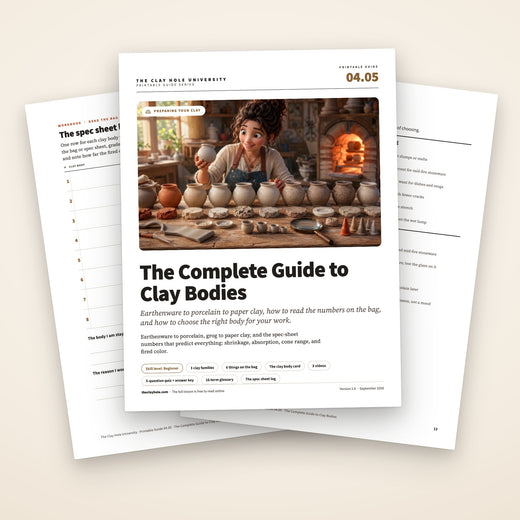
 Printable Pottery Guides
 Free Printable Trackers
 Gifts for Potters
 Christmas Pottery Ideas
 Mother’s Day Gift Ideas
 Pottery Date Night
 Studio Calendar
 2027 Studio Events
 What Should I Do Today?
 How to Throw on the Pottery Wheel
 How to Make a Pinch Pot
 How to Tap Center a Pot
 The Five Stages of Clay
 Is Pottery Hard to Learn?
 Pottery Wheel Practice Drills
 20 Easy Hand-Building Projects
 Everything That Sounds Wrong

 A Beautiful Piece, Every Time
 Slab Roller Tips
 Any Dish as a Slump Mold
 Slab Roller & Slab Mold Certification
 The Pottery Skill Tree
 Clay & Pottery Calculators
 Logging Your Pottery and Glazes
 The Pottery Dictionary
 Why Did My Pottery Do That?
 The Pottery Cone Chart
 Pottery Myths, Fact-Checked
 Is Handmade Pottery Food Safe?
 Incredible Ceramic Artist Videos
 How Dan Throws Giant Pots
 How to Dry Your Pottery
 The Pottery Wheel Introduction
 Pottery by Zodiac Sign
 Personality and the Pottery Wheel
 Pottery for Engineers
 ADHD, Hyperfocus, and Never Running Out
 Hobbies for Burnout
 Screen-Free Hobbies for Adults
 Every Addiction I Ever Had Lost to Art
 Functional Pottery Is Engineering
 How Do We Compare?
 Pottery Classes by City
 Every Pottery Studio in Utah
 Pottery in Draper
 Featured Members
 The Signature Wall
 Making Friends as an Adult Is Brutal
 The Clay Hole Commandments
 2027 Pottery Contests
 2027 Studio Parties
 Gallery Night

 Scream It Into the Void
 Destroy the Glaze Wall
 Daily Affirmation Cards
 Everything That Can Go Wrong
 Subscribe to Our Newsletters
 Contact The Clay Hole
 Corporate Team Building

 Glaze Combinations
 Glazes We Do Not Carry
 Making Glaze Test Tiles
 The Mega Glaze Tool
 How to Use the Mega Glaze Tool

 Glaze Brushing Techniques
 How to Use Underglaze
 How to Use Dipping Glazes
 Glaze Problems, Causes and Fixes
 The Dipping Glaze Guide

 Making a Glaze Catcher
 Fused or Sharp After Firing
 The Signature Wall
 His Viral Videos
 His Own Ceramics
 Meet Mud
Every pot starts as a decision you probably let someone else make.
Most potters inherit their clay the way they inherit a phone plan: somebody handed it to them once and they never thought about it again. But the bag you wedge from decides more about your finished pot than any glaze ever will: its color, its strength, its weight, whether it survives the dishwasher, whether it throws tall or slumps, whether that speckle you love shows up at all. This is the complete guide to what clay bodies actually are, earthenware to porcelain to paper clay, how to read the numbers on the bag like a professional, and how to choose the right body for the work you want to make.
The bag you wedge from decides more than any glaze will. Below: the three clay families in three lines, the two numbers that matter, the studio rule, and one video. The long version is one toggle away.

Clay bodies in five lines
- Earthenware fires low, stays porous, and loves bright color: flowerpot physics. Terracotta is its iron-rich orange cousin.
- Stoneware fires mid to high, goes dense and dishwasher-tough, and is what nearly all functional handmade pottery is made of, including everything thrown here.
- Porcelain is the white, glassy, occasionally translucent diva: glazes glow on it, and it fights you the whole way. Not a first clay.
- Two numbers predict everything: shrinkage (roughly 10 to 13 percent total for mid-fire stoneware, plan your fits around it) and absorption (lower means more vitrified; low single digits is honest daily-mug territory).
- Choosing: a smooth-to-lightly-grogged mid-fire stoneware is the right first clay for almost everyone; heavy grog for big work; whites when you want glaze-glow. Then stay with one long enough to learn its moods.
The one rule below is not optional reading. Wondering how to read a spec sheet, what grog and paper clay are for, or why the same glaze changes costumes between bodies? The Comprehensive Version above has all of it.
One firm rule at The Clay Hole: studio clay only
This page is education, not an invitation to bring clay in. No outside clay ever goes into our kilns, no exceptions, and here is the engineering reason why. Every clay body has a temperature it matures at, and a temperature where it slumps, bloats, or melts. A mystery clay that liquefies in one of our cone 5½ glaze firings does not just ruin its own pot; it welds itself to a kiln shelf and can wreck every neighboring piece on it, including work that other members waited weeks for. Every clay we stock has been proven in our firings, so when you buy your clay here, you are buying a guarantee that your pot and everyone else’s comes out safe. Learn everything on this page, get opinionated about clay bodies, and then choose from the ones on our shelf.
The big three: earthenware, stoneware, porcelain
Nearly every clay you will ever meet belongs to one of three families, and the family line is drawn by one thing: how much heat it takes to make the clay tighten into dense, watertight ceramic.
- Earthenware: the low-fire family. Matures at low temperatures and usually stays porous even then, soaking up water like a flowerpot unless glaze seals it, which is exactly why flowerpots are earthenware. Terracotta is simply earthenware rich in iron, which is where that famous orange comes from. It rewards bright low-fire color and forgives beginners, and it is the least durable of the three for daily dishes.
- Stoneware: the workhorse. Matures in the mid to high range, fires dense and strong, and shrugs off dishwashers, which is why nearly all functional handmade pottery, including everything made at The Clay Hole, is stoneware. It throws agreeably, takes glaze beautifully, and comes in everything from buttery white to chocolate brown to freckled tan.
- Porcelain: the diva. The finest particles, the whitest fire, and at full maturity it goes dense, glassy, and even translucent where thin. Glazes glow on it like nothing else. The price is workability: it is thirsty, floppy on the wheel, quick to crack in drying, and generally acts like it knows it is fancy. Worth the fight, eventually, and a terrible first clay.
One decoding note, because bags are confusing: ball clay and fire clay sound like families but they are ingredients, not bodies. A clay body is a recipe, and ball clay (for plasticity) and fire clay (for heat tolerance and tooth) are two of the pantry staples a manufacturer blends into it, along with feldspar to flux the melt and silica for the glassy backbone. When a bag says it contains fire clay, that is a recipe note, not a family name.
Reading the bag: the six numbers that matter
Every serious clay comes with a little spec sheet, and once you can read it, you can predict how a body behaves before you ever wedge it. Six things to find:
- Cone range. The temperatures the body is designed to fire between. This is the number that makes our studio rule non-negotiable: fire a clay past its range and it slumps or melts. Everything we stock is happy in our cone 5½ glaze firings, by design. What cones actually measure lives on our kiln firing page .
- Shrinkage. How much the clay contracts from wet to glaze-fired, commonly somewhere around 10 to 13 percent total for mid-fire stoneware. It is why your proud tall cylinder comes back shorter, why lids get thrown with their jars, and why anything that must fit anything gets made oversize on purpose.
- Absorption. The percentage of water the fired clay still soaks up, which is the honest measure of vitrification, the tightening of clay toward glass as it matures. Porcelain at maturity sits near zero, mature stoneware in the low single digits, earthenware often well above that. For dishes and mugs, lower is what you want; it is the number behind every honest dishwasher-safe claim.
- Grog and tooth. Grog is pre-fired clay ground into gritty particles and blended back in. It stiffens wet clay so big work stands up, opens the body so it dries with fewer cracks, and toughens it against thermal shock. The price is texture on your hands and a little less silkiness on the rim. Sand does a similar job with a different feel. Bodies built for sculptures and giant pots carry a lot; porcelain carries none.
- Plasticity. How willingly the clay bends without cracking, driven mostly by particle size: finer particles, more plasticity. Ball-clay-rich bodies stretch like taffy; short, grog-heavy bodies hold shape but crack if pushed. Throwers want more of it, slab builders can live with less.
- Fired color. The wet lump lies to you. Iron content and firing temperature decide the final color, so a gray-brown bag can fire toasty orange and a beige bag can fire nearly white. Trust the manufacturer’s fired chip, not the raw clay, and remember every glaze on our glaze finder shifts with the body underneath it.
Turn that literacy into a habit with a two-minute drill on your next studio visit. Tap each as you find it; the list remembers your progress on this device.
The specialists
Within and around the three families live the special-purpose bodies, each one a normal clay with one trait turned up loud.
- Grogged and sculpture bodies. Stoneware loaded with grog or sand until it stands up like a soldier. This is the territory of large work: wide platters, tall sectional pots, hand-built sculpture. The heavy tooth resists slumping, survives uneven drying, and takes thermal stress in stride. The clays built for our biggest throwing, the kind used for section-thrown giants , live here.
- Speckled bodies. Stoneware seeded with granular iron or manganese that blooms into freckles through the glaze in the fire. The speckle is in the clay, not the glaze, which is why the same glaze looks calm on one body and confetti on another. Delightful under the right glaze, opinionated under the wrong one.
- Porcelain-adjacent whites. White stonewares and porcelain blends give most of porcelain’s bright canvas with far better manners on the wheel. For potters who want glazes to glow without fighting the diva, this is the sensible middle.
- Paper clay. Any body blended with cellulose fiber. The fiber reinforces greenware like rebar, lets you join wet to bone dry in ways normal clay refuses, and burns out completely in the bisque. Beloved by sculptors and repair optimists; the trade is a shorter shelf life in the bag and a slightly open fired body.
- Colored and marbled bodies. Stains wedged through a body turn the clay itself into the decoration, the world of agateware and neriage . Same physics, louder wardrobe.
Choosing your clay
Match the body to the work, not to the romance. The short version of a decision most people overthink:
- Learning on the wheel? A smooth-to-lightly-grogged mid-fire stoneware is the right answer for almost everyone: plastic enough to forgive, toothy enough to stand, and it fires into real, dishwasher-grade pots.
- Making daily dishes? Stoneware, chosen for low absorption at maturity, with a fired color you like under your favorite glazes. Test the glaze on the body before committing a dinner set; the glaze finder exists for exactly this courtship.
- Going big or sculptural? Heavy grog, no debate. The bigger the work, the more tooth it needs to stand wet and survive drying.
- Chasing glaze-glow and fine detail? A white stoneware first, porcelain when your patience has a track record.
- Whatever you pick, stay a while. Clay bodies reveal themselves over dozens of pots, not two. Serial clay-switching is the potter’s version of changing gyms instead of going; pick one, learn its moods, and change for a reason, not a mood.
And at our studio the menu is the shortcut: every clay on our shelf is a mid-fire body proven in our cone 5½ glaze firings, so any of them will make honest functional pots. Grab whichever matches the work above, and ask any staff member which bag the big-pot throwers are hoarding this month.
Three videos worth your evening
One video worth your evening
A master throws the candidate clays back to back and narrates exactly what his hands feel. Reading gave you the families and the numbers; this is what the differences feel like at the wheel.
Clay behavior is easier to believe when you watch bodies fail and succeed side by side, so we picked three comparisons: a master choosing a beginner clay, the porcelain-versus-stoneware showdown, and a proper explanation of grog. A note on why the page is still mostly words: video shows you how two clays behave; reading is what lets you predict the third one, the bag in front of you, from its spec sheet. Watch to calibrate, read to decide.
The ones we get asked at the studio
Can I mix two different clay bodies together?
Wedged thoroughly, two compatible mid-fire stonewares generally get along, and potters blend them for color and feel all the time. The risks are mismatched shrinkage, which shows up as cracks at every joint, and lazy wedging, which leaves layers that split in drying. Blend on purpose, blend completely, and test the marriage on small pieces before trusting it with a platter. Scraps of the same body, meanwhile, always reunite happily in the reclaim bucket .
Why does the same glaze look completely different on two clays?
Because a glaze is a translucent-to-transparent layer over a colored, textured foundation, and the foundation votes. Iron in the body warms and darkens everything above it, speckles bleed through, white bodies let color sit bright and true, and grog textures the melt. That is not a defect, it is the whole romance of glaze-and-body pairs, and it is why serious potters keep test tiles of their glazes on every body they use.
What actually happens to clay in the kiln that makes it permanent?
Heat drives off the water, then chemically strips the water bound inside the clay crystals themselves, at which point there is no going back to mud. Keep climbing and fluxes in the body begin to melt, glass forms between particles, and the whole structure tightens and densifies: vitrification. A body fired to maturity has tightened as far as its recipe intends. The whole journey, cone by cone, is on our kiln firing page .
Is dug-from-the-ground wild clay usable?
Sometimes, after serious processing and testing, and it is a genuinely wonderful rabbit hole: potters have made pots from local dirt for all of human history. It is also the perfect example of why our studio-clay-only rule exists, because a wild clay’s maturing temperature is a mystery until laboratory-grade testing says otherwise, and mysteries do not go into shared kilns. Explore wild clay through books and dedicated workshops elsewhere; fire proven bags here.
Where this leads next
Meet the whole shelf in person
The fastest way to develop clay opinions is to throw the same form in three different bodies and feel the argument in your hands. A Clay Hole membership gets you 29 wheels, a shelf of proven mid-fire clays to choose from, the classes, and the kilns they all come home from. Green, Yellow, Purple or Black, whichever fits how often you can get here.
Every video on this page belongs to the potter who made it, and none of them are ours. We link them because they are excellent. The player and its cookies wait until you press play; the only thing that loads while you read is each video’s still frame.
Which version would you like to print?
Videos come out as a labeled box with the title and channel to search for, since paper does not play them.