
 Pottery Date Night
 Bring All Your Friends Free Week
 Give a Month of Pottery
 Private Pottery Parties

 The Welcome Booklet
 Your First Ten Sessions
 The Pottery Process
 Finding the Studio
 Your Classes Never Expire
 The Four Tables
 Who’s Who
 The Rewards Program
 Flux Glazes
 The Calculators
 Kiln Tracker
 Holiday Kiln Deadlines

 Beginner’s Tool Set
 Fingernail Clippers
 Mayco Clay Mender
 Epoxy for Kintsugi
 Applicator Bottles
 Large Bead Rack
 Raku Workshop
 Nighttime Raku
 Horsehair and Feather Raku
 The Clay Hole T-Shirt
 Embroidered Crewneck
 Zip-Up Hoodie
 Pre-Made Bisqueware
 Glaze Catchers
 Kiln Cookies
 Clay Cubby Rental
 The Glaze Bible, Printed
 The Book of Molds, Printed
 Printable Pottery Guides
 Free Printable Trackers
 Gifts for Potters
 Christmas Pottery Ideas
 Mother’s Day Gift Ideas
 Pottery Date Night
 Studio Calendar
 2027 Studio Events
 What Should I Do Today?
 How to Throw on the Pottery Wheel
 How to Make a Pinch Pot
 How to Tap Center a Pot
 The Five Stages of Clay
 Is Pottery Hard to Learn?
 Pottery Wheel Practice Drills
 20 Easy Hand-Building Projects
 Everything That Sounds Wrong

 A Beautiful Piece, Every Time
 Slab Roller Tips
 Any Dish as a Slump Mold
 Slab Roller & Slab Mold Certification
 The Pottery Skill Tree
 Clay & Pottery Calculators
 Logging Your Pottery and Glazes
 The Pottery Dictionary
 Why Did My Pottery Do That?
 The Pottery Cone Chart
 Pottery Myths, Fact-Checked
 Is Handmade Pottery Food Safe?
 Incredible Ceramic Artist Videos
 How Dan Throws Giant Pots
 How to Dry Your Pottery
 The Pottery Wheel Introduction
 Pottery by Zodiac Sign
 Personality and the Pottery Wheel
 Pottery for Engineers
 ADHD, Hyperfocus, and Never Running Out
 Hobbies for Burnout
 Screen-Free Hobbies for Adults
 Every Addiction I Ever Had Lost to Art
 Functional Pottery Is Engineering
 How Do We Compare?
 Pottery Classes by City
 Every Pottery Studio in Utah
 Pottery in Draper
 Featured Members
 The Signature Wall
 Making Friends as an Adult Is Brutal
 The Clay Hole Commandments
 2027 Pottery Contests
 2027 Studio Parties
 Gallery Night

 Scream It Into the Void
 Destroy the Glaze Wall
 Daily Affirmation Cards
 Everything That Can Go Wrong
 Subscribe to Our Newsletters
 Contact The Clay Hole
 Corporate Team Building

 Glaze Combinations
 Glazes We Do Not Carry
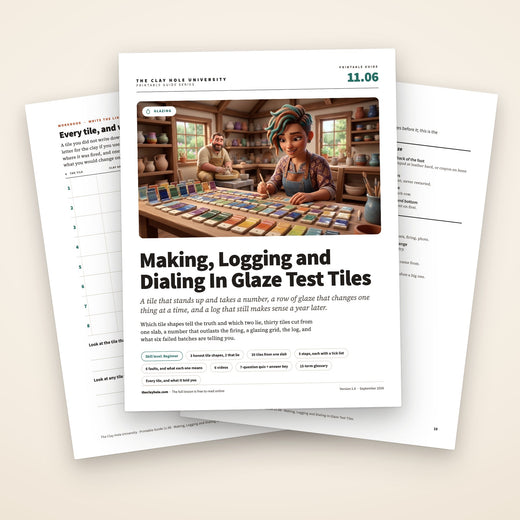
 Making Glaze Test Tiles
 The Mega Glaze Tool
 How to Use the Mega Glaze Tool

 Glaze Brushing Techniques
 How to Use Underglaze
 How to Use Dipping Glazes
 Glaze Problems, Causes and Fixes
 The Dipping Glaze Guide

 Making a Glaze Catcher
 Fused or Sharp After Firing
 The Signature Wall
 His Viral Videos
 His Own Ceramics
 Meet Mud
Glazing · Test tiles
A test tile is a question you get to ask the kiln for four dollars and eighty cents.
Every glaze on our wall is already fired onto a numbered tile, and for choosing a glaze off the shelf you never need to make one. But the moment you want to know what two glazes do on top of each other, what three coats look like against two, what a glaze does over a carved texture or over your underglaze, or what a glaze you mixed at home does at cone 5½, the studio’s tiles stop answering. Your own tile is the only way to ask. This page is how to make one that gives an honest answer, and how to keep the answers so you never ask the same question twice.
This page covers when the studio tiles are enough and when they are not, the tile shapes that actually work, a batch of thirty in an hour, numbering that survives the kiln, glazing in a grid, the log that turns a pile of tiles into a library, and the one-variable rule for dialing a result in. Six fixes and six videos.
This is the short version: when you need a tile, how to make a batch, how to number and glaze it, and the log. The tile shapes, the dialing-in method, the questions and five of the six videos are in the comprehensive version.

Read it, then watch it
Why this is written down and filmed, both.
Test tiles are two skills. Making them is quick and physical and films perfectly: a slab, a cutter, a stamp, a bend, and there they are on the bat in a row. Using them is slow and mental and does not film at all: a numbering system, a log sheet, the discipline of changing one thing per tile, the habit of looking at last year’s results before firing this year’s. This page carries the second skill in full, because nobody films a notebook, and points you at six videos for the first.
Read the system first, so you know what a tile is for before you make one. Then watch the batch get made. The words give you the questions to ask and the videos give you the hands, and people who do both remember the whole practice rather than half of it. Then roll a slab with the tick list open.
Use both, in this order
The when band and the log band first. Then the first video, which shows tiles made from thrown rings in eighteen minutes. Then the slab roller.
The whole idea
Make thirty tiles that stand up. Number them before the bisque. Change one thing per tile. Log every one.
The studio’s numbered tiles answer what a glaze looks like alone. Your own tiles answer everything else: combinations, coats, texture, underglaze, your clay body, a glaze mixed at home. Cut a slab into tiles with a foot so they stand, a texture on one half, and a hole to hang them by. Scratch a number into each before the bisque. Glaze them in a grid where every tile changes exactly one thing from its neighbor. Write each one into a log with the glaze, the coats, the clay and the firing, and photograph the sheet. Then repeat what worked and never guess again.
Before you make one
When the studio tiles are enough, and when only your own will do.
Every brush-on glaze and underglaze here is fired onto a numbered tile in the Glaze Bible and on the wall, and the Mega Glaze Tool on your phone gives you a color shortlist, with the tile number of each glaze to look up in the Glaze Bible. For choosing a glaze, that is the whole job done for you. Here is where it stops.
For choosing a glaze off the wall, the studio’s tiles are enough. For any of these, make your own.
Two glazes on top of each other
The wall shows each glaze alone. What a celadon does over a tenmoku, or a matte over a gloss, is a new glaze that exists nowhere but on your pot. Test it.
How many coats
Most of the wall is three coats. One coat can be a thin wash; four is likely to run. If you plan to use a glaze thin or thick, tile it at that thickness.
Over texture and carving
A glaze that pools breaks over a ridge and settles in a groove. The studio tile is flat. A tile with your texture on it tells the truth.
Over underglaze or slip
Underglaze changes a glaze’s color and sometimes its melt. A tile with a stripe of the underglaze you plan to use, and the glaze over half of it, saves a whole pot.
On a different clay
The wall tiles are on one clay. Porcelain, speckled buff and Berlin Gray all pull a glaze a different direction. Tile it on the clay the pot is made of.
A glaze mixed at home
Anything not from our shelves has to be tiled on a catcher before it goes near a pot, after a conversation with the studio team. Our mixing lesson has the rules.
- Two glazes on top of each other.
- A glaze at one or two coats instead of three.
- A glaze over your texture, carving, underglaze or slip.
- A glaze on a clay other than the one the wall tile is on.
- Anything mixed at home, which goes on a catcher after a word with the studio team.
The shape
Three tile shapes that give honest answers, two that lie, and one thing every tile needs.
A flat square on the shelf shows you what a glaze does on a floor. Almost nothing you make is a floor.
Step one
One slab, thirty tiles, an hour.
Strips, bent, textured, holed. Roll a slab a quarter inch thick on the slab roller (it needs the slab roller certification first), in the clay your pots are made of. Cut it into strips two inches wide and four inches long with a ruler and a knife. On each strip, score a line an inch from one end and bend it to ninety degrees, so the tile stands on a one inch foot with a three inch upright. Press a texture into the top half of the upright with a stamp, a rib edge or a piece of lace, leave the bottom half smooth, and cut a hole near the top with a straw. Stand them up on a bat, and you have thirty questions ready to ask.
Strips, bent, textured, holed. A quarter inch slab in your own clay, cut into two by four inch strips. Score an inch from one end and bend it up so the tile stands on a foot. Texture the top half of the upright, leave the bottom smooth, cut a hole near the top with a straw. Thirty from one slab, standing on a bat.
Bend the foot toward the textured side, so when the tile stands, the upright faces you with the texture at the top and the foot in front of it where a run will land. Compress the bend with a finger on both sides; a cracked bend snaps off in the kiln and the tile falls face down onto the cookie, glaze and all.
A thrown ring is the other batch. Throw a cylinder five inches tall with walls as thin as your mugs, leave it slightly soft, and cut it into two inch segments with a knife at leather hard. Each has a real throwing surface and a real curve. One of the videos below makes tiles both ways in fourteen minutes.
Make tiles from every clay you use, not just the one you are testing today. A shelf of tiles with the clay stamped on the back is what lets you answer next year’s question with this year’s firing.
Step two
A number that is part of the clay, not painted on top of it.
Scratched, on the back, before the kiln. A tile with no number is a tile you will fire and then be unable to read, and it happens to everyone once. Scratch a number into the back of the foot with a needle tool while the clay is leather hard, deep enough to read after glazing, or press it with number stamps. Then write the same number in the log with the clay body next to it. The number is the tile’s name for the rest of its life; the glaze gets recorded against the number later, not on the tile.
Scratched, on the back, before the kiln. Scratch a number into the back of the foot at leather hard, deep enough to read after glazing, or press it with stamps, and write the number and the clay into the log. Glaze details go in the log against the number, never on the tile.
An underglaze crayon or pencil on bone dry clay, before the bisque, is the other honest method: write on the back of the foot where no glaze will go, and it fires in permanently. A marker does not survive the kiln, and a number written in glaze on the front is a number hidden under the second coat.
Use one running series and never restart it. Tile 1 through 30 this month, 31 through 60 next, so a number can only ever mean one tile. Add a letter for the clay if you use several: B for B-Mix, P for porcelain, S for speckled. B41 tells you the clay and the tile before you look at the log.
Bisque them like any greenware, which here means bone dry and free. Staff load every kiln here, so leave the tiles on the bisque firing table.
Step three
Every tile changes exactly one thing from its neighbor.
One row, one question. Set the bisqued tiles out on the table in rows and decide what one thing each row is testing. A row for coats: tile one gets one coat of a glaze, tile two gets two, tile three gets three. A row for combinations: the same base glaze on every tile, with a different second glaze over the top half of each. A row for underglaze: a stripe of the same underglaze across each, painted on the raw tile at leather hard or bone dry and bisque fired before any glaze goes over it, with a different clear or celadon over it. Glaze the whole tile the way you glaze a pot, brush-on and coat by coat, and stop the glaze a quarter inch above the foot so a run has somewhere to go.
One row, one question. Lay the tiles out in rows, and give each row one question: coats, or a second glaze over the top half, or a glaze over an underglaze stripe that was painted on the raw tile and bisque fired first. Every tile in a row changes exactly one thing from its neighbor. Glaze them coat by coat like a pot and stop a quarter inch above the foot.
Two glazes on a tile go top and bottom, not side by side. The top glaze runs down into the bottom one exactly as it will on a pot, and the overlap is the result you wanted to see. Note which went on first; the same two glazes in the other order are a different result, and a different tile.
Keep the foot bare and dry. It is the part that touches the shelf, and a tile that fuses to a shelf is a tile somebody has to grind off. Wax it if your Level has a wax station, or ask an instructor how to keep it clean, and put every tile on a kiln cookie or glaze catcher, every time, because a run lands on the foot; our glaze catcher lesson is a short make.
Write the glaze against the number in the log as you go, not after. Thirty tiles glazed in an afternoon are thirty tiles you will not remember by evening, and the tile that looks incredible is always the one whose entry is blank.
Step four
A tile without a log entry is a pretty rock.
Number, clay, glaze, coats, under, firing, photo, verdict. The log is a notebook, a spreadsheet, or the notes app on your phone; it does not matter which, as long as it is the only one and you can find it in a year. Every tile gets a line: the number, the clay, the glaze or glazes with their jar numbers and the order they went on, the coats, anything underneath, where and how it was fired, and a photograph once it is out. Then a column that matters more than all the others: what you thought of it, in one line, and what you would change next time. That last column is the difference between a record and a plan.
Number, clay, glaze, coats, under, firing, photo, verdict. One notebook, spreadsheet or notes file, and only one. A line per tile: number, clay, glaze and jar number, order, coats, anything underneath, the firing, a photo, and a one-line verdict with what to change next time. Photograph the fired tiles laid out on the sheet, numbers up.
Photograph tiles laid out on the log page itself, numbers visible, the day they come out of the kiln, in daylight by a window. A photograph of thirty tiles on a sheet with the numbers next to them is worth more than thirty separate photographs you will never match up, and the daylight matters because glaze color under the studio lights is not the color of the glaze.
Record the firing, not just the glaze. Our glaze firing is cone 5½, but where a tile sits in the kiln changes the result, and a test that ran on a top shelf might not run on a bottom one. If you are told where it went, write it down; if not, write the date so it can be matched to a load.
A log is worth keeping in the Mega Glaze Tool’s terms: the jar numbers it uses are the numbers on our shelves, and a tile logged with the same numbers can be found again in thirty seconds. Our Mega Glaze Tool lesson shows where the numbers live.
Step five
Look at the tile, change one thing, make the next tile.
Change one thing. Only one. The first batch is never the answer; it is the map of where the answer is. A combination that is nearly right but a little too runny gets a second tile with one fewer coat of the top glaze. A texture that reads beautifully on the tile but disappears on the pot gets a tile with the texture carved deeper. Each round changes exactly one thing from the tile that came closest, and each round is logged against the tile it came from, so the log reads as a chain: 41 was close, 52 fixed the run, 63 is the one. Three rounds is usually enough. Ten is a hobby.
Resist the urge to fix two things at once. A tile with one fewer coat and a different underglaze tells you nothing about either, because you cannot know which change did what. It feels slower to change one variable; it is faster, because every tile teaches you something you can use.
When a tile is right, glaze a small pot exactly the way the tile was glazed, coats and order and all, before you commit a big one. A tile is a wall three inches tall; a vase is a wall twelve inches tall, and a glaze that stopped a quarter inch short on the tile can run an inch on the pot. Our glaze problems lesson is for reading what went wrong when it does.
Then the tile goes on the ring or the nail with its number facing out, and the next time you want that result, you look at the tile, read the line in the log, and do that. That is the entire payoff, and it is enormous.
Watch it done
Now watch six videos on making and reading tiles.
Watch this one, then go roll a slab.
None of these potters work here or know we exist. Between them they cover both batches, what a test tile needs, combination testing, and results from three brands we carry. The still frames load while you read; the player and its cookies wait until you press play.
Eighteen minutes on making test tiles from thrown rings. The other five videos are in the comprehensive version.
When it goes wrong
Six things that go wrong, and what each one is telling you.
The three things that go wrong first.
Pick the one that looks like your shelf. Half of these are a missing number or a missing log line, which is the whole subject.
Pick the one that looks like your shelf.
Thirty fired tiles and no idea which glaze is which
No number, a number written in marker, or a number on the front under the glaze. Or a log that was going to be filled in later.
Scratched into the back of the foot at leather hard, or underglaze crayon or pencil on bone dry clay, and the log line written as each tile is glazed.
Match what you can from memory and the photograph of the table, mark the rest as unknown, and hang them anyway; an unknown tile that looks good is still a lead.
A tile face down on the shelf, or three tiles fused in a heap
The foot was too short, the bend cracked, or the tiles were stood touching each other.
A full inch of foot, the bend compressed on both sides, and a quarter inch between tiles on the cookie.
Ask a staff member about a fused pair; fired work is ground wet, never dry, with safety glasses and an N95 or better. A face-down tile is a lesson, and the cookie under it takes the glaze, not the shelf.
Glaze off the tile and onto the kiln shelf
Too many coats, a combination that fluxes hard, or glaze taken down to the foot with nowhere to go.
Glaze stopped a quarter inch above the foot, every tile on a kiln cookie, and anything you suspect might run on a catcher. That is what the catcher is for.
Tell the front desk; staff deal with the shelf. Then log the run as a result: a glaze that runs on a three inch tile will pour off a pot.
The tile was perfect and the pot is not
The pot is taller, thicker, curved, or a different clay, or the coats were not the same. A tile is a small pot; it is not the pot.
Tile on the pot’s clay, with the pot’s texture, and glaze a small pot exactly like the tile before a big one.
Log the pot as a tile. What it did differently is the next question, and our glaze problems lesson reads the symptom.
Nothing readable on the fired tile
The face was under two inches, or flat, or smooth. Speckle, break and pooling only show on a face big enough and textured enough to have somewhere to happen.
Two by three inch upright faces, texture on the top half, and combinations top and bottom rather than in a corner.
Fire the next batch bigger. A small tile is not wrong, it is just quiet.
The second batch is different and you cannot say why
Two changes on one tile: fewer coats and a different underglaze, or a new glaze and a new clay. Whatever happened, you cannot credit it.
One change per tile, logged against the tile it came from, in a chain you can read back.
Make two more tiles, one with each change on its own, and the chain repairs itself.
How it works here
Our tiles are already fired. Yours are for the questions ours cannot answer.
This page is written for potters everywhere. Here is where our studio stands.
Four things to know here
Every glaze on the wall is already fired onto a numbered tile: the Glaze Bible by the mold room, the wall itself, and, on your phone, the Mega Glaze Tool, which gives a color shortlist and the tile number of each glaze. Make your own for combinations, coats, texture, underglaze and your own clay. Tiles bisque free and are measured for the glaze firing like any piece, which for one tile means the flat charge, and several tiles on one 6 inch kiln cookie, a quarter inch apart and 125 cubic inches or less in total, pay as one piece. Home-mixed glazes go on a catcher, after a word with the studio team.
The tiles we already have
Every brush-on glaze and underglaze in the building is fired onto a numbered tile. The Glaze Bible lives on the table by the mold room, the wall carries the tiles, and the Mega Glaze Tool on your phone gives you a color shortlist and the tile number of each glaze. For choosing a glaze off the shelf, you never need to make one.
When you make your own
Combinations, coats, texture, underglaze, a different clay, or a home-mixed glaze. Anything the wall tile cannot show you. Most potters who test make a batch now and then and never run out of questions.
What it costs
Bisque is free. The glaze firing is measured like any piece, five cents a cubic inch, and a test tile is small enough that one tile is one flat charge. Several small tiles that fit on one 6 inch kiln cookie, a quarter inch apart and 125 cubic inches or less in total, pay as one piece, and that is the only time pieces combine. Put a batch on one cookie instead of firing them one at a time.
Home-mixed glazes
Anything not from our shelves goes on a catcher, and only after a conversation with the studio team about what is in it. A glaze nobody here has seen fired can take a shelf with it, and the catcher is the price of the experiment.
Your clay
Tile the clay your pots are on. Our clays pull the same glaze different directions, and the wall tiles are on one body. A speckled buff tile under a celadon looks nothing like the wall.
Storage
Fired tiles go home, or hang on a ring on your shelf. They are yours. A tile left loose on a shared shelf reads as abandoned and goes to the lost pots.
Questions people actually ask
The ones that come up at the glaze wall.
Do I need test tiles at all here?
Not for choosing a glaze off the wall. Every glaze is already fired onto a numbered tile. You need your own the moment you want a combination, a thickness, a texture, an underglaze, a different clay, or a glaze mixed at home.
What size and shape?
A two by four inch slab strip, bent an inch from one end so it stands on a foot, with texture on the top half of the upright and a hole near the top. Flat squares lie about running; tiles under two inches are too small to read.
How do I number them so it survives?
Scratch or stamp the number into the back of the foot at leather hard, or write it there in underglaze crayon or pencil on bone dry clay. Marker burns off and a number on the front disappears under the glaze.
What goes in the log?
Number, clay, glaze and jar number, the order they went on, coats, anything underneath, the firing, a photograph, and a one-line verdict with what to change next time. One log, only one.
How many coats should the tile have?
Whatever the pot will have. If you test three coats and glaze the pot with two, you tested a different glaze. A row of tiles at one, two and three coats answers the question once for good.
Why does the pot not match the tile?
The pot is taller, thicker, curved, on another clay, or got different coats. A tile is a small pot, not the pot. Glaze a small pot exactly like the winning tile before a big one.
What does a tile cost to fire?
Bisque is free. The glaze firing is measured like any piece, and a tile is small enough that one tile is one flat charge. Several small tiles that fit on one 6 inch kiln cookie, a quarter inch apart and 125 cubic inches or less in total, pay as one piece, so put a batch on one cookie.
Can I test a glaze I mixed at home?
On a catcher, after a conversation with the studio team about what is in it. Never straight onto a shelf, and never on a pot before a tile.
Related lessons
Six lessons that sit next to this one.
Three to read next.
A tile is a question. These are the pages about the glazes it asks about, and what to do with the answers.
That is the whole practice
Make thirty. Number them. Change one thing. Write it down.
Potters who test are not more talented than potters who do not. They have a shoebox of tiles and a notebook, and when a pot comes out of the kiln looking exactly the way they meant it to, that is why. The first batch feels like homework. The second batch feels like cheating.
If you want the tile shapes, the dialing-in method, the six fixes and the other five videos, switch to the comprehensive version at the top. Otherwise, roll a slab and cut thirty.
Written for potters everywhere. Where our studio does things differently, the page says so.
Which version would you like to print?
Both print clean, with the videos turned into labeled boxes you can search for later.