

 Pottery Date Night
 Bring All Your Friends Free Week
 Give a Month of Pottery
 Private Pottery Parties

 The Welcome Booklet
 Your First Ten Sessions
 The Pottery Process
 Finding the Studio
 Your Classes Never Expire
 The Four Tables
 Who’s Who
 The Rewards Program
 Flux Glazes
 The Calculators
 Kiln Tracker
 Holiday Kiln Deadlines

 Beginner’s Tool Set
 Fingernail Clippers
 Mayco Clay Mender
 Epoxy for Kintsugi
 Applicator Bottles
 Large Bead Rack
 Raku Workshop
 Nighttime Raku
 Horsehair and Feather Raku
 The Clay Hole T-Shirt
 Embroidered Crewneck
 Zip-Up Hoodie
 Pre-Made Bisqueware
 Glaze Catchers
 Kiln Cookies
 Clay Cubby Rental
 The Glaze Bible, Printed
 The Book of Molds, Printed
 Printable Pottery Guides
 Free Printable Trackers
 Gifts for Potters
 Christmas Pottery Ideas
 Mother’s Day Gift Ideas
 Pottery Date Night
 Studio Calendar
 2027 Studio Events
 What Should I Do Today?
 How to Throw on the Pottery Wheel
 How to Make a Pinch Pot
 How to Tap Center a Pot
 The Five Stages of Clay
 Is Pottery Hard to Learn?
 Pottery Wheel Practice Drills
 20 Easy Hand-Building Projects
 Everything That Sounds Wrong

 A Beautiful Piece, Every Time
 Slab Roller Tips
 Any Dish as a Slump Mold
 Slab Roller & Slab Mold Certification
 The Pottery Skill Tree
 Clay & Pottery Calculators
 Logging Your Pottery and Glazes
 The Pottery Dictionary
 Why Did My Pottery Do That?
 The Pottery Cone Chart
 Pottery Myths, Fact-Checked
 Is Handmade Pottery Food Safe?
 Incredible Ceramic Artist Videos
 How Dan Throws Giant Pots
 How to Dry Your Pottery
 The Pottery Wheel Introduction
 Pottery by Zodiac Sign
 Personality and the Pottery Wheel
 Pottery for Engineers
 ADHD, Hyperfocus, and Never Running Out
 Hobbies for Burnout
 Screen-Free Hobbies for Adults
 Every Addiction I Ever Had Lost to Art
 Functional Pottery Is Engineering
 How Do We Compare?
 Pottery Classes by City
 Every Pottery Studio in Utah
 Pottery in Draper
 Featured Members
 The Signature Wall
 Making Friends as an Adult Is Brutal
 The Clay Hole Commandments
 2027 Pottery Contests
 2027 Studio Parties
 Gallery Night

 Scream It Into the Void
 Destroy the Glaze Wall
 Daily Affirmation Cards
 Everything That Can Go Wrong
 Subscribe to Our Newsletters
 Contact The Clay Hole
 Corporate Team Building

 Glaze Combinations
 Glazes We Do Not Carry
 Making Glaze Test Tiles
 The Mega Glaze Tool
 How to Use the Mega Glaze Tool

 Glaze Brushing Techniques
 How to Use Underglaze
 How to Use Dipping Glazes
 Glaze Problems, Causes and Fixes
 The Dipping Glaze Guide

 Making a Glaze Catcher
 Fused or Sharp After Firing
 The Signature Wall
 His Viral Videos
 His Own Ceramics
 Meet Mud
Glazing · Glaze problems, causes and fixes
Crawling, pinholes, crazing, shivering, blisters and dunting.
What each one looks like, what caused it, and which are worth refiring. Most of them are application problems, which means the coat was wrong, and many of those can be refired. Two are fit problems between the glaze and the clay, and no second firing changes fit. One, dunting, is the pot itself cracking on the way down from temperature. The diagnostic below names all of them. Running onto the shelf has its own lesson, Making a Glaze Catcher.
Four steps with a tick list at each: naming the defect, deciding which of the three kinds it is, fixing the cause for the next pot, and the refire. Seven defects in the diagnostic with causes and verdicts, a picture of six of them, and seven videos.
This is the short version: name it, decide which of the three kinds it is, the bisque and the coat, the refire, each with a tick list. The reasoning, the clay-body notes and the questions are in the comprehensive version.

Read it, then watch it
Why this is written down and filmed, both.
Glaze problems are a diagnosis. You are holding a pot with something wrong on it, and the job is to name it, find the cause, and decide whether a refire is worth a second firing fee. That is a table with three columns, and a table is what a page holds. What a page cannot do is talk you through each defect one at a time, and that is the videos, one of which is thirty-seven minutes of exactly that.
Use both, in this order
Hold the pot. Find its picture in the diagnostic below. Read the cause and the refire verdict. Watch the video for that defect if the picture is not enough.
The whole idea
Three kinds of problem. Only one of them refires.
Every defect on this page is one of three things, and the three are worth learning in this order.
The coat, the pairing, or the pot
Application is the coat. How the glaze went on. Crawling, pinholes, blisters and dry glaze. Many of these can be refired, once an instructor has looked.
Fit is the pairing. This glaze against this clay, and how much each one shrinks while it cools. Crazing and shivering. These do not refire.
Dunting is the pot. The clay cracked as the kiln cooled, usually because the pot was built with uneven walls, and cooling too fast made it worse. This does not refire either, and it is the only one that leaves you holding two pieces.
Name the defect, read its kind, let the kind decide.
The five-minute version
The whole method in six moves.
If you already glaze and you just want the shape of it, this is the shape of it. Everything below is these six moves, slowed down, with the places they fail marked.
Before you decide
What you need on the table.
Six things, and one of them is the fee. The damp sponge is the one that prevents the most.
The pot under a lamp, a green scouring pad and a diamond pad, the same glaze, a damp sponge, a test tile, and the refire fee.
Step one
Name the defect. Seven of them cover nearly every pot.
Hold it under a lamp. Beads with bare clay between: crawling. Pits: pinholes. A fine network of cracks in the glaze: crazing. Slivers off the rim and edges: shivering. Bubbles or craters: blisters. Dry, rough or paler than the jar: thin. A crack running through the wall of the pot, or a pot in two pieces: dunting.
The first question is whether the damage is in the glaze or in the clay. Glaze damage sits on the surface and the pot underneath is whole. A dunt goes through the wall, and you can see it from both sides.
Two of the glaze faults look alike and matter most to tell apart. Crazing is cracks in a glaze that is still stuck down, sometimes heard as a ping days later. Shivering is glaze that has come off, leaving a bare edge with a sharp lip of glass beside it. One is a curiosity. The other is a pot that should not be on a table, and the difference is whether a fingernail catches on an edge.
A crack tells you when it happened
Run a fingernail along it and look at the edges under the lamp. If the crack cuts straight through the glaze and the edges are sharp, it opened on the way down, after the glaze had already set hard. That is a dunt, and it is a firing-stage crack.
If the glaze has rolled over into the crack and the inside of it is smooth and glossy, the crack was already there when the kiln got hot, and the melting glaze poured into it. That one came from drying or from a joint that never welded, weeks before the pot was glazed.
Neither one refires. The difference is which habit to change next.
The Washington Street Studios video below is thirty-seven minutes of a teacher at a whiteboard taking the glaze faults one at a time, and if the picture in your head does not match the pot in your hand, its chapters are where to look.
Step two
Ask which kind it is. There are three, and the kind decides the verdict.
This is the question that decides everything. Three questions, asked in this order, sort every pot on the drop-off table.
Ask them in this order
1. Is the pot cracked through, or in pieces? Then it is a crack in the clay, and a dunt if the edges are sharp with no glaze run into them. Nothing else on this page applies to that pot.
2. Is the glaze cracked in a fine net, or flaked off the edges? Then it is fit. The net is crazing. The flakes are shivering.
3. Anything else. Application, which means the coat. Crawling, pinholes, blisters, dry glaze. Most of them can go back in, blisters only sometimes. Show an instructor before you add glaze.
Two of those three verdicts are disappointing, and it is better to know which one you are holding before you pay for a second firing.
Application: the coat
Crawling, pinholes, thin and dry glaze, and blisters once. The glaze is fine and the clay is fine. The coat was wrong: a dusty bisque, a layer too thick or too thin, coats not dried between, wax where it should not be. Show an instructor, then add glaze where it is missing, wipe the excess and fire again at the normal fee.
Fit: the pairing
Crazing and shivering. Everything shrinks as it cools, and the glaze and the clay under it shrink by different amounts. When the glaze shrinks more it is stretched and it cracks. When the clay shrinks more the glaze is squeezed and it buckles off at the edges. The fix is a different pairing, not a second firing.
Dunting: the pot
A crack through the clay itself, opened while the kiln cooled. Clay does not shrink smoothly on the way down. Around 1,063 degrees Fahrenheit the silica in it contracts all at once, and a pot with a thick base and thin walls reaches that moment with one part still moving and another already still. It splits along the stress.
Eight clay bodies and 650+ glazes is a lot of pairings, and most of them are fine at cone 5½. The ones that are not get found on a test tile if you are careful and on a pot if you are not, and either way the pairing goes on your own do-not-use list, and you can tell the studio team the pairing. Dunting is not on that list, because it is not about the glaze at all. It is about how the pot was built.
Step three
Fix the cause for the next pot, which is usually the bisque or the coat.
A damp sponge on the bisque and three coats dried between. That sentence is the habit that prevents the most glaze defects. Damp means wrung nearly dry, or a quick flash rinse at the wash pit, never a soak. Dust and finger oil on bisque make glaze crawl and pinhole; a coat too thick crawls and blisters; a coat too thin fires dry; coats laid wet on wet slide and crack and crawl.
Then the things people blame the kiln for. Our kilns fire the same cone 5½ schedule every load, the half being a twelve-minute hold at the top, and the hold is there to let a glaze heal over its bubbles. Most pinholes come from what was on the pot or in the clay, and the hold at the top gives the ones that start a chance to heal. A glaze at the very edge of its range can blister; the jar says the range, and the test tile says the rest.
Dunting is prevented weeks earlier, at the wheel and at the table. Even walls, and a base no thicker than the walls beside it. A floor that got compressed before the pot came off the wheel. Joints scored and welded rather than pressed together. A soft inside curve where the wall meets the floor instead of a sharp corner. A pot that is twice as thick in one place as another is a pot asking to crack, and no amount of careful glazing changes that.
And the clay. A groggy, iron-bearing body outgasses more than a smooth white one and pinholes and blisters more under thick glaze. Our glaze brushing lesson is the coat method, and the test tiles lesson is how to ask the kiln a question on your own clay before a pot pays for it.
Step four
Refire what refires, and let the rest go.
A refire is adding what is missing and firing again. Crawled: rough the bare patches wet with a green pad, brush glaze into them and over the island edges. Pinholed: ask an instructor first, then rub glaze into the holes and wipe the surface. Dry: one more coat. Blistered: grind it flat, wet, in safety glasses and an N95 or better, and a thin coat over the scar, once. Same glaze every time. Keep the new glaze thin, and stop well above the foot, because two layers run more than one.
A refired pot goes to the drop-off table like any other, on a cookie with a naked bottom, at five cents a cubic inch with the $4.80 minimum. Glaze added to a fired surface does not soak in the way it does on bisque, so let it dry completely and handle it gently; it flakes if knocked. Tell the studio team it is a refire when you drop it off, with a note on the ticket.
A dunted pot is the shortest verdict on the page. The crack goes through the clay, heat does not close a crack in clay, and a second firing usually opens it further. Keep the pieces if the pot was worth keeping, glue them for a shelf, and read the crack for what it says about the next one.
Crazed and shivered pots do not refire either. A crazed pot should not hold food, and most potters keep it for dry things. A shivered pot has edges like glass, gets ground with a diamond pad, wet, and does not go back on a table. Pottery by Kent’s video below is a batch of old failures reglazed, with the results shown, and it is one potter’s try at what a refire can and cannot do.
Watch it done
Now watch seven videos on glaze faults.
Watch this one with the pot in your hand.
None of these makers work here. Between them they cover the glaze faults chapter by chapter, one potter’s pinhole experience, fit at a chalkboard, one maker’s view on crazing and food safety, one potter’s crawling fix, cracks sorted by cause, and one potter’s try at reglazing. Only the still frame loads until you press play.
Thirty-seven minutes of a teacher at a whiteboard taking the glaze faults one at a time. The other six videos are in the comprehensive version.
When it goes wrong
The seven defects: what it is, what caused it, and whether it refires.
The four defects you will meet first.
Start with the picture. Find the tile that looks like your pot, then find its heading below for the cause, the fix for next time, and the refire verdict.
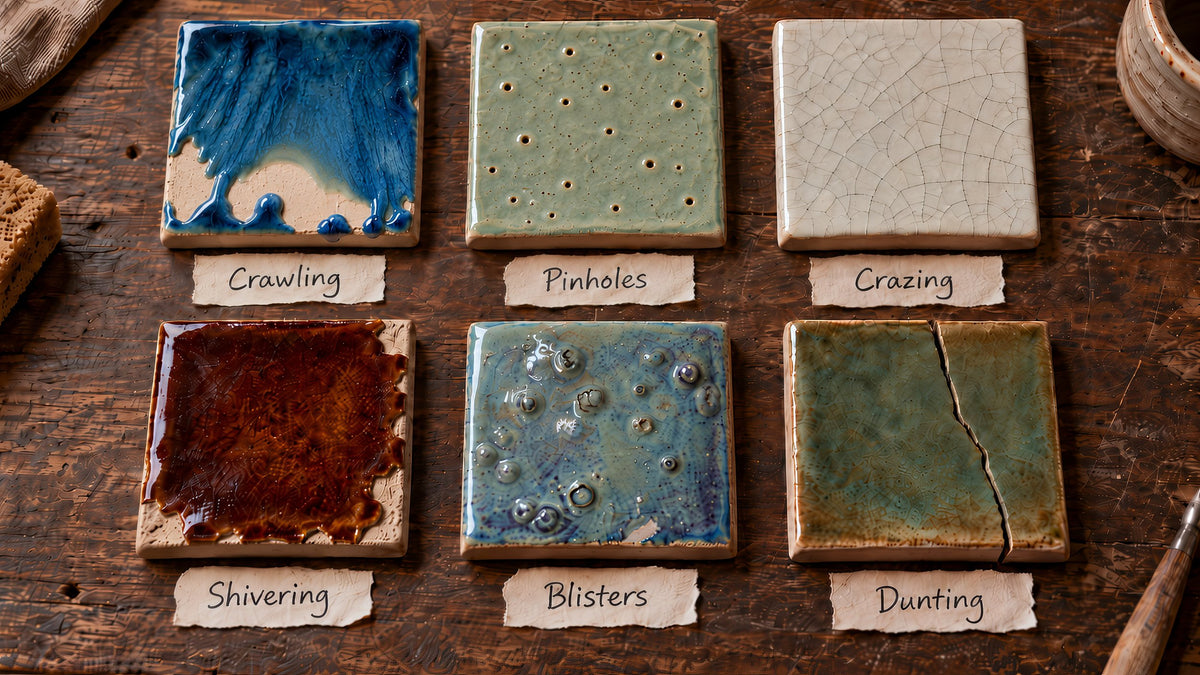
Six of the seven, fired on test tiles. Top row, left to right: crawling, pinholes, crazing. Bottom row, left to right: shivering, blisters, dunting. The seventh is a glaze that came out dry and pale, and it has no tile here because it looks like a duller version of the right color, which is exactly what makes it the one people miss.
The glaze pulled back into beads and left bare clay
Crawling. The glaze did not stick to the bisque before it melted, so surface tension pulled it into islands. Dust, oil from fingers, wax where it should not be, a coat put on too thick, or a second glaze laid over a first that had dried and cracked.
Wipe the bisque with a damp sponge before glazing and keep fingers off it afterwards. Three coats, not five. Let each coat dry before the next. Wax only where you mean to.
Often refires. Rough the bare patches wet with a green scouring pad, brush glaze into the gaps and over the edges of the islands, and fire again. Show an instructor first.
Tiny holes and pits all over the glaze
Pinholes. Gas from the clay or the glaze bubbled through the melt and the glaze did not heal over the hole before it stiffened. Underfired bisque, a dusty or greasy surface, glaze put on thick, or a firing that got to temperature and stopped.
Wipe the bisque. Thinner coats, dried between. A groggy or dark clay pinholes more than a smooth light one; know your body. A hold at the top of the firing gives pinholes a chance to heal, and our cone 5½ firing has that hold built in.
Sometimes refires, and sometimes it makes them worse, so ask an instructor first. Then rub a little glaze into the holes with a fingertip, wipe the excess off the surface, and fire again. Pinholes in a thin clear usually heal; pinholes in a thick matte usually do not.
A fine network of cracks in the glaze
Crazing. The glaze shrank more than the clay as the pot cooled, so it ended up stretched over a pot slightly too big for it, and it cracked. It is a fit problem between that glaze and that clay body, not an application problem, and it sometimes shows up weeks later with a ping.
A different glaze on that body, or that glaze on a different body. Thinner helps a little. Nothing about how you brushed it changes fit.
Does not refire out; the cracks close in the kiln and reopen on cooling. On a vitrified body at cone 5½ a crazed pot does not weep, but the cracks hold coffee and bacteria and are hard to clean, so it should not hold food. Keep it for dry things or flowers, and the glaze goes on the do-not-use list for that clay.
Slivers of glaze flaked off the rim and edges
Shivering. The opposite of crazing. The clay shrank more than the glaze, so the glaze was squeezed rather than stretched, and it buckled off at the edges where there was nothing holding it down. Less common than crazing, and worth taking seriously, because the flakes are sharp as glass.
A different glaze on that body. Shivering is a fit problem in the other direction, and a glaze that shivers on one clay is often perfect on another.
Does not refire. Grind the sharp edges off with a diamond pad, wet, in safety glasses and an N95, and retire the pot from the table. Tell the studio team which glaze and which clay, because that pairing goes on a list.
Bubbles, blisters and craters in the surface
Blisters. Gas that came through the glaze late and big, or a glaze that boiled: too thick, overfired for that glaze, or a body with something in it that outgasses at the top of the firing. Craters are blisters that burst.
Thinner. Check the glaze’s cone range on the jar; a glaze at the very top or bottom of its range at cone 5½ blisters more easily. A clean bisque fired properly.
Sometimes. Grind the blister flat with a diamond pad, wet, in safety glasses and an N95, brush a thin coat of the same glaze over the scar, and refire once. If it blisters again, it is the glaze on that clay, and the pot is done.
A crack running through the pot, or a pot in two pieces
Dunting. This is the one that is not a glaze problem at all. The clay cracked while the kiln was cooling, and the tell is the edge: a dunt cuts straight through the glaze and leaves it sharp, with no glaze melted down into the crack.
Clay does not shrink smoothly on the way down. Around 1,063 degrees Fahrenheit the silica in it contracts all at once, and every pot in the load passes through that moment. A pot with even walls passes through it in one piece. A pot with a heavy base and thin walls arrives with one part still shrinking and another already finished, and it splits along the stress. Uneven wall thickness, a heavy base under thin walls and a sharp inside corner where the wall meets the floor are the causes you control, and cooling too fast makes every one of them worse.
Even walls, and a base no thicker than the walls beside it. Compress the floor before the pot leaves the wheel. Score and weld every joint. Round the inside corner where the wall meets the floor. Compressing the floor and welding joints matter too: they stop the cracks that open earlier, in drying, which are not dunts. Dunting is decided at the wheel and the table, not at the glaze bench.
Does not refire, and this is the shortest verdict on the page. Heat does not close a crack in clay, and a second firing usually opens it further. Glue the pieces for a shelf if the pot was worth keeping. A dunted mug is also unsafe to drink from, because the crack holds water inside the wall.
The glaze came out dry, rough or a different color
Underfired or too thin. A coat that was one brushload short fires dry and pale, and a glaze that needed three coats to develop its color gives a different color at two. On a shelf near the door of a big kiln it can be a cooler spot as well.
Usually three coats, each fully covering, checked against the light for thin patches before it goes to the drop-off table.
Often the best refire on the page. Ask an instructor, then one thin coat of the same glaze, stopped well above the foot.
How it works here
At The Clay Hole, the kiln is the same every time, so the pot is the variable.
This page is written for potters everywhere. A few things are specific to our building.
Four things to know here
Our glaze firing is cone 5½ on the same schedule every load, with a hold at the top that gives pinholes a chance to heal. A pot that comes out wrong nearly always went in wrong. A refire is a normal glaze firing at the normal fee. Tell the studio team about any glaze that crazes or shivers on one of our bodies. And a crack through the clay is not something the studio team can fire out, so even walls and a rounded inside corner are the prevention on your side, and we never open a warm kiln.
The firing
Cone 5½, the half being a twelve-minute hold at the top, the same every load, with our staff loading. The hold gives a glaze time to heal over bubbles and settle. Most problems still trace to what went on the pot.
Cracks
A crack through the clay is not a glaze fault, and nobody here can fire it out. Every pot on a shelf gets the same schedule, so when one dunts and the pot beside it does not, look at the pots first. Even walls and a rounded inside corner are the prevention on your side, and both happen weeks before the glaze goes on. We never open a warm kiln.
After it leaves
A finished pot can still crack, from the same physics in a smaller way. Boiling water into a cold mug, a cold dish into a hot oven, a hot dish onto a wet counter. Stoneware fired to cone 5½ takes more of that than earthenware does, and it does not take all of it. Warm a piece up gradually and most of them last decades.
Refires
A refire is a glaze firing: five cents a cubic inch, $4.80 minimum, on a cookie with a naked bottom, paid before it goes on the drop-off table. A note on the ticket if the studio team should know something. Bisque is cone 05 and free, and a refire never needs one.
Bad pairings
Eight clay bodies, 650+ brush-on glazes and seven dipping buckets. Nearly every pairing is fine. Tell the studio team about one that is not, glaze and clay both, because a crazing or shivering pairing is worth every member knowing.
Tools
A green scouring pad and a diamond pad are worth owning; the diamond pad is the best small purchase in pottery. Grinding is wet, over a bucket, away from shared tables, in safety glasses and an N95 or better, and the grindings go in the bin, per the sanding and grinding lesson.
Questions people actually ask
The ones people ask most.
Which problems can be fixed by refiring?
Crawling, pinholes, dry and thin glaze, and sometimes blisters: anything that is an application problem. Show an instructor, add glaze where it is missing, fire again, and many come back. Crazing and shivering are fit problems between the glaze and the clay, and no amount of refiring changes fit. The cracks close in the kiln and reopen on cooling. Dunting does not refire either, because the crack is in the clay and heat does not close it.
Can I refire at The Clay Hole?
Yes. A refire is a glaze firing, paid at the same five cents a cubic inch with the $4.80 minimum, on a cookie with a naked bottom like any other pot. Show an instructor, add the glaze, let it dry, and put it on the drop-off table with a note.
What is dunting?
Dunting is a crack that opens in the clay itself while a pot cools in the kiln. Clay does not contract smoothly on the way down. Around 1,063 degrees Fahrenheit the silica in it shrinks all at once, and a pot whose walls and base are wildly different thicknesses reaches that moment with one part still moving and another already still. The pot splits along the stress. It is a making problem rather than a glazing problem, and it does not refire.
My pot came out of the kiln cracked. Was it the firing?
Usually not, and the crack itself will tell you. Look at the edges under a lamp. A crack that cuts clean through the glaze and leaves sharp edges opened on the way down, after the glaze had set, and that is a dunt, usually from uneven wall thickness and made worse by cooling too fast, which is why we never open a warm kiln. A crack with glaze melted smoothly into it was already there before the kiln got hot, from drying or from a joint that never welded. Every pot on that shelf got the same schedule, so the difference was in the pots.
Can a dunted pot be saved?
Not by firing it. Heat does not close a crack in clay, and a second firing usually opens it further. Glue is honest work if the pot meant something, and a mended pot is a shelf pot rather than a mug. A dunted mug should not be drunk from either way, because the crack holds water inside the wall where nothing can clean it.
Is a crazed pot food safe?
No, it should not hold food. Our clay bodies fire vitrified at cone 5½, so a crazed pot does not weep, but the cracks hold coffee and bacteria and are hard to clean. Keep crazed pots for dry things or flowers, and for any glaze you do want on a food dish, check the Food Safe Lookup. The Earth Nation video on this page gives one maker’s view.
Why do some glazes craze on one clay and not another?
Because fit is a relationship. Every clay body shrinks by its own amount as it cools, and every glaze does too. When the glaze shrinks more it cracks; when the clay shrinks more the glaze flakes. Eight clay bodies and 650+ glazes is a lot of pairings, and a test tile on your own clay is where the bad ones are found before a pot pays for it.
What causes most problems?
Application. A dusty bisque, a coat too thick, coats not dried between, wax where it should not be, a thin patch missed. The kiln gets blamed, and our kilns fire the same cone 5½ schedule every time; the pots that come out wrong are nearly always the pots that went in wrong.
Does the glaze firing hold at the top?
Yes. Our glaze firing is cone 5½, the half being a twelve-minute hold at the top, and the hold is there to let the glaze heal over bubbles and settle.
What do I do with a pot that cannot be saved?
Keep it as a test tile with a lesson on it, or let it go. A shivered pot with sharp edges should not be on a table. Everything else is a plant pot. The fused and sharp pottery lesson covers the grinding.
Related lessons
Six lessons that sit next to this one.
Three to read next.
A glaze defect is a coat, a pairing or a firing. These are the pages for each.
That is the whole method
Name it. Pick the kind. Wipe the bisque, three coats. Refire what refires.
Your first crawled mug will get roughed, reglazed and refired into a mug you like more than the one you meant to make. Your first crazed one will teach you a pairing you never repeat. Your first dunted one will teach you to feel the base against the wall before a pot ever leaves the wheel. All three are the University working, and the kiln was rarely the problem.
If you want the reasoning, the clay-body notes, the food-safety argument and the answers to the questions everybody asks, switch to the comprehensive version at the top. Otherwise, go hold the pot under a lamp.
Written for potters everywhere. Where our studio does things differently, the page says so.
Which version would you like to print?
Both print clean, with the videos turned into labeled boxes you can search for later.
- Choosing a selection results in a full page refresh.
- Opens in a new window.
New member deal
30 of 30 discounted spots left this month
Every month we discount 30 new memberships. Then that is it until the 1st.
Tell us where to send it and this month’s deal lands in your inbox. If this month runs out, you get next month’s before it opens.
Almost done
Where should we send it?
Done
On its way.
It should land in the next few minutes. One thing while you wait: we are members only and we do not run walk-in tours, so the virtual tour is the closest you can get to standing in one.
Test mode. Visitors are not seeing this.
One question
Would you want to know if a Clay Hole opened near you?
We started in Draper, Utah, and we would like to be in more places than that. Where they go next is the part we have not worked out yet.
Where are you?
The zip code is the part that counts.
That is how we work out where the demand actually is. The rest is so we know who to tell.
Got it
You are on the map.
Being straight with you: this could be a long wait, and we will not email you in the meantime. If your area is where the numbers land, you will be the first to know.
Test mode. Visitors are not seeing this.

Keep this lesson open beside you
Fixing Glaze Problems, as a printable guide. A fired pot with something wrong on it, diagnosed on paper: name the fault under a lamp, decide whether the coat, the pairing or the pot is to blame, know which faults a second firing can help, and keep a log of what each pot taught you.