

 Pottery Date Night
 Bring All Your Friends Free Week
 Give a Month of Pottery
 Private Pottery Parties

 The Welcome Booklet
 Your First Ten Sessions
 The Pottery Process
 Finding the Studio
 Your Classes Never Expire
 The Four Tables
 Who’s Who
 The Rewards Program
 Flux Glazes
 The Calculators
 Kiln Tracker
 Holiday Kiln Deadlines

 Beginner’s Tool Set
 Fingernail Clippers
 Mayco Clay Mender
 Epoxy for Kintsugi
 Applicator Bottles
 Large Bead Rack
 Raku Workshop
 Nighttime Raku
 Horsehair and Feather Raku
 The Clay Hole T-Shirt
 Embroidered Crewneck
 Zip-Up Hoodie
 Pre-Made Bisqueware
 Glaze Catchers
 Kiln Cookies
 Clay Cubby Rental
 The Glaze Bible, Printed
 The Book of Molds, Printed
 Printable Pottery Guides
 Free Printable Trackers
 Gifts for Potters
 Christmas Pottery Ideas
 Mother’s Day Gift Ideas
 Pottery Date Night
 Studio Calendar
 2027 Studio Events
 What Should I Do Today?
 How to Throw on the Pottery Wheel
 How to Make a Pinch Pot
 How to Tap Center a Pot
 The Five Stages of Clay
 Is Pottery Hard to Learn?
 Pottery Wheel Practice Drills
 20 Easy Hand-Building Projects
 Everything That Sounds Wrong

 A Beautiful Piece, Every Time
 Slab Roller Tips
 Any Dish as a Slump Mold
 Slab Roller & Slab Mold Certification
 The Pottery Skill Tree
 Clay & Pottery Calculators
 Logging Your Pottery and Glazes
 The Pottery Dictionary
 Why Did My Pottery Do That?
 The Pottery Cone Chart
 Pottery Myths, Fact-Checked
 Is Handmade Pottery Food Safe?
 Incredible Ceramic Artist Videos
 How Dan Throws Giant Pots
 How to Dry Your Pottery
 The Pottery Wheel Introduction
 Pottery by Zodiac Sign
 Personality and the Pottery Wheel
 Pottery for Engineers
 ADHD, Hyperfocus, and Never Running Out
 Hobbies for Burnout
 Screen-Free Hobbies for Adults
 Every Addiction I Ever Had Lost to Art
 Functional Pottery Is Engineering
 How Do We Compare?
 Pottery Classes by City
 Every Pottery Studio in Utah
 Pottery in Draper
 Featured Members
 The Signature Wall
 Making Friends as an Adult Is Brutal
 The Clay Hole Commandments
 2027 Pottery Contests
 2027 Studio Parties
 Gallery Night

 Scream It Into the Void
 Destroy the Glaze Wall
 Daily Affirmation Cards
 Everything That Can Go Wrong
 Subscribe to Our Newsletters
 Contact The Clay Hole
 Corporate Team Building

 Glaze Combinations
 Glazes We Do Not Carry
 Making Glaze Test Tiles
 The Mega Glaze Tool
 How to Use the Mega Glaze Tool

 Glaze Brushing Techniques
 How to Use Underglaze
 How to Use Dipping Glazes
 Glaze Problems, Causes and Fixes
 The Dipping Glaze Guide

 Making a Glaze Catcher
 Fused or Sharp After Firing
 The Signature Wall
 His Viral Videos
 His Own Ceramics
 Meet Mud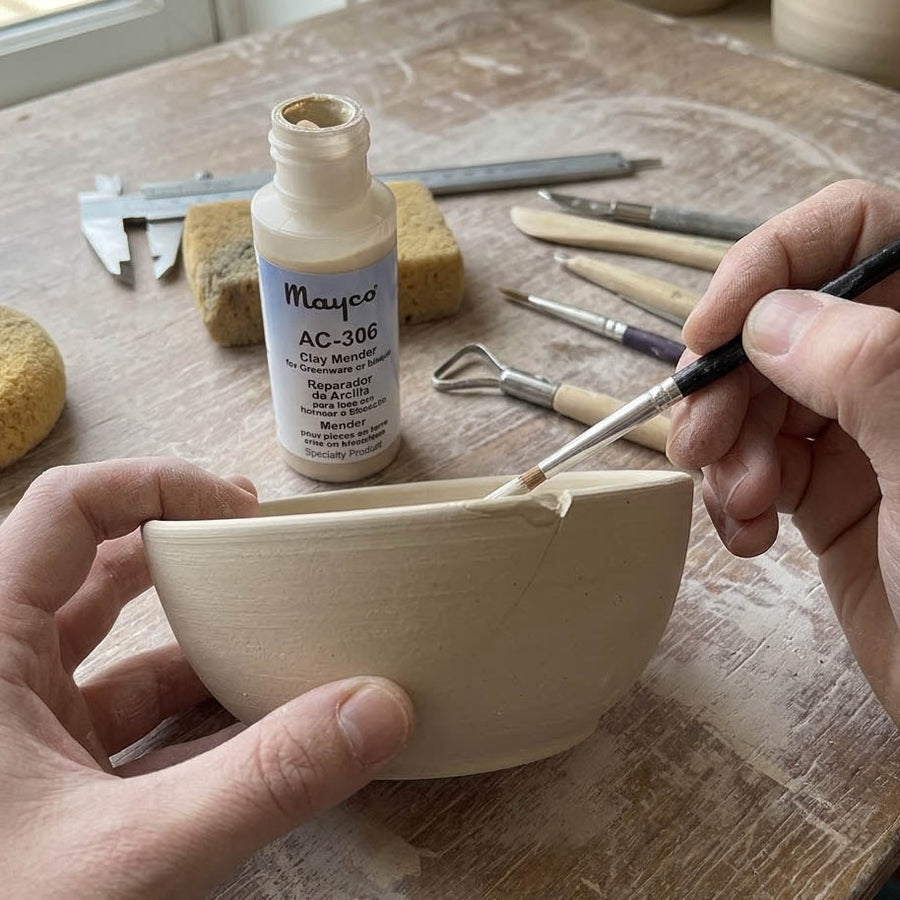
REPAIRS AND ATTACHMENTS
Mayco Clay Mender
For when the handle pops off, the little attachment betrays you, or a crack shows up in the exact spot you spent the most time on.
Clay Mender is an enhanced slip. It grabs harder than the slip you mix in a yogurt cup, it needs no other adhesive, and it is happiest on greenware.
In-studio purchase only. We do not ship any of this. If you are not a member standing in the building, this one is not for you.
How to use it
Five steps. The one people skip is the scoring, and the one that decides whether it holds is the drying.
-
1
Wet the area
A damp brush or a wrung-out sponge on both faces. Damp, not dripping, and definitely not soaked.
-
2
Score both sides
Needle tool, toothpick, fork, the corner of a rib. Scratched-up clay grabs. Smooth clay slides.
-
3
Lay it on thick
A generous coat, not a polite one. Thin Clay Mender is just expensive water.
-
4
Press and hold
Firm pressure for ten to twenty seconds, until it stops wanting to move. Then stop fiddling with it.
-
5
Dry it all the way
All the way. Then sand and smooth the repair before you decorate it.
A wider crack or a hole
Thicken it. Stir in a pinch of your own clay until it is about the consistency of spackle, then fill the gap slowly and let each pass dry before the next one. Support the back of a hole with a scrap of cardboard while you work.
A hairline crack
Open it up first. Widen the crack with a needle tool so there is somewhere for the mender to go, then fill it. Packing Clay Mender onto the surface of a crack you cannot get inside is packing it onto nothing, and hairlines are still the hardest thing on this list.
What it will and will not do
The good version of this product page is the one that stops you losing a piece you cared about, so here is the unflattering half.
ONE BOTTLE LASTS
Because it is only ever meant for small fixes, a 2 fl oz bottle lasts most members a very long time. If you are burning through one, the repair is probably bigger than Clay Mender was built for.
It is slip, not glue
Clay Mender works because it is clay. That means greenware is where it shines. It will join bisque, and people do it all the time, but a bisque joint is always the weaker bet.
It may not match your clay
It often dries a slightly different shade than the body you are using, and glaze does not always sit down over a repair the way it sits down everywhere else. A coat of underglaze over the mend usually evens both problems out.
Rated low fire, and it still holds
Mayco rates Clay Mender to cone 04, which is below the temperature our glaze firings run at. In practice most of our members have had pretty good success with it anyway. Small cracks, fissures, patched holes and small lightweight reattachments have come through the second firing at full temperature holding fine. Anything bigger or heavier is where it gets unpredictable, so ask a staff member if you are unsure about a particular piece.
Big structural repairs are a gamble
Small cracks, fissures, patched holes and small lightweight reattachments: that is the job, and it does that job well. A piece that is currently in three pieces is a different conversation, and one worth having with us before you buy a bottle.
Worth knowing
- In-studio purchase only. We do not ship any of this. If you are not a member standing in the building, this one is not for you.
- No refunds.
- One 2 fl oz bottle of Mayco AC-306. Yours to keep, and it lasts most members a very long time.
- Mayco rates it to cone 04, below our glaze firing temperature. Most members have still had good success with small repairs holding through the second firing at full temperature. Ask a staff member if you are unsure about a particular piece.
- Keep the cap on between repairs. It dries out in the bottle just as happily as it dries on your pot.
- It is not food safe on its own and it is not a substitute for a glaze. It is a repair that then gets fired and finished like the rest of the piece.
- It will not save everything. Nothing does.
Buy it before you need it. Nobody has ever needed Clay Mender at a convenient moment.