
 Pottery Date Night
 Bring All Your Friends Free Week
 Give a Month of Pottery
 Private Pottery Parties

 The Welcome Booklet
 Your First Ten Sessions
 The Pottery Process
 Finding the Studio
 Your Classes Never Expire
 The Four Tables
 Who’s Who
 The Rewards Program
 Flux Glazes
 The Calculators
 Kiln Tracker
 Holiday Kiln Deadlines

 Beginner’s Tool Set
 Fingernail Clippers
 Mayco Clay Mender
 Epoxy for Kintsugi
 Applicator Bottles
 Large Bead Rack
 Raku Workshop
 Nighttime Raku
 Horsehair and Feather Raku
 The Clay Hole T-Shirt
 Embroidered Crewneck
 Zip-Up Hoodie
 Pre-Made Bisqueware
 Glaze Catchers
 Kiln Cookies
 Clay Cubby Rental
 The Glaze Bible, Printed
 The Book of Molds, Printed
 Printable Pottery Guides
 Free Printable Trackers
 Gifts for Potters
 Christmas Pottery Ideas
 Mother’s Day Gift Ideas
 Pottery Date Night
 Studio Calendar
 2027 Studio Events
 What Should I Do Today?
 How to Throw on the Pottery Wheel
 How to Make a Pinch Pot
 How to Tap Center a Pot
 The Five Stages of Clay
 Is Pottery Hard to Learn?
 Pottery Wheel Practice Drills
 20 Easy Hand-Building Projects
 Everything That Sounds Wrong

 A Beautiful Piece, Every Time
 Slab Roller Tips
 Any Dish as a Slump Mold
 Slab Roller & Slab Mold Certification
 The Pottery Skill Tree
 Clay & Pottery Calculators
 Logging Your Pottery and Glazes
 The Pottery Dictionary
 Why Did My Pottery Do That?
 The Pottery Cone Chart
 Pottery Myths, Fact-Checked
 Is Handmade Pottery Food Safe?
 Incredible Ceramic Artist Videos
 How Dan Throws Giant Pots
 How to Dry Your Pottery
 The Pottery Wheel Introduction
 Pottery by Zodiac Sign
 Personality and the Pottery Wheel
 Pottery for Engineers
 ADHD, Hyperfocus, and Never Running Out
 Hobbies for Burnout
 Screen-Free Hobbies for Adults
 Every Addiction I Ever Had Lost to Art
 Functional Pottery Is Engineering
 How Do We Compare?
 Pottery Classes by City
 Every Pottery Studio in Utah
 Pottery in Draper
 Featured Members
 The Signature Wall
 Making Friends as an Adult Is Brutal
 The Clay Hole Commandments
 2027 Pottery Contests
 2027 Studio Parties
 Gallery Night

 Scream It Into the Void
 Destroy the Glaze Wall
 Daily Affirmation Cards
 Everything That Can Go Wrong
 Subscribe to Our Newsletters
 Contact The Clay Hole
 Corporate Team Building

 Glaze Combinations
 Glazes We Do Not Carry
 Making Glaze Test Tiles
 The Mega Glaze Tool
 How to Use the Mega Glaze Tool

 Glaze Brushing Techniques
 How to Use Underglaze
 How to Use Dipping Glazes
 Glaze Problems, Causes and Fixes
 The Dipping Glaze Guide

 Making a Glaze Catcher
 Fused or Sharp After Firing
 The Signature Wall
 His Viral Videos
 His Own Ceramics
 Meet Mud
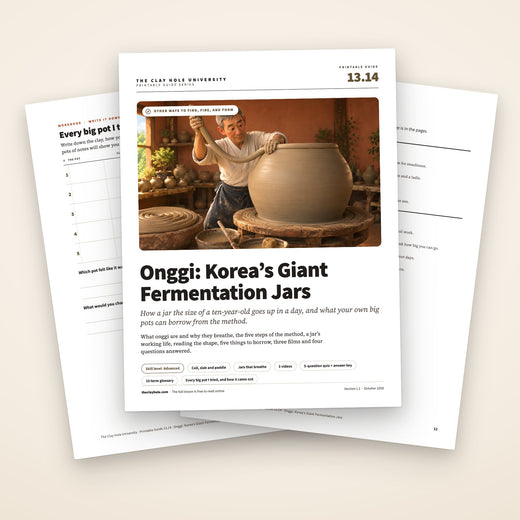
Onggi: the Korean jars that breathe, and the masters who build them in a day.
In courtyards across Korea stand ranks of dark, shoulder-high earthen jars, some older than the houses behind them, quietly fermenting kimchi and soybean pastes the way they have for many centuries. They are called onggi, and they are one of the great pottery traditions on Earth: chest-high vessels built by hand at a speed that looks like a magic trick, from a method so efficient a master raises a jar taller than your kitchen counter in a day. This page is the whole story: what onggi are and why they breathe, how the coil-and-paddle method actually works, and, most usefully, what any potter at any studio can steal from it the next time a big pot is on the table.
Korea’s chest-high fermentation jars, built at impossible speed with slabs, ropes, and a wooden paddle. Below: five lines of tradition, the steal-this checklist, one film for tonight.

Onggi in five lines
- What they are: Korea’s large earthenware fermentation jars, kimchi and the soybean pastes, kept for generations on the household jar terrace, the jangdokdae.
- Why they matter: the fired walls stay micro-porous, so the jars breathe, trading gases while holding liquid, and cooks credit them with flavor no steel tank matches.
- How they are built: a slab floor, then thick ropes and wide slats added course by course, paddled thin against an inner anvil, each tap thinning, compressing, and truing the wall, with every join still scored and slipped. The paddle is why a master raises a chest-high jar in a session.
- Still alive: honored masters work across Korea today, and the method now travels worldwide.
- What to steal: the paddle-and-anvil strike, adding clay in bigger bites, a grogged clay with tooth, and the work-in-courses rhythm; the checklist below turns all four into your next big pot.
Then watch the Lee Kang-hyo film below tonight. The full story is one toggle away.
What onggi are, and why they breathe
An onggi is a large Korean earthenware jar built for fermentation and storage: kimchi through the winter, and the great soybean trinity of doenjang, ganjang, and gochujang ripening through the seasons. Households keep them together on a jangdokdae, a sunny raised terrace of jars that is half pantry, half family monument, tended across generations.
The famous part is that onggi breathe. The traditional clay is coarse and mineral-rich, and the fired wall stays subtly micro-porous under its dark natural glaze, enough for the slow exchange of gases that fermentation loves, while the jar’s sheer mass buffers the temperature swings of a Korean courtyard. Cooks will tell you, with conviction, that jang made in onggi tastes like nothing made in steel or plastic, and researchers have measured gas passing through the wall of an onggi while the helpful bacteria did well inside it. The jar is not a container for the food; it is an instrument in the recipe. Kimjang, the making and sharing of kimchi, sits on UNESCO’s Intangible Cultural Heritage list (2013).
And the tradition is alive, not archival. Onggi masters still work across Korea, several honored as cultural treasures, and the craft has traveled: potters from around the world, including Americans who apprenticed in Korean onggi workshops, now carry the method into studios everywhere, which is exactly how it arrives on this page.
The method: coils, slabs, and the paddle
Watch an onggi master work and the first impression is impossible speed: a jar the size of a ten-year-old goes up in a day. The secret is not hurry. It is a method where every motion does two jobs at once.
- Start from a slab floor on a slow wheel. The base is a thick slab trued on a slow, light kick wheel that acts more like a turntable than a throwing wheel: the potter keeps it turning with a foot while building, and the jar stays center stage.
- Build with heavy ropes and wide slats. Instead of the slender coils most hand-builders know, onggi construction adds clay in thick ropes and broad flattened slabs of clay, whole courses of wall at a time. Each round is joined to the last with firm downward strokes, and suddenly the jar is a hand taller.
- The paddle does the real throwing. Here is the heart of it: a wooden paddle outside strikes against a curved anvil held inside, and the blows do everything at once, thinning the thick wall, compressing the clay into strength, truing the curve, and tightening every scored and slipped joint from the outside. Paddling turns rough added clay into a finished wall faster than pulling ever could, which is the entire speed trick.
- Rhythm is the tool you cannot buy. Masters work in a steady percussion, wheel turning, paddle answering anvil, that keeps the wall even without measuring anything. The rhythm is decades of practice compressed into sound, and it is why watching the videos below feels like watching music.
- Glazed dark, traditionally in ash. The classic finish is a natural glaze built on wood ash and clay, fired in long wood kilns to that deep brown-black onggi shine. The glaze coats the jar without sealing away the breathing that makes it an onggi.
A jar’s working life
An onggi is a working appliance with a career measured in decades, and the way Koreans live with them says as much about pottery as the way they are made.
- The jangdokdae is the point. Jars live outdoors on their terrace through summer heat and hard frost, lids on, contents alive. A vessel that shrugs off decades of freeze and ferment in the open is a masterclass in durable making.
- Each ferment gets a loyal jar. Households traditionally dedicate jars: this one has made soy sauce for thirty years and will not be switching careers, because the jar itself becomes seasoned to its job. Pottery as a family member, not a purchase.
- Scale is function, not flex. A winter’s kimchi for a family is a genuinely enormous volume, and the jars are exactly as big as that math demands. Every giant pot in history got big for a reason; onggi just kept theirs.
- Care is simple and serious. Sun on the terrace, rinses between seasons, lids managed daily with the weather. The tradition treats maintenance as part of the recipe, which is a habit worth importing along with the pots.
Reading an onggi like a potter
Once you know the job, every curve on an onggi starts explaining itself, and that habit of reading form as function is worth more than any single technique on this page.
- The swollen belly is capacity doing its math: a winter of kimchi for a whole household, held low where the mass steadies the jar and buffers the temperature.
- The generous mouth is a working opening, wide enough for two arms, a gourd ladle, and the seasonal rituals of packing and pressing, then narrow enough at the rim to manage evaporation.
- The rolled rim does double duty, seating a heavy lid against the weather and giving a tied cloth cover something to grip during open-air fermentation days.
- The paddled wall wears its making on its skin: the faint facets and combed bands are compression made visible, structure and decoration in the same stroke.
- The regional accent is real: silhouettes shift province to province with climate and custom, from taller, tighter-mouthed jars in colder regions to rounder, fuller forms in the warm south. A trained eye can guess a jar’s home from its shoulders.
What to steal for your own big pots
You do not need a Korean kiln to profit from the onggi mindset. Every technique below transplants straight into a member’s big-pot practice, and together they are the fastest cure for the timid-tall-pot problem. Tap them off as you try them; the list remembers your progress on this device.
Three films worth your evening
One film worth your evening
A documentary about Lee Kang-hyo, a celebrated Korean potter who joins onggi building with painted decoration, building three giant pots over five days. Thirty-five minutes that change how your hands think about scale.
This is the rare page where the videos outrank the words, because onggi is a rhythm before it is a recipe, and rhythm has to be seen. So watch generously, then come back to the method section and the words will suddenly describe things your eyes already know. Reading still earns its keep here: it hands you the why, the vocabulary, and the steal-this list no film narrates.
The ones we get asked at the studio
Can I make a real onggi at the studio?
You can make an onggi-method jar, absolutely: the coil-and-paddle construction, the forms, and the scale thinking all translate straight into our stoneware bodies and cone 5½ glaze firings, and the result is a sturdy, handsome jar. Staff load every kiln here, and a jar has to fit the kiln, so ask the studio team how big you can go before you build. A thick paddled wall and a thick base dry slowly, so plan on weeks, not days, because water left in thick clay turns to steam in the kiln. Big pots also take more kiln space, so they cost more to fire, and a kiln cookie goes under every piece. Our sectional pots lesson has the clay math. The complete tradition, its specific regional clays, leached-ash glazes, and long wood firings, lives in Korea’s onggi workshops, and the films above are the place to see it. Build the method here; save the pilgrimage for the tradition.
If onggi breathe, do they leak?
No, and the distinction is lovely: breathing is gas exchange through micro-pores, while leaking is liquid finding a channel, and a well-made onggi does the first without the second. The dark glaze and the dense paddled wall hold brine and soy sauce for decades; mostly gases pass, with a little slow evaporation. A modern stoneware jar fired to maturity sits at the other end of the spectrum, absorbing very little, which is exactly what you want for everything except traditional fermentation.
Why paddle a pot instead of throwing it?
Above a certain size, paddling simply wins. A thrown wall must support its own wet weight the whole climb, which is why giant thrown pots get built in stages; a paddled wall arrives thick and gets compressed thin in place, gaining strength from every blow. Paddling also tightens scored and slipped joints from the outside and trues curves by feel, so one tool does the work of three. For chest-high jars it is the fastest honest method humans have found.
Could I ferment in a jar I make here?
Yes, happily: a fully vitrified stoneware jar with a fitted lid makes an excellent modern fermentation vessel for kimchi, krauts, and pickles; it just ferments without the breathing of an onggi, so use a lid that sits loose or a water seal, never one clamped tight. Choose a liner glaze from the Food Safe Lookup, test a tile with vinegar overnight (a change means no, and no change is still not proof), and read our food-safe claims page before promising anyone pickles.
Where this leads next
Big pots need a big room
Paddle work, tall coil builds, and jars with ambition all want space, shelves, and kilns that can keep up. A Clay Hole membership gets you the electric wheels, first come, first served (the kick wheel opens at Purple Level), the hand-building tables, the classes, and the kilns, plus people who will absolutely gather when your first big jar comes off the shelf. Green, Yellow, Purple or Black, whichever fits how often you can get here.
Every video on this page belongs to the potter or filmmaker who made it, and none of them are ours. We link them because they are excellent. The player and its cookies wait until you press play; the only thing that loads while you read is each video’s still frame.
Which version would you like to print?
Videos come out as a labeled box with the title and channel to search for, since paper does not play them.