
 Pottery Date Night
 Bring All Your Friends Free Week
 Give a Month of Pottery
 Private Pottery Parties

 The Welcome Booklet
 Your First Ten Sessions
 The Pottery Process
 Finding the Studio
 Your Classes Never Expire
 The Four Tables
 Who’s Who
 The Rewards Program
 Flux Glazes
 The Calculators
 Kiln Tracker
 Holiday Kiln Deadlines

 Beginner’s Tool Set
 Fingernail Clippers
 Mayco Clay Mender
 Epoxy for Kintsugi
 Applicator Bottles
 Large Bead Rack
 Raku Workshop
 Nighttime Raku
 Horsehair and Feather Raku
 The Clay Hole T-Shirt
 Embroidered Crewneck
 Zip-Up Hoodie
 Pre-Made Bisqueware
 Glaze Catchers
 Kiln Cookies
 Clay Cubby Rental
 The Glaze Bible, Printed
 The Book of Molds, Printed
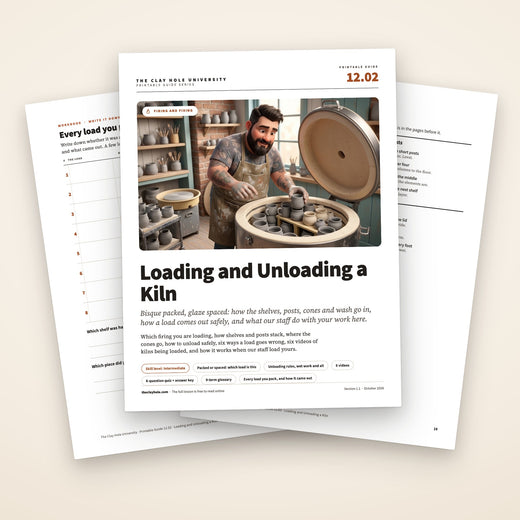
 Printable Pottery Guides
 Free Printable Trackers
 Gifts for Potters
 Christmas Pottery Ideas
 Mother’s Day Gift Ideas
 Pottery Date Night
 Studio Calendar
 2027 Studio Events
 What Should I Do Today?
 How to Throw on the Pottery Wheel
 How to Make a Pinch Pot
 How to Tap Center a Pot
 The Five Stages of Clay
 Is Pottery Hard to Learn?
 Pottery Wheel Practice Drills
 20 Easy Hand-Building Projects
 Everything That Sounds Wrong

 A Beautiful Piece, Every Time
 Slab Roller Tips
 Any Dish as a Slump Mold
 Slab Roller & Slab Mold Certification
 The Pottery Skill Tree
 Clay & Pottery Calculators
 Logging Your Pottery and Glazes
 The Pottery Dictionary
 Why Did My Pottery Do That?
 The Pottery Cone Chart
 Pottery Myths, Fact-Checked
 Is Handmade Pottery Food Safe?
 Incredible Ceramic Artist Videos
 How Dan Throws Giant Pots
 How to Dry Your Pottery
 The Pottery Wheel Introduction
 Pottery by Zodiac Sign
 Personality and the Pottery Wheel
 Pottery for Engineers
 ADHD, Hyperfocus, and Never Running Out
 Hobbies for Burnout
 Screen-Free Hobbies for Adults
 Every Addiction I Ever Had Lost to Art
 Functional Pottery Is Engineering
 How Do We Compare?
 Pottery Classes by City
 Every Pottery Studio in Utah
 Pottery in Draper
 Featured Members
 The Signature Wall
 Making Friends as an Adult Is Brutal
 The Clay Hole Commandments
 2027 Pottery Contests
 2027 Studio Parties
 Gallery Night

 Scream It Into the Void
 Destroy the Glaze Wall
 Daily Affirmation Cards
 Everything That Can Go Wrong
 Subscribe to Our Newsletters
 Contact The Clay Hole
 Corporate Team Building

 Glaze Combinations
 Glazes We Do Not Carry
 Making Glaze Test Tiles
 The Mega Glaze Tool
 How to Use the Mega Glaze Tool

 Glaze Brushing Techniques
 How to Use Underglaze
 How to Use Dipping Glazes
 Glaze Problems, Causes and Fixes
 The Dipping Glaze Guide

 Making a Glaze Catcher
 Fused or Sharp After Firing
 The Signature Wall
 His Viral Videos
 His Own Ceramics
 Meet Mud
Firing and fixing · Loading and unloading a kiln
Shelves, posts, clearances and what can touch what.
Bisque and glaze firings want opposite things from you: a bisque load is packed and nested, a glaze load is spaced a finger’s width from everything. Under both, the same skeleton: three posts in columns, an inch from the wall, a cone on two shelves, and nothing opened above 200 degrees. Our staff load ours; this page is for a kiln of your own.
Four steps with a tick list at each: which firing, shelves and posts, cones and wash, and unloading. Six things that go wrong, and six videos of kilns being loaded.
This is the short version: bisque against glaze, the posts, the cones, the unload, each with a tick list. The reasoning, the packing notes and the questions are in the comprehensive version.

Read it, then watch it
Why this is written down and filmed, both.
Loading a kiln is rules and a feel for a three-dimensional puzzle. The rules, three posts, an inch from the wall, a quarter inch between glaze, bisque can touch and glaze cannot, cones on two shelves, are a list a page holds. The puzzle, how a production potter fits sixty mugs into a load without a wasted inch, is a thing you watch. Our staff load our kilns, so this page is written for a kiln of your own, and for members who want to know why the drop-off rules exist.
Use both, in this order
Read the rules for the firing you are loading, bisque or glaze, because they are opposite. Watch a load of that kind packed. Then load with the tick list next to the kiln.
The whole idea
Bisque is packed. Glaze is spaced. Everything sits on three posts, an inch from the wall.
Bare clay can touch bare clay, so a bisque load is stacked and nested. Glazed clay is liquid glass at temperature, so a glaze load has a finger’s width around every piece, on cookies, naked bottoms. Three matched posts in columns to the floor, the bottom shelf off the floor, an inch from the wall, a cone on two shelves, nothing opened above 200 degrees. Our staff load ours.
The five-minute version
The whole load in six moves.
If you have loaded a kiln before and you just want the shape of it, this is the shape of it. Everything below is these six moves, slowed down and with the places they fail marked.
Before the first shelf
What you need at the kiln.
Six things, and one of them is a plan. More posts than you think is the advice every potter gives after their first load.
Shelves and plenty of posts, kiln wash on the shelf tops, witness cones, cookies and catchers, gloves and a diamond pad, and a loading plan.
Step one
Decide which firing this is, because the two loads are opposites.
Bisque is packed. Glaze is spaced. In a bisque every piece is bare clay, and bare clay can touch bare clay: stacked, nested, rim to rim, foot to foot, lids on. In a glaze firing every glazed surface is liquid glass at the top, and anything it touches, it joins: a finger’s width from every neighbor and post, an inch from the wall, on a cookie, naked bottom.
Loading a bisque
Stack and nest, with two rules: nothing heavy on anything thin, and nothing wedged so tightly it cannot shrink, because clay shrinks in the bisque and a bowl jammed inside a bowl cracks both. Rim to rim for bowls, foot to foot for mugs, plates in short stacks, lids on. Packed close is fine; packed solid, with no route for heat and steam, is not. Packing a bisque well is a skill, and Florian Gadsby’s and ClayShare’s videos below show it being done.
Loading a glaze
A quarter inch between glazed pieces is the minimum; a finger’s width is the habit. Nothing glazed touches a post, a wall, a neighbor or the shelf; every piece stands on a cookie with a bare foot, and anything that might run stands in a catcher. Lids only if the seat is bare and waxed both sides. Jonthepotter’s video loads a glaze firing in its last two minutes.
Both firings share the rest: dry work only, an inch from the wall, three posts, a cone. The bisque is where things explode, because it is the firing that meets water; the glaze is where things fuse, because it is the firing that makes glass. Our firing lesson, What a Firing Actually Does, is the reasoning under both.
Step two
Bottom shelf on short posts, heavy things low, three posts in columns.
The first shelf sets up every shelf above it. It sits on short posts, never on the floor, so heat moves under it and the floor bricks are protected. Three posts, the same height, an inch from the wall, and a shelf that is level when you press each corner.
Then the load goes up in columns. Every shelf sits on three posts, never four, because three points always sit flat and four rock. Each set of three sits directly above the three below, all the way to the floor, so the weight travels down through posts and not through the middle of a shelf. Half shelves let one side of the kiln run tall while the other runs short, and a load with a few half shelves fits more than one with full ones.
Heavy, dense pieces go low and delicate ones go high. Tall pieces go in the middle of a shelf, never at the edge, because the edge is where the elements are; an inch from the wall is the rule for everything and the thermocouple gets a hand’s width. Measure the tallest piece before the shelf above it goes on, because a shelf set an inch too low will not clear the piece and the layer is wasted, and a shelf set an inch too high wastes an inch you could have used.
Step three
Cones on two shelves, kiln wash on the tops, and the lid down.
The controller reads a thermocouple. The cone reads the firing. A witness cone bends when it has received a certain amount of heat over time, which is what a glaze cares about. One set on the bottom shelf and one on the top tell you whether the kiln fired evenly and told the truth.
A set is three cones: the one you fire to, one below it, and one above. The lower one bending first says you are close; the target bending says done; the upper one staying upright says not over. A cone pack in every load is how a potter knows the elements are aging before the pots say so, and it is the first thing to look at when a load comes out wrong.
Kiln wash goes on the top face of every shelf, never the bottom or the edges, and gets patched whenever a drip has been ground off. A washed shelf lets a small drip chip away; a bare shelf is a permanent home for it. Then the lid down, the peepholes plugged the way the kiln’s maker says, and the schedule set. Our kilns fire cone 05 for bisque and cone 5½ for glaze; yours fires whatever your clay and glaze were made for.
Step four
Unloading has rules of its own: under 200, gloves, and a fingertip run round every foot.
Nothing opens above 200 degrees Fahrenheit. Crack the lid an inch at 200, open it all the way and unload at 150. A kiln opened hot hits its load with cold air, and the pots cool too fast; a plate with a thick base and a thin rim is the first to crack. Patience is free and plates are not.
Then gloves, because a warm kiln is still warm, and a fingertip run round every foot once the pot is cool to the touch: a glazed pot that picked up a grain of sand, a kiln wash flake or a neighbor’s drip has a foot that catches on a table, and a diamond pad kept wet, with safety glasses and an N95 or better on, takes it off in a minute. Read the cones before you move the shelves. Drips get ground off shelves wet, never dry, with safety glasses and an N95 or better on, and the wash patched before the shelf goes back in.
Bisque comes out chalky, rings when tapped, and goes straight to a shelf, not a wet table. Glaze comes out with a naked foot that might have a bump on it and a glaze that might have done something the diagnostic in our glaze problems lesson can name. Then the shelves get a HEPA vacuum or a damp sponge, never a dry sweep, the posts sorted by height, and the next load starts with the bottom shelf.
Watch it done
Now watch six videos of kilns being loaded.
Watch this one, then go count your posts.
None of these makers work here. Between them they cover loading from the bottom shelf up: a kiln maker’s three minute overview, a bisque packed and unpacked, bisque loading tips, a look at kiln shelves that ends with a glaze load, the bottom shelf, and stacking a bisque in full. Nothing but the still frame loads until you press play.
A kiln maker’s three minute walk through loading greenware and glazed ware. The other five videos are in the comprehensive version.
When it goes wrong
Six ways it goes wrong, and what to do about each.
The three failures that happen on the first load.
Pick the one that looks like your kiln. The first three are spacing, water and airflow.
Two glazed pots fused together or to the shelf
They touched, or a glaze ran. In a glaze firing every glazed surface is liquid glass at the top, and anything it touches, it joins. A quarter inch is the minimum gap.
A finger’s width between every glazed piece and its neighbor and its shelf post, an inch from the wall. Naked bottoms on cookies. A catcher under anything that runs.
Our fused pottery lesson. Sometimes a light tap, with safety glasses on, separates them; usually a wet diamond pad does the rest, with an N95 or better on, and the shelf gets ground wet and rewashed.
A piece exploded and took its neighbors with it
Water. A piece that was not dry all the way through, or was thick and hollow with no vent, turned its trapped water to steam. It is never air, and it almost always happens in a bisque firing.
Every piece bone dry all the way through before it goes in. The cheek test only reads the surface, so give thick work extra days. A small vent hole in every hollow form. A slow first ramp on a bisque, candling overnight for anything thick.
Shards out, shelves wiped damp or HEPA vacuumed, the neighbors inspected for chips, and the next load gets a slower start.
The top fired hotter than the bottom, or the middle underfired
Airflow and mass. A kiln packed solid in the middle with no gaps for heat to move, or a bottom shelf on the floor, or a lid propped wrong, fires unevenly. Elements age unevenly too.
Gaps between shelves and the wall, staggered posts, the bottom shelf on short posts off the floor, and heavy dense pieces low. Witness cones on more than one shelf tell you what actually happened.
Read the cones. Refire the underfired ones. If it is the elements, that is a repair, not a loading problem.
A shelf wobbled or tipped
Posts not matched in height, or not stacked one above another through the load, or a warped shelf on three posts that did not agree.
Three posts per shelf, the same height, placed directly over the three below them so the load runs in columns to the floor. A warped shelf gets flipped each firing or retired.
Unload it and start that shelf again. A shelf that tips at temperature takes a load with it.
A pot touched the elements or the thermocouple
Loaded too close to the wall. A pot against an element ruins the pot and can break the element; a pot against the thermocouple lies to the controller about the temperature.
An inch from the wall for everything, and a hand’s width around the thermocouple. Tall pieces in the middle of a shelf, never at the edge.
The pot is probably fine if it was bisque and probably fused if it was glaze. Check the element for damage before the next load.
You opened it too early and things cracked
Thermal shock. A kiln opened above about 200 degrees Fahrenheit hits the pots with cold air, and the pots cool too fast. The crack you see is a plate that could not take it. Pings and fine cracks in the glaze are crazing, a fit problem between glaze and clay that opening early does not cause (our glaze problems lesson covers it).
Under 200 degrees before the lid opens even a crack, and under 150 before it opens wide. Peeking with the kiln at 400 is how plates split.
Whatever cracked is cracked. The rest of the load is fine. Close the lid and wait next time.
How it works here
At The Clay Hole, our staff load and unload every kiln.
This page is written for potters with a kiln of their own. Here is what happens to your work between the drop-off table and the pickup shelf, and why the rules are what they are.
Three things to know here
Our staff load and unload every kiln; members put dry, finished, paid work on the drop-off tables and collect it from the pickup shelves. Every drop-off rule is a loading rule from this page: bone dry, a bare foot on a cookie or catcher every time (no cookie, no firing), a kiln ticket on glaze work. Bisque is cone 05 and free; glaze is cone 5½ at 5 cents a cubic inch, paid before drop-off.
The drop-off table
Bone dry, because a damp piece explodes in the bisque and takes its neighbors. For a glaze firing, a bare foot and a kiln cookie or glaze catcher under every piece, every time, no exceptions: no cookie means no firing, because a glazed foot fuses to a shelf. A kiln ticket with your order number on glaze work, so it comes back to you; bisque needs no ticket and costs nothing. Every one of those is a loading rule from this page, seen from the other side.
Why staff load
A kiln load is dozens of members’ work packed by a staff member who knows our kilns, and one badly placed pot can cost everyone on the shelf. Loading is a craft of its own, and here it is a staff craft. This page is so you know what they are doing and why your piece came back the way it did.
Firing and pickup
Bisque is cone 05 and free. The glaze firing is cone 5½ at 5 cents a cubic inch, $4.80 minimum, paid before the piece goes on the drop-off table. Fired work comes back to the pickup shelves; take it home within two weeks, because the shelves are shared.
Your own kiln
If you have one, every rule on this page applies to it, and the videos show kilns being loaded in other makers’ studios. Pots made here from our clay can go home bone dry to your own kiln, as long as both firings happen there, because our free bisque is paid for by other members’ glaze firings. Pots for our kilns are made from our clay, because a body we do not know at cone 5½ is a body that can spit on somebody else’s work.
Questions people actually ask
The ones that come up every week.
What is the difference between loading a bisque and loading a glaze?
Bisque is bare clay, and bare clay can touch bare clay: pieces can be stacked, nested, rim to rim, foot to foot, a bowl inside a bowl, as long as nothing heavy sits on anything thin and nothing is wedged so it cannot shrink. Glaze is liquid glass at temperature, and nothing glazed can touch anything: a finger width from every neighbor and post, an inch from the wall, on a cookie, with a naked bottom. Bisque is packed; glaze is spaced.
How far apart do things go?
A quarter inch between glazed pieces is the minimum and a finger’s width is the habit. An inch from the kiln wall for everything, in both firings. A hand’s width around the thermocouple. Between shelves, an inch above the tallest piece on the shelf below.
How do posts work?
Three per shelf, never four, because three points always sit flat and four rock. The same height as each other. Placed directly above the three posts on the shelf below, so every column of posts runs straight to the floor and the weight goes down through the posts, not the shelves. Half shelves let you stagger heights on each side.
Can lids fire on their pots?
In the bisque, usually, so they shrink together and fit. In the glaze firing, only if the seat is bare on both sides, waxed and cleaned, so the lid does not fuse to the pot. Many potters glaze fire lids on for fit and accept the wax work that takes.
What are cones for?
Witness cones are small pyrometric cones set on the shelf that bend when they have received a certain amount of heat over time, which is what matters to a glaze. The controller reads a thermocouple; the cone reads the firing. A cone on the bottom shelf and one on the top tell you whether the kiln fired evenly, and a cone in every load is how a potter knows the kiln is telling the truth.
When can I unload?
Not until the kiln reads 150 degrees Fahrenheit or less. Crack the lid an inch at 200, open it all the way and unload at 150. A kiln opened hot cracks its own load. Patience is free and plates are not.
Who loads the kilns at The Clay Hole?
Our staff, every load, bisque and glaze. Members put finished, dry, paid work on the drop-off tables and pick it up from the pickup shelves, and the whole of this page is what happens in between. It is written for potters with a kiln of their own, and for members who want to know why the drop-off rules are what they are.
Related lessons
Six lessons that sit next to this one.
Three to read next.
A kiln load is drying, catchers and glaze fit seen from the shelf. These are the pages on either side.
That is the whole load
Bisque packed. Glaze spaced. Three posts in columns. Cones on two shelves. Nothing opened above 200.
Your first load will have a shelf an inch too low and a mug you forgot to give a cookie, and the second will have a plan taped to the kiln. That is how everyone learns it, including the people who load ours. If you never own a kiln, now you know why the drop-off table asks what it asks.
If you want the reasoning, the stacking notes, the cone detail and the answers to the questions everybody asks, switch to the comprehensive version at the top. Otherwise, go count your posts.
Written for potters everywhere. Where our studio does things differently, the page says so.
Which version would you like to print?
Both print clean, with the videos turned into labeled boxes you can search for later.