
 Pottery Date Night
 Bring All Your Friends Free Week
 Give a Month of Pottery
 Private Pottery Parties

 The Welcome Booklet
 Your First Ten Sessions
 The Pottery Process
 Finding the Studio
 Your Classes Never Expire
 The Four Tables
 Who’s Who
 The Rewards Program
 Flux Glazes
 The Calculators
 Kiln Tracker
 Holiday Kiln Deadlines

 Beginner’s Tool Set
 Fingernail Clippers
 Mayco Clay Mender
 Epoxy for Kintsugi
 Applicator Bottles
 Large Bead Rack
 Raku Workshop
 Nighttime Raku
 Horsehair and Feather Raku
 The Clay Hole T-Shirt
 Embroidered Crewneck
 Zip-Up Hoodie
 Pre-Made Bisqueware
 Glaze Catchers
 Kiln Cookies
 Clay Cubby Rental
 The Glaze Bible, Printed
 The Book of Molds, Printed
 Printable Pottery Guides
 Free Printable Trackers
 Gifts for Potters
 Christmas Pottery Ideas
 Mother’s Day Gift Ideas
 Pottery Date Night
 Studio Calendar
 2027 Studio Events
 What Should I Do Today?
 How to Throw on the Pottery Wheel
 How to Make a Pinch Pot
 How to Tap Center a Pot
 The Five Stages of Clay
 Is Pottery Hard to Learn?
 Pottery Wheel Practice Drills
 20 Easy Hand-Building Projects
 Everything That Sounds Wrong

 A Beautiful Piece, Every Time
 Slab Roller Tips
 Any Dish as a Slump Mold
 Slab Roller & Slab Mold Certification
 The Pottery Skill Tree
 Clay & Pottery Calculators
 Logging Your Pottery and Glazes
 The Pottery Dictionary
 Why Did My Pottery Do That?
 The Pottery Cone Chart
 Pottery Myths, Fact-Checked
 Is Handmade Pottery Food Safe?
 Incredible Ceramic Artist Videos
 How Dan Throws Giant Pots
 How to Dry Your Pottery
 The Pottery Wheel Introduction
 Pottery by Zodiac Sign
 Personality and the Pottery Wheel
 Pottery for Engineers
 ADHD, Hyperfocus, and Never Running Out
 Hobbies for Burnout
 Screen-Free Hobbies for Adults
 Every Addiction I Ever Had Lost to Art
 Functional Pottery Is Engineering
 How Do We Compare?
 Pottery Classes by City
 Every Pottery Studio in Utah
 Pottery in Draper
 Featured Members
 The Signature Wall
 Making Friends as an Adult Is Brutal
 The Clay Hole Commandments
 2027 Pottery Contests
 2027 Studio Parties
 Gallery Night

 Scream It Into the Void
 Destroy the Glaze Wall
 Daily Affirmation Cards
 Everything That Can Go Wrong
 Subscribe to Our Newsletters
 Contact The Clay Hole
 Corporate Team Building

 Glaze Combinations
 Glazes We Do Not Carry
 Making Glaze Test Tiles
 The Mega Glaze Tool
 How to Use the Mega Glaze Tool

 Glaze Brushing Techniques
 How to Use Underglaze
 How to Use Dipping Glazes
 Glaze Problems, Causes and Fixes
 The Dipping Glaze Guide

 Making a Glaze Catcher
 Fused or Sharp After Firing
 The Signature Wall
 His Viral Videos
 His Own Ceramics
 Meet Mud
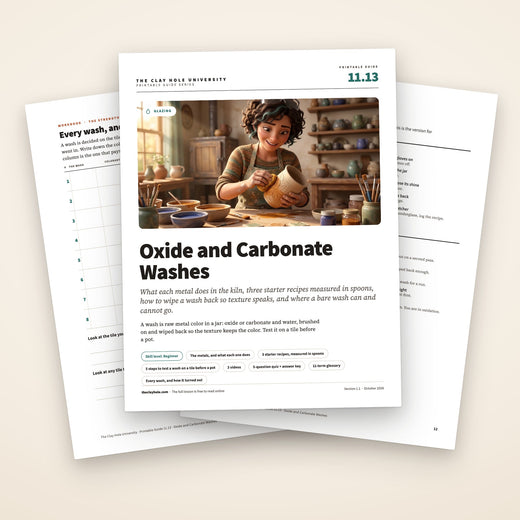
Oxide and carbonate washes: the oldest trick in the glaze room.
Before there were hundreds of brush-on glazes on anybody’s shelves, potters colored their work with the raw stuff: metal oxides and carbonates mixed with little more than water, rubbed into texture, brushed on like ink, and fired into permanence. Washes are still the cheapest, most direct line between you and dramatic surfaces, they make carved and stamped texture jump like nothing else, and they behave in ways worth understanding before you aim one at a pot you love. This page is the working guide: what each oxide actually does, three starter recipes measured in spoons, how to apply a wash so it flatters instead of muddies, and the atmosphere question answered for our kilns.
Raw metal color in a jar: oxides and water, rubbed into texture or brushed like ink, fired into permanence. Below: the cast in miniature, three spoon recipes, the drill, one video.

Washes in five lines
- A wash is pure pigment, a metal oxide or carbonate in water, that borrows its glass from clay or glaze; it colors but never seals.
- The cast in miniature: iron is the warm workhorse; cobalt a tyrant, always tiny-batch; copper goes green here; rutile mottles; manganese bronzes and needs the most care; every dry oxide earns a fitted respirator while mixing, and the studio team clears anything you bring in before you mix.
- Our electric kilns fire in oxidation, so the oxidation column of any oxide chart is the one that predicts your results at cone 5½.
- The signature move is the wipe-back: flood textured bisque, sponge the highs clean, and every carve and stamp keeps the color.
- Bare wash never touches food surfaces; under a fitted clear glaze it can go inside too, once the Food Safe Lookup clears that glaze.
The recipes and the five-step drill are just below, whole in both versions; the full cast and craft are one toggle away.
What a wash is, and what it is not
A wash is a colorant suspension with almost nothing in it: a metal oxide or carbonate, water, and sometimes a little melter, from a pinch up to half the dry mix, to help it grip. That emptiness is the point. A glaze is a complete glass recipe that happens to carry color; a wash is pure pigment that borrows its glass from wherever it lands, the clay surface itself or a glaze layered over it.
The practical consequences follow straight from that: a wash will not seal or waterproof anything on its own, it stays close to the surface where texture can grab it, and it concentrates in every recess you give it, which is why carvers, stampers, and sgraffito people treat washes as a food group. It also means a wash is only ever half of a finished surface. The other half is your decision: leave it raw and dry on sculptural outside surfaces, or trap it under or over a glaze and let the two argue beautifully in the fire.
The oxide cast, one metal at a time
Each metal has a personality, and each one behaves differently depending on the kiln’s atmosphere, oxygen-rich oxidation versus oxygen-starved reduction. Each entry says what happens in oxidation and in reduction where it matters; the atmosphere section below explains which one applies here.
- Red iron oxide, the workhorse. In oxidation: honey, amber, rust, and toasted brown, warm and forgiving, gorgeous wiped back over texture. In reduction it turns moody, feeding celadon greens and tenmoku blacks. Cheap, forgiving, and the first oxide wash to try.
- Black iron and yellow ochre, the cousins. Coarser or earthier iron sources that read softer and speckle more; treat them as seasoning variations on the workhorse.
- Copper carbonate, the chameleon. Oxidation: greens from spring leaf to blackened bronze depending on strength and the glaze above. Reduction: the famous blood reds and flashed pinks. Strong and a little runny-tempered under fluid glazes.
- Cobalt carbonate, the tyrant. Blue in nearly any atmosphere and shockingly powerful: a wash that looks like weak tea fires like midnight. Always the smallest recipe, always tested first, magnificent as inky brushwork.
- Manganese dioxide, the bronze-maker. Browns, plums, and metallic bronze effects, especially where it pools. Manganese carries the strongest warnings, so be strictest with it, but every dry oxide and carbonate here needs a fitted respirator (an N95 at the least) on before the jar opens, plus gloves, wet cleanup and never a broom. Keep manganese-heavy work modest, wash your hands before you touch your face or your lunch, and talk to the studio team before you mix, because anything you bring in has to be cleared before it goes into a kiln.
- Rutile, the weathermaker. Titanium-and-iron ore that gives tans, creams, and mottled variegation, and famously stirs up any glaze laid over it. Less a color than a special effect.
- Chrome oxide, the stubborn green. Opaque, forceful, refuses to budge in any atmosphere, and famous for one party trick: near tin-white glazes it can turn another member’s pot pink in a shared kiln. Use sparingly and tell us at drop-off.
- Nickel oxide, the mutterer. Muted grays, browns, and olive tones that never shout; the cast member you reach for when everything else feels too loud.
Three starter recipes, measured in spoons
Washes forgive imprecision, so these are ratios, not rituals. Mix small, label everything, and let test tiles be the judge.
- The classic iron wash. Equal parts red iron oxide and water by volume, then keep thinning with water until it moves like skim milk, and judge it on a tile. Brushes like watercolor, wipes back like a dream, and layers under most glazes without drama. With no melter it can dust off a bare pot. Under a glaze that matters less, but a powdery wash can still make the glaze crawl.
- The stay-put wash. Half oxide, half Frit 3134 by volume, plus water to that same skim-milk feel. The frit melts just enough in the fire to glue the color down, so it stops dusting off bisque and stops crawling under glazes. A favorite for handling reasons alone.
- The cobalt ink. One teaspoon cobalt carbonate to four to six teaspoons water, mixed in a cup, not a bucket. Keep the spoons and the cup for oxides only, and never return them to the kitchen. This is brushwork strength: lines, calligraphy, and shadows. If you want fields of blue, dilute it further and sneak up on it.
Then run the drill before any real pot. Tap each step off; the list remembers your progress on this device.
Application: where washes earn their keep
- The wipe-back is the signature move. Brush wash generously over textured bisque, let it lose its shine, then sweep the high surfaces clean with a barely damp sponge. Color stays trapped in every stamp, carve, and tool mark, and suddenly your texture has a hundred percent more opinion. Pairs perfectly with everything on our texture imprinting page.
- Brushwork reads like ink. Thin washes behave like watercolor: strokes, splatters, and calligraphy that keep their gesture in the fire. Cobalt ink on pale clay is the whole history of blue-and-white pottery in one move.
- Under glaze or over glaze, different arguments. Wash under a transparent glaze stays crisp and sealed in; wash brushed over an unfired glaze melts into it, softening, haloing, and sometimes running. Both are legitimate; test both; label which was which.
- Bare wash is an outside-only finish. Unglazed wash on fired clay is beautiful, dry, and slightly raw, right for sculpture and the outsides of planters, wrong for anything that touches food. Keep bare washes off eating surfaces. Under a fitted clear glaze a wash can go inside too, but the glaze is what makes the surface safe, so check it in the Food Safe Lookup. The full logic lives on our food-safe claims page.
- Strength is a dial, not a setting. Every wash can be brushed weak like tea or built strong like espresso, and the same jar does both. When in doubt, apply thin and add a second pass; a too-strong metallic crust is much harder to walk back.
Oxidation, reduction, and what our kilns do
Every oxide chart you will ever read has two columns because kilns come in two moods. In oxidation, the kiln has all the oxygen it wants and metals keep their calm, predictable colors. In reduction, a fuel-burning kiln is starved of air on purpose, and oxygen-hungry flames pull it straight out of the metals, flipping copper to red, iron toward celadon, and surfaces toward drama, which is why reduction potters age faster and grin wider.
Our electric kilns fire in oxidation, bisque and the cone 5½ glaze fire alike, so the oxidation column is the one that predicts your results here. That is not a consolation prize: oxidation is repeatable, honest, and exactly why your test tiles will still tell the truth next month. Read the reduction column the way you read travel writing, then go make gorgeous work in the atmosphere you actually have. And the fuller story of what any firing does to clay and color lives on our kiln firing page.
Three videos worth your evening
One video worth your evening
A blue wash mixed, put on several ways and fired on test tiles, with results that explain the appeal faster than any paragraph.
One results tour that will sell you on washes in about eleven minutes, one recipe deep-dive, and one focused iron-wash tutorial. A note on why the page is mostly words anyway: video shows you a wash moving under a brush; reading is what hands you the recipes, the per-metal cast list, and the food-surface rules. Watch for the feel, read for the numbers.
The ones we get asked in the glaze room
Oxide or carbonate: which form should I buy?
Chemically they deliver the same metal; practically, carbonates are usually finer, paler in the jar, and a touch gentler to disperse, while oxides are denser and stronger per spoonful. The cobalt ink is written for cobalt carbonate; if you only have the oxide, use about half as much and test on a tile. The iron recipes are written for red iron oxide, and iron carbonate is rarely used. For copper or manganese, use about twice as much carbonate as the oxide a recipe calls for, and test on a tile. Cobalt and copper are most often handled as carbonates precisely because the finer grind brushes smoother. Whatever you buy, the respirator rule is identical.
Why did my wash go metallic and crusty?
Strength, almost every time. Heavy applications of iron or manganese saturate the surface, and past saturation the color stops deepening and starts turning metallic, dry, and occasionally blistered. The fix is embarrassingly simple: thin the wash, apply less, and let a second pass do what one thick coat was straining to do. Espresso is for accents; tea is for fields.
Can I mix washes into or over our studio glazes?
Over, yes, and it is a classic move: wash brushed on top of an unfired glaze melts in and halos beautifully, and wash under a transparent glaze stays crisp. Test on tiles first because fluid glazes can take a strong wash for a run. Mixing washes into the shared glaze buckets is the one hard no, for the same reason we do not freelance anything into the dipping buckets: the next member inherits whatever chemistry you left behind. Use your own brush and sponge for washes, keep the rinse water in its own bucket and never pour it down the sink, and do not put a pot with unfired wash on it in a dipping bucket, because the wash would dissolve into the shared glaze. Ask us first if you are unsure.
Is a washed pot food safe?
The wash itself is not a food surface. Bare wash, however hard-fired, is unsealed colorant and belongs on outsides and sculpture only; the moment a surface will meet food or lips, it needs a proper stable liner glaze over any decoration. The glaze is what makes the surface safe, so check it in the Food Safe Lookup. When in doubt, decorate the outside and line the inside, and read the food-safe page before making promises to brunch guests.
Where this leads next
The glaze room is waiting
Washes reward the potter who tests, and testing rewards the potter with a studio: 650+ brush-on glazes and 150+ underglazes to layer against, kilns firing on schedule, and people who will lean over your tile tray and gasp on cue. Green, Yellow, Purple or Black, and your level decides which of those glazes you can use.
Every video on this page belongs to the potter who made it, and none of them are ours. We link them because they are excellent. The player and its cookies wait until you press play; the only thing that loads while you read is each video’s still frame.
Which version would you like to print?
Videos come out as a labeled box with the title and channel to search for, since paper does not play them.