


Spectrum · 1173
Running Hot Chowder
$21.00
Pint · yours to keep · no up-charge, any membership level
The odd one out, and the most interesting bottle in this collection. Spectrum does not sell this as a flux at all. It is listed as a glossy, creamy stoneware glaze that happens to be formulated to flow. Potters adopted it as a flux because of what it does to everything around it, and one technique in particular made it famous.
How you get it: show your receipt to one of our main instructors and they’ll grab you your bottle.
- Fires atCone 4 to 6
- SizePint
- Apply2 to 3 even coats
- Food surfacesRated food and dinnerware safe
Read this first
This one goes in the middle.
Honey, Light and Dark Flux are additives. They are mostly melter, they are translucent, and you put them on top of a glaze to make it move. Chowder is a complete, opaque, glossy glaze in its own right, so it does not disappear into a partner glaze, it competes with it.
Which is exactly why the pottery world stopped putting it on top and started putting it in between. Sandwiched between a stable glaze underneath and a flowing glaze on top, Chowder tears holes through the top layer as everything melts, and those holes read as pools. That is the whole trick, and it has a name.
Two to three even coats
Spectrum’s own guidance. Even matters more here than with the other three. This glaze is opaque, so thin patches read as patches rather than as subtlety.
Flat pieces are the easy mode
Plates, shallow bowls and tiles are where this glaze behaves. On a flat surface the pooling happens in place. On a vertical wall the same application becomes a run.
Thin it out as you go down
On anything vertical, go thinner the closer you get to the bottom. Fewer coats toward the foot is the standard advice for this glaze, and it is the difference between a drip and a puddle.
Texture does half the work
Carved, stamped, faceted or heavily ribbed surfaces give it somewhere to gather. On a smooth untextured pot with no partner glaze, this is just a cream glaze that runs.
How far down should it go?
On anything with a vertical wall, this is the decision that costs you time later. The closer to the bottom you take it, the more of it drips into your catcher, which usually means a lot more grinding afterward.
About a third of the way down
Leaves two thirds of the clay naked. Usually beautiful, the least grinding of the three, and the safest place to start with a glaze this fluid.
About two thirds of the way down
The other line that tends to look right. More movement, a strip of naked clay at the foot, and noticeably more in the catcher.
All the way down
With this glaze, on a vertical piece, expect a real puddle. Everything that runs lands in the catcher and you are grinding the foot afterward.
What people actually do with it
Frozen Pond, and five other ways to use it.
Most glazes have techniques. This one has a movement. Frozen Pond was pioneered by the potter Kathy McGuire, named for the way the finished surface looks like bubbles frozen into a pond, and it went around Instagram fast enough that Running Hot Chowder became hard to keep in stock at some suppliers.
Frozen Pond
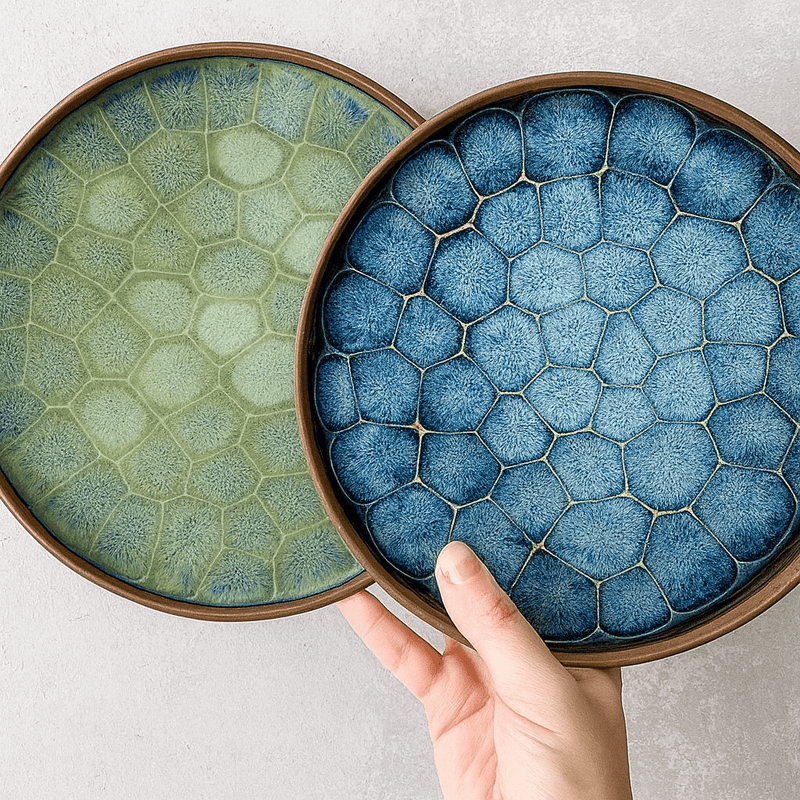
Three layers, and the order is the entire point. A stable glaze that will not move goes down first. Chowder goes on top of it in dots and circles. A flowing glaze goes over everything. In the firing, the Chowder pushes up through the flowing top layer and opens holes in it, and every hole becomes a pool with a dark ring around it.
Two coats of a stable base. Obsidian is the classic. Deep Firebrick works. Any of the Amaco Celadons will do it, and we carry all thirty-three of them.
Two coats of Chowder, in circles. Dabbed with a round sponge, trailed from an applicator bottle, or plopped with a brush. Vary the sponge size and you get irregular ponds instead of a polka dot.
Two coats of a flowing glaze over the whole thing. Iron Lustre is the one most people reach for. Temmoku and Ancient Jasper are worth testing.
Fire and find out. Cone 5 and cone 6 give visibly different results with this technique, and so does where your piece sat in the kiln. Write down what you did.
Credit where it is due: the technique is Kathy McGuire’s, and the potters who spread it have been generous about sharing their recipes. If you post yours, do the same.
Sponge dabbing
The workhorse of Frozen Pond. Round daubing sponges give you clean circles; different sizes in the same piece give you a pond rather than a pattern. Press and lift, do not drag.
Glaze trailing
Squeeze bottles and fine-tip applicators let you draw lines, spirals and deliberate blobs instead of circles. Our tool room stocks applicator bottles with various tips for exactly this.
Plopping and blotting
Load a brush heavily and drop it on, or lay it down and lift it off with a sponge. Thickness is what drives movement, so uneven on purpose gives you a surface that varies instead of one that runs uniformly.
Pooling into carving
This glaze’s native trick, and the one that needs no second bottle. Carve, stamp, facet or leave heavy throwing ribs, then glaze. It floods the low spots dark and pulls to near-white on every ridge.
The rim band
Chowder on the top inch or two only, over a darker glaze, and let the firing pull it down into a soft fade. All of the drama, a fraction of the risk, and it suits a mug.
The interior pond
Flat plates and shallow bowls are where this glaze is happiest, because the pooling happens where you put it instead of heading for the foot. If you are trying Frozen Pond for the first time, start on a plate.
One thing nobody warns you about: a speckled clay body raises your odds of pinholes in a smooth pooled surface, because the manganese that makes the speckle off-gasses during firing. If you want a flawless pond, think twice about Speckled Buff or B-Mix w/Specks for that piece and use a smooth body instead.
Six starting points
What to put it with.
Every glaze named here is on our wall right now. These are researched starting points, not tiles fired in our kilns. Test first, then tell us how it went so we can start marking the ones that are proven here.
Obsidian, Chowder, Iron Lustre
Sandwiched · 2 coats each, Chowder in circlesThe recipe most people start with, and the one behind most of the Frozen Pond pieces you have seen. Black underneath, cream dots in the middle, metallic bronze over the top, and pools opening through all of it.
Snapdragon Celadon, Chowder, Iron Lustre
Sandwiched · 3 base, 2 Chowder, 2 topThe same structure with color underneath instead of black. The Celadon glows out through every pool the Chowder opens, so the piece reads warm rather than graphic. Any of our thirty-three Celadons can take this slot.
Over Floating Blue
Chowder on top · 2 to 3 coatsCream flooding down over a blue that was already floating and breaking. Both are Spectrum glazes built to flow, so they melt into each other rather than sitting in layers. Messy if you take it low on the pot.
Over Temmoku
Chowder on top · 2 coatsCream poured over deep iron brown. Where the Chowder thins you get tan and rust; where it gathers you get an almost porcelain white sitting on the dark. Brutal contrast, and it photographs beautifully.
Over Texture Dark Cloud
Chowder on top · 2 coatsCream gathers in every carved line and pulls thin over every raised edge, so the pattern you cut into the clay becomes the pattern in the glaze.
Alone, on carved stoneware
2 to 3 even coats · nothing elseWorth saying out loud: on a deeply carved or faceted pot this needs no partner at all. It pools dark in the cuts and pulls to near-white on the ridges, and looks like a far more complicated glazing job than it was.
Sixteen more combinations across all four fluxes are on the flux collection page, and every glaze named here is in the Glaze Bible.
Plan it before you brush it
Where it sits, and how much it will run.
Under, over or sandwiched
The standard, and the one to learn
This is the sandwich that made Chowder famous. A stable glaze underneath, Chowder dabbed in the middle, a flowing glaze on top, and in the firing the Chowder opens holes through the top layer that read as pools or bubbles. That is Frozen Pond, and it is why most people buy this bottle at all.
The starting recipe: two coats Obsidian, two coats Chowder in circles, two coats Iron Lustre.
This is the only one of our four fluxes where sandwiched is the normal answer rather than the experiment.
How much will it run?
High run risk
This is the drippy end of the scale, which is probably why you are here. Assume glaze reaches the foot and plan for it. Keep the bottom third clear.
Glaze catcher required. There is flux on the outside of this piece, so it goes into the kiln on a catcher you supply. No exceptions, at any height.
The one rule
Chowder on the outside means a glaze catcher.
Any pottery with Running Hot Chowder applied to the exterior must go into the kiln sitting on a glaze catcher that you supply. Every piece, at any height, no exceptions. This one has run in its name and earns it.
Members are financially responsible for any damage to kiln shelves, and for the wages I pay my studio manager to fix the problem. Just don’t do it. Not to mention, glazes running onto shelves destroy your pot too.
A catcher protects the shelf and the studio. It does not save the pot. Once glaze has run off the foot you have a hard ring of glass on the bottom and a grinder in your future. The further down the pot you took it, the more of that there will be.
Before you commit a good pot to it
Where Chowder disappoints people.
Alone on a smooth pot it is just cream
No texture, no partner glaze, no technique, and this is a nice creamy glaze that runs. Everything interesting about it comes from giving it something to react with or somewhere to gather.
It dominates its partner
It is opaque and it brings its own body. Unlike the Mayco fluxes, it does not let the glaze underneath stay in charge. You get Chowder with something breaking through it.
Frozen Pond on a mug is a hard mode
The technique was built on flat pieces for a reason. On a vertical wall, the pools you are trying to make turn into runs on their way to the foot. Start on a plate.
Cone 5 and cone 6 are not the same result
Potters who chase this technique seriously end up choosing a cone and sticking to it. In a shared studio you do not control that, so record which load your piece went in and expect variation between them.
Pinholes love a speckled clay body
The manganese that gives you speckles off-gasses in the firing, and a smooth pooled surface shows every pinhole it leaves. Use a smooth clay when the surface is the whole point.
Nobody gets it first try
The potters who post the good ones have test tiles and notebooks. This is a three-layer technique with at least six variables. Write down what you did or you will not be able to repeat the one you love.
How it compares to the other three
Honey Flux
$26 · Amaco PC-17
Amber and cream. The one for dark iron glazes, and the only one that changes identity between cone 5 and cone 6.
Light Flux
$22 · Mayco SW-401
Translucent cream and the most neutral of the four. Movement without a color agenda, and built for Stroke & Coat.
Dark Flux
$22 · Mayco SW-402
Translucent brown. Shadow, depth and a warm dark edge on any pale glaze that currently reads flat.
Running Hot Chowder
$21 · Spectrum 1173
A complete glaze rather than an additive, and the only one of the four that is normally used as a middle layer. The Frozen Pond bottle.