


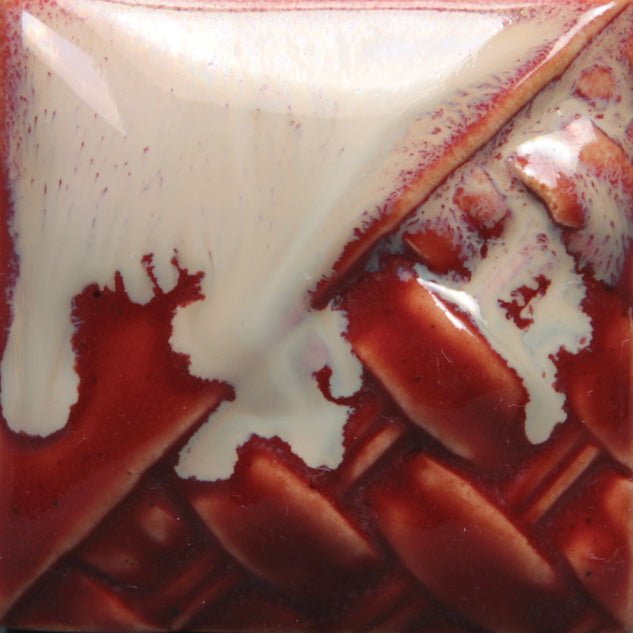
Mayco · Stoneware SW-401
Light Flux
$22.00
Pint · yours to keep · no up-charge, any membership level
A translucent cream on its own, and a pure flow agent underneath that. This is the least opinionated of our four fluxes: it adds movement and pulls hidden colors out of whatever it touches without pushing the color in one direction. If the color is already right and you just want the glaze to do something, this is the bottle.
How you get it: show your receipt to one of our main instructors and they’ll grab you your bottle.
- Fires atCone 5–10
- SizePint
- Apply2 to 3 coats
- Food surfacesNon-toxic, dinnerware safe
Using it
Two coats minimum, and stop well before the foot.
Light Flux is extra melter in a bottle. It behaves according to how much of it you put where, and Mayco is unusually specific about the variables: how fluid the partner glaze is, how thick you go, how many coats, and whether the surface is vertical or flat.
Two to three coats
One coat will change the color of what it touches but barely move it at all. If you brushed a single thin coat and nothing happened, you did not test the combination — you tested one coat.
Thin it out as you go down
We recommend going thinner the closer you get to the bottom. Mayco says the same thing their way: to prevent run-off, keep flux off the bottom third of the ware.
Your partner glaze decides the drama
Mayco is blunt about this. Layered with a stable Stoneware Gloss you get modest movement. Layered with their Classics or Crystals — the livelier glazes — you get far more of it.
Test where it cannot hurt you
Mayco’s own recommendation is to try a new combination inside a piece, or on a cookie. When the people who made it assume you will have a run, believe them.
How far down should it go?
This is the decision that costs you time later. The closer to the bottom you take it, the more of it drips into your catcher — which usually means a lot more grinding afterward. It is also, deliberately, where a lot of the beauty comes from.
About a third of the way down
Leaves two thirds of the clay naked. Usually beautiful, and the least grinding of the three. Good on a piece where the clay body is worth showing.
About two thirds of the way down
The other line that tends to look right. More glaze, more movement, a strip of naked clay at the foot, and more drips reaching the catcher.
All the way down
Maximum movement and maximum cleanup. Everything that runs lands in the catcher, and you are grinding the foot afterward. Go in expecting that.
Vertical walls move dramatically more than flat surfaces. The same combination on the inside of a bowl and on the side of a mug is effectively two different experiments.
Six starting points
What to put it with.
Mayco built the fluxes to layer with their own Stoneware glazes and with Stroke & Coat, and we carry both by the wall-full. These are researched starting points, not tiles fired in our kilns. Test first, then tell us how it went.
Over Tuxedo
Flux on top · 3 coatsSolid black opens into gray, blue and cream streaks. The single best demonstration of what a flux does to a flat color, and the one to try first if you have never used one.
Over Blue Yonder
Flux on top · 2 coatsThe blue keeps its identity but softens into bands, with pale cream breaking over every rim and edge. Reads expensive on a simple form.
Over Blue Hydrangea
Flux on top · 2 coatsMaximum drama, maximum danger. Mayco says their Crystal and Classic glazes move far more with flux than their gloss line does, and this combination is that warning in glaze form.
Over Wrought Iron
Flux on top · 2 coatsA matte black-brown turns glossy and starts breaking rust at every edge. Go in knowing the matte surface is gone — on an iron matte that is a feature, but it is still a trade.
Cotton Tail, flux, then Moody Blue
Sandwiched · 2 coats eachCream and blue bleed into each other through the flux layer instead of sitting in two separate zones, and the boundary becomes the interesting part of the pot.
Over Sour Apple Speckled
Flux on top · 2 coatsThe speckle stays put while the green moves around it, so you get dark flecks suspended in a glaze that is clearly flowing. Excellent on a bowl interior.
Sixteen more combinations across all four fluxes are on the flux collection page, and every glaze named here is in the Glaze Bible.
Plan it before you brush it
Where it sits, and how much it will run.
Under, over or sandwiched
The dramatic one
The flux melts on top and travels downward, pulling the color underneath along with it into streaks and rivulets. Mayco calls what comes out of this the hidden colors — shades the bottom glaze never shows when you use it alone.
Best over: Tuxedo and the other solid Stroke & Coat colors, where a flat color splits into three or four.
Mayco says it plainly: the order you apply flux in, above or beneath another glaze, changes the fired result.
How much will it run?
Moderate run risk
Expect real movement and some visible travel down the wall. Thin your coats as you get closer to the bottom.
Glaze catcher required. There is flux on the outside of this piece, so it goes into the kiln on a catcher you supply. No exceptions, at any height.
The one rule
Light Flux on the outside means a glaze catcher.
Any pottery with Light Flux applied to the exterior must go into the kiln sitting on a glaze catcher that you supply. Every piece, at any height, no exceptions.
Members are financially responsible for any damage to kiln shelves, and for the wages I pay my studio manager to fix the problem. Just don’t do it. Not to mention, glazes running onto shelves destroy your pot too.
A catcher protects the shelf and the studio — it does not save the pot. Once glaze has run off the foot you have a hard ring of glass on the bottom and a grinder in your future. The further down the pot you took the flux, the more of that there will be.
Before you commit a good pot to it
Where Light Flux disappoints people.
It turns matte glazes glossy
Mayco says so outright. If you picked a matte for the way it feels in the hand, Light Flux deletes that decision. This is the number one surprise with this bottle.
One coat does nothing
A single coat shifts the color and leaves the mobility more or less alone. Two to three is where the behavior everyone is buying this for actually starts.
The photos online are often cone 10
These fluxes are rated to cone 10, where they move dramatically more. Our kilns fire cone 5/6. If a picture online looks wilder than your result, check what cone it was fired to before you blame your brushwork.
Neutral cuts both ways
Being the least opinionated flux is the point of this bottle, but it means it will not rescue a boring color on its own. It moves what is there. It does not add drama that was never in the glaze.
Lively partners multiply it
Over a stable gloss you get a controlled result. Over a Classic or a Crystal you can get a landslide. Same bottle, same coats, wildly different day.
Rough is not a food surface
Mayco rates it non-toxic and dinnerware safe, and we are fine with it inside a mug or bowl. But layered glazes sometimes come out rough or pitted, and rough traps food. If it comes out textured, keep that piece decorative.
How it compares to the other three
Honey Flux
$26 · Amaco PC-17
Amber and cream. The one for dark iron glazes, and the only one that changes identity between cone 5 and cone 6.
Light Flux
$22 · Mayco SW-401
Translucent cream and the most neutral of the four. Movement without a color agenda, and built for Stroke & Coat.
Dark Flux
$22 · Mayco SW-402
The same chemistry as this bottle, translucent brown instead of cream. Pick it when you want shadow and depth rather than a clean lift.
Running Hot Chowder
$21 · Spectrum 1173
Creamy and glossy, and a complete glaze on its own. Pick it for carved texture, where it floods the cuts and thins on the ridges.