
 Pottery Date Night
 Bring All Your Friends Free Week
 Give a Month of Pottery
 Private Pottery Parties

 The Welcome Booklet
 Your First Ten Sessions
 The Pottery Process
 Finding the Studio
 Your Classes Never Expire
 The Four Tables
 Who’s Who
 The Rewards Program
 Flux Glazes
 The Calculators
 Kiln Tracker
 Holiday Kiln Deadlines

 Beginner’s Tool Set
 Fingernail Clippers
 Mayco Clay Mender
 Epoxy for Kintsugi
 Applicator Bottles
 Large Bead Rack
 Raku Workshop
 Nighttime Raku
 Horsehair and Feather Raku
 The Clay Hole T-Shirt
 Embroidered Crewneck
 Zip-Up Hoodie
 Pre-Made Bisqueware
 Glaze Catchers
 Kiln Cookies
 Clay Cubby Rental
 The Glaze Bible, Printed
 The Book of Molds, Printed
 Printable Pottery Guides
 Free Printable Trackers
 Gifts for Potters
 Christmas Pottery Ideas
 Mother’s Day Gift Ideas
 Pottery Date Night
 Studio Calendar
 2027 Studio Events
 What Should I Do Today?
 How to Throw on the Pottery Wheel
 How to Make a Pinch Pot
 How to Tap Center a Pot
 The Five Stages of Clay
 Is Pottery Hard to Learn?
 Pottery Wheel Practice Drills
 20 Easy Hand-Building Projects
 Everything That Sounds Wrong

 A Beautiful Piece, Every Time
 Slab Roller Tips
 Any Dish as a Slump Mold
 Slab Roller & Slab Mold Certification
 The Pottery Skill Tree
 Clay & Pottery Calculators
 Logging Your Pottery and Glazes
 The Pottery Dictionary
 Why Did My Pottery Do That?
 The Pottery Cone Chart
 Pottery Myths, Fact-Checked
 Is Handmade Pottery Food Safe?
 Incredible Ceramic Artist Videos
 How Dan Throws Giant Pots
 How to Dry Your Pottery
 The Pottery Wheel Introduction
 Pottery by Zodiac Sign
 Personality and the Pottery Wheel
 Pottery for Engineers
 ADHD, Hyperfocus, and Never Running Out
 Hobbies for Burnout
 Screen-Free Hobbies for Adults
 Every Addiction I Ever Had Lost to Art
 Functional Pottery Is Engineering
 How Do We Compare?
 Pottery Classes by City
 Every Pottery Studio in Utah
 Pottery in Draper
 Featured Members
 The Signature Wall
 Making Friends as an Adult Is Brutal
 The Clay Hole Commandments
 2027 Pottery Contests
 2027 Studio Parties
 Gallery Night

 Scream It Into the Void
 Destroy the Glaze Wall
 Daily Affirmation Cards
 Everything That Can Go Wrong
 Subscribe to Our Newsletters
 Contact The Clay Hole
 Corporate Team Building

 Glaze Combinations
 Glazes We Do Not Carry
 Making Glaze Test Tiles
 The Mega Glaze Tool
 How to Use the Mega Glaze Tool

 Glaze Brushing Techniques
 How to Use Underglaze
 How to Use Dipping Glazes
 Glaze Problems, Causes and Fixes
 The Dipping Glaze Guide

 Making a Glaze Catcher
 Fused or Sharp After Firing
 The Signature Wall
 His Viral Videos
 His Own Ceramics
 Meet Mud
Pottery workshops worth crossing an ocean for.
Somewhere out there right now, somebody is throwing porcelain in the porcelain capital of the world, somebody is loading a wood kiln in the Tuscan hills, and somebody is eating breakfast at a craft school in the North Carolina mountains before eight straight hours of clay.
Destination workshops are the graduate school of studio pottery: a week or a month of total immersion with teachers whose work you have admired from a screen, in places where the tradition is the local industry.
This page is the field guide: what travel teaching gives you that home cannot, the famous institutions worth knowing by name, how to vet a workshop before you wire anyone a deposit, and how to bank the trip back into your everyday practice.
Destination workshops are the graduate school of studio pottery. Below: the famous names, the two questions that matter before any deposit, the plan, one film.

The field guide in five lines
- What travel buys: immersion, lineage, and atmosphere, the wood, soda, and salt firings our clean electric cone 5½ kilns do not do.
- The famous names: La Meridiana in Tuscany, Guldagergaard in Denmark, the Jingdezhen porcelain scene, Shigaraki and Mashiko in Japan, and the American craft schools led by Penland.
- The two questions that matter most: who is actually teaching, and exactly what firing of your work is included. Get both answered by email before any deposit.
- The souvenir truth: plan for most pieces not to make it home; budget to ship one small box of favorites and photograph everything.
- The payoff move: repeat the workshop’s core exercise at your home studio the week you return, while your hands still remember.
The five-move plan below is whole in both versions; the rest is one toggle away.
What a destination workshop gives you that home cannot
Most of your growth as a potter happens at your home studio, in unglamorous repetition, and no plane ticket changes that. But a great workshop abroad does three things repetition cannot.
It gives you immersion: days that are nothing but clay, meals with people who dream in glaze chemistry, and the compound interest of learning with zero errands in between. It gives you lineage: hands-on time with teachers who carry a specific tradition, whether that is Tuscan majolica, Jingdezhen porcelain, or a Japanese apprenticeship line, the kind of transmission you can feel in your own hands for years after. And it gives you atmosphere, literally: many destination programs are built around wood, soda, and salt kilns that community studios like ours, running clean electric firings at cone 5½, simply do not have. If long wood, salt and soda firings and ash-kissed surfaces are on your bucket list, travel is the way to get them.
The pattern that works: go with a question your home practice has already raised, and come back with a habit, not just photographs.
The world map: institutions with reputations
These are famous, long-running programs that anchor the destination-workshop world, listed for orientation, not endorsement. Programs, teachers, and offerings change season to season, so always verify current details on the institution’s own site.
- La Meridiana, Tuscany, Italy. An international ceramics school in the Tuscan countryside running short courses and masterclasses with a rotating cast of well-known visiting artists, plus the Tuscan-countryside-and-long-lunches setting that made it legendary.
- Guldagergaard, Skaelskoer, Denmark. The International Ceramic Research Center: part residency, part research lab, with a famous kiln yard and a steady stream of serious makers from around the world.
- Jingdezhen, China. The porcelain capital of Earth for a thousand years, now thick with residencies, studios, and programs, including the long-running Pottery Workshop, where visiting potters work alongside a whole city built on clay.
- Shigaraki and Mashiko, Japan. Shigaraki’s Ceramic Cultural Park hosts an internationally known residency in one of Japan’s Six Ancient Kilns towns, while Mashiko, the town Shōji Hamada made famous, welcomes visitors into a living folk-pottery tradition.
- The American craft schools. Penland School of Craft in North Carolina, Haystack in Maine, Arrowmont in Tennessee, and Anderson Ranch in Colorado: immersive sessions, mostly one to two weeks long, with national-caliber instructors, no passport required.
- Everywhere else. Greek islands, Oaxaca, Bali, Morocco, Portugal: anywhere with a pottery tradition now has workshop tourism to match. The famous names above set the standard; the vetting band below is how you judge everything else.
How to vet a workshop like a professional
A beautiful landing page is not a curriculum. Here is the checklist of questions that separates transformative weeks from expensive pottery-themed vacations, and either can be fine, as long as you know which one you booked. Six questions follow, and the first two, who is teaching and what firing is included, matter most.
- Who is actually teaching, and how much? Look up the instructor’s own work and confirm they teach the sessions personally rather than lending a name. Daily contact hours matter more than famous ones.
- What firing is included? The single most-missed question. Will your work be bisqued, glazed, and fired during the session, in what kind of kiln, and does a wood or soda firing actually include your pieces or just a demonstration?
- What is the real skill level? Honest programs state prerequisites plainly. A masterclass full of beginners frustrates everyone in the room, including you, whichever one you are.
- How big is the group, and how many wheels? Twelve students on six wheels is a schedule, not a workshop. Ask for the ratio in writing.
- Language, lodging, and logistics. Confirm the teaching language, what accommodation and meals are included, and what a day actually looks like hour by hour.
- The paper questions. Cancellation and refund policy, travel insurance expectations, and what happens to your finished work: shipped, carried, or lovingly abandoned. Get answers by email so they exist in writing.
The money, structurally
Prices change constantly, so this page names none; what stays constant is the shape of the bill, and knowing it keeps quotes comparable.
- Tuition is only the headline. Under it sit materials and firing fees (sometimes bundled, sometimes not), lodging and meals (the biggest swing between programs), and travel. Two workshops with identical tuition can differ enormously once the whole shape is priced.
- Included beats cheap. A program that bundles clay, glazes, all firings, lodging, and meals is usually the better deal and always the better week, because nothing ambushes your attention mid-course.
- Ask what a cancellation costs, in writing, and whether travel insurance is expected. International workshops book far ahead, and life happens; the refund policy is part of the price.
The plan: five moves that make the trip pay off
The difference between a workshop that changes your pottery and one that just fills a camera roll is mostly made before you leave and the month after you return. Tap these off as you go; the list remembers your progress on this device.
Three videos worth your evening
One video worth your evening
A pottery student’s days in Jingdezhen, food included: forty-five minutes of what immersion actually feels like.
One student’s diary from the porcelain capital, one school showing you around its Tuscan home, and one throwing demonstration by that school’s founder, filmed by a potter who was an assistant there. A note on why the page is mostly words anyway: video shows you the light in the rooms; reading is what hands you the vetting questions and the plan that makes the trip stick. Watch to want it, read to book it well.
The ones we get asked at the studio
Am I good enough yet for a workshop abroad?
If you can center, throw a basic cylinder, and handle your own reclaim, a general workshop will meet you where you are, and most programs run true beginner sessions too. The real gate is the program’s stated prerequisites, not your imposter syndrome. Masterclasses are the exception: those really do assume fluency, and taking one early wastes the very access you paid for.
Do I bring my own tools?
Bring your small personal kit, the ribs and trimming tools your hands already know, because familiar tools free your attention for the new teaching, and check the program’s packing list for anything unusual. Everything heavy stays home; most studios provide the wheels and many include clay and glazes (ask what the price covers), and airport security has strong opinions about wire tools in carry-ons, so pack the kit in checked luggage.
Will my pieces make it home?
Plan for most of them not to, and be delighted when some do. Workshop timelines often mean your last pieces come out of the kiln after you leave; programs vary between shipping finished work (at real cost), holding it for pickup, or gently recycling it. Ask before you go, budget for shipping one small box of favorites, photograph everything, and remember the actual souvenir is in your hands, not your suitcase.
Is a workshop worth it compared to a year of membership?
They are not competitors; they are a cycle. Membership is where skills compound, and a workshop is a concentrated dose of direction that your daily practice then spends a year metabolizing. The potters who get the most from travel are always the ones with a steady home practice on both sides of the trip, which is the least subtle membership pitch on this whole hub, and also true.
Where this leads next
Train here, travel far, come back better
The potters who thrive abroad are the ones with a steady practice waiting at home: 29 wheels, classes to sharpen the fundamentals, kilns firing on schedule, and a community to show your workshop stories to. Green, Yellow, Purple or Black, whichever fits how often you can get here.
Programs, teachers, and schedules change; always confirm details with the institutions themselves. Every video on this page belongs to its maker, and none of them are ours. We link them because they are excellent. The player and its cookies wait until you press play; the only thing that loads while you read is each video’s still frame.
Which version would you like to print?
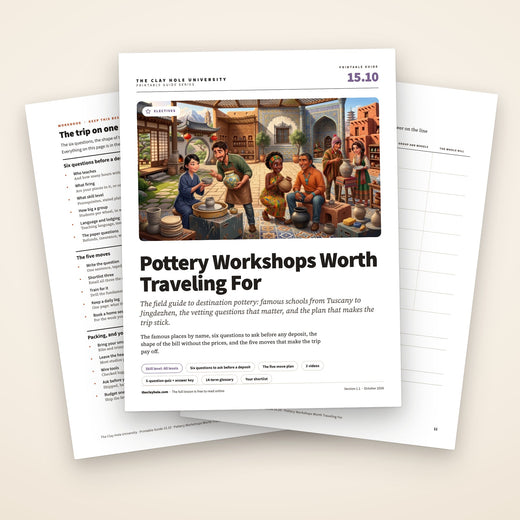
Videos come out as a labeled box with the title and channel to search for, since paper does not play them.