
 Pottery Date Night
 Bring All Your Friends Free Week
 Give a Month of Pottery
 Private Pottery Parties

 The Welcome Booklet
 Your First Ten Sessions
 The Pottery Process
 Finding the Studio
 Your Classes Never Expire
 The Four Tables
 Who’s Who
 The Rewards Program
 Flux Glazes
 The Calculators
 Kiln Tracker
 Holiday Kiln Deadlines

 Beginner’s Tool Set
 Fingernail Clippers
 Mayco Clay Mender
 Epoxy for Kintsugi
 Applicator Bottles
 Large Bead Rack
 Raku Workshop
 Nighttime Raku
 Horsehair and Feather Raku
 The Clay Hole T-Shirt
 Embroidered Crewneck
 Zip-Up Hoodie
 Pre-Made Bisqueware
 Glaze Catchers
 Kiln Cookies
 Clay Cubby Rental
 The Glaze Bible, Printed
 The Book of Molds, Printed
 Printable Pottery Guides
 Free Printable Trackers
 Gifts for Potters
 Christmas Pottery Ideas
 Mother’s Day Gift Ideas
 Pottery Date Night
 Studio Calendar
 2027 Studio Events
 What Should I Do Today?
 How to Throw on the Pottery Wheel
 How to Make a Pinch Pot
 How to Tap Center a Pot
 The Five Stages of Clay
 Is Pottery Hard to Learn?
 Pottery Wheel Practice Drills
 20 Easy Hand-Building Projects
 Everything That Sounds Wrong

 A Beautiful Piece, Every Time
 Slab Roller Tips
 Any Dish as a Slump Mold
 Slab Roller & Slab Mold Certification
 The Pottery Skill Tree
 Clay & Pottery Calculators
 Logging Your Pottery and Glazes
 The Pottery Dictionary
 Why Did My Pottery Do That?
 The Pottery Cone Chart
 Pottery Myths, Fact-Checked
 Is Handmade Pottery Food Safe?
 Incredible Ceramic Artist Videos
 How Dan Throws Giant Pots
 How to Dry Your Pottery
 The Pottery Wheel Introduction
 Pottery by Zodiac Sign
 Personality and the Pottery Wheel
 Pottery for Engineers
 ADHD, Hyperfocus, and Never Running Out
 Hobbies for Burnout
 Screen-Free Hobbies for Adults
 Every Addiction I Ever Had Lost to Art
 Functional Pottery Is Engineering
 How Do We Compare?
 Pottery Classes by City
 Every Pottery Studio in Utah
 Pottery in Draper
 Featured Members
 The Signature Wall
 Making Friends as an Adult Is Brutal
 The Clay Hole Commandments
 2027 Pottery Contests
 2027 Studio Parties
 Gallery Night

 Scream It Into the Void
 Destroy the Glaze Wall
 Daily Affirmation Cards
 Everything That Can Go Wrong
 Subscribe to Our Newsletters
 Contact The Clay Hole
 Corporate Team Building

 Glaze Combinations
 Glazes We Do Not Carry
 Making Glaze Test Tiles
 The Mega Glaze Tool
 How to Use the Mega Glaze Tool

 Glaze Brushing Techniques
 How to Use Underglaze
 How to Use Dipping Glazes
 Glaze Problems, Causes and Fixes
 The Dipping Glaze Guide

 Making a Glaze Catcher
 Fused or Sharp After Firing
 The Signature Wall
 His Viral Videos
 His Own Ceramics
 Meet Mud
Your best teacher is the pot you just made. Here is how to listen to it.
Every pot you finish is full of information about what to do differently next time, and most of us never collect it. We look at the shelf, feel vaguely proud or vaguely disappointed, and wedge up the next ball having learned almost nothing.
This page fixes that. It replaces the useless question, do I like it, with a repeatable walkaround that tells you exactly what is working, what is not, and what to change on the next one. It is the cheapest skill upgrade in pottery, because the tuition is pots you already made.
Every finished pot is feedback, if you know how to collect it. Below: a sixty-second method, the walkaround, and one video. The long version of everything is one toggle away.

How to critique a pot in sixty seconds
The whole skill is swapping do I like it for what specifically works and what specifically does not. Sixty seconds, five moves:
- Back up ten feet and squint. A pot is its outline first. Judge the silhouette as a black shape before you let details vote.
- Flip it upside down. Is the foot as considered as the rim? The underside is where honest craftsmanship shows.
- Hold it. Does the weight match what your eyes promised, are the walls even, and is the rim friendly to a thumb?
- Say two sentences out loud. One specific thing that works, one specific thing that does not. I like it is banned; it carries no instructions.
- Ask the ten-more question. If you made ten more of this exact pot, what one thing would you change? Write that sentence down. It is next session’s plan.
The walkaround below picks up where these five moves leave off, and it remembers your progress. Wondering why any of this works, or which traps to dodge? The Comprehensive Version above has all of it.
Stop asking whether you like it
Do I like it is a dead-end question. It has three possible answers, yes, no, and shrug, and none of them tells you what to do at the wheel tomorrow. Worse, the answer usually is not even about the pot. It is about your mood, how the firing went, and whether you saw somebody better on the internet this morning.
The working question is different: what, specifically, is working here, and what, specifically, is not? Specific observations are the only kind you can act on. My mugs feel off is a feeling. The handle meets the wall at a hard right angle and the negative space it makes is a lumpy triangle is a to-do list. Critique, done right, is just the discipline of turning the first kind of sentence into the second kind.
And a definition, because the word scares people: critique is not criticism. Criticism is a verdict, and it tends to land on the potter. Critique is information, and it lands on the pot. The pot is not you. It is one afternoon of your decisions, frozen at cone 5½, and you are allowed to look at it the way a coach watches game film: warmly, closely, and on the hunt for the next adjustment. If your inner voice cannot tell the pot apart from the potter yet, our page on imposter syndrome is the companion read.
The one-sentence version of this whole page: replace every I like it and I hate it with one specific thing that works and one specific thing to change. Do that on every pot you finish and you will improve faster than any class can take you.
Set up an honest look
You cannot critique what you cannot see clearly, and fresh-off-the-wheel eyes see almost nothing clearly. A few minutes of setup, plus a night’s wait if you can manage one, turns the same pot into a different, far more honest object.
- Wait a day if you can. Wet-pot pride and midnight doubt are both liars. A pot you have not seen since yesterday gets judged as a pot, not as a memory of how hard the throwing was.
- Neutral light, plain background. Daylight from a window, a bare table, nothing busy behind it. Dramatic lighting is for photographing pottery; flat honest light is for judging it.
- Start from across the room. Set the pot ten feet away. That distance deletes the details and leaves only the silhouette, which is where form succeeds or fails. Details get their turn later.
- Turn it. A banding wheel or a slow turntable if you have one, your own two feet if you do not. Pots are round; a critique from one angle is a critique of one third of the pot.
- Photograph it in profile. Then drop the exposure until the pot is a black shape. The squint test from our design page works even better in reverse, on pots that already exist.
- Hold it last. Weight, balance, and how the rim meets a thumb are real information, but they are so persuasive that they drown out your eyes. See first, then touch.
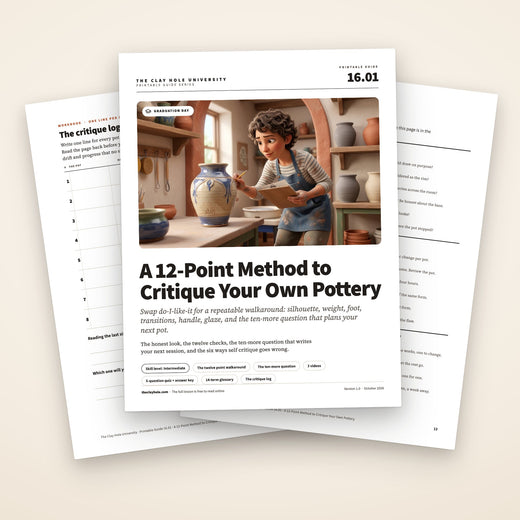
The twelve-point walkaround
The seven-point walkaround
The sixty-second method above covered the wide view. These seven checks go where a quick look cannot: the details. Tap each one as you finish it; the list remembers your progress on this device, and every answer should be one specific sentence, never a grade.
Pick one pot and work top to bottom through these twelve checks. Tap each one as you finish it; the list remembers your progress on this device. The rule for every check is the same: answer in one specific sentence, out loud or on paper, never with a grade.
The ten-more question
If you made ten more of this exact pot, what one thing would you change? Of the twelve checks above, this is the one that changes potters, because it quietly converts taste into an instruction. You do not have to know why the pot feels off. You only have to know what you would try differently, and that answer is next session’s plan, written by the only teacher who was in the room when you made it.
It also explains something you have probably noticed about professional work: the pots that look effortless are almost never one-offs. They are the eleventh pot, the thirtieth, the two-hundredth, each one carrying a single deliberate change from the one before. Singles lie to you, because a single pot is a coin flip. Runs tell the truth. When a form matters to you, throw it in threes and fives on purpose and let the ten-more question steer the run.
One habit turns all of this from a nice idea into actual progress:
- Keep a critique log. A cheap notebook in your studio bag or a note on your phone. It does not need to be pretty. It needs to exist.
- One line per pot. What worked, and the ten-more answer. Two sentences. Thirty seconds. That is the entire tax.
- Photograph the lineup in profile. When you finish a run, shoot the whole family side by side. Nothing shows drift and progress like six silhouettes in a row.
- Read the log before you wedge. Last month’s ten-more answers are a better lesson plan than anything the internet will hand you today. If a note says the walls ran thick, our proportions and wall thickness page has the numbers to aim at.
The six traps
Self-critique fails in predictable ways. Every potter falls into at least one of these; the trick is knowing which one is yours.
The kindness trap
Everything you make is fine, nice, pretty good. Fine is a fog; nothing specific ever comes out of it, so nothing ever changes. The cure is a quota: one specific improvement per pot, no exceptions, even on the ones you love.
The cruelty trap
Everything you make is garbage. That is a mood wearing a critique costume, and it produces exactly as little useful information as the kindness trap. If every answer comes out as I am bad at this, you are reviewing the potter, not the pot, and it is time to step away or reread the definition above.
The effort trap
This took me four hours, so it must be good. The shelf cannot see your four hours. Judge the object the way a stranger will meet it: cold, in ordinary light, with no backstory. Effort explains a pot; it does not excuse one.
The comparison trap
Grading your pot against a twenty-year professional’s highlight reel tells you nothing except that twenty years is a long time. Compare this pot to your last run of the same form, that is the only comparison with information in it. We wrote a whole page on comparison because this trap eats more potters than all the others combined.
The keeper bias
Your favorite pot is usually the one with the best story, the first porcelain piece, the one that survived the glaze disaster, not the best form. Stories are wonderful and they are not critique. The squint test breaks ties: black shapes have no backstory.
The sunk-time trap
Refusing to see a flaw because seeing it would mean the piece did not work. Here is the liberation hiding in that trap: the next pot is cheap. Clay is the most forgiving medium on earth, and a flaw you finally admit costs you one honest sentence and a fresh ball of clay.
Three videos worth your evening
One video worth your evening
Hear the skill you just read: a potter goes through pots that viewers sent in. Reading gave you the checklist; pause on each pot and run it yourself before the potter does.
Critique is a spoken skill as much as a visual one, and hearing experienced eyes narrate what they see installs the vocabulary faster than anything. We picked three angles on it: the design principles behind a critique, a potter going through pots that viewers sent in, and a potter answering a subreddit question by making the form again. A note on why this page is mostly words anyway: watching calibrates your eye, but reading is what hands you the checklist you can actually run alone in your kitchen on Tuesday. Watch to hear it done, read to keep it.
The ones we get asked at the studio
How harsh should I be with myself?
Wrong axis. Harsh and gentle are both moods, and moods produce verdicts, not information. Aim for specific instead: one true sentence about what works, one true sentence about what to change. Said that way, the hardest observation stops feeling like an attack, because it arrives holding a plan.
Should I keep my bad pots?
Keep a few as mile markers, honestly labeled, because in a year they will be the clearest proof of how far you came. Recycle the rest without ceremony; greenware goes straight back to the bucket, and our reclaim page shows how. A shelf full of pots you have quietly stopped believing in is not humility, it is clutter with feelings.
What about critiquing other people’s pots?
Only when invited, and then by the same rules: specific, about the pot, never about the potter, and always paired, one thing working for every one thing to change. Around the studio, want thoughts on it? is the whole etiquette. Unrequested critique is just criticism with better posture, and nobody has ever improved because of it.
What if I honestly cannot see anything wrong?
That usually means your eyes have gone stale on the piece, not that it is finished. Force freshness: the black-shape photo, upside down, a week in a drawer, or the pot sitting among strangers on a crowded shelf. Then ask the ten-more question anyway; it works even on pots you love. And sometimes the answer really is nothing yet, which is your cue to make the run longer and let pot number six reveal what pot number one could not.
Where this leads next
Critique improves fastest with company
Self-critique is the daily practice, and a studio full of other potters is the accelerant: shelves of work to calibrate your eye against and people who will give you an honest want thoughts on it? whenever you ask. A Clay Hole membership gets you 29 wheels, the classes, the kilns, and all of that company. Green, Yellow, Purple or Black, whichever fits how often you can get here.
Every video on this page belongs to the potter who made it, and none of them are ours. We link them because they are excellent. The player and its cookies wait until you press play; the only thing that loads while you read is each video’s still frame.
Which version would you like to print?
Videos come out as a labeled box with the title and channel to search for, since paper does not play them.