
 Pottery Date Night
 Bring All Your Friends Free Week
 Give a Month of Pottery
 Private Pottery Parties

 The Welcome Booklet
 Your First Ten Sessions
 The Pottery Process
 Finding the Studio
 Your Classes Never Expire
 The Four Tables
 Who’s Who
 The Rewards Program
 Flux Glazes
 The Calculators
 Kiln Tracker
 Holiday Kiln Deadlines

 Beginner’s Tool Set
 Fingernail Clippers
 Mayco Clay Mender
 Epoxy for Kintsugi
 Applicator Bottles
 Large Bead Rack
 Raku Workshop
 Nighttime Raku
 Horsehair and Feather Raku
 The Clay Hole T-Shirt
 Embroidered Crewneck
 Zip-Up Hoodie
 Pre-Made Bisqueware
 Glaze Catchers
 Kiln Cookies
 Clay Cubby Rental
 The Glaze Bible, Printed
 The Book of Molds, Printed
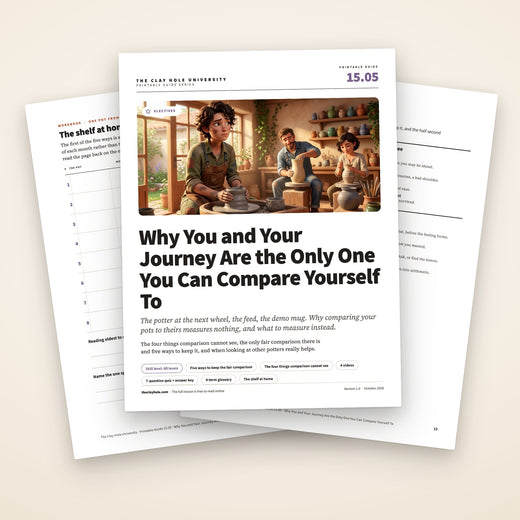
 Printable Pottery Guides
 Free Printable Trackers
 Gifts for Potters
 Christmas Pottery Ideas
 Mother’s Day Gift Ideas
 Pottery Date Night
 Studio Calendar
 2027 Studio Events
 What Should I Do Today?
 How to Throw on the Pottery Wheel
 How to Make a Pinch Pot
 How to Tap Center a Pot
 The Five Stages of Clay
 Is Pottery Hard to Learn?
 Pottery Wheel Practice Drills
 20 Easy Hand-Building Projects
 Everything That Sounds Wrong

 A Beautiful Piece, Every Time
 Slab Roller Tips
 Any Dish as a Slump Mold
 Slab Roller & Slab Mold Certification
 The Pottery Skill Tree
 Clay & Pottery Calculators
 Logging Your Pottery and Glazes
 The Pottery Dictionary
 Why Did My Pottery Do That?
 The Pottery Cone Chart
 Pottery Myths, Fact-Checked
 Is Handmade Pottery Food Safe?
 Incredible Ceramic Artist Videos
 How Dan Throws Giant Pots
 How to Dry Your Pottery
 The Pottery Wheel Introduction
 Pottery by Zodiac Sign
 Personality and the Pottery Wheel
 Pottery for Engineers
 ADHD, Hyperfocus, and Never Running Out
 Hobbies for Burnout
 Screen-Free Hobbies for Adults
 Every Addiction I Ever Had Lost to Art
 Functional Pottery Is Engineering
 How Do We Compare?
 Pottery Classes by City
 Every Pottery Studio in Utah
 Pottery in Draper
 Featured Members
 The Signature Wall
 Making Friends as an Adult Is Brutal
 The Clay Hole Commandments
 2027 Pottery Contests
 2027 Studio Parties
 Gallery Night

 Scream It Into the Void
 Destroy the Glaze Wall
 Daily Affirmation Cards
 Everything That Can Go Wrong
 Subscribe to Our Newsletters
 Contact The Clay Hole
 Corporate Team Building

 Glaze Combinations
 Glazes We Do Not Carry
 Making Glaze Test Tiles
 The Mega Glaze Tool
 How to Use the Mega Glaze Tool

 Glaze Brushing Techniques
 How to Use Underglaze
 How to Use Dipping Glazes
 Glaze Problems, Causes and Fixes
 The Dipping Glaze Guide

 Making a Glaze Catcher
 Fused or Sharp After Firing
 The Signature Wall
 His Viral Videos
 His Own Ceramics
 Meet Mud
Electives · The thief of joy
You and your journey are the only one you can compare yourself to.
Somewhere in the second month there is an evening when the pot on your wheel is the best you have ever made, and you look up, and the person at the next wheel is pulling a wall twice as tall with one hand. The pot on your wheel has not changed. Your evening has. That is comparison doing the only thing it knows how to do, which is take a good night and hand you back a bad one. This page is about why it cannot measure anything worth measuring, what to measure instead, and the one way looking at other potters actually helps.
This page covers why comparison is a broken instrument, the four things it cannot see, the only fair comparison there is and how to keep it, the difference between envy and admiration, when looking at other potters really helps, and how a room of thirty to fifty people at different stages is the studio’s design and not an accident. Four videos.
This is the short version: why it measures nothing, the one fair comparison, and how to keep it. The reasoning, the questions and the other three videos are in the comprehensive version.

Read it, then watch it
Why this is written down and filmed, both.
Comparison is a habit of mind, and habits of mind are best described in words and best dislodged by watching somebody else name them out loud. So the page carries the argument, which is short, and the videos carry the voices: a therapist, a doctor who talks to gamers, somebody who makes study videos, and a potter who opened a studio and published what its first six months actually brought in.
Read the four things comparison cannot see, then watch one or two of the videos, and the next time it happens at the wheel you will catch it a few seconds earlier. That is all a page like this can do, and it is enough. Then go put a pot on a shelf.
Use both, in this order
The broken instrument and the fair comparison first. Then the first video. Then a shelf at home with one pot on it and a date underneath.
The whole idea
The pot next door cannot measure you. The pot you made last month can.
The potter at the next wheel has different hands, different hours, different goals and different clay, and you see only their finished pot, never their reclaim bucket. Comparing against that measures nothing and costs an evening. The only fair comparison is you, a month ago: one pot a month on a shelf at home with the date under it, and a count of hours, not pots. Look at other potters’ work the way you look at a map, for what is possible, and never as a score.
The instrument
Comparison is a ruler with no marks on it.
It feels like measurement. It is not, and here is why.
A measurement needs two things: a fixed scale and a thing that stays still while you read it. Comparison has neither. The person at the next wheel is not a scale, they are another moving object, and what you are reading off them is not their skill but the small slice of it that is visible tonight, from your seat, through your own mood. Two potters can look at the same tall vase and one sees a goal and the other sees a verdict, and the vase has nothing to do with which.
That is why the feeling arrives so reliably on good nights. A bad pot on your wheel gives comparison nothing to work with; you already know it is a bad pot. A good pot is a claim, and comparison exists to test claims, so it goes looking for the tallest pot in the room and holds yours up to it. The better you get, the more often it fires. Nobody at the wheels tonight is immune, including the one you were just looking at.
What it misses
Four things comparison cannot see, and every one of them is the whole story.
Their hours
The person pulling that wall has been at the wheel for two years, or eleven. Your pot is being compared to hundreds or thousands of hours you cannot see. Adjusted for hours, you may well be ahead of them, and neither of you will ever know.
Their hands
Long fingers, big palms, a strong forearm, a bad shoulder. Hands set the size of pot a person centers easily and the height they pull without strain. Comparing pots across different hands is comparing shoe sizes.
Their goal
They are making a tall vase because they want a tall vase. You are making a mug because you want a mug. A mug is not a failed vase. Most comparison is between two people who are not even attempting the same thing.
Their reclaim bucket
You see the pot that survived. Under the table is the one that collapsed twenty minutes ago and the three from last week. Every finished pot in the room stands on a pile of reclaim you were not there for, and so does yours.
The fair one
The only fair comparison there is: you, a month ago.
You, a month ago.
Same hands, same clay, same goals, and the hours known exactly. It is the one measurement that has a scale on it.
Same hands, same clay, same goals. The one measurement with a scale on it.
You a month ago had the same hands, the same clay, the same goals and a known number of hours fewer. That is a fixed scale and a thing that stays still, which makes it the only comparison that can tell you anything. And it always tells you something you can use, in either direction: if the hands have moved, you know what worked; if they have not, you know what to practice. Scoring yourself against someone else never produces a next step. Comparison against yourself always does.
Five ways to keep it
- 1One pot a month on a shelf at homeNot the best pot. The one from the middle of the month. Line them up oldest to newest with the date under each. In six months the shelf will show you a curve no feed ever could.
- 2Count hours, not potsA pot is a verdict; an hour is a fact. Keep a running total somewhere you can see it. The number only goes up, and a hundred hours is a hundred hours no matter what came off the wheel.
- 3Photograph the first oneThe very first pot, in daylight, from the bad side. Keep it on your phone. On the night comparison fires, open it. Nothing on the shelf next door can argue with it.
- 4Write down what you could not doA list, dated, of the things that do not work yet: centering over three pounds, a handle that stays on, a lid that fits. Cross them off as they go. Our fifty ways lesson lists what goes wrong at each stage, with the fix, and is a good place to borrow items for this list.
- 5Ask an instructor once a seasonNot how you compare to the room. What has changed since the last time they watched you. Instructors see hundreds of hands and they remember yours, and their answer is the closest thing to a fixed scale a studio has.
Two feelings
Envy and admiration look the same from outside. They are opposites.
Envy looks at the tall vase and feels smaller. Admiration looks at the same vase and feels curious. They start from the same glance and go in opposite directions, and the direction is a choice you get to make in about half a second. The tell is what you do next. Envy goes quiet and looks at its own pot. Admiration walks over and asks how they got the wall that thin, and the answer is always some version of hours and a specific trick, both of which you can go and get.
Studios run on admiration and are poisoned by envy, and the difference is mostly whether people talk to each other. A room where the beginner asks the ten-year potter how they compress a rim is a room where both of them are happier, because the ten-year potter has just been reminded that they know something. That conversation is the thing the feed cannot give you and the thing the next wheel over can.
The half second
When the glance lands and the feeling starts, ask one question instead: how did they do that? It turns envy into admiration before either has finished forming, and it usually gets you a technique.
The useful kind
When looking at other potters actually helps, which is often.
None of this means do not look. Looking is how you find out what is possible; nobody throws a tall vase who has not seen one. The difference is what you are looking for. As a map, another potter’s pot tells you a form exists, a surface exists, a technique exists, and you can go and learn it. As a score, the same pot tells you where you rank, which is nothing, because there is no ranking. Use every pot you see as a map and none of them as a score and the feed becomes a library instead of a leaderboard.
Watch it
Now hear four people name the habit out loud.
Watch this one, then go to the wheel.
None of these people work here or know we exist. A therapist, a doctor, somebody who makes study videos, and a potter who opened a studio. Different rooms, the same habit. The still frames load while you read; the player and its cookies wait until you press play.
Sixteen minutes from a therapist on why comparing yourself to others misleads you and how to loosen the habit. The other three videos are in the comprehensive version.
How it works here
Thirty to fifty people at different stages, on purpose.
This page is written for potters everywhere. Here is where our studio stands.
Three things to know here
A class night here puts a first-week beginner next to a ten-year potter at the same tables, and that mix is the design, not an accident. Nobody is graded, nobody is ranked, and show and tell is for the pot you learned from, not the one you are proudest of. Ask the potter next to you how they did it; they will tell you.
The mix is the design
Thirty to fifty people on a class night, from first week to tenth year, at the same tables and wheels. That is the design. A room of only beginners has nobody to ask, and a room of only experts has nobody to teach.
Nobody is ranked
In class there is no grade, no leaderboard and no featured wall of the best pots. Show and tell is for the pot you learned something from, and the room treats a collapsed cylinder with a good story the same as a perfect vase.
Ask how
The potter pulling the tall wall will tell you how, and will be pleased you asked. Plenty of what gets passed around this studio started as one member asking another that question.
Instructors remember your hands
Ask the onsite instructor once a season what has changed since they last watched you throw. They see hundreds of hands and they remember yours, and their answer is the fairest measurement in the building.
Hours are the only score
Membership is measured in months and the wheel in hours. Nobody counts your reclaim, and the reclaim is free.
The feed, at the door
Members who put the phone away for the class night and pick it up at the car report better evenings. Not a rule. An observation.
Questions people actually ask
The ones that come up quietly, mid-class.
Why does it hit on my good nights?
Because a good pot is a claim, and comparison exists to test claims. A bad pot gives it nothing to work with. The better you get, the more often it fires, which is the opposite of what it feels like it means.
Is it wrong to look at other potters’ work?
No. Look at it as a map of what is possible: forms, surfaces, techniques you can go and learn. Just never as a score, because there is no ranking to score on.
How do I compare against myself without lying?
One pot a month on a shelf at home, the middle pot, not the best, with the date under it. A photograph of the first pot ever, from the bad side. A count of hours. None of those can be argued with.
The person next to me is so much better. What do I do?
Ask them how they did the thing you noticed. Envy goes quiet; admiration walks over. The answer will be hours and a trick, and you can go and get both.
What if I really am behind?
Behind whom? Adjusted for hours, hands and goals, the question dissolves. Behind yourself a month ago is the only version that means anything, and if that one is true, the fix is a specific skill and an instructor, not a feeling.
Should I stop using the feed?
For a month, if you can. Long enough to find out what you make when nobody is showing you what to make. Then come back and use it as a library.
Related lessons
Six lessons that sit next to this one.
Three to read next.
The other Electives about the person at the wheel, and the pages that turn a comparison into a skill.
That is the whole idea
The pot next door is a map. Your shelf is the score.
Nobody at the wheels tonight can tell you how far you have come, because they were not there for the first month, and you were. The only potter who knows what your hands could do a year ago is you. Compare against that, honestly, once a month, and the person at the next wheel goes back to being what they always were, which is a neighbor.
If you want the four things comparison cannot see, envy and admiration, the questions and the other three videos, switch to the comprehensive version at the top. Otherwise, go put one pot a month on a shelf and stop looking sideways.
Written for potters everywhere. Where our studio does things differently, the page says so.
Which version would you like to print?
Both print clean, with the videos turned into labeled boxes you can search for later.