
 Pottery Date Night
 Bring All Your Friends Free Week
 Give a Month of Pottery
 Private Pottery Parties

 The Welcome Booklet
 Your First Ten Sessions
 The Pottery Process
 Finding the Studio
 Your Classes Never Expire
 The Four Tables
 Who’s Who
 The Rewards Program
 Flux Glazes
 The Calculators
 Kiln Tracker
 Holiday Kiln Deadlines

 Beginner’s Tool Set
 Fingernail Clippers
 Mayco Clay Mender
 Epoxy for Kintsugi
 Applicator Bottles
 Large Bead Rack
 Raku Workshop
 Nighttime Raku
 Horsehair and Feather Raku
 The Clay Hole T-Shirt
 Embroidered Crewneck
 Zip-Up Hoodie
 Pre-Made Bisqueware
 Glaze Catchers
 Kiln Cookies
 Clay Cubby Rental
 The Glaze Bible, Printed
 The Book of Molds, Printed
 Printable Pottery Guides
 Free Printable Trackers
 Gifts for Potters
 Christmas Pottery Ideas
 Mother’s Day Gift Ideas
 Pottery Date Night
 Studio Calendar
 2027 Studio Events
 What Should I Do Today?
 How to Throw on the Pottery Wheel
 How to Make a Pinch Pot
 How to Tap Center a Pot
 The Five Stages of Clay
 Is Pottery Hard to Learn?
 Pottery Wheel Practice Drills
 20 Easy Hand-Building Projects
 Everything That Sounds Wrong

 A Beautiful Piece, Every Time
 Slab Roller Tips
 Any Dish as a Slump Mold
 Slab Roller & Slab Mold Certification
 The Pottery Skill Tree
 Clay & Pottery Calculators
 Logging Your Pottery and Glazes
 The Pottery Dictionary
 Why Did My Pottery Do That?
 The Pottery Cone Chart
 Pottery Myths, Fact-Checked
 Is Handmade Pottery Food Safe?
 Incredible Ceramic Artist Videos
 How Dan Throws Giant Pots
 How to Dry Your Pottery
 The Pottery Wheel Introduction
 Pottery by Zodiac Sign
 Personality and the Pottery Wheel
 Pottery for Engineers
 ADHD, Hyperfocus, and Never Running Out
 Hobbies for Burnout
 Screen-Free Hobbies for Adults
 Every Addiction I Ever Had Lost to Art
 Functional Pottery Is Engineering
 How Do We Compare?
 Pottery Classes by City
 Every Pottery Studio in Utah
 Pottery in Draper
 Featured Members
 The Signature Wall
 Making Friends as an Adult Is Brutal
 The Clay Hole Commandments
 2027 Pottery Contests
 2027 Studio Parties
 Gallery Night

 Scream It Into the Void
 Destroy the Glaze Wall
 Daily Affirmation Cards
 Everything That Can Go Wrong
 Subscribe to Our Newsletters
 Contact The Clay Hole
 Corporate Team Building

 Glaze Combinations
 Glazes We Do Not Carry
 Making Glaze Test Tiles
 The Mega Glaze Tool
 How to Use the Mega Glaze Tool

 Glaze Brushing Techniques
 How to Use Underglaze
 How to Use Dipping Glazes
 Glaze Problems, Causes and Fixes
 The Dipping Glaze Guide

 Making a Glaze Catcher
 Fused or Sharp After Firing
 The Signature Wall
 His Viral Videos
 His Own Ceramics
 Meet Mud
Electives · Planning
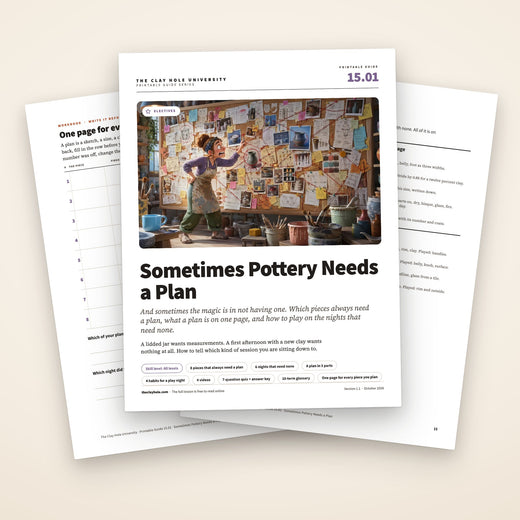
Sometimes pottery needs a plan. Sometimes the magic is in not having one.
There are two kinds of night at the wheel, and most frustration in a studio comes from having the wrong one. A set of six mugs, a lid that has to fit, a commission for a friend, a planter for a specific plant: those nights need a sketch, a number, a clay weight, a schedule and a glaze chosen from a tile, and treating them as play produces mugs that do not match. But a new form, a bag of clay and no idea, a slump you cannot throw your way out of: those nights need the plan taken away, and treating them as work produces careful, dead pots. The skill is knowing which night you are having.
This page covers the pieces that always need a plan and why, what a real plan looks like when it fits on one notebook page, the nights that need no plan at all and how to play in a way that actually teaches you something, and the middle path most working potters live on, where the parts that must fit are planned and everything else is not. Four videos, and how the studio makes both kinds of night easier.
This is the short version: which pieces need a plan, what a plan is, and which nights need none. The play habits, the reasoning, the questions and three of the four videos are in the comprehensive version.
Read it, then watch it
Why this is written down and filmed, both.
This is a page about judgment, and judgment is mostly words: which pieces need what, and why, and what happens when you get it wrong. A list of the things that need a plan is a list, and a list is what a page is for. But a plan being made is something you have to see: a potter drawing a form, adjusting a line, writing a number next to it, and then throwing that exact pot. Watching that once teaches more about what a sketch is for than any paragraph.
So read the two lists first, and then watch a potter go from a drawing to a pouring bowl. Reading gives you the categories and watching gives you the feel of a plan being obeyed, and people who do both remember the whole idea rather than one half of it. Then go to the wheel with a decision already made about which kind of night it is.
Use both, in this order
The two lists first. Then the first video, which is a plan being drawn and then thrown. Then a notebook page, or a bag of clay and nothing.
The whole idea
Some pieces have parts that have to fit. Everything else is allowed to surprise you.
If two things have to fit each other, match each other, or fit a thing that already exists, the piece needs a plan: a sketch, a size, a clay weight, a schedule for drying and firing, and a glaze chosen from a tile. If nothing has to fit anything, the piece is allowed to become whatever it becomes, and planning it kills it. Most working potters do both in the same evening: the set is planned to the quarter inch, and the handles are pulled by feel. Decide which night it is before you sit down.
The first list
Pieces that always need a plan, whatever it feels like.
Pieces that always need a plan.
The rule underneath most of these: if a part has to fit another part, match another piece, or fit a thing that already exists, wanting it to work out is not a method.
If a part has to fit, match, or meet something that already exists, it needs a plan.
One page
What a plan actually is, and why it fits on one page.
Not a spreadsheet. A notebook page you can prop against the splash pan.
A plan is five things. A sketch, in profile, with the rim, the widest point and the foot drawn as lines you can compare, because a pot is mostly its silhouette and a silhouette is easy to draw. A size, written next to the sketch as the fired height and width you want, and then the wet size after shrinkage, which for our clays at cone 5½ is the fired size divided by 0.88, since they shrink roughly twelve percent, so about fourteen percent bigger. A clay weight, from the last time you threw something that size, or from the proportions lesson. A schedule, which is when it dries, when it gets its parts, when it goes in the bisque, and when you glaze. And a glaze decision, which means a tile you have already seen.
That is the whole thing. The sketch does not need to be good; it needs to have the proportions you are aiming for so you can hold it next to the wet pot and see whether you are there. Potters who draw badly draw the same three lines and the pots come out right, because the sketch was never for anyone else.
- 1The sketchProfile only. Rim, belly, foot, as three widths you can compare. Add the lid or the handle if there is one.
- 2The sizeFired height and width, then wet height and width. Divide the fired size by 0.88, about fourteen percent bigger, which is close enough for most of our clays; measure a shrinkage bar once and know for sure.
- 3The weightFrom the last pot this size, or from the proportions lesson. Written down so the next one in the set uses the same number.
- 4The scheduleThrown, trimmed, parts on, dry, bisque, glaze, fire. Backwards from the day it is needed, with the studio’s kiln rhythm in mind.
- 5The glazeA tile you have seen, with its number, and the coats. If you have not seen it, the plan starts with making the tile.
The plan is allowed to be wrong
The first pot in a set is where the plan meets the clay. If the number was off, change the number, not the pot, and make the rest of the set to the corrected page. A plan is a hypothesis with a clay weight on it.
The second list
The nights that need no plan at all.
The nights that need no plan.
The rule underneath these: if nothing has to fit anything, a plan is a set of expectations, and expectations are what you are trying to get rid of.
If nothing has to fit anything, take the plan away on purpose.
Playing well
No plan is not the same as no rules.
A no-plan night with no structure produces a pile of pots and no lesson. Four habits keep the play honest.
- 1One form, ten times, each one differentPick a cylinder, a bowl, a bottle. Throw ten with the same clay weight and change one thing on each: the rim, the belly, the foot, the height. At the end, line them up. The one you keep looking at is the one to plan next week.
- 2Follow the clay instead of correcting itA wobble becomes a lobed rim. A collapse becomes a wide low bowl. A too-thick wall becomes a carved surface. On a plan night those are mistakes; on a play night they are the whole point, and the pot that follows them is usually the best of the ten.
- 3Keep the rejects for a weekDo not wire off and reclaim the ones you do not like on the night. Put them on the shelf under a sheet and look at them on the next visit, when you are not the person who made them. Half of the good ones are in that group.
- 4Give play pots a glazing night of their ownPlay pots want play glazing, which is its own night, with its own tiles. A play pot glazed in a hurry with the safest glaze on the wall is a play pot that taught you nothing twice.
Most nights
The middle path: plan the parts that must fit, and let go of everything else.
This is where almost every working potter actually lives.
A set of six mugs is planned to the quarter inch: same weight, same height, same rim. And then the handles are pulled by feel, one at a time, each one a little different, because a handle does not have to match anything except the hand that will hold it. A lidded jar has a gallery measured with calipers and a knob that got made up on the spot. A commission has the dimensions the friend gave you and a surface that was decided by what the clay did when you carved it. In every one of those pieces the plan covers exactly the parts that would fail without it, and stops there.
That is the whole skill of this page: not choosing between planning and playing, but knowing which part of the pot in front of you is which. The rim of a lidded jar is a plan. The belly of the same jar is play. Do the plan first, while your attention is sharp, and let the play happen in the parts that are allowed to.
A set of mugs
Planned: weight, height, rim diameter, clay. Played: the handles, the trimmed foot, the glaze on the last two.
A lidded jar
Planned: the gallery, the lid, the clay, the night both are made. Played: the belly, the knob, the surface.
A commission
Planned: the dimensions, the deadline, the glaze from a tile. Played: everything the client did not mention.
A planter
Planned: the roots, the hole, the inside. Played: the rim, the outside, the texture. Our planters lesson is exactly this split.
Watch it done
Now watch a plan get drawn and then obeyed.
Watch this one, then decide which night it is.
None of these people work here or know we exist. Between them they cover a design sketch becoming a pot, how one potter draws before making, line decoration on the surface, and the notebook habit. Nobody films a night without a plan, because there is nothing to film; that half you have to go and have. The still frames load while you read; the player and its cookies wait until you press play.
Twenty-two minutes from rough sketches to a pouring bowl. The other three videos are in the comprehensive version.
How it works here
Both kinds of night, and what the building does to each.
This page is written for potters everywhere. Here is where our studio stands.
Three things to know here
Class nights are short, so a plan here includes when the piece dries and when it fires. The Mega Glaze Tool and the Glaze Bible let you plan a glaze from a tile before you throw. And a bag of clay with no plan is always allowed; the wheels are open to every Level, the slab rollers open up with the slab certification, the slab molds step up with your membership color, and nobody is grading the rejects.
A plan includes the calendar
A class night is a few hours and a piece dries on a shelf for days between them. A plan here is mostly a schedule: thrown this visit, trimmed next, handle the one after, bisque, glaze, fire. Work backwards from the day you need it, and add more than a week: a beginner’s first finished piece takes about two months here, and the kilns fire when there is enough work to fill one.
Plan the glaze from a tile
Every glaze on the wall is already fired onto a numbered tile, in the Glaze Bible by the mold room and in the Mega Glaze Tool on your phone. Decide the glaze before you throw, and the pot gets made for it. Glazes at your Level are included, and a premium glaze costs extra, so check before you plan a piece around one.
Plan the firing cost
Glaze firing is 5 cents a cubic inch with a $4.80 minimum. A big planned piece is a known number before you open the bag; a big unplanned one is a surprise at the front desk.
Play is welcome
Wheels are open to every Level, and so are the slab rollers once you have the slab certification. The slab molds step up with your membership color, and the sticker under each one says which. Nobody counts your rejects. A night of ten cylinders you cut in half to look at the walls is a normal night here.
Keep the rejects a week
Put play pots on a bat under a sheet, with your name and the date on the bat, and decide next visit.
Ask which kind of night
The onsite instructor will tell you whether the thing you want to make tonight needs a plan. Lids, sets and teapots always do, and it saves an evening to hear it before you center.
Questions people actually ask
The ones that come up at the wheel.
How do I know which kind of night it is?
Ask whether any part of the piece has to fit, match, or meet something that already exists. If yes, plan. If no, do not. Most nights are both: plan the part that has to fit, play with the rest.
Do I have to be able to draw?
No. A plan sketch is a profile with three widths: rim, belly, foot. Nobody else sees it. Potters who draw badly draw those three lines and the pots come out right.
How much bigger do I throw for shrinkage?
Most of our clays shrink roughly twelve percent by cone 5½, so divide the finished size you want by 0.88, which is about fourteen percent bigger. Throw a ruler line into a scrap slab, fire it, and measure once to know your clay exactly.
What if the plan keeps producing bad pots?
The plan is usually wrong about the clay weight or the height, not about the idea. Change the number on the page after the first pot and make the rest to the corrected page. If the pots are technically fine and still bad, the problem is the plan itself, and a night without one is the fix.
Is play a waste of clay?
Only if you reclaim the pots before you have looked at them. Ten of one form, kept a week, is the fastest way to find the shape that is yours. Here, reclaiming happens at home, and every member can take clay home free each month from the discard barrels.
Can I plan a set and still play?
That is the whole middle path. Plan the weight, height and rim so the set matches. Pull the handles by feel. The set matches because it was planned; the handles are alive because they were not.
What about glazing? Plan or play?
Plan it from a tile for anything that matters. Play it on a night of its own, on pots you do not care about, and log what happened. Our test tile lesson covers the tiles and the log.
Related lessons
Six lessons that sit next to this one.
Three to read next.
These are the pages for the pieces that always need a plan, and the pages about finding out what to plan.
That is the whole thing
Plan the parts that have to fit. Let go of everything else.
The potters whose work you admire are not more disciplined than you and they are not more free. They have learned to be both, on different nights, and sometimes in different halves of the same pot. The set matches because it was planned. The handles sing because they were not.
If you want the reasoning behind each list, the middle path, the questions and the other three videos, switch to the comprehensive version at the top. Otherwise, decide which night this is, and go have it on purpose.
Written for potters everywhere. Where our studio does things differently, the page says so.
Which version would you like to print?
Both print clean, with the videos turned into labeled boxes you can search for later.