
 Pottery Date Night
 Bring All Your Friends Free Week
 Give a Month of Pottery
 Private Pottery Parties

 The Welcome Booklet
 Your First Ten Sessions
 The Pottery Process
 Finding the Studio
 Your Classes Never Expire
 The Four Tables
 Who’s Who
 The Rewards Program
 Flux Glazes
 The Calculators
 Kiln Tracker
 Holiday Kiln Deadlines

 Beginner’s Tool Set
 Fingernail Clippers
 Mayco Clay Mender
 Epoxy for Kintsugi
 Applicator Bottles
 Large Bead Rack
 Raku Workshop
 Nighttime Raku
 Horsehair and Feather Raku
 The Clay Hole T-Shirt
 Embroidered Crewneck
 Zip-Up Hoodie
 Pre-Made Bisqueware
 Glaze Catchers
 Kiln Cookies
 Clay Cubby Rental
 The Glaze Bible, Printed
 The Book of Molds, Printed
 Printable Pottery Guides
 Free Printable Trackers
 Gifts for Potters
 Christmas Pottery Ideas
 Mother’s Day Gift Ideas
 Pottery Date Night
 Studio Calendar
 2027 Studio Events
 What Should I Do Today?
 How to Throw on the Pottery Wheel
 How to Make a Pinch Pot
 How to Tap Center a Pot
 The Five Stages of Clay
 Is Pottery Hard to Learn?
 Pottery Wheel Practice Drills
 20 Easy Hand-Building Projects
 Everything That Sounds Wrong

 A Beautiful Piece, Every Time
 Slab Roller Tips
 Any Dish as a Slump Mold
 Slab Roller & Slab Mold Certification
 The Pottery Skill Tree
 Clay & Pottery Calculators
 Logging Your Pottery and Glazes
 The Pottery Dictionary
 Why Did My Pottery Do That?
 The Pottery Cone Chart
 Pottery Myths, Fact-Checked
 Is Handmade Pottery Food Safe?
 Incredible Ceramic Artist Videos
 How Dan Throws Giant Pots
 How to Dry Your Pottery
 The Pottery Wheel Introduction
 Pottery by Zodiac Sign
 Personality and the Pottery Wheel
 Pottery for Engineers
 ADHD, Hyperfocus, and Never Running Out
 Hobbies for Burnout
 Screen-Free Hobbies for Adults
 Every Addiction I Ever Had Lost to Art
 Functional Pottery Is Engineering
 How Do We Compare?
 Pottery Classes by City
 Every Pottery Studio in Utah
 Pottery in Draper
 Featured Members
 The Signature Wall
 Making Friends as an Adult Is Brutal
 The Clay Hole Commandments
 2027 Pottery Contests
 2027 Studio Parties
 Gallery Night

 Scream It Into the Void
 Destroy the Glaze Wall
 Daily Affirmation Cards
 Everything That Can Go Wrong
 Subscribe to Our Newsletters
 Contact The Clay Hole
 Corporate Team Building

 Glaze Combinations
 Glazes We Do Not Carry
 Making Glaze Test Tiles
 The Mega Glaze Tool
 How to Use the Mega Glaze Tool

 Glaze Brushing Techniques
 How to Use Underglaze
 How to Use Dipping Glazes
 Glaze Problems, Causes and Fixes
 The Dipping Glaze Guide

 Making a Glaze Catcher
 Fused or Sharp After Firing
 The Signature Wall
 His Viral Videos
 His Own Ceramics
 Meet Mud
Electives · The field guide to failure
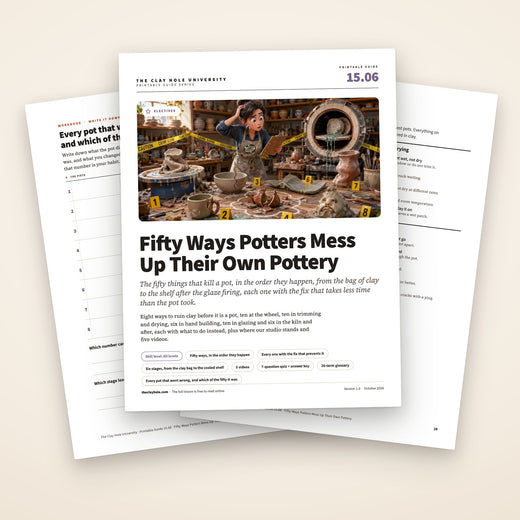
Fifty easy ways potters mess up their own pottery.
Nobody breaks a pot on purpose. Pots break because of something small that happened days earlier, at a stage nobody was paying attention to, and by the time the damage shows up the moment that caused it is long gone. This is a list of those moments, in the order they happen, from the bag of clay to the shelf after the glaze firing. None of them is a mystery. Every one of them has a fix that takes less time than the pot took.
Fifty ways, grouped by stage: preparing the clay, at the wheel, trimming and drying, hand building, glazing, and the kiln and after. Each one is a sentence about what went wrong and a sentence about what to do instead, and about a third of them link to the lesson that goes into it properly. Five videos, and where our studio stands.
This is the short version: the nineteen ways that cost the most pots, each with its fix. The rest are in the comprehensive version.
Read it, then watch it
Why this is written down and filmed, both.
A list is a list; it reads better than it films, and this one is meant to be scrolled on a phone at the wheel when a pot has just done something and you want to know which of the fifty it was. But a mistake in the making is a different thing from a mistake described, and watching a potter work through a mistake and then its fix puts the idea in your hands in a way a sentence cannot.
So read the list for the map of everything that can go wrong, and watch the videos for the handful of mistakes that need to be seen to be understood: pulling, the wheel, and cracks. Between the two you will recognize your own mistakes on sight, which is the whole game.
Use both, in this order
Skim all fifty once, fast. Then watch the first video, which goes through five common beginner mistakes in nineteen minutes. Then come back to the list the next time a pot dies.
The whole idea
Nineteen of the fifty cost the most pots.
The other thirty-one matter too, and two of them matter for safety: a vent hole in any closed form, and sanding a fired foot wet, never dry, over a bucket, with safety glasses and an N95 or better. The nineteen below are the ones that cost the most pots, in the order they happen, each with its fix.
Stage one
Preparing the clay. Eight ways to start a pot already in trouble.
Preparing the clay.
Most of what goes wrong here shows up at the wheel, as a wobble or a wall that will not hold, and by then nobody remembers the wedging.
Most of what goes wrong here shows up at the wheel, and by then nobody remembers the wedging.
Stage two
At the wheel. Ten ways, and three of them are the floor.
At the wheel.
These are the ones that feel like bad luck and are not.
These feel like bad luck. They are not.
Stage three
Trimming and drying. Ten ways, and this is where most pots actually die.
Trimming and drying.
Nothing dramatic happens at this stage, which is why nobody is watching when it goes wrong.
Nothing dramatic happens here, which is why it goes wrong.
Stage four
Hand building. Six ways, and every one is a join, a slab or a coil.
Hand building.
Hand-built pots fail at the seams, and the seams fail because of what happened when they were made.
Hand-built pots fail at the seams.
Stage five
Glazing. Ten ways, and three of them can fuse a pot to the shelf.
Glazing.
A glaze mistake can take somebody else’s pot with it.
The mistakes here can take somebody else’s pot with them.
Stage six
The kiln and after. Six ways, and half of them happen after the firing.
The kiln and after.
The last six happen after you have stopped thinking about the piece.
These happen after you have stopped thinking about the piece.
Watch it done
Now watch the mistakes happen, in five videos.
Watch this one, then pick your three.
None of these potters work here or know we exist. Between them they cover pulling, the wheel mistakes beginners run into, and reading a crack after the fact. The still frames load while you read; the player and its cookies wait until you press play.
Nineteen minutes on five mistakes most beginners run into. The other four videos are in the comprehensive version.
How it works here
Which of the fifty we see most, and what the studio does about them.
This page is written for potters everywhere. Here is where our studio stands.
Three things to know here
The four we see most: glaze on the foot, not bone dry, a handle at the wrong stiffness, unlabeled work, which is not one of the fifty. The front desk can refuse a piece that is not bone dry. A pot that died in the kiln usually died days earlier, one of these ways.
The four we see most
Glaze on the foot, not bone dry, handles at the wrong stiffness, and unlabeled work, which did not make the list of fifty. Between them they cost us more pots and more shelves than anything else on the list.
The desk can say no
A piece that is not bone dry does not go in the bisque, and the front desk is the one who decides. It is not personal. It is every other pot in that kiln.
The certifications
Dipping glaze, slab rollers and slab molds, brush-on glaze and raku each have a short course and a signed agreement, and a lot of what they ask about is on this list.
Firing fees
5 cents a cubic inch, with a flat $4.80 for 125 cubic inches or less, and bisque firings free. A pot that dies in the glaze firing still cost the firing, which is one more reason to look at this list before it goes in.
The glaze problems page
When a glazed pot comes out wrong, the glaze problems lesson reads the symptom and names the way. It is stage five of this page in much more detail.
Nobody is keeping score
Every instructor here has done most of the fifty, and the ones who have not are lying. Bring the dead pot to show and tell; it teaches the room more than a good one.
Questions people actually ask
The ones that come up at the reclaim bucket.
Which mistake ruins the most pots?
Not bone dry into the bisque, because it takes other people’s pots with it. After that, glaze on the foot, because it takes the shelf. After that, uneven walls, because thick and thin parts dry at different speeds, and that sits behind a lot of the cracks on the list.
My pot cracked. Which of the fifty was it?
An S-crack in the floor is way ten, eleven or fourteen, and all three come down to the floor drying later than the wall. A crack at a handle join is way twenty-four. A crack at the rim is way sixteen or twenty-two. A spiral crack is way eighteen. A crack across the base on a thick pot is way eleven. The last video above, on reading a crack, covers S-cracks, thermal shock, crazing and shivering.
Was it the kiln?
Occasionally, and the studio will tell you when it was. Almost every other time the pot died one of the ways above before it ever went in, and the kiln just revealed it.
Which three should I fix first?
Whichever three you know you do. Everybody has favorites. Most people’s are uneven walls, drying too fast, and too many coats of glaze.
Are hand-built pots safer?
They fail differently, not less. Joins and slabs instead of floors and rims. Ways twenty-nine through thirty-four are the hand-builder’s list.
How do I know a piece is bone dry?
Room temperature against your cheek, not cool; pale and even all the way through, no darker patches at the base; and a few more days if you are not sure. Nothing bad happens to a piece that waits.
Related lessons
Six lessons that fix most of the fifty.
Three to read next.
Sixteen of the fifty name a lesson that goes deeper. These cover the most ground.
That is the list
Every pot that died had a reason. Now you have fifty of them.
The point of a list like this is not to make you careful; careful potters make stiff pots. The point is that when a pot fails, you can look at it and know which of the fifty it was, so the next one is not the same one. Everybody on this list has been here. The good potters are just the ones who stopped repeating their favorites.
If you want all fifty, the questions and the other four videos, switch to the comprehensive version at the top. Otherwise, pick the three of these you know you do, and stop doing them this week.
Written for potters everywhere. Where our studio does things differently, the page says so.
Which version would you like to print?
Both print clean, with the videos turned into labeled boxes you can search for later.