
 Pottery Date Night
 Bring All Your Friends Free Week
 Give a Month of Pottery
 Private Pottery Parties

 The Welcome Booklet
 Your First Ten Sessions
 The Pottery Process
 Finding the Studio
 Your Classes Never Expire
 The Four Tables
 Who’s Who
 The Rewards Program
 Flux Glazes
 The Calculators
 Kiln Tracker
 Holiday Kiln Deadlines

 Beginner’s Tool Set
 Fingernail Clippers
 Mayco Clay Mender
 Epoxy for Kintsugi
 Applicator Bottles
 Large Bead Rack
 Raku Workshop
 Nighttime Raku
 Horsehair and Feather Raku
 The Clay Hole T-Shirt
 Embroidered Crewneck
 Zip-Up Hoodie
 Pre-Made Bisqueware
 Glaze Catchers
 Kiln Cookies
 Clay Cubby Rental
 The Glaze Bible, Printed
 The Book of Molds, Printed
 Printable Pottery Guides
 Free Printable Trackers
 Gifts for Potters
 Christmas Pottery Ideas
 Mother’s Day Gift Ideas
 Pottery Date Night
 Studio Calendar
 2027 Studio Events
 What Should I Do Today?
 How to Throw on the Pottery Wheel
 How to Make a Pinch Pot
 How to Tap Center a Pot
 The Five Stages of Clay
 Is Pottery Hard to Learn?
 Pottery Wheel Practice Drills
 20 Easy Hand-Building Projects
 Everything That Sounds Wrong

 A Beautiful Piece, Every Time
 Slab Roller Tips
 Any Dish as a Slump Mold
 Slab Roller & Slab Mold Certification
 The Pottery Skill Tree
 Clay & Pottery Calculators
 Logging Your Pottery and Glazes
 The Pottery Dictionary
 Why Did My Pottery Do That?
 The Pottery Cone Chart
 Pottery Myths, Fact-Checked
 Is Handmade Pottery Food Safe?
 Incredible Ceramic Artist Videos
 How Dan Throws Giant Pots
 How to Dry Your Pottery
 The Pottery Wheel Introduction
 Pottery by Zodiac Sign
 Personality and the Pottery Wheel
 Pottery for Engineers
 ADHD, Hyperfocus, and Never Running Out
 Hobbies for Burnout
 Screen-Free Hobbies for Adults
 Every Addiction I Ever Had Lost to Art
 Functional Pottery Is Engineering
 How Do We Compare?
 Pottery Classes by City
 Every Pottery Studio in Utah
 Pottery in Draper
 Featured Members
 The Signature Wall
 Making Friends as an Adult Is Brutal
 The Clay Hole Commandments
 2027 Pottery Contests
 2027 Studio Parties
 Gallery Night

 Scream It Into the Void
 Destroy the Glaze Wall
 Daily Affirmation Cards
 Everything That Can Go Wrong
 Subscribe to Our Newsletters
 Contact The Clay Hole
 Corporate Team Building

 Glaze Combinations
 Glazes We Do Not Carry
 Making Glaze Test Tiles
 The Mega Glaze Tool
 How to Use the Mega Glaze Tool

 Glaze Brushing Techniques
 How to Use Underglaze
 How to Use Dipping Glazes
 Glaze Problems, Causes and Fixes
 The Dipping Glaze Guide

 Making a Glaze Catcher
 Fused or Sharp After Firing
 The Signature Wall
 His Viral Videos
 His Own Ceramics
 Meet Mud
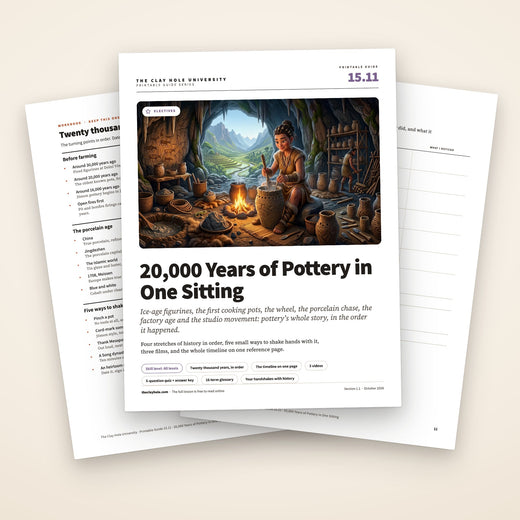
Twenty thousand years of pottery in one sitting.
Fired clay is the first synthetic material humans ever made: take mud, add fire, and get a brand-new stone that nature never offered. It is also the most stubborn witness in archaeology, because a pot may shatter but its pieces are functionally immortal, which is why so much of what we know about ancient people we know from their dishes. This page is the whole ride at highway speed: ice-age figurines that beat the first pots by millennia, cooking vessels older than farming, the wheel, the thousand-year porcelain chase, the factory age, and the studio movement that leads directly to the wheel you sat at last week. Bring snacks; humanity took its time.
Mud plus fire, twenty thousand years of consequences. Below: the whole arc in five lines, five ways to shake hands with history this month, one origin-story film.

Twenty thousand years in five lines
- Art came first: ice-age people fired ceramic figurines around 30,000 years ago, millennia before any pot existed.
- Then dinner: the oldest known pottery vessels, cooking pots from Xianrendong Cave in China, are about 20,000 years old, roughly ten thousand years older than farming in East Asia.
- The wheel arrives around 6,000 years ago in the Near East and never gets replaced; hotter kilns drive the climb from earthenware to stoneware to porcelain.
- China perfects porcelain, the world spends a thousand years chasing it, and Europe finally cracks the recipe at Meissen in 1708.
- Wedgwood industrializes it, the studio movement hands it back: Leach and Hamada champion the individual maker, and community studios like ours are that movement’s descendants. You are the newest sentence in the story.
The checklist below is whole in both versions; the full ride is one toggle away.
Deep time: art first, dinner second
The most delightful plot twist in the whole story comes first: humans fired clay into art thousands of years before anyone fired a pot.
- Around 30,000 years ago, ice-age people in what is now the Czech Republic fired small ceramic figures, including the famous Venus of Dolní Věstonice, in simple earthen hearths at a mammoth-hunters’ camp. The first known ceramics were sculpture, made for meaning, not meals. Every member who has a little figure fired before their first mug is reenacting the actual order of history.
- Around 20,000 years ago, in Xianrendong Cave in China’s Jiangxi Province, people were making the oldest known pottery vessels on Earth: simple, sturdy cooking pots, some still carrying scorch marks from ice-age dinners. That is the scene the illustration above imagines, and it predates agriculture by roughly ten thousand years. Pottery did not come from farming; hungry hunter-gatherers wanted soup.
- By around 16,000 years ago, Japan’s Jōmon culture had begun one of the longest unbroken pottery traditions in history, named for the cord-marked patterns pressed into their pots, texture as decoration, more than ten thousand years before anyone at our studio pressed a rope into a slab and felt clever. Some Jōmon pots grew flame-like sculpted rims so elaborate they barely worked as pots, proof that showing off is also ancient.
- The pattern to notice: pottery was invented independently, multiple times, on multiple continents, including the Americas and Africa, because everywhere there are humans, there is mud, fire, and the urge to make both useful and beautiful.
- And the first kilns were bonfires. Pit and bonfire firings, pots nested in fuel and burned in the open, carried the craft for many thousands of years, and they still work: the same low-fire physics lives on today in raku and pit-fire workshops.
Turning points: storage, the wheel, and hotter fire
- Farming turns pots into infrastructure. Once villages grew grain, around ten thousand years ago in the Near East, pottery became civilization’s warehouse: sealed jars for seed, oil, beer, and water. Because fired clay survives in the ground, archaeologists date whole cultures by their pot styles, and broken sherds became the ancient world’s scratch paper, reused as ballots and receipts.
- Around 6,000 years ago, somebody spun the table. True throwing from a lump of clay shows up in the Near East, building on the slow turntables that came before it, and over the next two thousand years pottery becomes one of history’s first true crafts-as-industries: faster, rounder, and a profession. Every session at our 29 wheels runs on an invention thousands of years old that has never needed replacing.
- Kilns get serious. Open bonfires gave way to enclosed kilns that could climb far hotter, and temperature became the secret axis of the whole art: hotter fire meant harder, tighter, more waterproof pots, a race that leads in a straight line to stoneware, then porcelain, then the cone charts every potter learns to read.
- Pottery becomes a canvas. Greek workshops turned amphorae and cups into painted storytelling, black-figure and red-figure scenes so good that much of what we know about Greek myth and daily life survives because somebody painted it on a pot. Surface decoration has been half the art form ever since.
- Clay also carried the words. Before paper, Mesopotamia wrote on it: cuneiform pressed into damp tablets, then sun-dried or fired, gave humanity its first great archives. For a few thousand years, clay was not just the dishes; it was the library.
The porcelain age: China makes it, everyone else loses their minds
- China cracks the code. Building on centuries of high-fire mastery, Chinese potters developed true porcelain, white, translucent, ring-like-a-bell hard, maturing through the Tang dynasty and reaching breathtaking refinement under the Song. It was so identified with its homeland that English simply calls the material china, and the Song bowls in museums still set the bar potters measure themselves against.
- Jingdezhen becomes the porcelain capital, a whole city organized around clay for a thousand years, running imperial kilns and export lines that shipped millions of pieces along the Silk Road and across the seas. It is still a working pottery mecca today, which is why it stars on our worldwide workshops page.
- The Islamic world answers with chemistry. Unable to source porcelain’s ingredients, potters across the Islamic golden age invented gorgeous workarounds: opaque tin glazes and shimmering luster, innovations that flowed into Spain and Italy and became maiolica, then Delftware, whole European traditions born from trying to imitate a Chinese cup.
- Europe finally catches up in 1708, when experiments in Meissen, Germany, at last produced true hard-paste porcelain after centuries of expensive failure. The recipe Europe chased for so long, kaolin plus high fire, is porcelain, the hottest of the three families in our clay bodies guide, sitting in plain sight the whole time.
- Blue-and-white conquers the planet. Cobalt painted under a clear glaze, perfected at Jingdezhen and traded everywhere ships could reach, became the most copied look in ceramic history, from Ottoman Iznik to Dutch Delft to the willow-pattern plates in your grandmother’s cabinet. One pigment, six centuries of fashion.
Factory to studio: how the story arrives at your wheel
The modern chapters happen fast. In the 1700s, Josiah Wedgwood turns English pottery into one of the world’s first modern industries, standardized bodies, division of labor, marketing genius, and suddenly ordinary families own matched dishes. Then the twentieth century swings back: Bernard Leach and Shōji Hamada bridge English and Japanese traditions and ignite the studio pottery movement, the idea that one person at one wheel, making honest work start to finish, is a complete artistic life. Community studios like ours are that movement’s direct descendants, and every member who pulls a wobbly first cylinder is the newest sentence in a twenty-thousand-year story.
Which deserves marking: five ways to shake hands with history this month. Tap them off; the list remembers your progress on this device.
Three videos worth your evening
One video worth your evening
A talk of about half an hour on the oldest ceramics, why hunter-gatherers took up pottery before farming, and how it spread to Europe.
One deep dive on the world’s first pottery, one short prehistory documentary on where pottery began, and one full film on the man who industrialized the craft. A note on why the page is mostly words anyway: the films bring the eras alive one at a time; reading is what hands you the whole arc in one sitting, with every chapter linked to a skill you can practice this week.
The ones history students ask
What is the oldest pottery ever found?
The oldest known pottery vessels are the cooking pots from Xianrendong Cave in Jiangxi, China, dated to roughly 20,000 years ago, with other very early finds across East Asia close behind. The oldest fired ceramics of any kind are older still: the Dolní Věstonice figurines from the Czech Republic, at around 30,000 years old. Dates get refined as archaeology improves, but the headline has held for years: pottery is far older than farming.
Why does pottery survive when everything else rots?
Because firing is a one-way door. Once clay passes through the kiln’s transformation it becomes a ceramic, chemically closer to stone than to mud, so it never softens back into clay in water, and bacteria and millennia in the ground barely touch it. Wood rots, cloth vanishes, metal corrodes, but a broken pot just waits. That is why archaeology leans so hard on pottery sherds, and why the pot you have fired this month is, in the least dramatic sense possible, permanent.
Is porcelain a different thing from pottery?
Porcelain is pottery, just the most demanding branch of the family: a white kaolin-based clay fired high enough to become translucent and glassy-hard. Earthenware, stoneware, and porcelain are three families of clay bodies sorted by how much heat they take, which is exactly how our clay bodies guide lays them out. The centuries-long European mystery was never whether porcelain was pottery; it was which clay and how much fire.
Did the pottery wheel really never get replaced?
Essentially, yes. The fast wheel of the ancient world and the electric wheel in our studio differ in motor, not in idea: a spinning platform, centered clay, and two hands. Industry added slip casting, jiggering, and 3D printing for mass production, but for one potter making one pot, a six-thousand-year-old invention remains the undefeated tool, which should make your next session feel pleasantly ancient.
Why did some great traditions never throw on the wheel?
Because the wheel is an option, not a requirement. The magnificent ceramic traditions of the pre-contact Americas, from Moche portrait vessels to Pueblo pottery, were built without the wheel, by coil, slab, paddle and, for many Moche vessels, mold, and lost nothing for it; Korea’s chest-high onggi jars are paddle-built on a slow turntable to this day. The wheel optimizes for round and fast, and plenty of the art form’s history simply wanted other things; our onggi guide is a whole page of that other wanting.
Where this leads next
Twenty thousand years of colleagues are waiting
Every tradition on this page comes down to a person, clay, and fire, all ready here: 29 wheels, hand-building tables, classes, and kilns firing to cone 5½ on schedule. Green, Yellow, Purple or Black, whichever fits how often you can get here.
Dates in deep prehistory are scholarly best estimates and get refined as archaeology improves. Every video on this page belongs to its maker, and none of them are ours. We link them because they cover the same ground. The player and its cookies wait until you press play; the only thing that loads while you read is each video’s still frame.
Which version would you like to print?
Videos come out as a labeled box with the title and channel to search for, since paper does not play them.