
 Pottery Date Night
 Bring All Your Friends Free Week
 Give a Month of Pottery
 Private Pottery Parties

 The Welcome Booklet
 Your First Ten Sessions
 The Pottery Process
 Finding the Studio
 Your Classes Never Expire
 The Four Tables
 Who’s Who
 The Rewards Program
 Flux Glazes
 The Calculators
 Kiln Tracker
 Holiday Kiln Deadlines

 Beginner’s Tool Set
 Fingernail Clippers
 Mayco Clay Mender
 Epoxy for Kintsugi
 Applicator Bottles
 Large Bead Rack
 Raku Workshop
 Nighttime Raku
 Horsehair and Feather Raku
 The Clay Hole T-Shirt
 Embroidered Crewneck
 Zip-Up Hoodie
 Pre-Made Bisqueware
 Glaze Catchers
 Kiln Cookies
 Clay Cubby Rental
 The Glaze Bible, Printed
 The Book of Molds, Printed
 Printable Pottery Guides
 Free Printable Trackers
 Gifts for Potters
 Christmas Pottery Ideas
 Mother’s Day Gift Ideas
 Pottery Date Night
 Studio Calendar
 2027 Studio Events
 What Should I Do Today?
 How to Throw on the Pottery Wheel
 How to Make a Pinch Pot
 How to Tap Center a Pot
 The Five Stages of Clay
 Is Pottery Hard to Learn?
 Pottery Wheel Practice Drills
 20 Easy Hand-Building Projects
 Everything That Sounds Wrong

 A Beautiful Piece, Every Time
 Slab Roller Tips
 Any Dish as a Slump Mold
 Slab Roller & Slab Mold Certification
 The Pottery Skill Tree
 Clay & Pottery Calculators
 Logging Your Pottery and Glazes
 The Pottery Dictionary
 Why Did My Pottery Do That?
 The Pottery Cone Chart
 Pottery Myths, Fact-Checked
 Is Handmade Pottery Food Safe?
 Incredible Ceramic Artist Videos
 How Dan Throws Giant Pots
 How to Dry Your Pottery
 The Pottery Wheel Introduction
 Pottery by Zodiac Sign
 Personality and the Pottery Wheel
 Pottery for Engineers
 ADHD, Hyperfocus, and Never Running Out
 Hobbies for Burnout
 Screen-Free Hobbies for Adults
 Every Addiction I Ever Had Lost to Art
 Functional Pottery Is Engineering
 How Do We Compare?
 Pottery Classes by City
 Every Pottery Studio in Utah
 Pottery in Draper
 Featured Members
 The Signature Wall
 Making Friends as an Adult Is Brutal
 The Clay Hole Commandments
 2027 Pottery Contests
 2027 Studio Parties
 Gallery Night

 Scream It Into the Void
 Destroy the Glaze Wall
 Daily Affirmation Cards
 Everything That Can Go Wrong
 Subscribe to Our Newsletters
 Contact The Clay Hole
 Corporate Team Building

 Glaze Combinations
 Glazes We Do Not Carry
 Making Glaze Test Tiles
 The Mega Glaze Tool
 How to Use the Mega Glaze Tool

 Glaze Brushing Techniques
 How to Use Underglaze
 How to Use Dipping Glazes
 Glaze Problems, Causes and Fixes
 The Dipping Glaze Guide

 Making a Glaze Catcher
 Fused or Sharp After Firing
 The Signature Wall
 His Viral Videos
 His Own Ceramics
 Meet Mud
Electives · A field guide
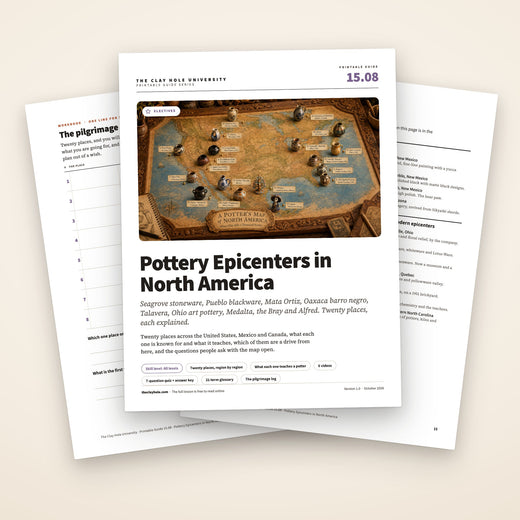
Pottery epicenters in North America.
Nobody thinks of North America as a pottery continent, and that is a mistake with a few thousand years in it. The Pueblo potters of New Mexico and Arizona were coiling and burnishing thin-walled vessels a thousand years ago and more. The Southern stoneware potters turned local clay, wood ash and salt into a tradition that is still firing. Mexico holds more living village traditions than most countries hold in total. And in the twentieth century, a foundation in Montana and a college in upstate New York rewrote what studio ceramics could be. Twenty places make up the full map, and in most of them somebody is still making pots.
This page covers the seventeen traditional and regional meccas grouped by where they are, the three modern epicenters that changed contemporary ceramics without inheriting a style, what the continent teaches, and six documentaries.
This is the short version: the ten places that give you a working map of North American ceramics, and one film. All twenty, the reasoning and the other five films are in the comprehensive version.
Read it, then watch it
Why this is written down and filmed, both.
A field guide is a map, and a map reads well. But a Pueblo potter polishing a pot with a river stone, a groundhog kiln in North Carolina being salted at full heat, a Mata Ortiz painter drawing a line finer than a hair with a brush made from a child’s hair: those are the reasons the places matter, and they only come through on film. So this page is the map, and six documentaries are the reasons.
Start with what counts, so the names attach to something. Then watch one film, and the rest of the map will make sense by contrast. Then read the full list, region by region, and notice how often the story is a family, a road, or a school rather than a technique.
Use both, in this order
What counts first. Then the Mata Ortiz film, the one we send people to. Then the rest of the list, one region at a time.
If you only learn ten
The shortest list that still captures the range of the continent.
Ten places, and between them they cover Southern stoneware, three Pueblo traditions, four Mexican ones, and the modern studio movement.
- 1Seagrove, North CarolinaTraditional American stoneware. Around a hundred working potteries spread across about twenty miles.
- 2Edgefield, South CarolinaAlkaline-glazed stoneware, and the face vessels.
- 3Acoma Pueblo, New MexicoFine-line hand-coiled pottery with impossibly thin walls.
- 4San Ildefonso Pueblo, New MexicoBlack-on-black pottery. Maria and Julian Martinez.
- 5Hopi Mesas, ArizonaSikyatki Revival pottery, and the Nampeyo family.
- 6Mata Ortiz, ChihuahuaPrecision-painted Casas Grandes revival, begun by one man in the 1970s.
- 7Oaxaca, MexicoBarro negro and a dozen village pottery traditions.
- 8Puebla and Tlaxcala, MexicoTalavera. Tin-glazed, hand-painted, protected by law.
- 9Tonalá and Tlaquepaque, JaliscoBurnished, petatillo, canelo and painted earthenware.
- 10Helena, Montana, or Alfred, New YorkModern studio ceramics. A residency and a college that changed everything after them.
Before the list
What counts, and the logic of a pilgrimage.
Traditional and regional, part one
The American South. Three stoneware traditions, still firing.
Local clay, wood ash, salt and family. Potteries here have been handing the work down for two hundred years, and the kilns are still lit.
Traditional and regional, part two
The Southwest. Four Pueblo traditions, coiled and burnished for a thousand years.
No wheel, no glaze, and some of the finest pottery on the continent. These are among the oldest living traditions on this page.
Traditional and regional, part three
Mexico. Six places, and a whole vocabulary of pottery.
Mexico holds more living village pottery traditions than most countries hold in total. These six are the ones every clay nerd should know.
Traditional and regional, part four
The industrial centers. Four places where clay met the factory.
Local clay and cheap fuel turned four towns into pottery cities, and collectors still hunt what they made.
Not one inherited style, enormous influence
The modern epicenters. Three places that changed studio ceramics without inheriting a tradition.
These belong on a pilgrimage because institutions, research, residencies and dense communities of working artists changed contemporary studio ceramics from here.
The big picture
What can North American pottery teach us?
That place matters. Clay bodies, fuel, trade, migration, Indigenous knowledge, industrialization, schools, family and residencies all shaped what got made and where. Together these twenty places cover stoneware, alkaline and salt glazes, Pueblo coil-and-burnish traditions, black-on-black and carved blackware, ultra-thin hand-built painted vessels, tin-glazed maiolica, burnished village earthenware, narrative sculpture, industrial tableware, art pottery, and the modern studio movement.
And that some of it is close. From Utah, four Pueblo traditions and the Bray are all within a long day’s drive, and Mata Ortiz is a two day trip. Nobody has to go to Jingdezhen to stand in a pottery mecca.
Watch it
Now see six of these places on film.
Watch this one, then pick a place.
None of these filmmakers work here or know we exist. Between them they cover Mata Ortiz, Seagrove, San Ildefonso, Acoma, Oaxaca and the Bray. The still frames load while you read; the player and its cookies wait until you press play.
Forty-six minutes in Mata Ortiz, from clay to firing, and the one film we send people to. The other five are in the comprehensive version.
How it connects here
Some of this map is a long day’s drive from Draper.
This page is a map of the continent. Here is where it touches our studio.
Three things to know here
The Pueblos and Helena are all within a long day’s drive of Utah, and Mata Ortiz is a two day trip. Our burnishing, coil and pinch lessons are their techniques. And the salt, soda and wood-fired lessons in the University cover the firings Seagrove and the mountain potteries use.
A day’s drive
Acoma, San Ildefonso and Santa Clara are Pueblos in New Mexico, and First Mesa is in Arizona. From Utah, those and the Bray in Helena are a long day’s drive. Mata Ortiz, a few hours south of the border, is a two day trip. Some of our members have made the trip.
Burnishing
Every Pueblo tradition, Mata Ortiz and Oaxaca share it. Our burnishing lesson is the same technique with a river stone from Utah instead of New Mexico.
Coils and pinch pots
Acoma and Mata Ortiz make some of the thinnest pots on the continent without a wheel. Our coil lesson and pinch pot lesson start where they start.
Salt, soda and wood
Seagrove salts its stoneware and the mountain potteries fire with wood. Those are the firings in our salt and soda and wood-fired lessons.
Primitive firing
Pueblo and Mata Ortiz pots are fired in the open, not in a glaze kiln. Our primitive firing lesson and pit firing lesson are the same fire.
Show and tell
We have been to a few of these places. Ask around. A photograph of a Santa Clara kiln firing at dawn is worth a semester.
Questions people actually ask
The ones that come up when the map is open.
Which one place should I learn first?
Seagrove, for the living American stoneware tradition, or San Ildefonso, for the Pueblo one. Then Mata Ortiz, which is a revival that turned a village into a pottery town in one generation.
Why are there no wheels in some of these?
Because the Pueblo, Mata Ortiz and Oaxaca traditions never needed one. Coil, pinch, scrape, burnish, paint, fire in the open. Some of the thinnest pots on earth are made that way.
What is black-on-black?
A polished black pot with matte black designs painted on it before a smothered firing. Maria and Julian Martinez worked it out at San Ildefonso around 1920. Santa Clara carves instead of paints; Oaxaca burnishes with quartz and fires in reduction.
Is Mata Ortiz an ancient tradition?
No, and that is the point. Juan Quezada rediscovered the techniques of the Paquimé ruins by studying sherds in the 1970s and taught his family and neighbors. The village had no pottery tradition fifty years ago and now has hundreds of potters.
Why do Helena and Alfred count?
Because the Archie Bray Foundation and the New York State College of Ceramics changed what studio pottery could be, for everyone who came after. Not an inherited style, but an enormous influence.
Can I visit?
Most of these places, yes. The Pueblos have their own rules about visitors and photography and they matter; check before you go. Seagrove, Mata Ortiz and the Bray welcome visitors, and Tonalá has market days.
Related lessons
Six lessons that descend from places on this map.
Three to read next.
Many of the techniques on this continent have a lesson in the University. These are the closest ones.
That is the map
Place matters. Clay, fuel, trade, migration, schools, family. Twenty times over.
What North American pottery teaches is that a tradition is never only a technique. It is a clay bed, a kind of wood, a road that trade came down, a family that stayed, a school that opened, a residency that let people experiment. Every place on this page is all of those at once, and every one of them can be reached by road.
If you want the other ten places, the modern epicenters, the reasoning and the other five films, switch to the comprehensive version at the top. Otherwise, pick one place from the ten. Several of them are a long day’s drive from Utah.
This is a field guide, not a ranking. It combines historical importance, technical influence, living pottery culture, recognizability and the distinctiveness of each place’s specialty, and it is selective on purpose.
Which version would you like to print?
Both print clean, with the videos turned into labeled boxes you can search for later.