
 Pottery Date Night
 Bring All Your Friends Free Week
 Give a Month of Pottery
 Private Pottery Parties

 The Welcome Booklet
 Your First Ten Sessions
 The Pottery Process
 Finding the Studio
 Your Classes Never Expire
 The Four Tables
 Who’s Who
 The Rewards Program
 Flux Glazes
 The Calculators
 Kiln Tracker
 Holiday Kiln Deadlines

 Beginner’s Tool Set
 Fingernail Clippers
 Mayco Clay Mender
 Epoxy for Kintsugi
 Applicator Bottles
 Large Bead Rack
 Raku Workshop
 Nighttime Raku
 Horsehair and Feather Raku
 The Clay Hole T-Shirt
 Embroidered Crewneck
 Zip-Up Hoodie
 Pre-Made Bisqueware
 Glaze Catchers
 Kiln Cookies
 Clay Cubby Rental
 The Glaze Bible, Printed
 The Book of Molds, Printed
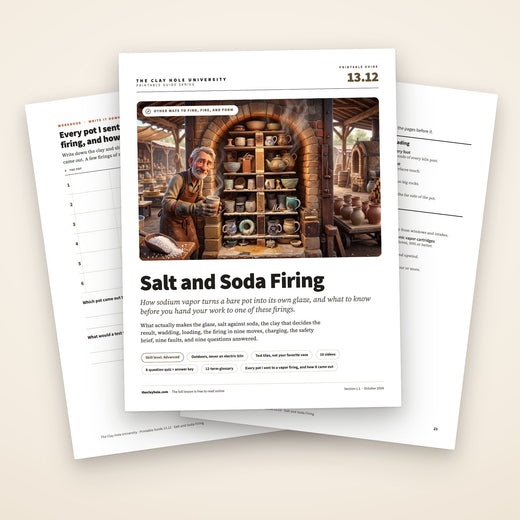
 Printable Pottery Guides
 Free Printable Trackers
 Gifts for Potters
 Christmas Pottery Ideas
 Mother’s Day Gift Ideas
 Pottery Date Night
 Studio Calendar
 2027 Studio Events
 What Should I Do Today?
 How to Throw on the Pottery Wheel
 How to Make a Pinch Pot
 How to Tap Center a Pot
 The Five Stages of Clay
 Is Pottery Hard to Learn?
 Pottery Wheel Practice Drills
 20 Easy Hand-Building Projects
 Everything That Sounds Wrong

 A Beautiful Piece, Every Time
 Slab Roller Tips
 Any Dish as a Slump Mold
 Slab Roller & Slab Mold Certification
 The Pottery Skill Tree
 Clay & Pottery Calculators
 Logging Your Pottery and Glazes
 The Pottery Dictionary
 Why Did My Pottery Do That?
 The Pottery Cone Chart
 Pottery Myths, Fact-Checked
 Is Handmade Pottery Food Safe?
 Incredible Ceramic Artist Videos
 How Dan Throws Giant Pots
 How to Dry Your Pottery
 The Pottery Wheel Introduction
 Pottery by Zodiac Sign
 Personality and the Pottery Wheel
 Pottery for Engineers
 ADHD, Hyperfocus, and Never Running Out
 Hobbies for Burnout
 Screen-Free Hobbies for Adults
 Every Addiction I Ever Had Lost to Art
 Functional Pottery Is Engineering
 How Do We Compare?
 Pottery Classes by City
 Every Pottery Studio in Utah
 Pottery in Draper
 Featured Members
 The Signature Wall
 Making Friends as an Adult Is Brutal
 The Clay Hole Commandments
 2027 Pottery Contests
 2027 Studio Parties
 Gallery Night

 Scream It Into the Void
 Destroy the Glaze Wall
 Daily Affirmation Cards
 Everything That Can Go Wrong
 Subscribe to Our Newsletters
 Contact The Clay Hole
 Corporate Team Building

 Glaze Combinations
 Glazes We Do Not Carry
 Making Glaze Test Tiles
 The Mega Glaze Tool
 How to Use the Mega Glaze Tool

 Glaze Brushing Techniques
 How to Use Underglaze
 How to Use Dipping Glazes
 Glaze Problems, Causes and Fixes
 The Dipping Glaze Guide

 Making a Glaze Catcher
 Fused or Sharp After Firing
 The Signature Wall
 His Viral Videos
 His Own Ceramics
 Meet Mud
Atmospheric firing
Salt and soda firing, where the kiln makes the glaze
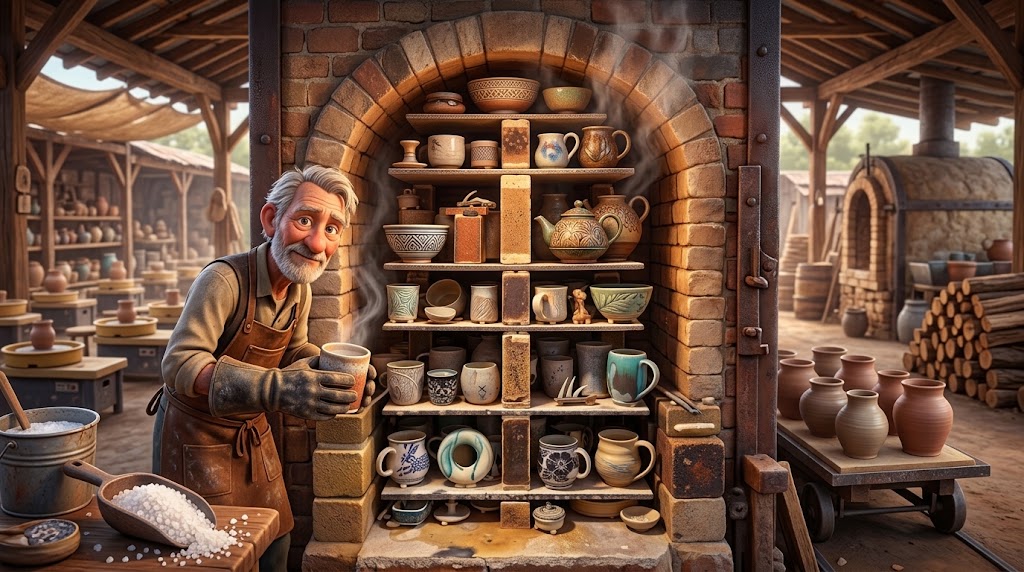
Nobody glazes the outside of these pots the usual way. Sodium goes into the kiln as salt or soda near the top of the firing, turns to vapor, rides the flame wherever the flame happens to go, and welds itself into the clay surface as glass. The pot and the glaze end up being the same object. Here is how that works, how it is done, and what you need to get right before you hand your work to one of these firings.
Written for anybody who has picked up a salt fired mug and wondered why it feels like an orange, and for anybody about to load their first soda kiln somewhere else.
The short version
Vapor glazing in seven sentences
Everything on this page rests on these seven. If you only read one band, read this one.
The glaze is not on the pot when it goes in.
You load bare clay, or clay with a thin slip on it. The surface gets made during the firing.
Sodium is the entire trick.
Salt or soda ash goes into the kiln late in the firing, from about cone 8 going over up to cone 9 or 10. The heat frees the sodium and the flame carries it as vapor.
It welds into the clay, not onto it.
Sodium meets the silica and alumina already sitting in the clay surface and turns them into glass in place. There is no layer to chip off.
Your clay body is your glaze recipe.
Two pots in different clays, sitting side by side in the same kiln, come out looking nothing like each other.
Everything gets glazed, including the shelves.
Which is why every pot sits on small refractory wads, and why every lid gets wadded in its own seat.
Where a pot sits decides how it looks.
Vapor follows flame. The front and the back of the same pot come out different, and that is the point rather than a fault.
Salt makes hydrogen chloride. Soda does not.
That one fact is why many studios now fire soda. Neither one ever happens indoors or in an electric kiln: both need a flame, a draft and a stack, and both are fuel burning firings.
Six minutes on salt glaze pottery as art and as science, with a family of North Carolina potters. Nothing loads until you press play.
What you actually prepare
- An approved clay body. Ask the kiln owner before you make anything.
- Flashing slip on leather hard work, if you want color rather than just glass.
- A liner glaze inside anything meant to hold food or drink.
- Wadding to their recipe, and more of it than you think.
- Test tiles. Several clays, several slips, so one firing teaches you something.
- Your time. Loading and firing are hours, not minutes, and they are the interesting part.
Start here
What is actually happening in there
Six minutes on salt glaze pottery as art and as science, with a family of North Carolina potters. Nothing loads until you press play.
An ordinary glaze is ground rock suspended in water. You dip a bisque pot in it, the water soaks away, and a powdery coat is left sitting on the surface waiting for the kiln to melt it. There is a pot and there is a glaze, and they meet at a boundary.
Vapor glazing has no coat and no boundary. The pot goes into the kiln bare, or wearing nothing more than a thin skin of slip. Near the top of the firing, with the kiln somewhere around 2,300°F, sodium is thrown or sprayed in. In a salt firing that sodium arrives as common salt, sodium chloride. In a soda firing it arrives as soda ash, sodium carbonate, or as ordinary baking soda.
At that temperature the material comes apart. The sodium half becomes sodium oxide, which is one of the most aggressive fluxes in ceramics, and it goes up into the kiln as a vapor riding the flame. Everywhere that vapor touches hot clay, it meets the silica and alumina already present in the clay surface and melts the three of them together into a sodium alumino-silicate glass. Which is, chemically, a close relative of window glass.
So the glaze is made out of the pot. That is the whole idea, and it explains almost every strange thing about these firings. You cannot get an even coat, because vapor is weather and not a bucket. You cannot control it from the glaze room, because the decisions that matter are which clay you chose and where in the kiln you put it. And you cannot keep it off anything, which is why the kiln shelves, the posts, the door bricks and the inside of the kiln itself all get glazed too.
The other half of the material has to go somewhere. Salt sends its chlorine up the flue as hydrogen chloride gas, which is the single most important practical fact on this page and gets its own section further down. Soda sends out carbon dioxide instead (baking soda adds a little steam), which is the entire reason soda exists.

-
Burner and firebox
Heat and flame come in down here. On a wood fired kiln this is where somebody is stoking every ten minutes for a day and a half.
-
Charging port
The salt or the soda goes in through here, in small doses, near the top of the firing. Most kilns have several, and you feed them in turn.
-
Bag wall
A short interior wall that stops raw flame from cooking the nearest pots and pushes it up into the chamber instead.
-
Wadded ware
Every pot is standing on small refractory pads. Without them the vapor glazes the pot to the shelf and both are finished.
-
Spy hole and draw ring
Small test rings hang inside on a wire. You hook one out mid firing, quench it, and read how far the glaze has built.
-
Floor flue
A downdraft kiln pulls the flame down through the ware and out at floor level, which is what drags the vapor past everything on its way through.
-
Chimney and damper
The damper sets how hard the kiln pulls, which sets the atmosphere. The chimney disperses whatever leaves, and on a salt kiln that job matters a great deal.
Why this page has both
Read it first, then watch somebody do it
Lists on the left, potters on the right
Most sections here hand you the words first and the video second. Read the list, watch the hands, then go and do the thing.
Video is the only way to show you some of this. No paragraph can tell you what it looks like when somebody pulls a brick out of a glowing kiln and shovels a cup of damp salt into 2,300 degrees, or how fast the flame answers back. You have to see it.
But video runs at the teacher's pace, not yours. When the number you needed goes past at minute eleven, you are left scrubbing a timeline with a wet thumb and starting the sentence again. Video is also terrible at holding still. A quantity, a ratio, a temperature: all of them slide off the screen while you are still thinking about the last one.
Text does the opposite job. You set the speed, your eye jumps back up a list without losing its place, and a number sits there long enough to copy down.
What we keep finding is that the order matters more than the medium. Read first and you build a frame. Then when you watch, the video drops into a frame that already exists, and you notice what the potter is choosing rather than just enjoying the fire. Watch first and it is a lovely video that leaves very little behind.
So that is how this page is built. Short blunt lists, then somebody doing it, section after section. And the lists are short on purpose, because they are meant to be read off a phone propped against a bucket by somebody with clay on their hands.
If you only have a few minutes, hit Nutshell at the top. Same teaching, a fraction of the words, and it remembers your choice on every other page on this site.
Two materials, two processes
Salt or soda, and why the difference is real
People talk about them in one breath, and the chemistry is a cousin relationship rather than a twin one. Experienced potters treat them as two different processes because they behave differently in the kiln and they leave different pots behind.
| Salt (sodium chloride) | Soda (sodium carbonate or bicarbonate) | |
|---|---|---|
| How it goes in | Damp granular salt, shoveled or pushed through ports in small charges | Dissolved in hot water and sprayed, or pushed in as a damp paste on angle iron |
| What leaves the kiln | Sodium stays behind and glazes. Hydrogen chloride gas goes up the flue | Sodium stays behind and glazes. Carbon dioxide goes up the flue (a little steam too, with baking soda) |
| Coverage | Aggressive and even. It wraps a pot and reaches into interiors | Directional and local. One side of a pot can be glassy and the other nearly dry |
| Surface | Classic heavy orange peel, glossier, more uniform | Softer dimple, closer to skin than to citrus. Brighter color response |
| What it does to the kiln | Eats refractories. Wants dense hard brick rather than soft insulating brick | Gentler. Some potters run treated insulating brick successfully |
| Where it is allowed | Restricted in some places. Outdoor kilns with tall stacks, and nowhere else | Widely used, and the reason many potters choose it over salt |
Plenty of kilns end up doing both
Plenty of potters put a little salt into a soda firing, or a handful of soda into a salt one, to borrow a bit of each character. The two are not enemies and nobody will throw you out for mixing them. What is worth knowing is that once salt has been in a kiln, it lives there.
A kiln gets seasoned
Sodium soaks into the brick over dozens of firings and comes back out later. A brand new kiln is thirsty and needs a heavy charge to do anything. A well seasoned salt kiln can produce a light glaze with no fresh salt at all, which potters call a residual firing. It also means the kiln is committed: you do not get clean firings out of it again.
Seventeen minutes that put salt, soda, wood and reduction next to each other so you can see what each atmosphere actually contributes.
Where it came from
Six centuries of very useful accident
Salt glazing at Conner Prairie in Indiana, where the potters use historically accurate techniques and a wood fired brick kiln.
Salt glazing shows up in the German Rhineland in the fifteenth century, around Cologne, Frechen and the Westerwald. Those gray jugs with the cobalt blue smears and the bearded faces on the neck are the ancestors of everything on this page.
Nobody planned it. The usual explanation is that somebody burned salt soaked driftwood, or the staves of old brine barrels, and noticed what came out of the kiln. Once noticed, it was extremely hard to argue with. You got a hard, watertight, acid resistant surface on a storage jar, in a single firing, using the cheapest material available on earth, with no glaze bucket and no second trip through the kiln.
It traveled. Staffordshire and Fulham took it up in England, and it crossed to America with German and English potters. Bennington, Red Wing and the Seagrove potteries of North Carolina all built industries on it. So did the people who made the sewer pipe under a great many American cities, which is the least romantic and most widespread use it ever had.
Industrial salt glazing largely stopped in the twentieth century, and it stopped on air quality grounds rather than aesthetic ones. Studio potters kept it alive because the surface has never been matched by anything you can apply with a brush.
Then in the 1970s potters started reaching for soda ash instead. Same sodium, same idea, same family of surfaces, and no chlorine going up the chimney. That single substitution is why atmospheric firing is still a normal thing to find at a university or a community studio today.
The decision that decides everything
Your clay body is your glaze recipe
The sodium only brings the flux. Everything else in the glass comes out of the surface it lands on, which means the pot you chose to make is most of the result before the kiln is even lit.
More silica, more glaze
A silica rich body gives the sodium plenty to work with, so it builds a thicker, glossier layer and a heavier orange peel. This is the classic salt glaze surface.
More alumina, more restraint
A high alumina porcelain gives a thinner, smoother, often satin surface. Less texture, more of the form. Whether that reads as elegant or as underdone is a matter of taste.
Iron gives you the color
Iron in the body is what produces the warm oranges, rusts and browns, and the blushing where a glazed area meets a bare one. A white body with no iron stays pale no matter how much sodium hits it.
Grog and sand make halos
Coarse particles sitting proud of the surface catch vapor differently from the clay around them, and each one can end up ringed with a small colored halo. Some potters chase this deliberately.
Flashing slips do the work
A flashing slip is a thin clay coat, usually high in kaolin, brushed or sprayed onto leather hard work. It is not a glaze. It is a surface engineered to respond to vapor, and it is where most of the orange and coral in soda fired pots comes from.
Line the insides
A vapor glazed interior is uneven by nature, and the inside of a mug is the one place you do not want a surprise. Put a real liner glaze in anything that will hold food or drink and let the outside be the atmospheric part.
Bring test tiles. Bring far too many.
The single most useful thing you can put in a first atmospheric firing is a rack of tiles: three or four clay bodies, several slips, and the same set repeated in different parts of the kiln. One firing then teaches you something you can use for years, instead of handing you six pretty mugs and no information about why.
Three minutes on sodium deposits that show up on dried casting clay, and why two kaolins behave differently.
Non-negotiable
Wadding, and why nothing sits flat
The vapor glazes whatever it can reach, and it does not care whether two things were supposed to come apart afterwards. Wadding is the answer, and it is the part first timers skimp on.
- What it is. Small pads of a refractory mix that hold your work off the shelf, break the contact, and let vapor travel underneath so the foot gets treated like the rest of the pot.
- A standard recipe. By weight, 40 parts kaolin, 10 parts ball clay, 50 parts alumina hydrate. Mix to a plastic clay and wedge it properly. The same mix doubles as shelf wash.
- Alumina is the working ingredient. It does not melt at these temperatures and it does not stick to anything, which is the entire job.
- Where it goes. Three under every foot. Under both ends of every kiln post. Between every lid and its own seat. Anywhere two surfaces touch, including your pot and a saggar.
- Size it sensibly. Pea to marble. Too small and the vapor welds through it. Too big and the pot rocks, which is worse.
- Make them stick. Wads dry out and fall off during loading, usually at the moment you decide to move a pot. Damp them and press them on firmly, and check the whole load again before the door closes.
- They leave marks. Three small scars on a foot ring are not a flaw. They are how you know a pot came out of a vapor kiln, and most potters leave them exactly as they are.
Wash the shelves too
A silica based kiln wash fluxes in a sodium atmosphere and welds itself to the shelf. Use an alumina hydrate wash, recoat it as often as it needs, and expect to scrape shelves after every firing, with safety glasses and an N95 or better. Nitride bonded silicon carbide shelves are the exception and can be scraped clean without a wash.
Mixing and placing wadding, from a potter. If anything needs grinding clean, do it wet, with safety glasses and an N95 or better.
Three minutes from a potter on an alternative to wadding the lid seat. Compare it with the wadding rule above before you copy it.
Loading is aiming
The kiln is a landscape and you are choosing addresses
Photograph the load
Before the door bricks go back in, take a picture and write down what went where. It is the difference between a firing you enjoyed and a firing you can learn from.
In an electric kiln, a shelf is storage, and here our staff do the loading for you. In a vapor kiln, every position is a different set of conditions, and choosing where a pot goes is the last real decision you make about how it will look.
Vapor follows flame, and flame follows the draft. Work near the firebox gets the heaviest deposit, the most drama and the most risk of the glaze running down onto the wads. Work further downstream gets a leaner coat, more flashing than glass, and often the subtler pots. Neither is better. They are different products from the same hour of work.
Orientation counts as much as position. The side of a pot facing the flame path is the glazed side, and the far side may be almost bare. Turn a jar ninety degrees and you have made a different jar. Potters who fire regularly build a mental map of their kiln and place work into it the way you would cast a play.
You can also shadow deliberately. A brick, a shell, a saggar, or simply another pot standing in front of yours will block vapor and leave a clean silhouette behind it. Sitting a piece on a seashell with wadding underneath leaves a shell print, because the shell calcines away and the mark stays.
One practical difference from a glaze load: leave gaps. Vapor has to be able to get around a pot to reach the far side of it, and a load packed the way you would pack a bisque kiln will come out with a lot of dry shadowed surfaces you did not ask for.
The shape of a firing
A salt or soda firing, in nine moves
A salt or soda firing, in six moves
Every kiln has its own schedule and every potter has their own opinions, but the shape underneath is fairly consistent. Somewhere between fourteen and twenty hours for a gas kiln, not counting the candling, and considerably longer once wood is involved.
- Candle it. Low heat for several hours or overnight, to drive off every trace of water. A damp load and 2,000 degrees do not get along.
- Climb in oxidation. Plenty of air, a steady rise, up through the low thousands. Nothing interesting is happening yet and that is correct.
- Body reduction. Somewhere around cone 010 to 08 most potters cut the air back for a stretch and pull oxygen out of the iron in the clay. This is where the warm colors get set up, long before any sodium arrives.
- Climb to cone 8. Neutral to lightly reduced, depending on whose kiln you are standing in front of.
- Start charging. Cone 8 going over is the usual trigger. Salt or soda goes in a little at a time, alternating ports so both sides of the kiln get fed.
- Read the draw rings. Hook a test ring out through the spy hole, quench it, look at it. That reading is what tells you whether to charge again, and it is the only honest information you get while the door is shut.
- Keep going to cone 9 or 10. More charges, spread across the last stretch. Small and frequent beats one big dose: it wears the kiln less and it builds a more even skin.
- Finish the atmosphere. A short burst of air at the end brightens the iron reds. Some potters do the opposite and cool slowly in reduction to trap carbon in the surface. Both are deliberate and they give completely different pots.
- Shut down and wait. Two to three days before the door comes off is normal. Opening early does not just cost you your own pot, it costs everybody else theirs.
- Candle it dry , then climb in oxidation.
- Reduce the body somewhere in the cone 010 to 08 range, which is where the warm colors get set up.
- Climb to cone 8 and start charging. Salt or soda, a little at a time, alternating ports.
- Pull draw rings through the spy hole to see how far the glaze has built. That reading is what tells you whether to charge again.
- Finish at cone 9 or 10 , then either burst the air for brighter iron or cool slowly in reduction for carbon.
- Shut down and leave it alone for two to three days.
Twenty six minutes of studio potters talking through how they fire their soda kiln.
Charging the kiln
Getting the sodium in there
Introducing salt or soda is called charging. The numbers below are working ranges from potters who publish theirs. Your kiln will have its own, and the only way to find them is to write everything down.
Salt
- Damp it first. Roughly five to eight percent water. The moisture is part of the reaction, and bone dry salt behaves badly going in.
- Small charges. One to two cups per charge is a common working figure, every ten to twenty minutes across an hour or more.
- Total. Half a pound to a pound per cubic foot of kiln is the usual quoted range, with the higher end for a heavy orange peel. A well seasoned kiln needs far less than a new one.
- Methods. Shoveled or angle-ironed through the ports, or wrapped in damp newspaper packets and pushed in.
- Alternate the ports so one side of the kiln does not receive everything.
- Small and often beats big and rarely. Large charges volatilize slowly, can choke the temperature climb, and chew through the refractories faster.
Soda
- Dissolve it in hot water, and know there is a ceiling. Past saturation it stops going into solution and you are just spraying grit.
- Spray it. A pump garden sprayer with a metal wand through the ports is the standard rig.
- Work in waves. Spray every port, wait fifteen to thirty minutes, go around again. Layered charges read very differently from one long soaking.
- Totals run lower than salt. Around three pounds in a small seven cubic foot kiln and six pounds in a twenty cubic foot kiln are real published working figures.
- Dry methods exist. Soda ash damped into a paste and carried in on angle iron, or briquettes of soda and sawdust set on the shelves before loading.
- Baking soda works too, and behaves a little differently. Plenty of potters use a blend of the two.
Keep a charge log or you are just gambling
Time, port, quantity, what the cones were doing, and what the draw ring looked like afterwards. It takes ten seconds a charge and it is the only thing that turns a lucky firing into a repeatable one. The potters who get consistent results out of these kilns are not more talented than you. They have better notebooks.
Four minutes with master potter Vernon Owens on salt firing and the local clay he works with.
The part we will not soften
Salt firing makes hydrogen chloride, and that is not a footnote
This is the section to read even if you skip everything else. Not because atmospheric firing is reckless, but because the whole practice is built around one hazard, and every rule you will be handed at a real kiln traces back to it.
What the chlorine does
When salt breaks down, the sodium half stays and glazes your pots. The chlorine half leaves the kiln as hydrogen chloride gas. When that meets moisture, in the air or in a person, it becomes hydrochloric acid.
Every safety office says the same three things
University environmental health departments are strikingly consistent on this. Salt glazing happens outdoors only. The stack must be tall enough to disperse what leaves, and well away from air intakes and open windows. And where you can substitute sodium carbonate for sodium chloride, do it. Some municipalities restrict salt kilns outright, so the local answer matters before the technical one.
It also eats metal
Hydrochloric acid vapor corrodes kiln hardware, tools, hinges, and anything parked nearby. Potters who salt regularly plan the whole kiln yard around that fact.
Soda produces carbon dioxide instead
That is the entire reason soda firing was developed, and it is why many potters now choose soda over salt. It is a genuine improvement on the one hazard that matters most.
It is not, however, a safe indoor process. It is still a fuel burning kiln at 2,300 degrees with open ports, combustion gases, carbon monoxide and hot vapor. It belongs outdoors with a real chimney, exactly like its older sibling.
Neither one goes near an electric kiln
Sodium vapor destroys elements. An electric kiln also has no flame to carry the vapor, no draft to move it through the ware and no stack to send anything anywhere, so there is nothing to make it work and nothing to take it away. If you have seen this suggested online, it is a reliable way to ruin a kiln and fill a room.
What people actually wear, and do
For salt, a fitted respirator with acid gas and organic vapor cartridges. For soda, eye protection, gloves and an N95 or better while you mix and spray, because soda ash is alkaline and hard on eyes, skin and lungs. For both, a face shield at the ports, glasses made for kiln glare, heat resistant gloves and sleeves, and a habit of standing upwind. Nobody fires alone: a charge cycle runs for an hour or more at full temperature with ports coming in and out, and that is not a solo job.
None of this is here to talk you out of it. It is here because the people who run these kilns take it seriously, and turning up already knowing why is the fastest way to be trusted with a port.
It will not all work
Nine ways a vapor firing disappoints you
Three ways a first firing disappoints you
Some of these are faults and some of them are the process behaving normally while you were expecting something else. Knowing which is which is most of the skill.
The pot is welded to the shelf
Wadding was too small, missing, or it dried out and fell off while you were shuffling the load. Wad every contact surface and walk the whole kiln again before the door goes on.
One side is glassy, one side is dry
That is not a fault, that is soda. If you wanted even coverage you wanted salt, or you wanted a different address in the kiln. Note where it sat and aim better next time.
The lid will not come off
The gallery was not wadded. Wad between a lid and its seat every single time, and if a lid does weld, ask whoever runs the kiln before you touch it.
The whole load is dull and gray
Not enough sodium, or it went in too late, or the kiln never truly reached temperature. A draw ring would have told you an hour before the door shut, which is exactly what draw rings are for.
It ran and pooled at the foot
Too much sodium too fast, or a glazed pot parked directly in the flame path. Smaller charges further apart, and think harder about what you put in the front row.
The shelves are ruined
Wrong wash. A silica based kiln wash fluxes under sodium and becomes part of the shelf. Alumina hydrate is what survives, and it needs recoating more often than you would like.
The interior came out bare
Salt reaches into interiors far better than soda does. If a pot needs a usable inside, line it with a glaze rather than hoping the vapor finds its way in there.
Nothing like the test tile
The tile was somewhere else in the kiln. Position is a variable in its own right, and it is the one people forget to record, which is why the same slip can produce two results in one firing.
The clay slumped
Sodium is a powerful flux and it lowers the melting point of whatever surface it lands on. A body that stands up fine at cone 10 in an electric kiln can go soft under a heavy salt charge.
The mid-range question
Can any of this happen at cone 6?
A short, practical clip from Justin Rothshank on glazing for low fire soda firing of earthenware, a step below cone 6.
Yes, and it is a real and growing practice rather than a curiosity. It is also a different animal, and it is worth being clear about why.
The traditional numbers are cone 9 to 10 for a reason. There is a lot of heat available up there, which volatilizes sodium readily and melts whatever lands. Come down to cone 6 and you have less of both, so the results are lighter, the surfaces are leaner, and the clay bodies and slips have to be more fluxed to make up the difference. People do it well, and there are studios running cone 6 soda kilns as their main practice.
What does not change at any temperature: it is still a fuel burning kiln, it is still outdoors, everything still gets wadded, and you still need a draft to move the vapor through the ware.
Why this matters to our members. We fire glaze to cone 5½, which sits right next to that territory. It means the clay bodies you already know are not automatically wrong for a cone 6 soda kiln. It also means they are entirely untested in one, because nothing you have made here has ever met sodium vapor. Which is a very good argument for arriving at your first firing with a box of test tiles rather than your favorite vase.
Where you can actually do this
Not here, and not in an electric kiln
We run four electric kilns. Bisque at cone 05, glaze at cone 5½. Electric kilns fire in oxidation, they have no flame to carry vapor, no draft to push it through a load and no stack to disperse anything, and sodium destroys elements. There is no version of salt or soda firing that happens on our floor, and we have no plans to change that.
The closest thing we do run
Raku, which is atmospheric in its own way. Pieces come out glowing at low temperature and go straight into combustible material, and the smoke does the decorating. It is dramatic, it is not food safe, it runs as a separate workshop, with a waiver and a safety meeting for everyone, and we invite everybody to take the safety certification first.
Where it does happen
- University and college ceramics departments, some of which run community firings.
- Community studios and clay centers with gas kilns, which often sell space in a firing to outside potters.
- Artist residencies, which is how a lot of people get their first proper run at it.
- Two and three day workshops, where you bring bisqueware, help load, take a shift on the firing, and unload together.
What a guest firing usually asks of you
- Work in a clay body they have approved. Ask before you make anything, not after.
- Bisqued, unless they specifically want raw work.
- No glaze on the outside unless they tell you otherwise, and a liner glaze inside anything functional.
- Wadding to their recipe, made by you, in quantity.
- Hours of your time on loading and firing. This is not a drop-off service and you would not want it to be.
A potter's first soda firing at a workshop run by somebody else. Worth watching for the expectations as much as the pots.
Asked constantly
Salt and soda questions we get
Usually asked by somebody holding a salt fired mug from a craft fair and wondering what on earth happened to it.
Is salt or soda fired pottery food safe?
Sometimes, but we cannot promise it for a firing we do not run. A well melted surface is a good start, and food safety is judged pot by pot. Ask the kiln owner what else goes into the firing, put a food safe liner glaze inside anything for food or drink (our Food Safe Lookup shows how we check ours), and treat a dry, gritty surface as unsafe.
Here is why. An under-charged pot can come out with a dry, unmelted, slightly gritty surface that never became glass at all. And unglazed interiors are common on soda work, because the vapor does not reach inside a narrow form well. If the inside is going to hold food or liquid, put a liner glaze in it and let the outside be the atmospheric part.
Why do these pots have little scars on the foot?
Wadding. Every pot is standing on small refractory pads so the vapor cannot glaze the pot and the shelf into one permanent object. Those marks are where the pads were.
Most potters leave them exactly as they are. If one is rough, smooth it wet, never dry, with safety glasses and an N95 or better. On a salt or soda pot they are a signature rather than a defect, in the same way a wood fired pot wears its ash drips.
Can I salt fire in an electric kiln?
No. Sodium vapor destroys kiln elements, and an electric kiln has no flame to carry the vapor, no draft to move it through the load and no chimney to send the byproducts anywhere. There is no safe version and no useful version.
If you want atmospheric surfaces and only have an electric kiln, the closest you can get is a colored slip or an engobe under an ordinary glaze, which gives you warm color but not the flashing, or finding a gas kiln to be a guest at.
Do I glaze my pots before a soda firing?
Sometimes, and usually only partly. A lot of vapor work goes in bare or wearing a flashing slip, with a liner glaze inside. Some work carries a full glaze that the sodium then alters, often by making it run further and shift color.
What you should not do is guess. Whoever runs the kiln has a specific answer for their firing, and it is one of the first questions to ask.
What exactly is orange peel?
The dimpled texture of a salt glazed surface, which really does feel like the skin of an orange under a thumb. It happens because the glass is forming in place on the clay rather than being applied as a smooth liquid coat and then melted flat.
More silica in the body and more salt in the kiln both push it further. Soda tends to give a softer, shallower version of the same thing.
Can you fire a normal glaze in a soda kiln?
Yes, if the glaze suits that kiln and the kiln owner says so. Our own glazes are made for our own firings, so ask before you take anything glazed to a vapor kiln. Expect it to change, though. Sodium is a strong flux, so glazes run further than they do in a clean firing, colors shift, and a reliable matte can come out glossy where the vapor hit it hardest.
That reaction is often the point rather than a problem. It is also a good reason to keep the bottom inch of a pot clear and to wad generously.
Why is the draw ring shinier than the pots?
Because a draw ring is a bare scrap of clay hanging in the vapor stream with nothing in front of it. It sees more sodium than almost anything else in the kiln.
That is exactly what makes it useful. It is an early warning rather than a fair sample, and reading it correctly means knowing it runs ahead of the load.
How long does a firing take, start to finish?
For a gas kiln, roughly fourteen to twenty hours of firing, on top of a candling period the night before and a day or more of loading. Then two to three days of cooling before anybody opens anything.
Wood fired salt and soda kilns run much longer, often a day and a half of continuous stoking with people working in shifts. That length is a large part of why these firings tend to be communal.
Is soda actually safe, or just safer?
Safer, and by a wide margin on the thing that matters most, because it swaps hydrogen chloride for carbon dioxide. That is a real difference and it is why soda largely replaced salt in teaching studios.
It is not a safe indoor process. It is a fuel burning kiln at 2,300 degrees with open ports, combustion gases, carbon monoxide and hot vapor coming out of it, and it belongs outdoors with a proper stack.
One last thing
You are not glazing the pot, you are aiming it
Everything you control happens before the door bricks go back in. The clay you chose, the slip you brushed on, the wads under the foot, and the address you gave it in the kiln. After that, the surface belongs to a vapor that moves like weather. That is the whole appeal of the thing, and it is also why the potters who are consistently good at it keep the most boring notebooks you have ever seen.
Pick the clay, slip it, wad it, place it, and then let go. The kiln decides the rest. There is a much longer version of this page behind the Comprehensive toggle at the top, with ten videos, the charging numbers and the full safety brief.
Keep going
Six pages that pair with this one
Three pages that pair with this one
What a kiln firing actually does
The electric version, stage by stage and temperature by temperature. Read this one first if any of the cone talk above went past you.
The raku firing guide
The atmospheric firing you can actually take part in here, with tongs, fire and a bin of newspaper.
Engobes, and when to use one
A thin coat of colored clay slip put on before firing. A flashing slip is the same idea, but only a vapor kiln makes it flash.
Naked raku and slip resist
Another firing where the surface is made by removing something rather than applying it.
Horsehair and feather raku
Carbon drawing on a glowing pot. Fast, theatrical, and completely unlike anything a glaze bucket can do.
The many myths of pottery
Including several about kilns, which is where the most confidently wrong advice in this craft tends to live.
Which version would you like to print?
Videos come out as a labeled box with the title and channel to search for, since paper does not play them.