
 Pottery Date Night
 Bring All Your Friends Free Week
 Give a Month of Pottery
 Private Pottery Parties

 The Welcome Booklet
 Your First Ten Sessions
 The Pottery Process
 Finding the Studio
 Your Classes Never Expire
 The Four Tables
 Who’s Who
 The Rewards Program
 Flux Glazes
 The Calculators
 Kiln Tracker
 Holiday Kiln Deadlines

 Beginner’s Tool Set
 Fingernail Clippers
 Mayco Clay Mender
 Epoxy for Kintsugi
 Applicator Bottles
 Large Bead Rack
 Raku Workshop
 Nighttime Raku
 Horsehair and Feather Raku
 The Clay Hole T-Shirt
 Embroidered Crewneck
 Zip-Up Hoodie
 Pre-Made Bisqueware
 Glaze Catchers
 Kiln Cookies
 Clay Cubby Rental
 The Glaze Bible, Printed
 The Book of Molds, Printed
 Printable Pottery Guides
 Free Printable Trackers
 Gifts for Potters
 Christmas Pottery Ideas
 Mother’s Day Gift Ideas
 Pottery Date Night
 Studio Calendar
 2027 Studio Events
 What Should I Do Today?
 How to Throw on the Pottery Wheel
 How to Make a Pinch Pot
 How to Tap Center a Pot
 The Five Stages of Clay
 Is Pottery Hard to Learn?
 Pottery Wheel Practice Drills
 20 Easy Hand-Building Projects
 Everything That Sounds Wrong

 A Beautiful Piece, Every Time
 Slab Roller Tips
 Any Dish as a Slump Mold
 Slab Roller & Slab Mold Certification
 The Pottery Skill Tree
 Clay & Pottery Calculators
 Logging Your Pottery and Glazes
 The Pottery Dictionary
 Why Did My Pottery Do That?
 The Pottery Cone Chart
 Pottery Myths, Fact-Checked
 Is Handmade Pottery Food Safe?
 Incredible Ceramic Artist Videos
 How Dan Throws Giant Pots
 How to Dry Your Pottery
 The Pottery Wheel Introduction
 Pottery by Zodiac Sign
 Personality and the Pottery Wheel
 Pottery for Engineers
 ADHD, Hyperfocus, and Never Running Out
 Hobbies for Burnout
 Screen-Free Hobbies for Adults
 Every Addiction I Ever Had Lost to Art
 Functional Pottery Is Engineering
 How Do We Compare?
 Pottery Classes by City
 Every Pottery Studio in Utah
 Pottery in Draper
 Featured Members
 The Signature Wall
 Making Friends as an Adult Is Brutal
 The Clay Hole Commandments
 2027 Pottery Contests
 2027 Studio Parties
 Gallery Night

 Scream It Into the Void
 Destroy the Glaze Wall
 Daily Affirmation Cards
 Everything That Can Go Wrong
 Subscribe to Our Newsletters
 Contact The Clay Hole
 Corporate Team Building

 Glaze Combinations
 Glazes We Do Not Carry
 Making Glaze Test Tiles
 The Mega Glaze Tool
 How to Use the Mega Glaze Tool

 Glaze Brushing Techniques
 How to Use Underglaze
 How to Use Dipping Glazes
 Glaze Problems, Causes and Fixes
 The Dipping Glaze Guide

 Making a Glaze Catcher
 Fused or Sharp After Firing
 The Signature Wall
 His Viral Videos
 His Own Ceramics
 Meet Mud
Electives · A field guide
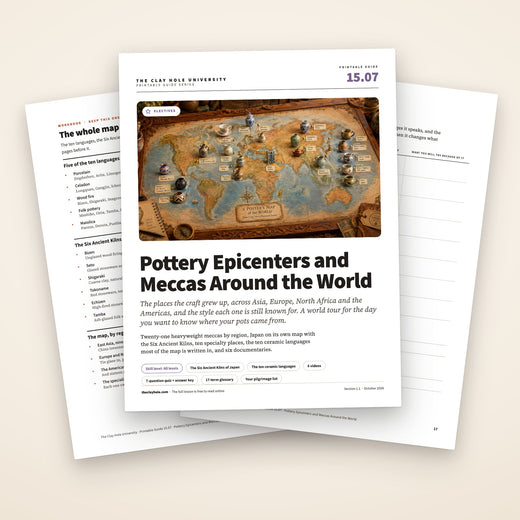
Pottery epicenters and meccas around the world.
Every one of these places is a different answer to the same question: what can you do with dirt and fire? Jingdezhen answered with porcelain so fine you can read through it. Bizen answered by refusing glaze altogether and letting the kiln paint the pot. Faenza answered in tin white and painted color, Stoke with a factory, Mata Ortiz with a coil and a paintbrush. A place becomes a pottery mecca when clay is woven into the identity of the town, when generations of makers built a recognizable tradition there, and when the local clay culture still matters today. Thirty-one of them are below.
This page covers the twenty-one heavyweight meccas grouped by region, Japan on its own map with the Six Ancient Kilns, ten specialty pilgrimage destinations, the ten ceramic languages most of the list is written in, and six documentaries. The North American places get a card each here and a page of their own.
This is the short version: the ten places that give you a working mental map of world ceramics, and one film. All thirty-one, Japan’s map, the languages and the other five films are in the comprehensive version.
Read it, then watch it
Why this is written down and filmed, both.
A field guide is a list, and a list of thirty-one places is exactly the kind of thing that reads well and films badly. But a place is not a paragraph. The sound of a kiln being stoked at three in the morning, the scale of a porcelain workshop, the way a potter’s hands move: those are the reasons the places matter, and you can only get them from film. So this page carries the map and six documentaries carry the feel.
Read the ten ceramic languages first, so the names mean something. Then watch a film about one of the places and the rest start to make sense by contrast. Then read the list region by region, and the world of ceramics, which looks enormous from outside, will turn out to be about a dozen ideas that traveled.
Use both, in this order
The ten ceramic languages first. Then the Jingdezhen film. Then the full list, one region at a time.
If you only learn ten
The fastest possible mental map of the world’s pottery.
Ten places, and between them they cover most of the ideas in ceramics. Learn what each one is known for and most of the world's traditions start to look like variations on one of them.
- 1Jingdezhen, ChinaPorcelain. Probably the closest thing pottery has to an undisputed world capital, and still full of potters.
- 2Mashiko, JapanStudio and folk pottery. Where the mingei movement got its hands dirty.
- 3Bizen, JapanWood firing and unglazed stoneware. The kiln does the decorating.
- 4Mino, JapanShino, Oribe and the tea-ware glaze traditions.
- 5Arita, JapanJapanese porcelain, and the export ware that reached Europe as Imari.
- 6Longquan, ChinaCeladon. Thick, jade-green, controlled reduction.
- 7Yixing, ChinaHandmade teapots and zisha clay.
- 8Faenza, ItalyMaiolica. The word faience comes from this town’s name.
- 9Iznik, TurkeyOttoman ceramics and tile. Cobalt, turquoise, and the raised red.
- 10Stoke-on-Trent, EnglandIndustrial pottery and tableware. The Potteries, literally.
Before the list
What counts as a mecca, and what this guide is not.
The heavyweights, part one
East Asia. Nine places where much of ceramics was invented.
China invented porcelain and celadon. Korea sent Japan potters, many of them taken there after the invasions of the 1590s. Japan turned all of it into dozens of traditions a few hours apart.
A country of kilns
Japan deserves its own pottery map.
Japan does not have a few famous pottery towns. It has dozens of traditions tied to specific places, many stretching back hundreds or more than a thousand years.
The Six Ancient Kilns
Six places that have been firing pottery continuously since the medieval period, recognized together as Japan Heritage. Two are heavyweights above; all six are here.
| Kiln | Known for |
|---|---|
| Bizen | Unglazed wood firing |
| Seto | Glazed stoneware and porcelain |
| Shigaraki | Coarse clay, natural ash, fire color, and the tanuki figures outside every shop |
| Tokoname | Red stoneware, teapots, and large storage vessels |
| Echizen | High-fired stoneware |
| Tamba | Ash-glazed folk stoneware |
Other major Japanese centers
| Place | Known for |
|---|---|
| Hagi | Soft tea ware, feldspathic glazes that craze, and a porous body that stains with use |
| Karatsu | Korean-influenced stoneware and tea ceramics |
| Kutani | Highly colorful overglaze porcelain |
| Kyoto | Kyo-yaki and Kiyomizu-yaki, and the raku tradition our raku workshops descend from |
| Okinawa | Yachimun pottery |
| Hasami | Functional porcelain |
| Koishiwara and Onta | Folk pottery, slip-decorated with chattered and brushed surfaces |
The heavyweights, part two
Europe, the Mediterranean and North Africa. Eight places.
Tin glaze arrived from the Islamic world, porcelain arrived from China, and Europe spent four hundred years trying to copy both before it built factories instead.
The heavyweights, part three
The Americas. Four places, and a page of their own.
These four are on the world list because they belong there. Our North America page gives each of them, and sixteen more, the room they deserve.
The specialists
Ten more places, each famous for one thing.
Not heavyweights, and not lesser. Each of these owns a single idea so completely that it belongs on the map.
The big picture
What can you do with dirt and fire? Ten answers.
Most places on this page speak one or two of these. Learn the ten and most of the map becomes readable.
Porcelain
Jingdezhen, Arita, Limoges, Meissen, Hasami. White, translucent, high-fired, and the material that Europe spent centuries trying to copy.
Celadon
Longquan, Gangjin, Icheon. A reduction-fired green that looks like jade and depends on iron, thickness and the kiln.
Wood fire
Bizen, Shigaraki, Seagrove. The kiln as the decorator: ash, flashing, and the pot’s position in the flame.
Folk pottery
Mashiko, Onta, Tamba, Kosiv. Functional ware made in quantity by people who did not call themselves artists, and the movement that gave that work a name.
Maiolica
Faenza, Deruta, Puebla, Talavera de la Reina. Tin-white glaze as a canvas for painted color.
Lusterware
Manises, Deruta. Metallic shimmer from a third, low, reduction firing, learned from the Islamic world.
Tea ware
Mino, Hagi, Karatsu, Kyoto, Yixing. Pots made to be held, for a ceremony that rewards the imperfect and the worn.
Architectural tile
Iznik, Fez, Delft, Puebla. Ceramics as a wall, a floor, a dome.
Industrial
Stoke-on-Trent, Limoges, Khurja. Repeatability, press molds, transfer printing, and the plate on your table.
Hand-built
Mata Ortiz, Yixing, Oaxaca, Chulucanas. Built by hand, without a wheel, at the highest level there is.
Watch it
Now see six of these places on film.
Watch this one, then pick a place.
None of these films were made by us or for us. Between them they cover Jingdezhen, Mashiko, Bizen, Stoke, Deruta and Puebla. The still frames load while you read; the player and its cookies wait until you press play.
Twenty-four minutes in Jingdezhen with a visitor. The other five films are in the comprehensive version.
How it connects here
Many of these places are already on our shelves.
This page is a map of the world. Here is where it touches Draper, Utah.
Three things to know here
Celadon on our wall came out of Chinese kilns like Longquan; our raku workshops came from Kyoto; Bizen is wood firing and Seagrove is salt glaze, and both of those firings happen somewhere other than here. Several of the ten have a glaze, a technique or a lesson here that descends from them.
The glaze wall
Celadon began in China, and Longquan is its most famous home. Tenmoku is a Chinese tea bowl. Shino and oribe are Mino. When you read a glaze name on our wall, you are reading a place.
Raku
Our raku workshops descend from Kyoto, by way of Paul Soldner and the American potters who turned a tea-bowl technique into a bonfire. The raku lesson tells that story.
Wood, salt and soda
Bizen and Shigaraki are wood firing, and Seagrove and Stoke-on-Trent are salt glaze, which came out of the German stoneware towns. Both are in our wood-fired and salt and soda lessons, and both of those firings happen somewhere other than here.
Hand building
Yixing, Mata Ortiz and Oaxaca are proof that the wheel is optional. Our coil and burnishing lessons are the techniques of Mata Ortiz and Oaxaca.
Slab molds
Stoke-on-Trent built an industry on the plaster mold, a way to make the same plate a thousand times. Our slab molds are the friendly version of that idea.
A pilgrimage
If you have been to one of these places, bring a photograph to show and tell.
Questions people actually ask
The ones that come up when the map is open.
Which one place should I learn first?
Jingdezhen. It is the closest thing pottery has to a world capital, porcelain is the material Europe spent centuries trying to copy, and it is still full of potters. After that, Mashiko and Bizen, which are two opposite answers to the question of what a pot is for.
Why is Japan so dense with pottery towns?
Clay, wood, a tea ceremony that prized handmade pots, and centuries of regional lords who supported their own kilns. Six of those kilns have been firing continuously since the medieval period, and dozens of other towns developed their own styles a few hours apart.
What is the difference between maiolica, faience and delftware?
The same idea in three languages: a white tin glaze over earthenware, painted with color, fired once more. Italy called it maiolica, France called it faience after Faenza, and the Dutch made their blue-and-white version in Delft.
Where did celadon come from?
China. It began at the Yue kilns about eighteen hundred years ago, and Longquan became its most famous home in the Song dynasty. Korea took it further with inlaid decoration at Gangjin, and every celadon on a studio wall today is a descendant.
Is Stoke-on-Trent still making pottery?
Yes, at a fraction of its peak. Several of the great names still fire there, a few of the bottle kilns are museums, and the city is still called The Potteries.
Why are the North American places so short here?
Because they have a page of their own with twenty entries. The four here are on the world list because they belong there; the North America page gives them room.
Related lessons
Six lessons that descend from places on this map.
Three to read next.
Every technique here came from somewhere. These are the somewheres, in lesson form.
That is the map
Dirt, fire, a place, and generations. Thirty-one times over.
Together these places cover porcelain, celadon, tea ware, wood firing, folk pottery, industrial ceramics, tin-glazed earthenware, lusterware, hand-built pottery, architectural tile and most of the decorated traditions that ever mattered. None of it is finished. Every one of these towns has a potter in it tonight, doing the thing.
If you want the other twenty-one places, Japan’s map, the ten languages and the other five films, switch to the comprehensive version at the top. Otherwise, pick one place from the ten and go find out everything about it.
This is a field guide, not a ranking. It combines historical importance, technical influence, living pottery culture, recognizability and the distinctiveness of each place’s specialty, and it is selective on purpose.
Which version would you like to print?
Both print clean, with the videos turned into labeled boxes you can search for later.