

 Pottery Date Night
 Bring All Your Friends Free Week
 Give a Month of Pottery
 Private Pottery Parties

 The Welcome Booklet
 Your First Ten Sessions
 The Pottery Process
 Finding the Studio
 Your Classes Never Expire
 The Four Tables
 Who’s Who
 The Rewards Program
 Flux Glazes
 The Calculators
 Kiln Tracker
 Holiday Kiln Deadlines

 Beginner’s Tool Set
 Fingernail Clippers
 Mayco Clay Mender
 Epoxy for Kintsugi
 Applicator Bottles
 Large Bead Rack
 Raku Workshop
 Nighttime Raku
 Horsehair and Feather Raku
 The Clay Hole T-Shirt
 Embroidered Crewneck
 Zip-Up Hoodie
 Pre-Made Bisqueware
 Glaze Catchers
 Kiln Cookies
 Clay Cubby Rental
 The Glaze Bible, Printed
 The Book of Molds, Printed
 Printable Pottery Guides
 Free Printable Trackers
 Gifts for Potters
 Christmas Pottery Ideas
 Mother’s Day Gift Ideas
 Pottery Date Night
 Studio Calendar
 2027 Studio Events
 What Should I Do Today?
 How to Throw on the Pottery Wheel
 How to Make a Pinch Pot
 How to Tap Center a Pot
 The Five Stages of Clay
 Is Pottery Hard to Learn?
 Pottery Wheel Practice Drills
 20 Easy Hand-Building Projects
 Everything That Sounds Wrong

 A Beautiful Piece, Every Time
 Slab Roller Tips
 Any Dish as a Slump Mold
 Slab Roller & Slab Mold Certification
 The Pottery Skill Tree
 Clay & Pottery Calculators
 Logging Your Pottery and Glazes
 The Pottery Dictionary
 Why Did My Pottery Do That?
 The Pottery Cone Chart
 Pottery Myths, Fact-Checked
 Is Handmade Pottery Food Safe?
 Incredible Ceramic Artist Videos
 How Dan Throws Giant Pots
 How to Dry Your Pottery
 The Pottery Wheel Introduction
 Pottery by Zodiac Sign
 Personality and the Pottery Wheel
 Pottery for Engineers
 ADHD, Hyperfocus, and Never Running Out
 Hobbies for Burnout
 Screen-Free Hobbies for Adults
 Every Addiction I Ever Had Lost to Art
 Functional Pottery Is Engineering
 How Do We Compare?
 Pottery Classes by City
 Every Pottery Studio in Utah
 Pottery in Draper
 Featured Members
 The Signature Wall
 Making Friends as an Adult Is Brutal
 The Clay Hole Commandments
 2027 Pottery Contests
 2027 Studio Parties
 Gallery Night

 Scream It Into the Void
 Destroy the Glaze Wall
 Daily Affirmation Cards
 Everything That Can Go Wrong
 Subscribe to Our Newsletters
 Contact The Clay Hole
 Corporate Team Building

 Glaze Combinations
 Glazes We Do Not Carry
 Making Glaze Test Tiles
 The Mega Glaze Tool
 How to Use the Mega Glaze Tool

 Glaze Brushing Techniques
 How to Use Underglaze
 How to Use Dipping Glazes
 Glaze Problems, Causes and Fixes
 The Dipping Glaze Guide

 Making a Glaze Catcher
 Fused or Sharp After Firing
 The Signature Wall
 His Viral Videos
 His Own Ceramics
 Meet Mud
Some pots carry more than others. Here is how to make one.
An urn is the most meaningful commission a potter ever takes: a vessel for a person, a pet, or a keepsake portion of either, made by hands that cared. It is also, technically, a lidded jar with three extra responsibilities: it must hold a specific volume, its lid must seat with dignity and seal for good, and it must be built to last generations. This page teaches the whole craft two ways, thrown on the wheel or built entirely by hand, with a path toggle below so you only read the method you will actually use. Everything else, the capacity math, the lid and seal design, the personalization, is shared, because it matters the same no matter how the walls go up.
A vessel for a person, a pet, or a keepsake portion of either, made by hands that cared. Below: the capacity math that cannot be wrong, the lid and seal, the seven-decision plan, and one complete build on video. The full craft, on the wheel or by hand, is one toggle away.

The urn, condensed to its duties
- The capacity cannot be wrong. One cubic inch of interior volume per pound of body weight; a standard adult urn is about 200 cubic inches, just under a gallon. Build the wet pot generous, then verify the finished, fired vessel with measured water or rice, because the fired measurement is the only one that counts. Bound for a columbarium niche? Get its dimensions in writing first.
- The lid seats deep and seals for good. A proper interior gallery or flanged cap, never a shallow decorative fit. No threads in clay: the seal is silicone or epoxy run around the flange at filling, or removable museum putty for a shelf urn, so keep the mating surfaces clean and smooth.
- Two paths. On the wheel it is a tall lidded jar thrown with patience: calipers at the gallery, lid from the same clay on the same day. By hand it is a slab base, truly blended coils, and a slab lid flanged with a coil. The toggle above holds the full walkthrough for whichever is yours.
- Built for generations. Slow drying, both firings, and a stoneware taken to maturity at cone 5½: dense enough for a shelf, a niche, or the ground.
- Permission and calendar. You are allowed to make one before anyone needs it, and the kindest urns are made that way, because the build takes weeks.
Then settle the seven decisions below before the first wedge. The full craft, capacity to inscription, is one toggle away in the Comprehensive Version.
Permission to make this pot
Two things before any clay moves. First: you are allowed to make an urn before anyone needs one. Potters practice this form on ordinary days so their hands are ready on the day it matters, and an urn that never gets used spends its life as a beautiful lidded jar, which is no failure at all. Making one for a still-thriving fourteen-year-old dog is not morbid; it is love doing prep work.
Second: give this build more calendar than usual. Between making, slow drying, two firings, and the care you will want to take at every step, a finished urn is a matter of weeks, not days. Families in the middle of loss often need a vessel faster than clay allows, which is exactly why the kindest urns are usually made ahead, with time to spare and steady hands. This page assumes you are giving the pot the schedule it deserves.
The capacity math
Everything else on this page is craft; this band is duty. An urn that comes up short is a heartbreak no glaze can fix, so the volume gets calculated first and verified last.
- The standard rule: one cubic inch per pound. The funeral industry’s long-standing guideline is roughly one cubic inch of interior capacity per pound of body weight before cremation. A standard adult urn is built to about 200 cubic inches, and the same one-to-one rule sizes a pet urn from the pet’s weight.
- A gallon is your gut check. One US gallon is 231 cubic inches, so a standard adult urn holds just under a gallon. If you can picture a gallon of milk fitting inside with a little room to spare, your interior is in the right neighborhood.
- Build generous, then verify. Clay shrinks roughly 10 to 13 percent in every direction on its way to fired, which compounds into a much bigger loss of volume than intuition expects. Aim your wet interior comfortably past the target, then verify the finished, fired vessel the honest way: fill it with measured water or dry rice and do the arithmetic. The fired measurement is the only one that counts.
- Measure the destination too. If the urn is bound for a columbarium niche, get the niche’s interior dimensions in writing before you build; many niches are compact, and a magnificent urn that does not fit its home is the second heartbreak this band exists to prevent. Burial vaults and home shelves are roomier, but ask anyway.
- Keepsake urns are exempt from all of it. Small companion vessels holding a token portion can be any size the heart wants, which makes them a gentle first urn project.
The lid and the seal
An urn lid has two jobs an ordinary jar lid does not: it must seat with quiet dignity in a hard moment, and it must be sealable for good. Both are design decisions you make before any clay moves.
- Choose a deep-seated style. A lid dropped into a proper interior gallery, or a cap style with a generous inner flange, seats positively and cannot skate. Shallow, decorative fits that shrug off with a bump have no place here. The measuring discipline, calipers at the wheel, lid and body from the same clay on the same day, a little clearance built in for glaze, is the same one from our lids that fit page .
- Forget threads; plan the seal. Clay does not do screw threads worth trusting, and it does not need to. The universal practice is a mechanical fit finished with an adhesive seal at the time of filling: clear silicone or two-part epoxy run around the flange seats the lid permanently, invisibly, and reversibly-with-effort. For an urn that will stay on a shelf and may be opened, a bead of removable museum putty holds the lid honest instead. Design the flange so either seal has a clean surface to grip, which mostly means leaving the mating surfaces unglazed or lightly glazed and smooth.
- Give the knob some gravity. A hollow, generous knob or a low domed cap reads calm and handles surely. This is one pot where a whimsical knob usually strikes the wrong note, though for a pet urn, a small sculpted ear or paw can be exactly the right one.
- Vent nothing, trap nothing. Unlike a casserole, an urn wants no steam hole and no rattling parts: one body, one lid, one clean interior with no interior ledges to catch. Simple inside, expressive outside.
Throwing the urn
On the wheel, an urn is a tall, generous lidded jar thrown with unusual patience. The sequence:
- Weigh for the volume, not the vibe. Work backward from your interior target: a standard adult urn wants a serious lump of clay, and centering it is the day’s first real work. If that much clay is past your comfort, throw the body in two joined pieces; the whole craft of stacking thrown sections lives on our sections page .
- Throw the cylinder tall and even, then shape. Pull an even-walled cylinder first and only then swell the belly and ease in the shoulder. Even walls are not just craft pride here; they are how the finished pot survives decades of seasons intact.
- Cut the gallery while the rim is true. Split the rim and form the interior gallery in the same session the body is thrown, then measure it with calipers immediately, twice.
- Throw the lid to the number, same clay, same day. Off the hump or on its own bat, thrown a breath generous so the glazed fit lands easy. Check it on the leather-hard body before trimming and adjust while adjustment is still possible.
- Trim a foot that plants. A wide, flat, softly finished foot ring: this pot should sit like it intends to stay. Then dry the body and lid together, slowly, under loose plastic, so they arrive at bone dry as the matched pair they were born.
Building the urn by hand
No wheel, no problem: coil and slab construction has been building vessels of exactly this gravity for thousands of years, and it offers forms the wheel cannot. The sequence:
- Start from a slab base cut to plan. Draw the footprint, cut a sturdy slab base, and set it on a banding wheel or turntable so the build can grow evenly from all sides.
- Coil the walls up in patient rounds. Even ropes, each one scored, slipped, and truly blended into the last so the wall becomes one continuous body rather than a stack of seams. Our even coils page and coil blending page carry the technique; a grogged clay body carries the height.
- Paddle and compress as you climb. A paddle outside against a hand inside trues the curve, compresses the wall, and quietly erases the build. Rest the piece whenever the fresh rounds go soft; big hand-built work is a series of patient sessions, not one heroic afternoon.
- Build the gallery as a shelf coil. At the rim, attach an interior coil and shape it into a level gallery seat with a vertical inner wall, then verify it round and true with a template card cut to your lid’s diameter.
- Make the lid from a slab, flanged with a coil. Cut the lid from a firm slab against your template, dome it gently over a soft form if you like, and attach a coil flange underneath, sized to drop into the gallery with a little room for glaze. Fit it to the leather-hard body, adjust, then dry lid and body together, slowly, under loose plastic.
Personalizing: names, dates, and quiet surfaces
This is where an urn stops being a vessel and starts being a portrait. The full menu of surface techniques lives on our giant surface design guide ; these are the ones that serve this pot best.
- Inscriptions that outlast everything. A name and dates carved at leather hard, or inlaid mishima-style so the letters sit flush and razor sharp, become part of the clay itself. Practice the lettering on a test slab first; carve the real thing when your hand has the phrase memorized.
- Imagery in underglaze. A brushed motif, the mountains they loved, a curled-up cat, a fly-fishing line mid cast, painted in underglaze and sealed beneath a clear or softly transparent glaze. Photographic ceramic decals are also a real option, applied after the glaze fire in an additional cooler firing; talk to the front desk before planning one so you know what is currently possible.
- Choose a glaze that behaves. This is the pot for a proven, stable glaze in a quiet register, not a wild-motion experiment that might run over your carved letters. Test the exact glaze over the exact technique on a tile first; our glaze finder exists to shortlist candidates. Glaze the interior smooth and simple, keep the gallery’s mating surfaces clean for the seal, and let the outside do the speaking.
- Fired to last. The whole build rides our normal bisque and cone 5½ glaze firings, and a mid-fire stoneware taken to maturity is dense, tight, and built for generations on a shelf, in a niche, or in the ground.
The urn plan: seven decisions on paper first
Every hard moment in this build gets easier if it was decided in advance. Tap each one off as you settle it; the list remembers your progress on this device.
The videos worth your evening
One video worth your evening
One complete build: a working potter making a real urn start to finish, with the care the object deserves. Reading gave you the duties; this is the craft, whichever path you take.
The path toggle above works here too: one complete urn build that everyone should watch, plus the deep dives for the path you chose. A note on why the page is mostly words anyway: the videos show the hands; reading is what carries the capacity math, the seal plan, and the seven decisions no video will make for you. Watch for the craft, read for the duty.
The ones we get asked, gently
Can any lidded jar serve as an urn?
Structurally, yes: an urn is a lidded jar that meets three extra standards. Verify the fired interior capacity against the one-cubic-inch-per-pound rule, make sure the lid seats deep enough to seal properly, and be sure the pot is fired to full maturity so it lasts. A beloved jar you already made can absolutely be promoted to the role once it passes those three checks; many of the most meaningful urns are.
How long does an urn take to make?
Weeks. The making itself is a session or a few, but slow drying is non-negotiable for a pot this important, and then the bisque and glaze firings add their own calendar. If a family needs a vessel sooner than clay allows, the kind answer is a temporary container now and your urn when it is truly ready, or an urn you wisely made ahead.
Is stoneware durable enough to bury?
Yes. A mid-fire stoneware taken to maturity in our cone 5½ glaze firings is dense, hard, and nearly non-absorbent, the same material family that survives centuries in the ground at archaeological digs. For burial, many cemeteries place the urn inside an urn vault regardless, so ask the cemetery about their requirements; for a niche or a shelf, fired stoneware will outlast all of us without trying.
What do I charge, or do I charge, for an urn commission?
There is no wrong answer, but decide before you start. Some potters make urns only as gifts; others treat them as their most serious commissions and price them accordingly, since the hours, the care, and the stakes are real. The one rule we would offer: never let an unclear arrangement hang over this particular pot. Settle it kindly up front so the making stays about the person it honors.
Where this leads next
Practice the form before the day it matters
The potters who make beautiful urns made a lot of lidded jars first. A Clay Hole membership gets you 29 wheels, the hand-building tables, the classes, and the kilns, everything this page asks for, plus people who will understand exactly why you are making this pot. Green, Yellow, Purple or Black, whichever fits how often you can get here.
Every video on this page belongs to the potter who made it, and none of them are ours. We link them because they are excellent. The player and its cookies wait until you press play; the only thing that loads while you read is each video’s still frame.
Which version would you like to print?
Videos come out as a labeled box with the title and channel to search for, since paper does not play them.
- Choosing a selection results in a full page refresh.
- Opens in a new window.
New member deal
30 of 30 discounted spots left this month
Every month we discount 30 new memberships. Then that is it until the 1st.
Tell us where to send it and this month’s deal lands in your inbox. If this month runs out, you get next month’s before it opens.
Almost done
Where should we send it?
Done
On its way.
It should land in the next few minutes. One thing while you wait: we are members only and we do not run walk-in tours, so the virtual tour is the closest you can get to standing in one.
Test mode. Visitors are not seeing this.
One question
Would you want to know if a Clay Hole opened near you?
We started in Draper, Utah, and we would like to be in more places than that. Where they go next is the part we have not worked out yet.
Where are you?
The zip code is the part that counts.
That is how we work out where the demand actually is. The rest is so we know who to tell.
Got it
You are on the map.
Being straight with you: this could be a long wait, and we will not email you in the meantime. If your area is where the numbers land, you will be the first to know.
Test mode. Visitors are not seeing this.
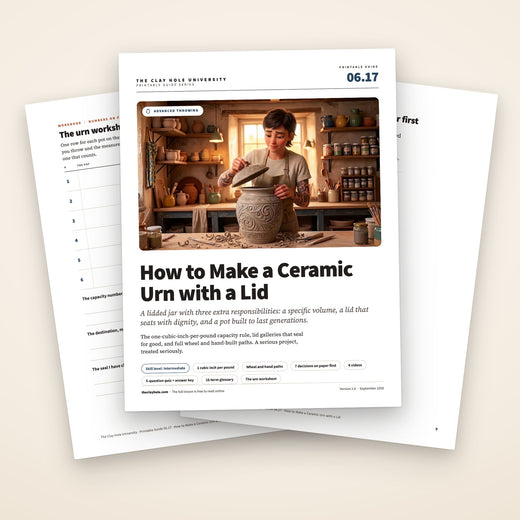
Keep this lesson open beside you
How to Make a Ceramic Urn with a Lid, as a printable guide. A lidded jar with three extra responsibilities: a specific volume, a lid that seats with dignity, and a pot built to last generations.