

Making friends as an adult is brutal.
It is not your fault, and I would like to show you why. Where all the rooms went, what it actually takes to walk into one, and why I built this one out of clay and concrete in Draper.
Somebody texted the studio at 9:40 on a Tuesday night to ask if it would be weird to come alone. Not whether we had space. Not what it cost. Whether it would be weird.
I have been getting some version of that text since the week we opened, and it is almost never actually about pottery. Nobody is nervous about a bag of clay. They are nervous about walking into a room where everybody already seems to know each other, and being the one person standing there holding nothing.
I wrote back something useless and encouraging, the way you do. Then I sat in my truck in the lot for a while, because that text bothered me and it took me a minute to work out why.
That question would not have existed when we were twenty.
Until about twenty five, somebody else handles your friendships for you. School, the dorm, the first job. It is proximity you never had to arrange, and it is the only reason any of this ever felt easy. Then it stops, nobody announces it, and you spend the next decade assuming you got worse at something.
You did not. Meanwhile the rooms where adults used to bump into each other on purpose have mostly closed, moved onto a screen, or started charging by the hour. So the bumping stopped too.
···Think about how you got your last real friend. Not an acquaintance. A friend. Somebody who has helped you carry something heavy up a staircase and complained the entire time.
I would bet almost anything that you did not go out and get them. I bet they were just there. Same hallway. Same dorm floor. Same shift. Same terrible first job where everybody was twenty three and nobody could afford a couch. You stood near each other enough times and a friend fell out of it.
That was not you being good at people. That was proximity. Assigned to you. By an institution. On a schedule. For free.
And then one day it stops. Here is the mean part, and I do mean mean. It stops quietly. There is no exit interview. Nobody hands you a pamphlet on the way out that says from here on out you build this yourself, on purpose, in your spare time, which incidentally you also no longer have. You just notice, on some ordinary Tuesday, that your best friend lives in another state, your group chat has not moved since March, and the last new person you met is a coworker you have only ever seen from the shoulders up.
I hit that wall in my thirties and decided it was a me problem. I was sure it was a me problem. I have spent my whole career being professionally likable. I have written things that millions of people read. I can hold a dinner table for three hours and I am genuinely good at it, which I mention only so you understand how confused I was when I sat down one night and could not name the last new friend I had made.
Years. It had been years. So obviously I concluded I was broken.
I was not broken. Neither are you. The machinery changed.
Somebody smarter than me put a name on this in 1989, which is a little annoying, because it means we have known about it for my entire adult life and did nothing.
A sociologist named Ray Oldenburg wrote a book where he called your home the first place and your work the second place, and then he named the third one. A third place is anywhere you turn up regularly that is neither of those. The barbershop. The diner counter with the same four regulars. The bowling league. The church hall on a weeknight. The bar where somebody says your name when the door opens.
His whole argument was that those rooms are where a community actually gets made, and that we were busy losing them.
He wrote that in 1989. Go look around.
Almost everything left has a cover charge. You are welcome to sit as long as you keep buying, and if you sit too long without buying there is a word for that, and the word is not regular.
Families spread out. People move for work and then move again. The cousins are a plane ride away, and that Sunday table that used to quietly eat an entire afternoon of your social life is not there anymore, and nothing replaced it.
Everybody works more, and works everywhere. Work followed us home and then followed us into the evening, one quick thing before dinner at a time. The second place ate the third one.
And then the screen showed up and did the cruelest thing of all, which was to be almost good enough. It hands you the feed of a friendship with none of the hours in it. It is close enough that you stop noticing what is missing. That is the worst possible amount of close.
Whatever is still standing mostly wants a reservation. A ticket, a start time, an end time, a party of four. That is an event. Events are lovely. Nobody in the history of the world has ever become a regular at an event.
···Now the part I would rather say myself than have you notice on your own.
The Clay Hole is not a public square. It costs money. There is a membership and there is a door that opens for the people who pay it, which makes it exactly the kind of buy-your-way-in room Oldenburg spent a good portion of the book discussing.
I am not going to pretend otherwise. I cannot make rent otherwise.
What I could do was make the money buy a place instead of a session. So there is no clock running while you work, no per-hour charge, no booking a slot and hoping. You get moments that are yours every week and a shelf with your name on it. If I am going to charge somebody for a room, that is the least the charge can buy.
Every book and article and well-meaning podcast about adult friendship eventually admits the same embarrassing thing, which is that there is no technique. There is no opening line. It is not charisma, and it is not some skill everybody else got issued and you missed.
It is repetition. And repetition is boring as hell, which is exactly why nobody sells it to you.
Here is the only line in this letter I would call a rule, and it is the whole thing.
You cannot schedule a friendship. You can only schedule the room.
That is why this place runs on a monthly membership instead of drop-ins and one-off classes. The room is the point. The clay is the excuse. The rest happens slower than you want and sooner than you think, and you do not have to be good at any of it.
As far as I can tell it takes three things at once, and not one of the three is a personality trait.
Repetition nobody has to negotiate. The same people, the same night, with nobody having to send hey, are we still on. A standing night survives a bad week. A friendship made entirely of individually scheduled coffees dies the first time one gets canceled, because it was never anything except those coffees.
Something to do with your hands. Two adults across a table with nothing in front of them is an interview. Two adults side by side with a job in front of them is a conversation, and it can stop and start four separate times without anybody feeling strange about the gaps.
No agenda at all. The second a room has a stated purpose, network, mingle, meet somebody, every person in it turns into a candidate being evaluated, and so do you. Rooms where nothing is supposed to happen are the only rooms where anything does.
Read that list again if you are the person whose shoulders went up at the word community. Present, on a schedule, doing something. That is the entire qualification. Nobody is grading your small talk.
···And I want to tell you why a pottery wheel is so unreasonably good at this, because it took me an embarrassingly long time to work it out myself.
Your eyes get a job. Face to face, a silence is a thing you are failing at. Side by side, with a pot spinning in front of both of you, a silence is two people concentrating, and the pauses stop counting against you.
The opener is not about you either. What are you making is a question anybody can ask and anybody can answer, and it is not small talk, because there is an actual object sitting on the table doing the work.
Being quiet reads as busy. Nobody in there thinks you are standoffish. They think you are trimming.
And everything collapses in public. Your pot goes down. Theirs goes down twenty minutes later.
Shared, visible, low stakes failure is the fastest bonding agent I have ever watched work, and this building manufactures it in every single class, on purpose, at scale.
Let me show you the math, because the number is a lot smaller than the fear.
A class here runs three and a half hours. Come once a week and that is about fourteen hours a month, and somewhere near a hundred and eighty hours across a year, in the same room, with mostly the same faces, doing something with your hands.
That number matters because of another one. The figure that gets thrown around is that it takes something like two hundred hours with a person before they are actually your friend. Two hundred hours sounds impossible when you are looking at a calendar that is already full.
It is one evening a week for a bit over a year.
Come more often than that and the math moves faster, which is honestly most of what the higher Levels are buying you. But once a week gets there, and once a week is the whole ask.
That is why I keep repeating the boring part. You do not have to be interesting. You have to be there, roughly weekly, for longer than feels reasonable while you are doing it.
And you will not feel it happening. I need you to believe that in advance, because not feeling it is exactly what makes people quit. Hours three through ten feel like nothing at all.
Hour forty feels like a place you go.
You will also miss weeks, because you have a life and everybody misses weeks. Nothing resets when you do. The hours you already put in are still in the bank, and the room does not start over on you.
Almost none of this room is an accident, and I would rather you know that than believe it is magic. I ran a much smaller studio for three years before this one, and most of what follows is me fixing something I watched go wrong in there.
A monthly membership instead of drop-ins and one-off classes, because an hour here and there gets you a craft and turning up all month gets you the same faces. Your own shelf with your name on it, because it turns out that when your things live somewhere, so do you. Name stands at every station, which are not name tags and I would like that on the record, because a name tag makes a room feel like a conference. Just a little stand with your name on it sitting at your spot, so the person across the table can learn who you are without having to admit they forgot.
Free Week five weeks a year, when any member brings anybody new for nothing, no pass and no RSVP, which exists for exactly one reason, and the reason is that nobody should have to do a first night by themselves. A wall people sign, where no name has ever been taken down. Class photos, because being seen making a thing is most of the point. And a dog named Mud, thirty five pounds of him, who has personally rescued more nervous first nights than any human I employ.
···Now the list I am actually prouder of.
No forced icebreakers. Nobody is going to make you stand up and say your name and one fun fact. I have sat through that and I wanted to leave through a window. Asking the person next to you what they are making is a different thing entirely, and it works.
No assigned partners. You sit where you want. If that is the far end by yourself for six straight weeks, that is a completely legitimate way to be a member here and not one person will bother you about it.
No forced mingling of any kind. No mixers, no group challenges, no getting-to-know-you exercises. Every single one of those things is aimed at precisely the people it drives out the door.
No leaderboard. Nothing in the building ranks you against the person beside you, because the moment a room has a ranking it stops being a room. Except that there is almost always a studio-wide contest running, with real winners and real prizes, so I am lying to you a little. In my defense, nobody has ever come last in one of those, mostly because I do not publish that part.
And no obligation to talk to me. I am around a lot. Being friendly at you is not a service you are paying for, and you are allowed to nod and go back to your clay.
The room does the work. It just needs you in it more than once, and every clever mechanism I have ever seen invented to speed that up has made it slower.
Now the part I actually sat down to write.
If the thing standing between you and this is not the money and not the talent, but the twelve feet of parking lot between your car and a door with strangers behind it, I am not going to tell you that is all in your head.
It is not in your head. It is real, and it is awful, and I have watched people sit out there and then drive home.
So here is everything I know that helps. It is embarrassingly ordinary.
One. If you know somebody who comes here, get them to bring you on a Free Week. One person you already know is the easiest on-ramp there is, and Free Week is exactly the excuse to ask them. If you do not know a soul, those are still the friendliest weeks of the year, because half the room is new too.
Two. Pick your night and then stop deciding. The weekly decision is what kills this, every single time. Pick Tuesday. Then never think about it again. Anything you have to choose all over again every week is a thing you will eventually not choose.
Three. Get there fifteen minutes early. That is as early as we let anybody in, and it is the only unstructured stretch of the whole night, so it is where the talking happens. Turn up right as class starts and you have skipped the entire social portion of the evening.
Four. Ask about the object, never about the person. What are you making beats so what do you do by a mile, because there is something on the table to point at and nobody has to perform. It has never once annoyed anybody in this building.
Five. Sit somewhere different once. Not every week. Once. You do not need a strategy, you just need to not accidentally build a wall out of the same three feet of table.
Six. Give it six weeks before you decide anything. Not two. Six. And if you want to know why six, keep reading, because the middle of it feels like failure and it is not.
Here is what actually happens, near enough, to almost everybody.
Week one you are a stranger and you know it. You will be extremely aware of your own hands. You will leave slightly deflated and slightly proud at the same time, and both of those are correct and neither one means anything yet.
Weeks two and three are the dip. Nothing has happened. Nobody has learned your name. You start quietly doing math on what you are paying for this. This is where most people stop, and it is the worst possible week in the whole process to make a decision.
Week three is a liar.
Week three is a liar. Nothing has gone wrong and you are exactly on schedule, and the only reason it feels like failure is that nobody ever tells you the shape of this.
Week four or five, somebody says your name. An instructor first, usually, then whoever tends to sit near you. It is a tiny thing. It also completely changes the feeling of the drive over, which you will notice on the way and think nothing of.
And then somewhere around week six or eight, there is a wheel you think of as yours. And one night somebody says hey, where were you last week. That sentence is the whole thing. That is what you came for. And it shows up with absolutely no ceremony, usually while you are carrying a bucket.
I should tell you who does not get there, because some people do not, and I would be lying if I dressed that up. It is almost never the shy ones. It is the ones who came twice in eleven weeks and then decided the room was cliquey.
Frequency beats personality. Not by a little.
One more thing and then I will let you go.
I did not build this place because I love kilns. I do love kilns. That is not the reason. I built it because I could not find the room I wanted to be in, and I got old enough to work out that nobody was going to build it for me.
So if you are reading this at eleven at night, quietly wondering whether it is a little sad to go looking for somewhere to belong on purpose, at your age, with a calendar that is already full: it is not sad. After twenty five it is the only way anybody gets one. Every person you know who seems to have a whole community around them is not luckier than you, and is not better at this than you. They just kept turning up somewhere on a Tuesday.
Every person you know who seems to have a whole community around them is not luckier than you, and is not better at this than you. They just kept turning up somewhere on a Tuesday. That is the entire secret and it is a deeply boring one.
Pick a night. Then keep picking it.
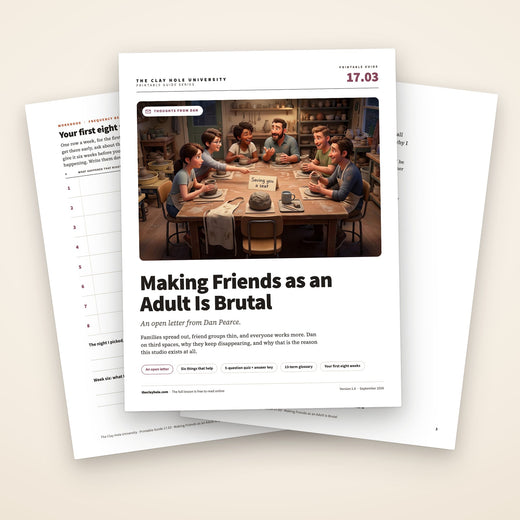
And glance at the picture at the top of this letter one more time. There is an empty chair pulled up to our tables here and it is not decoration. That is the whole idea of the building, drawn out. Somebody is saving you a seat. They just have not met you yet.
DanDan Pearce, founder of The Clay HoleDraper, Utah
P.S. If you read all of that and the only thought in your head is yes, but I am the exception, you are not. That sentence turns up in my texts about once a week, from people who have since become the ones other members are nervous about approaching.
P.P.S. The two hundred hour thing is not mine and I did not invent it to sell memberships. It is the number that keeps coming up wherever people study this, and it is the most useful thing I know, because it turns a mystery into arithmetic you can actually do on a calendar.
If you want more of this: The Signature Wall is the companion to this letter, and Comparison Is the Thief of Joy is the other half of being in a room full of people.
And if you are curious about me: the full story, wins and faceplants included.
Both come out as plain text with nothing hidden behind a tap.