
 Pottery Date Night
 Bring All Your Friends Free Week
 Give a Month of Pottery
 Private Pottery Parties


 The Welcome Booklet
 Your First Ten Sessions
 Finding the Studio
 Your Classes Never Expire
 The Four Tables
 Who’s Who
 The Rewards Program

 Flux Glazes
 The Calculators
 Kiln Tracker
 Holiday Kiln Deadlines


 Raku Workshop
 Nighttime Raku
 Horsehair and Feather Raku

 The Clay Hole T-Shirt
 Embroidered Crewneck
 Zip-Up Hoodie
 Pre-Made Bisqueware
 Glaze Catchers
 Kiln Cookies
 Clay Cubby Rental

 The Glaze Bible, Printed
 The Book of Molds, Printed
 Printable Pottery Guides
 Free Printable Trackers

 Gifts for Potters
 Christmas Pottery Ideas
 Mother’s Day Gift Ideas
 Pottery Date Night

 Studio Calendar
 2027 Studio Events
 What Should I Do Today?

 How to Throw on the Pottery Wheel
 How to Make a Pinch Pot
 How to Tap Center a Pot
 The Five Stages of Clay

 Is Pottery Hard to Learn?
 Pottery Wheel Practice Drills
 20 Easy Hand-Building Projects
 Everything That Sounds Wrong


 A Beautiful Piece, Every Time
 Slab Roller Tips
 Any Dish as a Slump Mold
 Slab Roller & Slab Mold Certification

 All Beginner Bundle
 All Intermediate Bundle

 The Pottery Skill Tree
 Clay & Pottery Calculators
 Logging Your Pottery and Glazes


 How Do We Compare?
 Pottery Classes by City
 Every Pottery Studio in Utah
 Pottery in Draper

 Featured Members
 The Signature Wall
 Making Friends as an Adult Is Brutal
 The Clay Hole Commandments

 2027 Pottery Contests
 2027 Studio Parties
 Gallery Night


 Scream It Into the Void
 Destroy the Glaze Wall
 Daily Affirmation Cards
 Everything That Can Go Wrong

 Subscribe to Our Newsletters
 Contact The Clay Hole

 Corporate Team Building


 Glaze Combinations
 Glazes We Do Not Carry
 Making Glaze Test Tiles

 The Mega Glaze Tool
 How to Use the Mega Glaze Tool


 Glaze Brushing Techniques
 How to Use Underglaze
 How to Use Dipping Glazes

 The Dipping Glaze Guide


 Making a Glaze Catcher
 Fused or Sharp After Firing

 The Signature Wall
 My Viral Videos
 My Own Ceramics
 Meet Mud
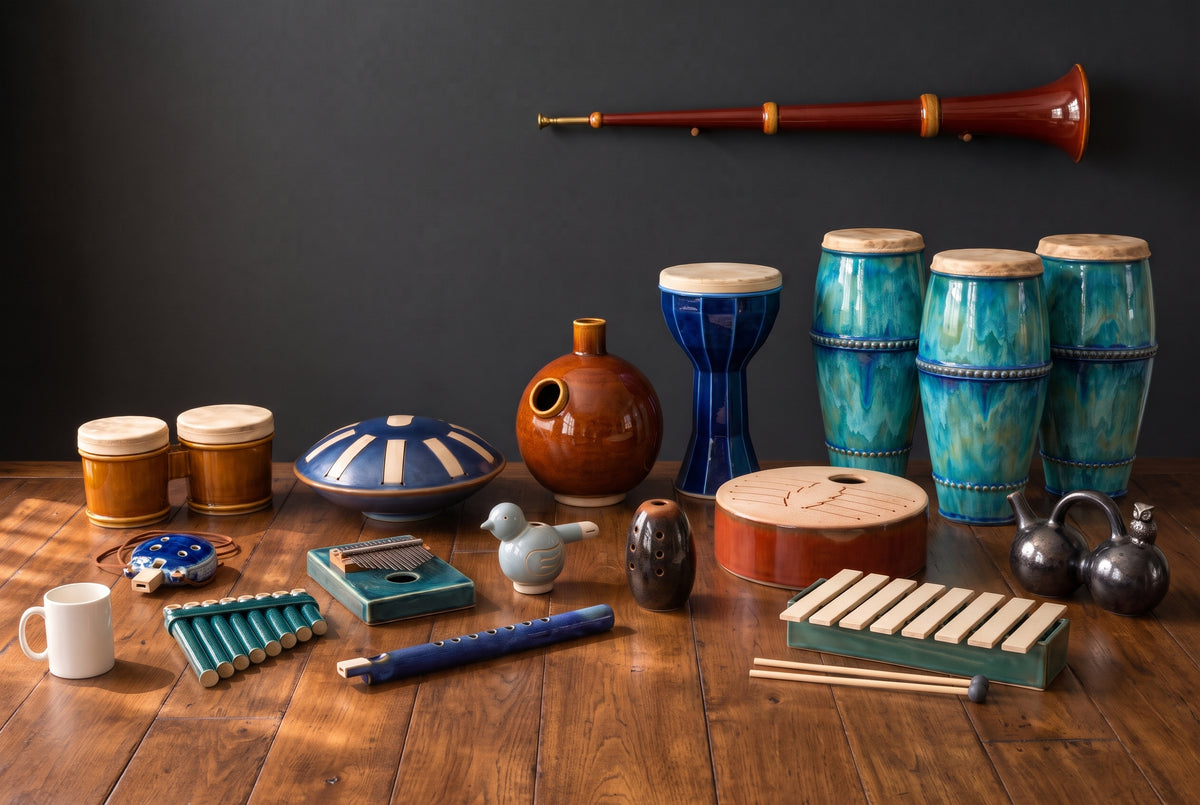


A complete set
The Water Whistle Family Bundle
Four water whistles, palm size to two hands, one C major chord.
$36.40$52saves $15.60
 The Clay Hole home page
Your hands in clay, every single week.
Weekly classes with four instructors on the floor, whether it is your first pot or your five hundredth. A shelf with your name on it, and classes that never expire.
Start my membershipPick your Level on the next page. Month to month, no contract.
4.9 on Google from 145+ reviews
This month’s new member deals 17 of 30 discounted spots left this monthPottery is better with your people.
Share one membership with your partner, split a shelf with a friend and both save 20%, or bring someone along for a single night. All of it month to month.
Every question, already answered.
More than a hundred answers on one page, from what time class starts to how long a finished piece takes. Type a word and the right answer opens on its own.
Walk in on day one already knowing the way.
Three quick things before you come. After that, your first class starts with a tour and your shelf, whether it is your first pot or your five hundredth.
Where your pottery goes between kilns, what happens to the classes you skip, who wears which shirt, and the few rules that keep a busy room working.
Move up a Level, add Unlimited, take a break or change your card. Memberships renew on the 25th, and most changes go in before then.
Eight clays, one for every kind of pot.
Every bag comes from the studio, and every one fires at our cone 5½, so any of them works with any glaze on the wall. 52 Buff, the house starter, is $28 a bag at Green Level and less at every Level above it.
Bisque is free. Glaze firing goes by size.
Glaze firings are 5 cents a cubic inch, measured at the widest points, with a $4.80 minimum and a $600 ceiling. Every firing is paid online before the piece goes on the drop-off table.
Bring a friend to your table.
Members bring guests to classes and open studio. Your guest works from your clay, with your tools and glazes, and you teach them for the night. The price follows your guest, not your Level.
Same price at every Level. If they join the same day, that day’s pass comes back to you.
Every two months · free
For one whole week, anyone comes free, to any class or open studio. Bring as many as you like. Your whole Level is theirs for the night, Black Level included. Once per person, every week.
The few things that have to be yours.
Membership covers thousands of tools. A handful of things cannot be shared, like clippers, epoxy and the tools a Green Level Member brings. Pay on your phone, then grab it at the studio. Nothing we sell ships.
 Beginner’s Tool SetThe kit Green Level Members bring
 Fingernail ClippersShort nails make throwing easier
 Mayco Clay MenderFor cracks in dry and bisqued work
 Epoxy for KintsugiFive-minute epoxy for golden repairs
 Applicator BottlesSix bottles and tips for slip lines
 Large Bead RackFor firing glazed beads
Six raku days in 2027, twenty spots each.
Pots come out of the kiln glowing and go straight into a can of shavings that catches on contact. Two daytime, two nighttime and two horsehair and feather workshops, in Alpine. Optional, and open to current and past members.
Grab a drink. Pay on your phone.
The drink fridge and the coffee and cocoa station both run on trust. Pay on the website, then help yourself. Our city water is not great to drink, so most members bring a bottle or grab one here.
Some days you just want to glaze.
Pre-made bisqueware, glaze catchers and kiln cookies are ready when you are. Pay online, take the size you paid for, and ask one of us if you are not sure which one that is.
Take the studio’s know-how home with you.
The Glaze Bible and The Book of Molds, printed, bound and in full color. Plus a printable guide for every lesson in The Clay Hole University, each one a PDF you keep.
Pick an amount and it arrives by email straight after checkout. It never expires, and four of the amounts are exactly one month of membership at each Level.
Right off I-15, open seven days a week.
12896 S Pony Express Rd, Suite 100, Draper, in the Pony Express Center. The next building north of Living Spaces, with a free shared lot out front.
217 pottery lessons, free to study.
The whole craft across 17 areas, in the order a piece is made, from wedging a bag of clay to selling what you made. Every lesson has its own quiz, and none of it asks you to sign up.
Nobody expects you to know anything yet.
Most people need a few weeks on the wheel before it feels like anything at all. That is the normal experience, not the sad one. Here is what to watch, what to learn first, and a plan for your first ten sessions.
Every way a pot goes wrong, and what to do about it.
The Pottery Failure Atlas: 54 failures from the wedging table to years of use, sorted by what you see and when you first saw it. Every one drawn, with its likely causes, the evidence that tells them apart, what can still be rescued and the experiment for the next pot. Free to read here, and printed and bound for the glaze table.
 Why Did My Pottery Do That?45 symptoms, the cause and the fix, in a line or two
 Glaze Problems, Causes and FixesCrawling, pinholes, crazing and the rest, in depth
 How to Rescue Pottery at Any StageWhat each stage still allows, and the odds
 Reglazing and RefiringWhich failures refire, and how it is done
Four certifications. Each one opens part of the studio.
Watch the video, agree to the rules, pass a quick check, and save a card to your phone. Do each one once and you are certified for as long as you are a member. Most people start with the slab rollers and slab molds, and take the rest when they need them.
248 slab molds, searchable by what they make.
A slab laid over one of these comes off as a bowl, a platter or a tray with an even wall and a shape that looks like somebody meant it. First try. Included with your membership once you are certified.
158 patterns. Print, cut, build.
Exact-size paper patterns for slab building, from a 30 minute ring dish to a thirteen-story pagoda. Current members pick five free every month. Everyone else buys them one at a time or in bundles: every Beginner or every Intermediate template, or a small set that belongs together.
Newest: Water Toucan Whistle, Water Penguin Whistle, Water Puffin Whistle
137 projects, three questions.
The project finder asks how you want to make it, how far along you are, and what you want to be holding at the end. Then it hands you a list, each one with a guide or a slab mold behind it.
Every guide on the site, shelved by what you are trying to do.
Start from the problem in front of you, not the day a guide was written. Search it, or pick a shelf.
 The Pottery Dictionary254 terms in plain English
Why Did My Pottery Do That?45 symptoms, the cause and the fix
 The Pottery Cone ChartEvery cone from 022 to 14
 Pottery Myths, Fact-Checked70 of them, against 117 sources
 Is Handmade Pottery Food Safe?Almost always, and how to check
 The Full Pottery ProcessBag of clay to finished piece
The videos that took off, sorted by mood.
My best and most viral reels on one page: the funny ones, the process ones, the oddly satisfying ones, and the dad jokes. Each one plays right there, with arrows to keep going.
 Incredible Ceramic Artist Videos24 free lessons by 15 makers, none of them ours
 How Dan Throws Giant PotsSection by section, with the numbers
 How to Dry Your PotteryThe video, and why S-cracks happen (opens in a new tab)
 The Pottery Wheel IntroductionMy wheel video for new members (opens in a new tab)
There is a corner of the studio with your name on it.
Sixteen personality types, five love languages and twelve signs, each matched to the way that person tends to work with clay. Lighthearted on purpose, and oddly specific.
 Pottery by Zodiac SignTwelve signs, one patient lump of clay
 Personality and the Pottery WheelYour habits show up in about four minutes
 Pottery for EngineersFor people who think for a living
 ADHD, Hyperfocus, and Never Running OutA letter from me
 Hobbies for BurnoutA room where you are allowed to be bad
 Screen-Free Hobbies for AdultsSomething that asks for all your attention
 Every Addiction I Ever Had Lost to ArtOn my blog
 Functional Pottery Is EngineeringA mug is a set of tolerances
Every studio near you, including the ones that suit you better.
I run one of these studios, and several of the others are wonderful. So here they are side by side: what each one charges, how each one works, and when another studio is the better pick.
The people who fill this place.
Hundreds of class photos taken mid-class, the pieces members bring back from the kiln, and member spotlights written in their own words. A new set loads every time you open the gallery.
Parties, contests and one gallery night.
Three parties, four contests the whole studio votes on, six free weeks for your friends, and one November night when the studio becomes a gallery. Every 2027 date is already set.
Six weeks a year, your friends come in free.
Every other month, for a whole week, members can walk in with anybody, new to clay or not, and it costs them nothing. No guest pass, no RSVP, no list at the front desk. Clay is the one thing they buy, from $28 a bag, or they split yours.
Things we probably should not have built.
A kiln god who takes offerings, a void that listens and keeps nothing, a glaze wall you are allowed to wreck, and a daily card that picks you. Built for the days the kiln wins.
Every message goes straight to me.
A suggestion, a complaint, a compliment, or an idea to make this place better. Not into a queue somebody gets to on Thursday. Put your name on it or stay completely anonymous. Both get read.
Nobody goes home with a bowl. That is the entire point.
Three hours with real clay, real wheels and real instructors, for up to 48 people. Families, friends and teams. Everybody in the room is equally bad at this, and that is the part that works.
We are always looking for our next instructor.
Not because somebody is about to quit. People move, go back to school and take the other job, so we keep a list of people to call when a spot opens. Pink shirts are our main instructors. Purple shirts are our trade instructors.
Every glaze we stock, fired on our own clay.
611 glazes and 105 underglazes, each fired on our own tiles, in our own kilns, at cone 5½. A page for every one: the fired photo, what it does over another glaze, which clays suit it, and what went wrong if yours came out different.
Type a name. An arrow points to the slot.
Every bottle on the real glaze wall, down to its shelf, row and slot. Search by name, brand or family, or press Surprise Me and let it pick for you.
Every bottle wears a colored sticker.
Your Level opens your color and every color below it, never one above. Some glazes cost several times what others do, and the Level is how that gets paid for. That is the entire pricing model.
Glaze is glass, made on purpose, stuck to a pot.
Everything confusing about glaze comes from that one fact. Start there, then learn to brush it, dip it and layer it, and to read what went wrong when the kiln opens.
Two certifications, then the wall and the buckets are yours.
Brush-on comes first, because it is required before your first glaze. Dipping comes when you want a smooth, even coat over a big batch. Each one is a video, the rules, a quick check and a card on your phone, and each lasts as long as your membership.
Four fluxes, 32 stains, and two fees worth knowing.
The flux glazes are the four built to run, and you buy your own pint. Mason stains sell by the 25 grams. A few premium glazes carry a sticker fee, and any dipping bucket your Level does not include goes by the piece.
Bisque at cone 05. Glaze at cone 5½.
Our glaze kilns run cone 5 with a twelve minute hold, which is the same heat work as half a cone past cone 5. Every tile in the Glaze Bible was fired that way, so the tile is what comes out.
I’m Dan Pearce, and I built this place for the people in it.
Writer, potter and artist, with millions of people following along online. I ran a first little studio out of a garage for almost four years, then built The Clay Hole from the ground up in Draper.
Loading the latest from the studio…
Taking longer than it should. See every announcement →
Your hands in clay, every single week.
Weekly classes with four instructors on the floor, whether it is your first pot or your five hundredth. A shelf with your name on it, and classes that never expire.
Start my membershipPick your Level on the next page. Month to month, no contract.
4.9 on Google from 145+ reviews
This month’s new member deals 17 of 30 discounted spots left this monthPottery is better with your people.
Share one membership with your partner, split a shelf with a friend and both save 20%, or bring someone along for a single night. All of it month to month.
Every question, already answered.
More than a hundred answers on one page, from what time class starts to how long a finished piece takes. Type a word and the right answer opens on its own.
Walk in on day one already knowing the way.
Three quick things before you come. After that, your first class starts with a tour and your shelf, whether it is your first pot or your five hundredth.
Where your pottery goes between kilns, what happens to the classes you skip, who wears which shirt, and the few rules that keep a busy room working.
Move up a Level, add Unlimited, take a break or change your card. Memberships renew on the 25th, and most changes go in before then.
Eight clays, one for every kind of pot.
Every bag comes from the studio, and every one fires at our cone 5½, so any of them works with any glaze on the wall. 52 Buff, the house starter, is $28 a bag at Green Level and less at every Level above it.
Bisque is free. Glaze firing goes by size.
Glaze firings are 5 cents a cubic inch, measured at the widest points, with a $4.80 minimum and a $600 ceiling. Every firing is paid online before the piece goes on the drop-off table.
Bring a friend to your table.
Members bring guests to classes and open studio. Your guest works from your clay, with your tools and glazes, and you teach them for the night. The price follows your guest, not your Level.
Same price at every Level. If they join the same day, that day’s pass comes back to you.
Every two months · free
For one whole week, anyone comes free, to any class or open studio. Bring as many as you like. Your whole Level is theirs for the night, Black Level included. Once per person, every week.
The few things that have to be yours.
Membership covers thousands of tools. A handful of things cannot be shared, like clippers, epoxy and the tools a Green Level Member brings. Pay on your phone, then grab it at the studio. Nothing we sell ships.
Beginner’s Tool SetThe kit Green Level Members bring
Fingernail ClippersShort nails make throwing easier
Mayco Clay MenderFor cracks in dry and bisqued work
Epoxy for KintsugiFive-minute epoxy for golden repairs
Applicator BottlesSix bottles and tips for slip lines
Large Bead RackFor firing glazed beads
Six raku days in 2027, twenty spots each.
Pots come out of the kiln glowing and go straight into a can of shavings that catches on contact. Two daytime, two nighttime and two horsehair and feather workshops, in Alpine. Optional, and open to current and past members.
Grab a drink. Pay on your phone.
The drink fridge and the coffee and cocoa station both run on trust. Pay on the website, then help yourself. Our city water is not great to drink, so most members bring a bottle or grab one here.
Some days you just want to glaze.
Pre-made bisqueware, glaze catchers and kiln cookies are ready when you are. Pay online, take the size you paid for, and ask one of us if you are not sure which one that is.
Take the studio’s know-how home with you.
The Glaze Bible and The Book of Molds, printed, bound and in full color. Plus a printable guide for every lesson in The Clay Hole University, each one a PDF you keep.
Pick an amount and it arrives by email straight after checkout. It never expires, and four of the amounts are exactly one month of membership at each Level.
Right off I-15, open seven days a week.
12896 S Pony Express Rd, Suite 100, Draper, in the Pony Express Center. The next building north of Living Spaces, with a free shared lot out front.
217 pottery lessons, free to study.
The whole craft across 17 areas, in the order a piece is made, from wedging a bag of clay to selling what you made. Every lesson has its own quiz, and none of it asks you to sign up.
Nobody expects you to know anything yet.
Most people need a few weeks on the wheel before it feels like anything at all. That is the normal experience, not the sad one. Here is what to watch, what to learn first, and a plan for your first ten sessions.
Every way a pot goes wrong, and what to do about it.
The Pottery Failure Atlas: 54 failures from the wedging table to years of use, sorted by what you see and when you first saw it. Every one drawn, with its likely causes, the evidence that tells them apart, what can still be rescued and the experiment for the next pot. Free to read here, and printed and bound for the glaze table.
Why Did My Pottery Do That?45 symptoms, the cause and the fix, in a line or two
Glaze Problems, Causes and FixesCrawling, pinholes, crazing and the rest, in depth
How to Rescue Pottery at Any StageWhat each stage still allows, and the odds
Reglazing and RefiringWhich failures refire, and how it is done
Four certifications. Each one opens part of the studio.
Watch the video, agree to the rules, pass a quick check, and save a card to your phone. Do each one once and you are certified for as long as you are a member. Most people start with the slab rollers and slab molds, and take the rest when they need them.
248 slab molds, searchable by what they make.
A slab laid over one of these comes off as a bowl, a platter or a tray with an even wall and a shape that looks like somebody meant it. First try. Included with your membership once you are certified.
158 patterns. Print, cut, build.
Exact-size paper patterns for slab building, from a 30 minute ring dish to a thirteen-story pagoda. Current members pick five free every month. Everyone else buys them one at a time or in bundles: every Beginner or every Intermediate template, or a small set that belongs together.
Newest: Water Toucan Whistle, Water Penguin Whistle, Water Puffin Whistle
137 projects, three questions.
The project finder asks how you want to make it, how far along you are, and what you want to be holding at the end. Then it hands you a list, each one with a guide or a slab mold behind it.
Every guide on the site, shelved by what you are trying to do.
Start from the problem in front of you, not the day a guide was written. Search it, or pick a shelf.
The Pottery Dictionary254 terms in plain English
Why Did My Pottery Do That?45 symptoms, the cause and the fix
The Pottery Cone ChartEvery cone from 022 to 14
Pottery Myths, Fact-Checked70 of them, against 117 sources
Is Handmade Pottery Food Safe?Almost always, and how to check
The Full Pottery ProcessBag of clay to finished piece
The videos that took off, sorted by mood.
My best and most viral reels on one page: the funny ones, the process ones, the oddly satisfying ones, and the dad jokes. Each one plays right there, with arrows to keep going.
Incredible Ceramic Artist Videos24 free lessons by 15 makers, none of them ours
How Dan Throws Giant PotsSection by section, with the numbers
How to Dry Your PotteryThe video, and why S-cracks happen (opens in a new tab)
The Pottery Wheel IntroductionMy wheel video for new members (opens in a new tab)
There is a corner of the studio with your name on it.
Sixteen personality types, five love languages and twelve signs, each matched to the way that person tends to work with clay. Lighthearted on purpose, and oddly specific.
Pottery by Zodiac SignTwelve signs, one patient lump of clay
Personality and the Pottery WheelYour habits show up in about four minutes
Pottery for EngineersFor people who think for a living
ADHD, Hyperfocus, and Never Running OutA letter from me
Hobbies for BurnoutA room where you are allowed to be bad
Screen-Free Hobbies for AdultsSomething that asks for all your attention
Every Addiction I Ever Had Lost to ArtOn my blog
Functional Pottery Is EngineeringA mug is a set of tolerances
Every studio near you, including the ones that suit you better.
I run one of these studios, and several of the others are wonderful. So here they are side by side: what each one charges, how each one works, and when another studio is the better pick.
The people who fill this place.
Hundreds of class photos taken mid-class, the pieces members bring back from the kiln, and member spotlights written in their own words. A new set loads every time you open the gallery.
Parties, contests and one gallery night.
Three parties, four contests the whole studio votes on, six free weeks for your friends, and one November night when the studio becomes a gallery. Every 2027 date is already set.
Six weeks a year, your friends come in free.
Every other month, for a whole week, members can walk in with anybody, new to clay or not, and it costs them nothing. No guest pass, no RSVP, no list at the front desk. Clay is the one thing they buy, from $28 a bag, or they split yours.
Things we probably should not have built.
A kiln god who takes offerings, a void that listens and keeps nothing, a glaze wall you are allowed to wreck, and a daily card that picks you. Built for the days the kiln wins.
Every message goes straight to me.
A suggestion, a complaint, a compliment, or an idea to make this place better. Not into a queue somebody gets to on Thursday. Put your name on it or stay completely anonymous. Both get read.
Nobody goes home with a bowl. That is the entire point.
Three hours with real clay, real wheels and real instructors, for up to 48 people. Families, friends and teams. Everybody in the room is equally bad at this, and that is the part that works.
We are always looking for our next instructor.
Not because somebody is about to quit. People move, go back to school and take the other job, so we keep a list of people to call when a spot opens. Pink shirts are our main instructors. Purple shirts are our trade instructors.
Every glaze we stock, fired on our own clay.
611 glazes and 105 underglazes, each fired on our own tiles, in our own kilns, at cone 5½. A page for every one: the fired photo, what it does over another glaze, which clays suit it, and what went wrong if yours came out different.
Type a name. An arrow points to the slot.
Every bottle on the real glaze wall, down to its shelf, row and slot. Search by name, brand or family, or press Surprise Me and let it pick for you.
Every bottle wears a colored sticker.
Your Level opens your color and every color below it, never one above. Some glazes cost several times what others do, and the Level is how that gets paid for. That is the entire pricing model.
Glaze is glass, made on purpose, stuck to a pot.
Everything confusing about glaze comes from that one fact. Start there, then learn to brush it, dip it and layer it, and to read what went wrong when the kiln opens.
Two certifications, then the wall and the buckets are yours.
Brush-on comes first, because it is required before your first glaze. Dipping comes when you want a smooth, even coat over a big batch. Each one is a video, the rules, a quick check and a card on your phone, and each lasts as long as your membership.
Four fluxes, 32 stains, and two fees worth knowing.
The flux glazes are the four built to run, and you buy your own pint. Mason stains sell by the 25 grams. A few premium glazes carry a sticker fee, and any dipping bucket your Level does not include goes by the piece.
Bisque at cone 05. Glaze at cone 5½.
Our glaze kilns run cone 5 with a twelve minute hold, which is the same heat work as half a cone past cone 5. Every tile in the Glaze Bible was fired that way, so the tile is what comes out.
I’m Dan Pearce, and I built this place for the people in it.
Writer, potter and artist, with millions of people following along online. I ran a first little studio out of a garage for almost four years, then built The Clay Hole from the ground up in Draper.
Loading the latest from the studio…
Taking longer than it should. See every announcement →
Follow along
Playable instrument templates
Flutes and whistles, drums of every size, a kalimba, a marimba and a horn you play like a bugle. Every one of them makes real music, and most are tuned to C, so a few friends can play them together.

Every one has a free sample to flip through. Sizes are what comes out of the glaze kiln at 12 percent shrinkage. New playable instrument templates join this collection the day they go live.
 Paper template 25, intermediate
The Pan Flute
Eight clay pipes in one row, tuned to a C major scale from low C to high C, finished with beeswax so it plays in tune.
eight pipes from low C to high C, 8 3/8 in across and 6 11/16 in tall
4 sheets, 11 pages$8(Free for members)
 Paper template 138, intermediate
The Water Bird Whistle
A round clay songbird that whistles when you blow its tail and warbles with a little water inside, tuned to C.
a round bird 3 7/8 in long and 2 1/4 in tall
1 sheet, 9 pages$8(Free for members)
 Paper template 139, advanced
The Udu Drum
A round clay pot drum that answers a slap on its side hole with a deep bloop, tuned to C with beeswax.
a round pot drum 12 7/8 in tall and 10 11/16 in across
3 sheets, 10 pages$12(Free for members)
I wanted instruments you could actually play, not pots shaped like them. So every one of these was designed from the acoustics before a single sheet got drawn. Flutes and whistles, drums of every size, a horn you play like a bugle and a marimba you tune by hand. A few need parts you buy separately, like kalimba tines and drum skins.
$252$360saves $108
 Paper template 140, advanced
The Kalimba
A clay box kalimba with 17 steel tines in C and two wah holes in the back.
a box 7 11/16 in long, 5 3/4 in across and 1 3/8 in deep
3 sheets, 10 pages$12(Free for members)
 Paper template 141, expert
The Goblet Drum
A ten-sided clay darbuka with a deep faceted bowl, a flared bell and a glued goatskin head.
a goblet drum 17 in tall with a 8 3/4 in head
3 sheets, 18 pages$20(Free for members)
 Paper template 142, expert
The End-Blown Flute
A clay recorder in C with seven finger holes and a thumb hole, tuned by you.
a flute 13 in long and 1 in across
2 sheets, 22 pages$20(Free for members)
 Paper template 143, expert
The Pendant Ocarina
A palm-size clay ocarina on a cord, with six holes and eight notes of C major, tuned by you.
an ocarina 3 7/16 in across and 1 3/8 in thick
2 sheets, 21 pages$20(Free for members)
 Paper template 146, expert
The Large Tongue Drum
A big round clay tongue drum with eight tongues and a sound hole.
a tongue drum 14 in across and 5 in tall
4 sheets, 20 pages$20(Free for members)
 Paper template 147, expert
The Xun
An egg-shaped Chinese clay flute with eight holes and nine notes of C major, tuned by you.
a xun 4 1/2 in tall and 2 7/8 in across
2 sheets, 21 pages$20(Free for members)
 Paper template 148, expert
The Peruvian Whistling Vessel
Two clay chambers, a spout, a strap bridge and an owl that whistles, tuned to C.
a whistling vessel 8 1/16 in long and 5 3/4 in tall
3 sheets, 20 pages$20(Free for members)
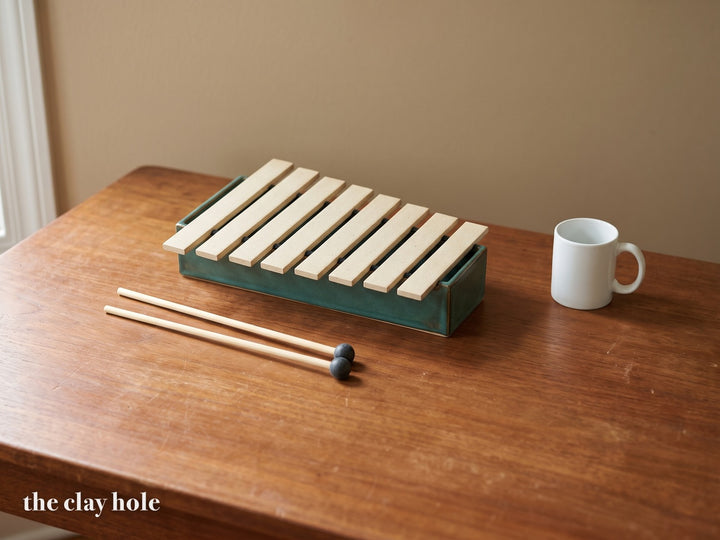 Paper template 149, expert
The Ceramic Marimba
A clay marimba with eight tuned bars on a resonator box.
a marimba 16 13/16 in long and 3 7/16 in tall
5 sheets, 22 pages$20(Free for members)
 Paper template 150, expert
The Tongue Pan
A handpan-shaped clay tongue drum with nine tuned tongues.
a tongue pan 16 in across and 7 1/8 in tall
6 sheets, 25 pages$20(Free for members)
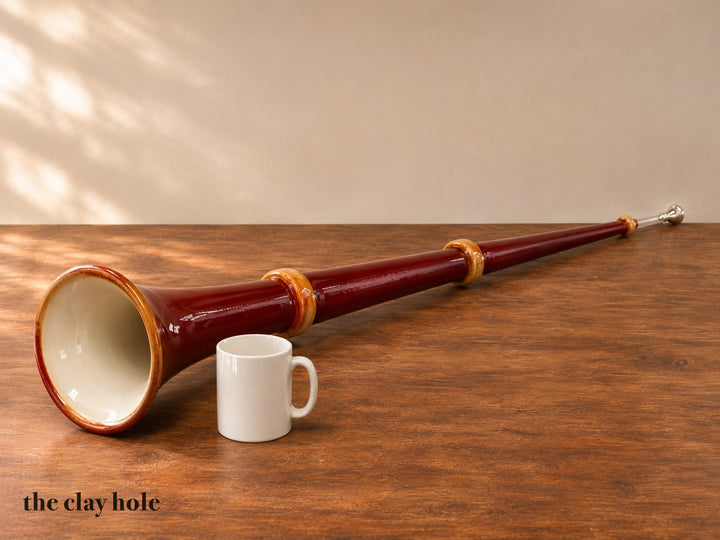 Paper template 151, expert
The Clay Horn
A straight, valveless clay horn in three sections that plays the bugle's notes and tunes with scissors.
a horn about 48 in long with a 5 13/16 in bell
8 sheets, 25 pages$20(Free for members)
 Paper template 152, expert
The Bongos
A pair of clay bongos, small and big, joined by a hollow bridge, with glued goatskin heads.
a pair of bongos 6 3/4 in tall with 7 1/4 in and 8 5/8 in heads
3 sheets, 18 pages$20(Free for members)
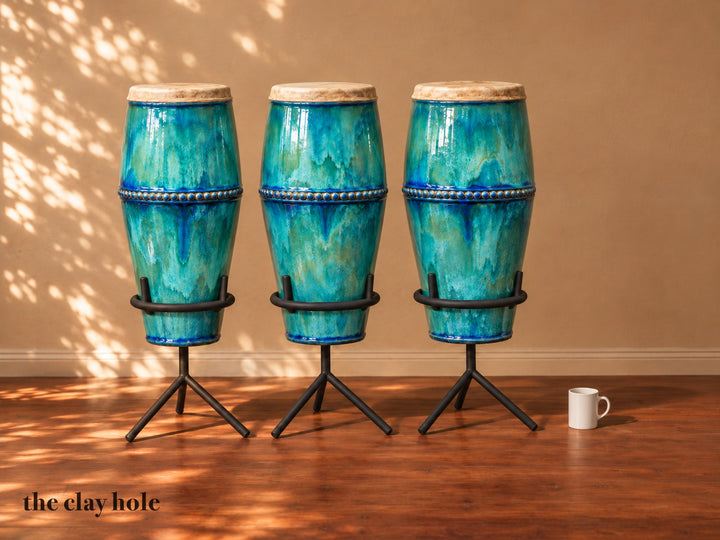 Paper template 153, insane
The Congas
Three full-size clay congas, quinto, conga and tumba, each in two sections, with glued goatskin heads.
three congas 28 in tall with 11 in, 11 3/4 in and 12 1/2 in heads
13 sheets, 30 pages$120(Free for members)
 Paper template 163, advanced
The Water Puffin Whistle
A clay puffin that whistles an E when you blow its tail and trills with water inside.
a puffin whistle 6 7/16 in tall and 6 5/16 in from bill to tail
3 sheets, 13 pages$12(Free for members)
 Paper template 164, advanced
The Water Penguin Whistle
A clay penguin that whistles a low G when you blow its tail and trills with water inside.
a penguin whistle 9 3/4 in tall and 6 7/8 in from beak to tail
6 sheets, 16 pages$12(Free for members)
 Paper template 165, expert
The Water Toucan Whistle
A clay toucan that whistles a middle C when you blow its tail and trills with water inside.
a toucan whistle 16 1/4 in from beak to tail and 11 3/4 in tall
11 sheets, 29 pages$20(Free for members)
Each one is a handful of templates that belong together, for less than they cost one at a time.
Four water whistles, palm size to two hands, one C major chord.
$36.40$52saves $15.60
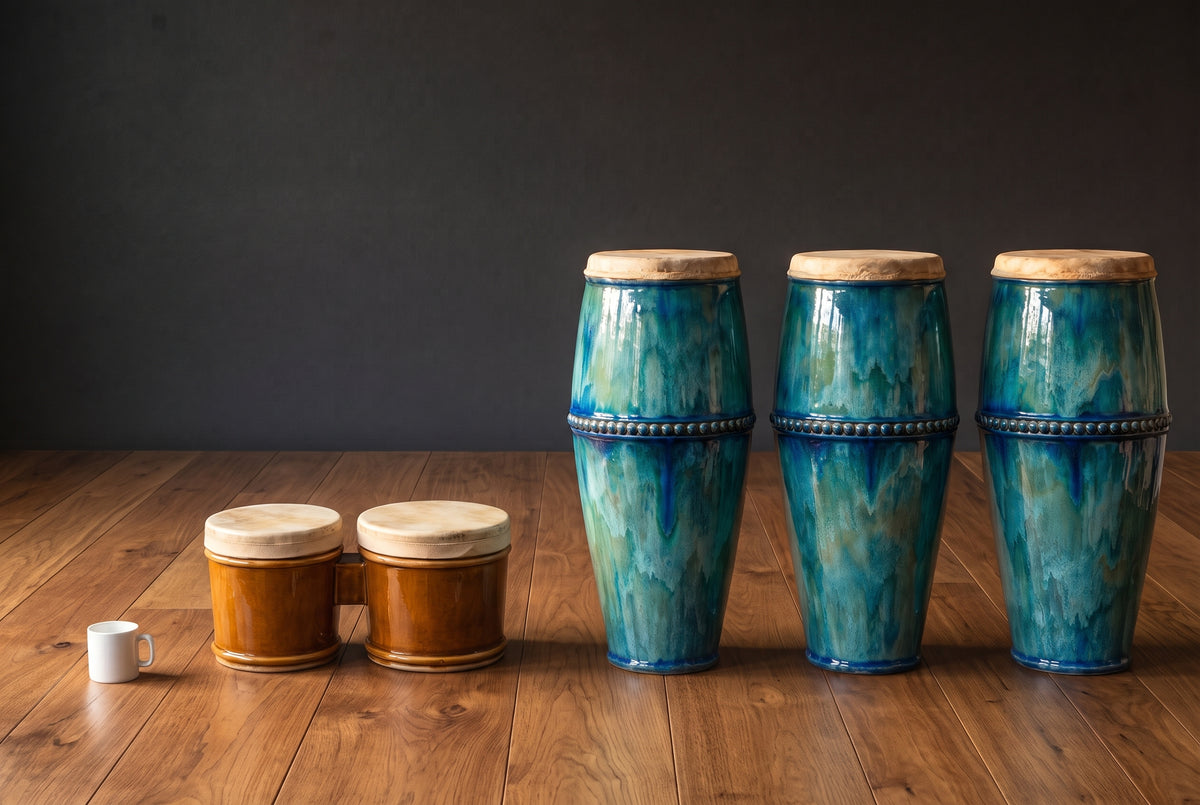
The bongos and all three congas, built as one family.
$98$140saves $42

Four instruments to start with, all tuned to C.
$28$40saves $12
A flute that looks right and plays flat is a paperweight. So every one of these started with the sound: the length of the air column, the size of the chamber, the hole that sets the note. Then the pattern was drawn around it at wet size, worked back through the shrinkage.
Clay never shrinks exactly the same twice, so nothing here trusts a size alone. The flutes, the ocarina and the whistles come out of the kiln a little low on purpose, and you file or drill them up into tune. The tongue drums and the marimba play a true major scale in whatever key your clay gives them.
A few need parts from outside the studio: steel tines for the kalimba, goatskins for the goblet drum, the bongos and the congas, and a brass mouthpiece for the horn. Anything that touches your lips stays bare clay or gets a food-safe glaze, and a windway never gets glazed at all, because glaze closes it.
Actual size, never Fit to page. Plain copy paper works. Card stock survives a wet slab and can be used again.
Every sheet carries a 1 inch square. A ruler on it settles whether the print is right before any clay is cut.
Each pack names its slab thickness on the cover. Let the slab firm up to soft leather hard, so it holds an edge and still bends.
Lay the paper on the slab, cut straight down just outside the edge, bevel where the hatching says, and follow the numbered steps. Score, slip, press, compress, every seam.
 Kitchen and Home
74 templates
 Dinnerware Set
8 templates
 Lamps and Lanterns
9 templates
 Vases
7 templates
 Birdhouses
3 templates
 Clocks
3 templates
 Origami
15 templates
 Showpieces
28 templates
 Bead Racks and Trees
4 templates
 Games
16 templates
 XL Geometric Figures
4 templates
 Giant Chess
6 templates
 Twisted Kitchen
10 templates
All of them side by side, with each bundle price, on the template collections page. Every template in one place, sorted by level, on the paper templates page.
The water bird whistle or the pan flute. Both are Intermediate, about two hours at the table, and you can play them the day they come out of the glaze kiln (the whistle tunes with a little water). The udu drum and the kalimba make good next steps.
Most do. The pan flute, the whistles, the udu, the kalimba, the xun, the whistling vessel, the end-blown flute, the ocarina and the horn are all built around C major at concert pitch, and the four water whistles play a C major chord. The tongue drums and the marimba play a major scale in their own key, and the hand drums sing at whatever pitch their heads give them.
Clay, mostly. The kalimba takes a set of steel tines, the goblet drum, the bongos and the congas take natural goatskins, and the horn takes a standard 7C trumpet mouthpiece and a short piece of vinyl tubing. Several tune with a set of diamond needle files. Each pack names the exact part and where to get it.
Out of the glaze kiln at 12 percent shrinkage, they run from a palm-size ocarina 3 7/16 inches across to a horn about 48 inches long, built in three sections. The toucan whistle is 16 1/4 inches from beak to tail, the tongue pan is 16 inches across, and the tallest conga stands 28 inches.
Yes. The pots are yours. The template files are for your own use and are not to be shared, which is the whole of the terms.
158 templates now and more as they are drawn, and current members of The Clay Hole pick five free every month. Print one tonight and bring it to your next session.
New member deal
30 of 30 discounted spots left this month
Tell me where to send it and this month’s deal lands in your inbox. If this month runs out, you get next month’s before it opens.
Almost done
Done
It should land in the next few minutes. One thing while you wait: we are members only and we do not run walk-in tours, so the virtual tour is the closest you can get to standing in one.
Test mode. Visitors are not seeing this.
One question
I opened The Clay Hole in Draper, Utah, and I would like it to be in more places than that. Where the next one goes is the part I have not worked out yet.
Where are you?
That is how I work out where the demand actually is. The rest is so I know who to tell.
Got it
This could be a long wait, and I will not email you in the meantime. If your area is where the numbers land, you will be the first to know.
Test mode. Visitors are not seeing this.