
 Pottery Date Night
 Bring All Your Friends Free Week
 Give a Month of Pottery
 Private Pottery Parties

 The Welcome Booklet
 Your First Ten Sessions
 The Pottery Process
 Finding the Studio
 Your Classes Never Expire
 The Four Tables
 Who’s Who
 The Rewards Program
 Flux Glazes
 The Calculators
 Kiln Tracker
 Holiday Kiln Deadlines

 Beginner’s Tool Set
 Fingernail Clippers
 Mayco Clay Mender
 Epoxy for Kintsugi
 Applicator Bottles
 Large Bead Rack
 Raku Workshop
 Nighttime Raku
 Horsehair and Feather Raku
 The Clay Hole T-Shirt
 Embroidered Crewneck
 Zip-Up Hoodie
 Pre-Made Bisqueware
 Glaze Catchers
 Kiln Cookies
 Clay Cubby Rental
 The Glaze Bible, Printed
 The Book of Molds, Printed
 Printable Pottery Guides
 Free Printable Trackers
 Gifts for Potters
 Christmas Pottery Ideas
 Mother’s Day Gift Ideas
 Pottery Date Night
 Studio Calendar
 2027 Studio Events
 What Should I Do Today?
 How to Throw on the Pottery Wheel
 How to Make a Pinch Pot
 How to Tap Center a Pot
 The Five Stages of Clay
 Is Pottery Hard to Learn?
 Pottery Wheel Practice Drills
 20 Easy Hand-Building Projects
 Everything That Sounds Wrong

 A Beautiful Piece, Every Time
 Slab Roller Tips
 Any Dish as a Slump Mold
 Slab Roller & Slab Mold Certification
 The Pottery Skill Tree
 Clay & Pottery Calculators
 Logging Your Pottery and Glazes
 The Pottery Dictionary
 Why Did My Pottery Do That?
 The Pottery Cone Chart
 Pottery Myths, Fact-Checked
 Is Handmade Pottery Food Safe?
 Incredible Ceramic Artist Videos
 How Dan Throws Giant Pots
 How to Dry Your Pottery
 The Pottery Wheel Introduction
 Pottery by Zodiac Sign
 Personality and the Pottery Wheel
 Pottery for Engineers
 ADHD, Hyperfocus, and Never Running Out
 Hobbies for Burnout
 Screen-Free Hobbies for Adults
 Every Addiction I Ever Had Lost to Art
 Functional Pottery Is Engineering
 How Do We Compare?
 Pottery Classes by City
 Every Pottery Studio in Utah
 Pottery in Draper
 Featured Members
 The Signature Wall
 Making Friends as an Adult Is Brutal
 The Clay Hole Commandments
 2027 Pottery Contests
 2027 Studio Parties
 Gallery Night

 Scream It Into the Void
 Destroy the Glaze Wall
 Daily Affirmation Cards
 Everything That Can Go Wrong
 Subscribe to Our Newsletters
 Contact The Clay Hole
 Corporate Team Building

 Glaze Combinations
 Glazes We Do Not Carry
 Making Glaze Test Tiles
 The Mega Glaze Tool
 How to Use the Mega Glaze Tool

 Glaze Brushing Techniques
 How to Use Underglaze
 How to Use Dipping Glazes
 Glaze Problems, Causes and Fixes
 The Dipping Glaze Guide

 Making a Glaze Catcher
 Fused or Sharp After Firing
 The Signature Wall
 His Viral Videos
 His Own Ceramics
 Meet Mud
Selling your work · Packing and shipping
The step that turns a first online sale into a refund and a bad review.
Double boxing, where the padding goes, and what handles and rims need. Two boxes, with two inches of padding on every side of the inner one, is the method this page teaches, and the three rules around it are that handles get filled, rims get wrapped first, and nothing rattles when you shake the box hard.
Four steps with a tick list at each: the wrap, the inner box, the outer box, and the label and the price. Six things that go wrong, most of them a refund, and six videos of people packing pottery for shipping.
This is the short version: the wrap, the inner box, the outer box, the label, each with a tick list. The plate and bowl detail, the pricing notes and the questions are in the comprehensive version.
Read it, then watch it
Why this is written down and filmed, both.
Packing is one method and three rules. The method is two boxes with two inches of padding all round the inner one, and the rules are that handles get filled, rims get wrapped first, and nothing rattles. That is a list, and a list belongs on a page next to the tape. What a page cannot show is a mug becoming a solid lump in bubble wrap, or the way someone who packs pottery all the time tapes a box, and that is the videos, from people who pack and ship ceramics themselves.
Use both, in this order
Read the method and the three rules. Watch one mug packed. Pack the first one with the tick list open, shake it hard, and send it to yourself first.
The whole idea
Two boxes, two inches between them, handles filled, rims wrapped first, nothing rattles.
Stuff the handle, band the rim, wrap the pot into one solid lump. A small inner box with padding on every side. An outer box four inches bigger in every direction, so two inches of crumpled paper surround the inner box, packed until nothing moves when you shake it hard. A printed label with a return address, and the packed box weighed before the price is set. Day to day the studio does not ship.
The five-minute version
The whole method in six moves.
If you have posted anything fragile before and you just want the shape of it, this is the shape of it. Everything below is these six moves, slowed down and with the places they fail marked.
Before the first parcel
What you need on the packing table.
Six things, and the boxes in three sizes are the decision that prevents most breakages before the padding is even out.
Boxes in three sizes, bubble wrap or paper, crumpled kraft paper, tape, a scale and a tape measure, and a printed label.
Step one
Fill the handle, wrap the rim, then make the pot one solid lump.
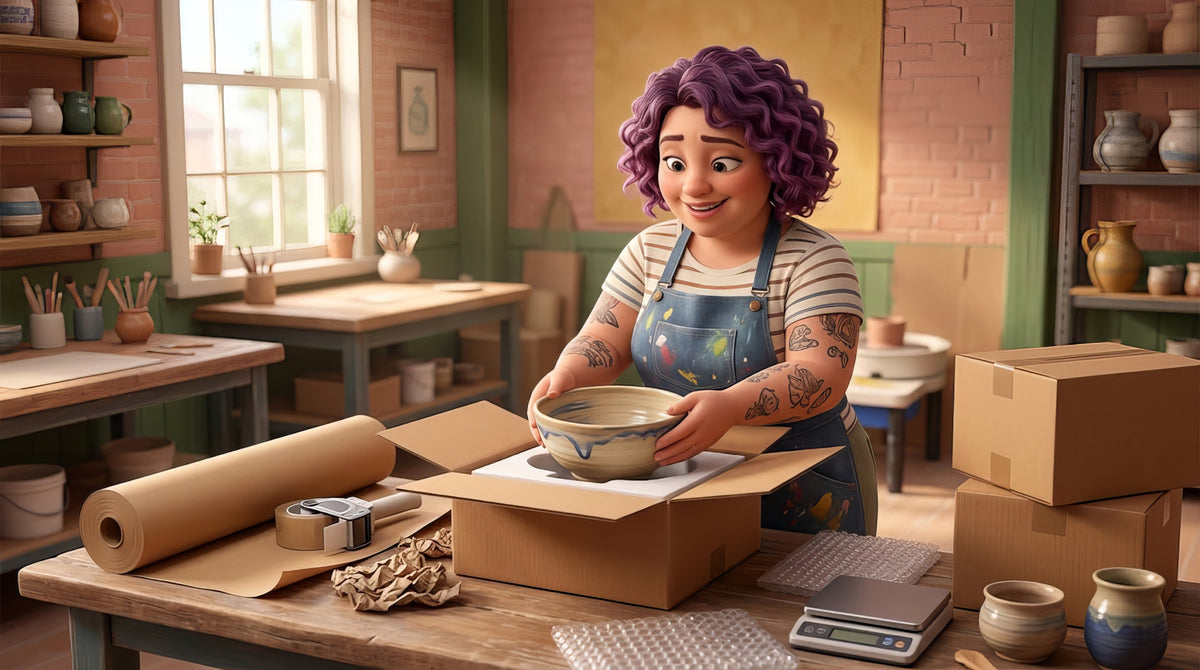
Handles and rims are what break. A handle is a lever; a rim is the thinnest edge on the pot. So the handle gets a wad of paper stuffed inside its loop until it cannot flex, and the rim gets a band of bubble wrap before anything touches the body.
Then the body: bubble wrap, or several layers of paper, round the whole pot, handle included, taped, until it is one solid shape with no edges sticking out. A wrapped mug should look like a lump, not a mug. Florian Gadsby’s video below is twenty-three minutes of wrapping and packing.
Plates and bowls are rims all the way round. A band of padding round every rim first, then the wrap, then a sheet of foam or card between neighbors. Plates travel on edge, standing like files, never flat in a stack, because the weight of the whole stack rests on the bottom plate and one knock can break it. Bowls nest only with a full wrap between each, and a bowl that matters gets its own inner box.
Step two
A small inner box the pot nearly fills, padded on every side.
The inner box is the pot’s own room. A box the wrapped pot nearly fills, paper on the bottom, down every side and over the top, lid taped. Shake it. If anything moves, fill the gap. A pot that can move is a pot that will hit something.
Too big a box is the common mistake. A mug in a bowl’s box has four inches of nothing on one side, the paper settles in transit, and the mug slides into the wall. Three inner box sizes, one for mugs, one for bowls, one for plates, bought in tens, is the cheapest decision in shipping and the one that stops most rattles before they start. Matthew Kelly’s video below is one potter’s routine, from materials to shipping.
Two mugs in one inner box is fine if each is a solid lump and there is paper between them so they cannot touch; a set of plates on edge with sheets between is fine in one inner box. Bowls nested inside each other are fine only with a full wrap between each. Anything you would be sorry to lose gets its own room.
Step three
An outer box four inches bigger in every direction. The inner box floats in two inches of paper.
The outer box takes the drop, and any parcel can be dropped. An outer box four inches bigger than the inner in every direction: two inches of crumpled paper under, around and over the inner box, every seam taped. The inner box floats and feels far less of the shock the outer box takes.
Crumpled kraft paper is the right filler for the gap: it springs back, it does not settle the way peanuts do, and it is cheap. Bubble wrap is the shock absorber round the pot; paper is the space between. Both, in their places. Then shake the whole thing hard, listen, and if anything shifts, open it and fill it. A box you can shake is a box that is not packed.
This is the whole method. A single box with a lot of padding is a pot in a box, and a drop puts the shock straight through the padding into the pot. BlueRainGallery’s three minutes below shows a gallery doing the same double box, with a two inch cushion all round.
Why two inches
Two inches of padding on every side is a common rule of thumb for double boxing, and the BlueRainGallery video below uses it too. It leaves the paper room to crush before the inner box meets the outer wall. Much less and a hard drop can carry the shock through to the inner box; much more is weight and postage for nothing.
Step four
Weigh it, measure it, price it, print the label, and send the first one to yourself.
The packed box is what the carrier charges for. Weigh and measure it packed and put those numbers into the carrier’s calculator before the pot is listed; carriers charge by size as well as weight. Price the shipping into the pot or as a real line; a guessed flat rate is how shipping costs more than the pot.
Then a printed label, not a hand-written one, with a return address so it can come home, and the tracking number sent to the buyer the day it ships. Fragile on the outside is a courtesy, not a strategy; the double box is the strategy. Old Forge Creations’ video below packs mugs for international shipping, with a label printer at the end.
And send the first one to yourself, or to a friend across the country, before you send one to a stranger. Open it. If the mug is fine, that is a good sign for the method. If it is not, fix the method before it costs a review. When one does break anyway, and one will, refund fast, apologize once, and ship the replacement double boxed; the review is decided by the recovery, not the breakage.
Watch it done
Now watch six people pack a pot.
Watch this one, then go buy boxes in three sizes.
None of these people work here or know we exist. Between them they cover wrapping a beaker, mugs, a teapot, bowls, a jar and a vase, one potter’s routine, shipping without plastic, tea cups, a gallery’s double box and mugs going far. Nothing but the still frame loads until you press play.
Twenty-three minutes of packing pottery for shipping, by the chapter list: preparing boxes, then a beaker, mugs, a teapot, bowls and a vase, then labels and customs forms. The other five videos are in the comprehensive version.
When it goes wrong
Six ways it goes wrong, and what to do about each.
Three breakages to know.
Pick the one that looks like the photo the buyer sent. The first three are the box, the handle and the rim. The last three are the rattle, the price and the label.
Pick the one that looks like the photo the buyer sent.
It broke in a single box
One box with padding is a pot in a box. A drop puts the shock straight through the padding into the pot, and any parcel can be dropped.
Two boxes. The pot wrapped and padded in an inner box, the inner box floating in two inches of padding inside an outer box. The outer box takes the drop; the inner box feels far less of it.
Refund fast, apologize once, ship the replacement double boxed. The review is decided by the recovery.
The handle snapped off in transit
A handle is a lever, and anything that presses on it in a box levers it off the mug. A mug that can shift in the box pushes the handle against the body or the box wall every time it moves.
Fill the handle: a wad of paper inside the loop so nothing can flex it, then wrap the mug so the handle is a solid lump, then pad around the lump.
Same refund, same recovery, and every mug from now on has a stuffed handle.
The rim chipped
A rim is the thinnest edge on the pot and it took the shock. A pot that touched the side of the inner box, or a rim that pointed at the box wall with nothing between.
Rim wrapped separately with a band of padding before the body is wrapped. Nothing hard touches the rim. The pot floats; it does not sit.
A chipped rim is a second-quality pot. Refund or replace; do not argue with a photograph.
You could hear it move when you shook the box
A gap. Padding that settled, or a box too big for the pot, or a pot wrapped but not held. A pot that can move is a pot that will hit something.
Fill every gap until the box does not rattle when shaken hard. Crumpled paper is the gap filler; bubble wrap is the shock absorber. Both.
Open it and fill it. A box you can shake is a box that is not packed.
Shipping cost more than you charged for it
A double box weighs more and measures more than a single one, and carriers charge by size as well as weight. A pot priced without the box is a pot sold at a loss.
Weigh and measure the packed box before listing, price the shipping into the pot or as a real line, and keep three box sizes so a mug does not ship in a bowl’s box.
Eat it once and reprice. A shipping calculator with the packed dimensions is the fix.
It went to the wrong address or came back
A hand-written label, a smudged one, or one the carrier could not scan. Or the return address was missing and it could not come home.
A printed label, a return address, the tracking number sent to the buyer, and the word fragile as a courtesy rather than a strategy; the double box is the strategy.
Track it, contact the carrier, contact the buyer. Print the next one.
How it works here
At The Clay Hole, the pickup shelf is the last thing we touch.
This page is written for potters everywhere. A few things are specific to our building.
Things to know here
Day to day the studio does not sell or ship members’ work; studio sales and showcases like Gallery Night are the exception. Fired work is collected from the pickup shelves within two weeks, and the packing happens after that, at home. Run a fingertip round the foot first, and if it catches, take it down wet over a bucket, with safety glasses and an N95 or better, before it goes in the box. Everything you make here is yours to sell and yours to ship.
Day to day, we do not ship
The pickup shelf is where the studio’s part ends. The box, the label, the carrier and the refund are the maker’s, and so is the sale. Studio sales and showcases, like Gallery Night, are the exception, and each has its own terms. Bring boxes from home; pack at home.
Getting it home first
Fired pots off the pickup shelf go home in a padded box or a bag with something between them, because a fired pot chipped in a car is as chipped as one broken in the post. Collect within two weeks; the shelves are shared.
Before the box
Every fired foot gets a fingertip and, if it catches, the diamond pad (bring your own), used wet over a bucket, with safety glasses and an N95 or better, per the sanding lesson. Then the photograph, per the photographing lesson, so the pot in the box matches the pot in the listing.
The price
Boxes, paper and tape are packaging, which goes on the month in the costs lesson, divided by the pots you finish. Postage is priced from the packed box, as in step four. A mug that ships costs more to sell than a mug that is handed over at a market, and the price should know that.
Questions people actually ask
The ones that come up every week.
What does double boxing mean?
The pot is wrapped and padded inside a small box that fits it closely. That inner box is placed inside a larger box with at least two inches of padding on every side, so it floats. The outer box takes the drop and the inner box feels far less of it. It is the method this page teaches.
What padding?
Bubble wrap for the shock absorber round the pot, crumpled kraft paper for filling gaps and for the two inches between the boxes. Packing peanuts settle and leave gaps. Foam sheets and corner protectors for plates. If you would rather not ship plastic, Kara Leigh Ford’s video below is about shipping without plastic.
How do I pack a mug?
Stuff the handle with a wad of paper so nothing can flex it. Wrap the rim with a band of bubble wrap. Wrap the whole mug, handle included, into one solid lump. Inner box with padding on all sides, no rattle. Outer box four inches bigger than the inner, which leaves two inches of paper on every side. The handle and the rim are the two things that break, and each gets its own layer before the body does.
How do I pack a plate or a bowl?
Plates on edge, never flat, each in its own wrap with a foam sheet or card between neighbors, standing in the inner box like files. Bowls nested only with a full wrap between each, or one per inner box. Rims are the whole problem for both; a band of padding round each rim first.
What box sizes?
Three. A mug size, a bowl size, a plate size, and outer boxes four inches bigger in every direction than each, for two inches of padding on every side. Buying boxes in tens is cheaper than any other packing decision. Do not ship a mug in a bowl’s box; the extra space is the extra rattle.
How do I price the shipping?
Weigh and measure the packed box, not the pot, and put those numbers into the carrier’s calculator before you list. Carriers charge by size as well as weight, and a double-boxed mug is bigger than people expect. Either price the shipping into the pot or show it as a real line; a guessed flat rate is how shipping costs more than the pot.
Does The Clay Hole ship?
Day to day, no. The studio does not ship members’ work or sell it for you; your pot, your box, your label. Studio sales and showcases like Gallery Night are the exception, and each has its own terms. Bring boxes from home, pack at home, and take a packed box to the carrier. The pickup shelf is where the pot is collected, and the packing happens after that, somewhere with a table and a roll of tape.
Related lessons
Six lessons that sit next to this one.
Three to read next.
Shipping is the last step of a sale and the first thing a buyer judges. These are the pages before it.
That is the whole method
Fill the handle. Band the rim. One lump. Inner box. Outer box, four inches bigger. Shake it. Print the label.
Your first parcel is the one to double box, shake and send to yourself. After that, every parcel gets the same two boxes. Potters who pack well have very few breakages, and two boxes is the method this page teaches.
If you want the plate and bowl detail, the box-size notes, the pricing arithmetic and the answers to the questions everybody asks, switch to the comprehensive version at the top. Otherwise, go buy boxes in three sizes.
Written for potters everywhere. Where our studio does things differently, the page says so.
Which version would you like to print?
Both print clean, with the videos turned into labeled boxes you can search for later.