
 Pottery Date Night
 Bring All Your Friends Free Week
 Give a Month of Pottery
 Private Pottery Parties

 The Welcome Booklet
 Your First Ten Sessions
 The Pottery Process
 Finding the Studio
 Your Classes Never Expire
 The Four Tables
 Who’s Who
 The Rewards Program
 Flux Glazes
 The Calculators
 Kiln Tracker
 Holiday Kiln Deadlines

 Beginner’s Tool Set
 Fingernail Clippers
 Mayco Clay Mender
 Epoxy for Kintsugi
 Applicator Bottles
 Large Bead Rack
 Raku Workshop
 Nighttime Raku
 Horsehair and Feather Raku
 The Clay Hole T-Shirt
 Embroidered Crewneck
 Zip-Up Hoodie
 Pre-Made Bisqueware
 Glaze Catchers
 Kiln Cookies
 Clay Cubby Rental
 The Glaze Bible, Printed
 The Book of Molds, Printed
 Printable Pottery Guides
 Free Printable Trackers
 Gifts for Potters
 Christmas Pottery Ideas
 Mother’s Day Gift Ideas
 Pottery Date Night
 Studio Calendar
 2027 Studio Events
 What Should I Do Today?
 How to Throw on the Pottery Wheel
 How to Make a Pinch Pot
 How to Tap Center a Pot
 The Five Stages of Clay
 Is Pottery Hard to Learn?
 Pottery Wheel Practice Drills
 20 Easy Hand-Building Projects
 Everything That Sounds Wrong

 A Beautiful Piece, Every Time
 Slab Roller Tips
 Any Dish as a Slump Mold
 Slab Roller & Slab Mold Certification
 The Pottery Skill Tree
 Clay & Pottery Calculators
 Logging Your Pottery and Glazes
 The Pottery Dictionary
 Why Did My Pottery Do That?
 The Pottery Cone Chart
 Pottery Myths, Fact-Checked
 Is Handmade Pottery Food Safe?
 Incredible Ceramic Artist Videos
 How Dan Throws Giant Pots
 How to Dry Your Pottery
 The Pottery Wheel Introduction
 Pottery by Zodiac Sign
 Personality and the Pottery Wheel
 Pottery for Engineers
 ADHD, Hyperfocus, and Never Running Out
 Hobbies for Burnout
 Screen-Free Hobbies for Adults
 Every Addiction I Ever Had Lost to Art
 Functional Pottery Is Engineering
 How Do We Compare?
 Pottery Classes by City
 Every Pottery Studio in Utah
 Pottery in Draper
 Featured Members
 The Signature Wall
 Making Friends as an Adult Is Brutal
 The Clay Hole Commandments
 2027 Pottery Contests
 2027 Studio Parties
 Gallery Night

 Scream It Into the Void
 Destroy the Glaze Wall
 Daily Affirmation Cards
 Everything That Can Go Wrong
 Subscribe to Our Newsletters
 Contact The Clay Hole
 Corporate Team Building

 Glaze Combinations
 Glazes We Do Not Carry
 Making Glaze Test Tiles
 The Mega Glaze Tool
 How to Use the Mega Glaze Tool

 Glaze Brushing Techniques
 How to Use Underglaze
 How to Use Dipping Glazes
 Glaze Problems, Causes and Fixes
 The Dipping Glaze Guide

 Making a Glaze Catcher
 Fused or Sharp After Firing
 The Signature Wall
 His Viral Videos
 His Own Ceramics
 Meet Mud
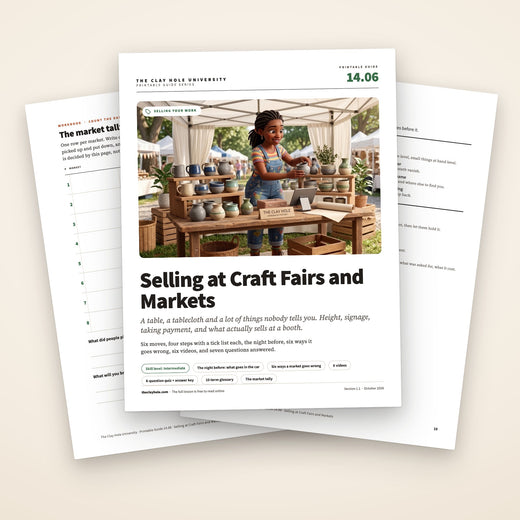
Selling your work · Craft fairs and markets
A table, a tablecloth and a lot of things nobody tells you.
Height, signage, taking payment, and what actually sells at a booth. A market is a list of things nobody tells a first-timer, and the list is short: height, prices on everything, a card reader that works, twice as many small things, stand up and say hello.
Four steps with a tick list at each: the market and the stock, the table, payment, and the day. Six mistakes, the first three free to fix, and six videos from potters and market people.
This is the short version: the market and the stock, the table, payment, the day, each with a tick list. The reasoning, the tax note and the questions are in the comprehensive version.

Read it, then watch it
Why this is written down and filmed, both.
A market is a list of things nobody tells you, and lists belong on a page you read the night before with the car half packed: height, prices on everything, a card reader that works, twice as many small things, stand up, say hello. What a page cannot show is a table that stops people from six feet away against one that does not, or how other makers talk about it. That is the videos.
Use both, in this order
Read the list. Watch a booth being built and a day being counted. Set the table up in your living room the week before, with the tick list open, and photograph it.
The whole idea
Height, prices on everything, a card reader that works, twice as many small things, and say hello.
Pick a market with a real crowd for handmade goods. Bring twice as many mugs and small bowls as feels sensible, a few big pieces to stop people, a price on every one. Height with crates, a cloth to the floor, a sign at eye level. A card reader tested at home and a float. Stand, say hello, let them hold things. Count what sold.
The five-minute version
The whole market in six moves.
If you have sold anything in person and you just want the shape of it, this is the shape of it. Everything below is these six moves, slowed down and with the places they fail marked.
The night before
What goes in the car.
Six things, and the card reader is the one to test twice. The stool is the one you will not use.
Small giftable stock, crates for height, a cloth and a sign, tags and a pen, a card reader with a backup and a float, bags, a tally sheet and water.
Step one
Pick the market, and bring twice as many small things as feels sensible.
The market decides half of the day before you arrive. One with a track record for handmade goods and a real crowd: ask makers who have done it, and go once as a shopper before you apply. A market of resold goods is the wrong table for a mug that took real money and hours to make. Small local markets are where many potters start, and the first one is tuition whatever it makes.
Then the stock, which is the second thing beginners get backwards. A market buys small and giftable at a price nobody has to consult anyone about: mugs first, then small bowls, planters, ring dishes, spoon rests, small vases, and sets of two, which sell better than singles. The large pieces are the reason a person stops at the table; the small pieces are what goes into the bag. Bring twice as many small things as feels sensible and a few big ones, and keep a tally so the ratio is a number next time. Finkle Pottery’s seven tips below are about the other half of the day: promoting yourself, talking to customers, add-ons and pricing.
Every pot priced before you leave the house, on a tag or a small sign per group, in numbers readable from a step back, the same price for the same shape in every glaze. Most people will not ask a price; they will assume it is more than they want to spend and keep walking. A price is permission to pick it up.
Step two
Height, a cloth to the floor, and a sign at eye level.
The decision to stop is made from six feet away. A flat table reads as a jumble from there; three levels read as a shop. Crates, risers or upturned boxes under a cloth: best pieces at eye level, mugs and small things at hand level where they can be picked up, large pieces high or at the back to stop people.
A cloth to the floor, so the boxes and bags under the table vanish and the table reads as clean. Groups by shape and color, not one of everything everywhere. Space in front for two people to stand without blocking each other. And a sign, your name in big letters at eye height with where else to find you, because a person who does not buy today wants to find you next month. Sparks of Joy’s ten display tips below take fourteen minutes.
Build the table in your living room the week before, with everything you will bring, and photograph it. Then pack it in the order it comes out. A table built for the first time at seven in the morning in a field is a table that opens late.
Step three
Payment tested at home, a backup, and a float with change.
A sale that cannot be taken goes to the next table. A card reader on your phone, set up and tested at home with a real transaction, not at the table with a line of people waiting. A second way to take a card, in case the reader or the battery fails. A cash float with change for a twenty. A sign that says what you take.
Phone charged, and a battery pack, because the reader and the signal both live on it. If the field has no signal, the reader may take cards offline and settle later; know before the day which yours does. Bags and wrapping paper for what sells, because a mug handed over naked is a mug that chips in the parking lot, and a bag with your name on it is an advertisement that walks.
Sales tax is collected on most in-person sales in most places, and the market organizer or the state small-business office will tell you how; this page teaches selling, not tax. The notebook from the selling lesson, what sold, for how much, what it cost, is what an accountant asks for, and the tally sheet is that notebook for the day.
Step four
Stand, say hello, let them hold it, and count the day.
A vendor on a phone is a closed shop. Stand, or sit on a stool at table height, and say hello to everyone who slows down. One thing about the pot they are looking at, then let them look. A mug in a hand is half sold, so encourage people to pick things up, and never follow anyone along the table.
Keep the table full as it sells: restock from under the cloth, close the gaps, put the next best piece where the sold one was. A table that is half empty by two o’clock looks like the good stuff has gone, and it is where the tally sheet earns its keep, because a market that sold out of mugs by noon is a market that wanted twice the mugs.
Then the count. What sold, what did not, what people picked up and put down, what they asked for that you did not have, and what the day cost: the fee, the drive, the display, the hours. That goes into the envelope from the costs lesson, and it decides the next market with numbers rather than a feeling. A first market can lose money; a second at the same market often does not. MugwortsArtcraft’s video below walks through one market day.
Watch it done
Now watch six videos from people who work tables.
Watch this one the week before.
None of these videos are ours. Between them they cover a whole show, the display in ten tips, selling out, booth setup and payment, the mistakes, and one market day with the numbers. Nothing but the still frame loads until you press play.
Thirty-five minutes on getting ready for an art show: the booth, the display, checkout and talking to customers. The other five videos are in the comprehensive version.
When it goes wrong
Six ways it goes wrong, and what to do about each.
The three mistakes that happen at the first table.
Pick the one that looks like your table. The first three are height, prices and payment, and all three are free to fix. The last three are stock, the phone and the fee.
Everything was flat on the table and nobody stopped
A flat table reads as a jumble from six feet away, which is where a decision to stop gets made. Eyes want levels.
Height: crates, risers, a shelf, so pots sit at three heights and the best ones at eye level. A tablecloth to the floor so the boxes under the table disappear. A sign with your name at eye height.
Turn a box over, put a cloth on it, put the best pots on top. Height is free.
Nothing had a price and people did not ask
Most people will not ask a price. They will assume it is more than they want to spend, and walk. A price on everything is permission to pick it up.
Every pot priced, on a tag or a small sign per group, in numbers big enough to read from a step back. Same price for the same shape, so the table reads as a shop.
A pen and some tags, now, before the next person walks past.
Someone wanted to buy and could not pay
Cash only, or a card reader that was not set up, or no signal. A sale that cannot be taken is a sale to the next table.
A card reader on your phone, tested at home, and a cash float with change, because cash works with no signal. Check your reader maker’s help page on taking cards offline, and keep a paper invoice pad for the rest. A sign that says which you take.
Take their number and send a payment link once you have signal. Set the reader up tonight.
You sold out of the ten-dollar thing and took home the sixty-dollar thing
A market buys small: mugs, small bowls, ring dishes, planters, things that fit in a bag and a budget. The big pieces are what stops people; the small pieces are what they buy.
Twice as many small things as you think, at a price people do not have to consult anyone about, and a few big pieces as the reason to stop. Keep a tally of what sold to learn the ratio for next time.
Sell what is left online, and make more mugs before the next one.
You sat behind the table on your phone
A vendor looking at a phone is a closed shop. People buy from someone who looks up, says hello, and lets them hold a mug.
Stand, or sit on a stool at table height. Say hello to everyone, say one thing about the pot they are looking at, then let them look. A mug in a hand is half sold.
Put the phone in the cash box, and take it out only to take a payment. Say hello to the next person.
The table fee, the travel and the day cost more than you sold
A market is a cost before it is a sale: the fee, the drive, the display, the day. A first market can lose money, and a second one at the same market often does not.
The fee in the costs envelope. A market with a track record for handmade and a real crowd, asked about before you apply. Two markets at the same place before you judge it.
Write down what sold and what it cost, per the costs lesson, and decide about that market with numbers rather than a feeling.
How it works here
At The Clay Hole, members do markets under their own names.
This page is written for potters everywhere. A few things are specific to our building.
Three things to know here
Members sell at markets under their own names; the studio takes no cut of what they sell themselves, and day to day does not sell or ship their work. Studio sales like Gallery Night are the exception. Ask at the studio which local markets other members have done, which is the best market research there is. Several small pieces on one 6 inch kiln cookie, a quarter inch apart and 125 cubic inches or less in total, are charged as one piece, so a few ring dishes are one firing charge.
Your name on the table
Everything you make here is yours to sell, and members do markets under their own names. The studio does not take a cut of what you sell yourself, and does not sell or ship your work for you. Studio sales and showcases, like Gallery Night, are the exception, and each has its own terms. The studio’s name on a sign is where the pot was made, not who is selling it. The claims on your labels are yours, per the claims lesson.
Market research
Other members have done local markets, and which ones had a crowd and which ones did not is the conversation to have at the wedging table. There is no better research than someone who stood at that table last year.
Stock, in batches
Small pieces like cups and spoon rests come fast off the hump on any of the 29 wheels, per the off-the-hump lesson, and shelf space by Level decides how much can wait between visits. Several small pieces that fit on one 6 inch kiln cookie, a quarter inch apart and 125 cubic inches or less in total, are charged as one piece, so a few ring dishes can go through for one firing charge.
The fee in the envelope
The table fee, the drive and the day go on the month in the costs lesson, divided by the pots you finished that month, with everything else. A market is a cost before it is a sale, and the envelope is what tells you whether it was one worth repeating.
Questions people actually ask
The ones that come up every week.
Which market?
One with a track record for handmade goods and a real crowd, which means asking other makers who have done it, looking at last year’s vendor list, and visiting one as a shopper before applying as a seller. A market full of resold goods is the wrong market for a mug that took real money and hours to make. Small local markets with a modest table fee are where many potters start, and a first market is tuition whatever it makes.
What do I bring?
Twice as many small things as feels sensible: mugs, small bowls, ring dishes, planters, things that fit in a bag and a budget. A few large pieces as the reason to stop. Prices on everything. Risers or crates for height, a cloth to the floor, a sign with your name, a card reader tested at home and a cash float, bags and wrapping paper, a tally sheet, water, and a stool you will not sit on much.
How do I set up the table?
Height first: three levels, the best pieces at eye level, the small things at hand level where they can be picked up. Groups by shape and color, not a jumble. A cloth to the floor so the boxes underneath vanish. A sign with your name and where else to find you. Room for two people to stand in front without blocking each other. The display tips video above has ten tips in fourteen minutes.
How do I take payment?
A card reader that plugs into or pairs with your phone, set up and tested at home, and a small cash float with change, because cash works with no signal. A sign that says what you take. Sales tax is collected on most in-person sales in most places, and the market organizer or the state small-business office will tell you how; this page teaches selling, not tax, and the notebook from the selling lesson is what an accountant needs.
What do I say?
Hello, to everyone. One thing about the pot they are looking at: the glaze, the clay, what you like about it. Then let them look. A mug in a hand is half sold, so encourage people to pick things up. Nobody buys from someone on a phone, and nobody buys from someone who follows them along the table talking.
What sells at a booth?
Small, useful, giftable, priced so nobody has to consult anyone: mugs first, then small bowls, planters, ring dishes, spoon rests, small vases. Sets of two sell better than singles. Big pieces stop people and rarely leave. Every potter learns their own ratio from the tally sheet, and it is different from what they expected.
Does The Clay Hole run a market?
Members sell at markets under their own names, and the studio takes no cut of what they sell themselves. Day to day it does not sell or ship members’ work; studio sales and showcases like Gallery Night are the exception. Anything you made at the studio was made from our clay and fired at cone 5 and a half here, and the claims on the label are yours, per the claims lesson. Ask at the studio about which local markets other members have done; that is the best market research there is.
Related lessons
Six lessons that sit next to this one.
Three to read next.
A market is the selling lesson with a table under it. These are the pages on either side.
That is the whole day
Pick the market. Small things, twice as many. Height. Prices. Payment tested. Say hello. Count.
Your first market will have everything flat on a table with no prices and a card reader you set up in the car, and you will probably sell a few things and lose the fee. That is normal, and the second one, at the same market, with crates and tags and a tested reader, is the one that works. The tally sheet from the first is what makes the second.
If you want the reasoning, the tax note, the restocking notes and the answers to the questions everybody asks, switch to the comprehensive version at the top. Otherwise, go build the table in your living room.
Written for potters everywhere. Where our studio does things differently, the page says so.
Which version would you like to print?
Both print clean, with the videos turned into labeled boxes you can search for later.