
 Pottery Date Night
 Bring All Your Friends Free Week
 Give a Month of Pottery
 Private Pottery Parties

 The Welcome Booklet
 Your First Ten Sessions
 The Pottery Process
 Finding the Studio
 Your Classes Never Expire
 The Four Tables
 Who’s Who
 The Rewards Program
 Flux Glazes
 The Calculators
 Kiln Tracker
 Holiday Kiln Deadlines

 Beginner’s Tool Set
 Fingernail Clippers
 Mayco Clay Mender
 Epoxy for Kintsugi
 Applicator Bottles
 Large Bead Rack
 Raku Workshop
 Nighttime Raku
 Horsehair and Feather Raku
 The Clay Hole T-Shirt
 Embroidered Crewneck
 Zip-Up Hoodie
 Pre-Made Bisqueware
 Glaze Catchers
 Kiln Cookies
 Clay Cubby Rental
 The Glaze Bible, Printed
 The Book of Molds, Printed
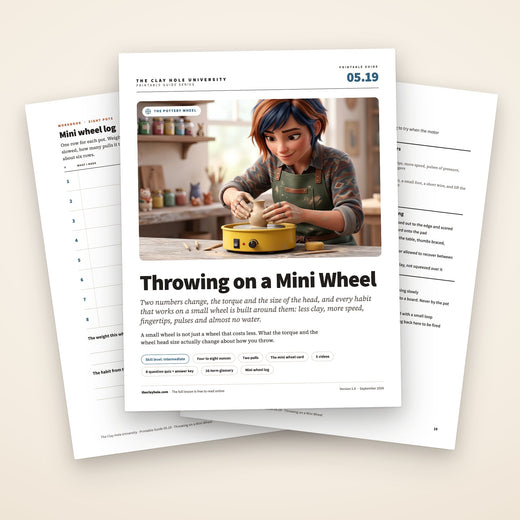
 Printable Pottery Guides
 Free Printable Trackers
 Gifts for Potters
 Christmas Pottery Ideas
 Mother’s Day Gift Ideas
 Pottery Date Night
 Studio Calendar
 2027 Studio Events
 What Should I Do Today?
 How to Throw on the Pottery Wheel
 How to Make a Pinch Pot
 How to Tap Center a Pot
 The Five Stages of Clay
 Is Pottery Hard to Learn?
 Pottery Wheel Practice Drills
 20 Easy Hand-Building Projects
 Everything That Sounds Wrong

 A Beautiful Piece, Every Time
 Slab Roller Tips
 Any Dish as a Slump Mold
 Slab Roller & Slab Mold Certification
 The Pottery Skill Tree
 Clay & Pottery Calculators
 Logging Your Pottery and Glazes
 The Pottery Dictionary
 Why Did My Pottery Do That?
 The Pottery Cone Chart
 Pottery Myths, Fact-Checked
 Is Handmade Pottery Food Safe?
 Incredible Ceramic Artist Videos
 How Dan Throws Giant Pots
 How to Dry Your Pottery
 The Pottery Wheel Introduction
 Pottery by Zodiac Sign
 Personality and the Pottery Wheel
 Pottery for Engineers
 ADHD, Hyperfocus, and Never Running Out
 Hobbies for Burnout
 Screen-Free Hobbies for Adults
 Every Addiction I Ever Had Lost to Art
 Functional Pottery Is Engineering
 How Do We Compare?
 Pottery Classes by City
 Every Pottery Studio in Utah
 Pottery in Draper
 Featured Members
 The Signature Wall
 Making Friends as an Adult Is Brutal
 The Clay Hole Commandments
 2027 Pottery Contests
 2027 Studio Parties
 Gallery Night

 Scream It Into the Void
 Destroy the Glaze Wall
 Daily Affirmation Cards
 Everything That Can Go Wrong
 Subscribe to Our Newsletters
 Contact The Clay Hole
 Corporate Team Building

 Glaze Combinations
 Glazes We Do Not Carry
 Making Glaze Test Tiles
 The Mega Glaze Tool
 How to Use the Mega Glaze Tool

 Glaze Brushing Techniques
 How to Use Underglaze
 How to Use Dipping Glazes
 Glaze Problems, Causes and Fixes
 The Dipping Glaze Guide

 Making a Glaze Catcher
 Fused or Sharp After Firing
 The Signature Wall
 His Viral Videos
 His Own Ceramics
 Meet Mud
Hand building, project guides · Throwing on a mini wheel
A small wheel is not just a wheel that costs less.
Two numbers change: the torque and the size of the head. Everything that feels wrong on a mini wheel is one of those two numbers, and everything that works is a habit built around them: less clay, more speed, fingertips, pulses, and almost no water.
Four steps with a tick list at each: the two numbers, the clay pad and fingertip centering, the two-pull pot, and getting it off, covered and fired. Six fixes, most of them about the motor, and five videos.
This is the short version: the setup, the pad, the fingertips, the two pulls, each with a tick list. The reasoning, the buying notes and the questions are in the comprehensive version.

Read it, then watch it
Why this is written down and filmed, both.
A mini wheel is a full-size wheel with two numbers changed, torque and head size, and this page is about what those two numbers do to your hands. That is reasoning, and reasoning belongs on a page you can come back to when the wheel stalls again. What a page cannot show is how light a fingertip touch has to be, or what pulsing pressure looks like against a motor that wants to stop. That is the videos, and two of them are from a potter who threw real pots on a wheel the size of a saucer.
Use both, in this order
Read the two numbers. Watch the fingertips. Throw four ounces with the tick list open, and stop while the pot still looks chunky.
The whole idea
Less clay, more speed, fingertips, and almost no water.
A small motor stalls under the pressure that centers a pound, and a small head has no room for a foot. So: four to eight ounces of clay, the wheel faster than feels natural, fingertips instead of palms, pulses of pressure instead of a constant push, a pad of clay as the bat, a sponge squeezed nearly dry, and two pulls. Stop while it looks chunky.
The five-minute version
The whole technique in six moves.
If you already throw and you just want the shape of it, this is the shape of it. Everything below is these six moves, slowed down and with the places they fail marked.
Before you plug it in
What you need on the table.
Six things, and the first one is the wheel itself, which is the only expensive decision on the page.
A mini wheel with a real motor, four to eight ounces of clay, a mat or a clamp, a small sponge and a cup, a short wire and a needle, a pad of clay and a lid for the pots.
Step one
Understand the two numbers before you touch the clay.
Torque and head size. A full-size wheel has a motor that shrugs off the pressure of two hands centering two pounds, and a head a foot across with room for a bat. A mini wheel has a motor that slows the moment you lean on it, and a head three or four inches across with room for a pot and nothing else. Every rule on this page is one of those two facts turned into a habit.
What a small motor changes
Less clay, because there is less force to center it against. Fingertips, because a palm is a brake. Pulses of pressure, because a constant push stalls the motor and a stalled motor under moving hands tears the pot. More speed, because momentum is the only reserve the wheel has. Cone with two fingers, not two hands.
What a small head changes
No room for a bat on most of them, so a pad of clay stuck to the head is the bat and a wire takes the pot off it. A small foot, because the head is the largest a foot can be. A wire the length of a hand, because a long one buckles. And a pot that has to be lifted by the bat or the pad, never by the pot.
Then set it up so it cannot move: a rubber mat under it or a clamp to the table, a cup of water rather than a bucket, a small sponge, a short wire, and a lid ready to go over each pot the moment it comes off. A mini wheel pot dries in the time it takes to admire it. Our miniature pottery lesson is the drying and firing half of very small work.
Step two
Stick down a clay pad, then center with fingertips and speed.
The pad is the bat. Dry the head. Press a flat pad of clay onto it with the heel of your hand and spread it out to the edge with a thumb, then score it lightly. Slap the throwing clay down onto the pad and press it down hard. The pad grips the head and the pot grips the pad, and at the end a wire slides between them.
Then center, and unlearn the palms. Wheel faster than feels natural. Elbows on the table, thumbs braced against each other, fingertips cupping the clay from both sides. Press inward in short pulses, a second on and a second off, so the motor gets its speed back between them, and press down with a thumb on top at the same time. A small lump centers quickly if you let the wheel do it and stalls instantly if you try to force it. Cone once, up and down, with two fingers, if it will not settle; on a small wheel the cone is easier than the lump.
Water is the other habit to break. A full-size splash on four ounces of clay is soup. Dip the sponge, squeeze it almost dry, and touch it to the clay rather than wringing it over the top. The slurry that builds on the pad is the best lubricant you have; use that before you reach for the cup.
Step three
Open with a fingertip, pull twice, stop while it looks chunky.
Everything is a fingertip. Open with one finger straight down the middle, stop a finger’s width off the pad, and draw it toward you to set the floor. Pull with a fingertip inside and a knuckle or a second fingertip outside, pressed toward each other at the base and lifted slowly. A small wall moves a long way for very little pressure.
Two pulls, three at most. A full-size pot takes five pulls because there is a lot of clay to move; a four ounce pot is thin after two, and the third takes the wall from a sixteenth of an inch to nothing. Leave the walls proportionally thicker than you would on a big pot: a mini pot that looks a little chunky wet looks right fired, and a mini pot that looks elegant wet folds before it is off the wheel.
Shape it with a fingertip inside and a small rib or a second fingertip outside, on a fast wheel, the way you would collar a big pot but with a tenth of the pressure. Rims get trued with a needle rather than a finger, because a finger is the size of the rim. Then stop. Small pots are done sooner than your hands expect.
Step four
Wire it off short, cover it fast, and get it fired.
One short pull of the wire between the pot and the pad. A wire the length of a hand, held taut, pulled toward you under the pot with the wheel turning slowly. Then leave it. Do not lift a wet mini pot with your fingers; lift the pad, or slide the pot onto a board with a rib.
Then a lid over it within a minute: a bowl, a tub, anything that stops the air moving. A four ounce pot has almost no mass and a lot of surface, and it goes leather hard in the time it takes to throw the next one, which is fine, and bone dry in the time it takes to throw four, which is not if you wanted to trim it. Trim small pots at soft leather hard, on a chuck or a pad, with a small loop and a fingertip holding them down.
Firing at The Clay Hole: pots thrown at home come back for bisque and glaze if the clay came from our shelves, and only then; outside clay never goes into our kilns. Bring them dry in a padded box, or damp in a sealed tub if they are still leather hard. Small pieces that fit on one six-inch cookie, roughly the same height and a quarter inch apart, fire as one piece at the $4.80 minimum, which is the mini wheel’s best trick.
Watch it done
Now watch five people throw small.
Watch this one, then go weigh out four ounces.
None of these potters work here or know we exist. Between them they cover a real potter on a tiny wheel, what torque buys you, fingertip throwing on a full-size wheel, the mistakes, and a quick run of small pots. Nothing but the still frame loads until you press play.
Nine minutes from a working potter on a wheel the size of a saucer, saying exactly what the low torque changes. The other four videos are in the comprehensive version.
When it goes wrong
Six ways it goes wrong, and what to do about each.
The three failures that happen on the first night.
Pick the one that looks like your wheel. The first three are the motor and the head. The last three are water, thickness and palms.
The wheel stalls or slows the moment you press
Low torque. A small motor cannot push back against the pressure that centers a pound of clay, so it slows, then stops, then the clay tears because the wheel stopped under moving hands.
Less clay, four to eight ounces. Fingertip pressure instead of palms. Wheel speed higher than feels natural, so there is momentum to spend. Center with pulses of pressure rather than a constant push.
Lift your hands, let the wheel come back up to speed, and go again with half the pressure. If it stalls at four ounces with fingertips, the wheel is a toy.
The wheel walks across the table or wobbles
A light wheel on a slick surface with a hand pushing sideways on the clay. Full-size wheels weigh enough to stay put; a mini wheel weighs less than the clay bucket.
A rubber mat under it, or clamp it to the table, or a heavy book on the base if the design allows. Push down into the wheel, not sideways across it.
Stop, put a damp towel under it, and brace the wheel with your forearm as you throw. It is annoying and it works.
The clay will not stick to the wheel head
A small smooth head, often plastic, with water on it. Clay grips a damp textured surface and slides on a wet slick one.
Dry the head, press the clay down hard with the heel of your hand, and throw on a small bat or a pad of clay stuck to the head instead. A pad of clay, scored, is the mini wheel’s bat.
Wipe the head dry, slap the clay down, press it out to the edge with a thumb and start again.
Everything turned to soup
A full-size amount of water on a quarter of the clay. A mini wheel pot has almost no mass to absorb water, so the same splash that lubricates a two pound pot dissolves a four ounce one.
A small sponge, squeezed almost dry, touched to the pot rather than squeezed over it. A cup of water, not a bucket. Slurry from the wheel head instead of fresh water.
Sponge it all out, wait a minute for the surface to firm, and go on with a damp fingertip. A soupy mini pot is a mini pot that needed a rest.
It collapsed or the rim folded
Pulled too thin for its size. A small pot dries and stiffens fast, but it is also small enough that one extra pull takes the wall from a sixteenth of an inch to nothing.
Two pulls, three at most. Walls proportionally thicker than a big pot. Stop while it looks a little chunky; it will look right fired.
Cut the folded rim off with a needle and settle for a shorter pot. Small pots are cheap to start again.
It will not center
Palms and force, which is how a full-size wheel centers, do not work on a small head with low torque. The clay wants fingertips and the wheel wants speed.
Wheel fast. Thumbs braced against each other, fingertips cupping the clay, elbows on the table. Small pulses of pressure, letting the wheel recover between them. Cone up and down with two fingers.
Slap it flat, press it down hard onto a dry head, and start again with less clay than you think is dignified.
How it works here
At The Clay Hole, the mini wheel is a home tool and the kilns are still here.
This page is written for potters everywhere. A few things are specific to our building.
Three things to know here
We have 29 full-size wheels, open to every Level, so a mini wheel is a home tool; nothing on this page changes what you do in the building. Pots thrown at home come back for firing only if the clay came from our shelves; outside clay never goes into our kilns. Small pots on one cookie, roughly the same height, fire as one piece at the $4.80 minimum.
The wheels here
All 29 wheels are full-size and open to every Level, so a mini wheel is a home tool and this page is for your kitchen table. Fingertip throwing, which the mini wheel forces on you, is worth practicing on our wheels too: Matthew Kelly’s miniature lidded pot video is exactly that.
Clay
Pots thrown at home come back for bisque and glaze only if the clay came from our shelves. Outside clay never goes into our kilns, because a body we do not know at cone 5½ is a body that can melt, bloat or spit onto somebody else’s work. A bag from here lasts a very long time on a mini wheel.
Getting them here
Dry pieces travel in a padded box. Leather hard pieces travel in a sealed tub or a bag with a damp paper towel, and get finished here. Put your name on the box; small pots on the drop-off table are easy to lose and easy to mistake for somebody else’s.
Firing
Bisque is cone 05 and free. The glaze firing is cone 5½ at five cents a cubic inch, $4.80 minimum. Small pieces that fit on one six-inch cookie, under 125 cubic inches together, roughly the same height and a quarter inch apart, pay as one piece. A tray of mini pots is $4.80.
Questions people actually ask
The ones that come up every week.
What actually changes on a small wheel?
Two things, and everything else follows from them. Torque: a small motor cannot resist the pressure that centers a pound of clay, so you use less clay, fingertips instead of palms, more speed and pulses of pressure. Head size: a three or four inch head means a small foot, throwing on a clay pad or a mini bat, and a wire that cuts the pot off in one short pull. The clay does not know it is on a small wheel; your hands have to.
How much clay?
Four to eight ounces. A pound is the upper limit on the better mini wheels and too much for the toys. Weigh it; on a small wheel a little too much clay is the difference between throwing and stalling.
Is a mini wheel a good way to learn?
It is a good way to learn fingertip control and water discipline, and a poor way to learn centering with your palms, which is what a full-size wheel teaches. If you have access to full-size wheels, learn there and use the mini wheel for what it is good at: small pots at home, tests, lids, knobs and miniatures.
Which mini wheels are worth it?
The ones with a real motor and enough weight to stay put. The videos on this page compare several. As a rule, if the listing calls it a toy or a kit, it is one; if it quotes torque or a motor wattage above a hair dryer, it might be a wheel. We do not sell them and we do not recommend a brand.
Can I fire pots I throw at home?
At The Clay Hole, only if the clay came from our shelves. Clay bought here, thrown at home on your own wheel, and brought back for firing is fine. Outside clay never goes into our kilns. Wrap the pieces damp for the trip if they are still wet, or box them padded if they are dry.
Do I need a bat?
On a small head, a pad of clay stuck down and scored is the bat, and a wire cut takes the pot off it. Some mini wheels take small bats on pins, which is better. Lifting a wet mini pot off a head with your fingers is how most of them end.
Why does everything dry so fast?
A four ounce pot has almost no mass and a lot of surface, so it loses water in minutes. Throw faster, use less water, and get it under plastic the moment it is off the wheel. Our miniature pottery lesson covers the drying and firing side of very small work.
Related lessons
Six lessons that sit next to this one.
Three to read next.
A mini wheel is a full-size wheel with the numbers changed. These are the full-size pages, and the ones about small work.
That is the whole adjustment
Less clay. More speed. Fingertips. Pulses. Almost no water. Two pulls.
Your first mini wheel pot will stall twice, flood once and fold at the rim, and every one of those is a habit from a bigger wheel. That is normal, and the second evening is different. A small wheel that is not a toy makes real pots, and a tray of them fires here for $4.80.
If you want the two numbers explained, the buying notes, the trimming notes and the answers to the questions everybody asks, switch to the comprehensive version at the top. Otherwise, go weigh out four ounces.
Written for potters everywhere. Where our studio does things differently, the page says so.
Which version would you like to print?
Both print clean, with the videos turned into labeled boxes you can search for later.