

 Pottery Date Night
 Bring All Your Friends Free Week
 Give a Month of Pottery
 Private Pottery Parties


 The Welcome Booklet
 Your First Ten Sessions
 The Pottery Process
 Finding the Studio
 Your Classes Never Expire
 The Four Tables
 Who’s Who
 The Rewards Program

 Flux Glazes
 The Calculators
 Kiln Tracker
 Holiday Kiln Deadlines


 Beginner’s Tool Set
 Fingernail Clippers
 Mayco Clay Mender
 Epoxy for Kintsugi
 Applicator Bottles
 Large Bead Rack

 Raku Workshop
 Nighttime Raku
 Horsehair and Feather Raku

 The Clay Hole T-Shirt
 Embroidered Crewneck
 Zip-Up Hoodie
 Pre-Made Bisqueware
 Glaze Catchers
 Kiln Cookies
 Clay Cubby Rental

 The Glaze Bible, Printed
 The Book of Molds, Printed
 Printable Pottery Guides
 Free Printable Trackers

 Gifts for Potters
 Christmas Pottery Ideas
 Mother’s Day Gift Ideas
 Pottery Date Night

 Studio Calendar
 2027 Studio Events
 What Should I Do Today?

 How to Throw on the Pottery Wheel
 How to Make a Pinch Pot
 How to Tap Center a Pot
 The Five Stages of Clay

 Is Pottery Hard to Learn?
 Pottery Wheel Practice Drills
 20 Easy Hand-Building Projects
 Everything That Sounds Wrong

 Why Did My Pottery Do That?
 Glaze Problems, Causes and Fixes
 How to Rescue Pottery at Any Stage
 Reglazing and Refiring


 A Beautiful Piece, Every Time
 Slab Roller Tips
 Any Dish as a Slump Mold
 Slab Roller & Slab Mold Certification

 The Beginner bundle
 The Intermediate bundle
 The Advanced bundle
 The Expert bundle
 The Insane bundle
 The Kiln furniture bundle

 The Pottery Skill Tree
 Clay & Pottery Calculators
 Logging Your Pottery and Glazes

 The Pottery Dictionary
 The Pottery Cone Chart
 Pottery Myths, Fact-Checked
 Is Handmade Pottery Food Safe?

 Incredible Ceramic Artist Videos
 How Dan Throws Giant Pots
 How to Dry Your Pottery
 The Pottery Wheel Introduction

 Pottery by Zodiac Sign
 Personality and the Pottery Wheel
 Pottery for Engineers
 ADHD, Hyperfocus, and Never Running Out
 Hobbies for Burnout
 Screen-Free Hobbies for Adults
 Every Addiction I Ever Had Lost to Art
 Functional Pottery Is Engineering

 How Do We Compare?
 Pottery Classes by City
 Every Pottery Studio in Utah
 Pottery in Draper

 Featured Members
 The Signature Wall
 Making Friends as an Adult Is Brutal
 The Clay Hole Commandments

 2027 Pottery Contests
 2027 Studio Parties
 Gallery Night


 Scream It Into the Void
 Destroy the Glaze Wall
 Daily Affirmation Cards
 Everything That Can Go Wrong

 Subscribe to Our Newsletters
 Contact The Clay Hole

 Corporate Team Building


 Glaze Combinations
 Glazes We Do Not Carry
 Making Glaze Test Tiles

 The Mega Glaze Tool
 How to Use the Mega Glaze Tool


 Glaze Brushing Techniques
 How to Use Underglaze
 How to Use Dipping Glazes

 The Dipping Glaze Guide


 Making a Glaze Catcher
 Fused or Sharp After Firing

 The Signature Wall
 My Viral Videos
 My Own Ceramics
 Meet Mud
Nearly 10,000 square feet. Here is all of it.
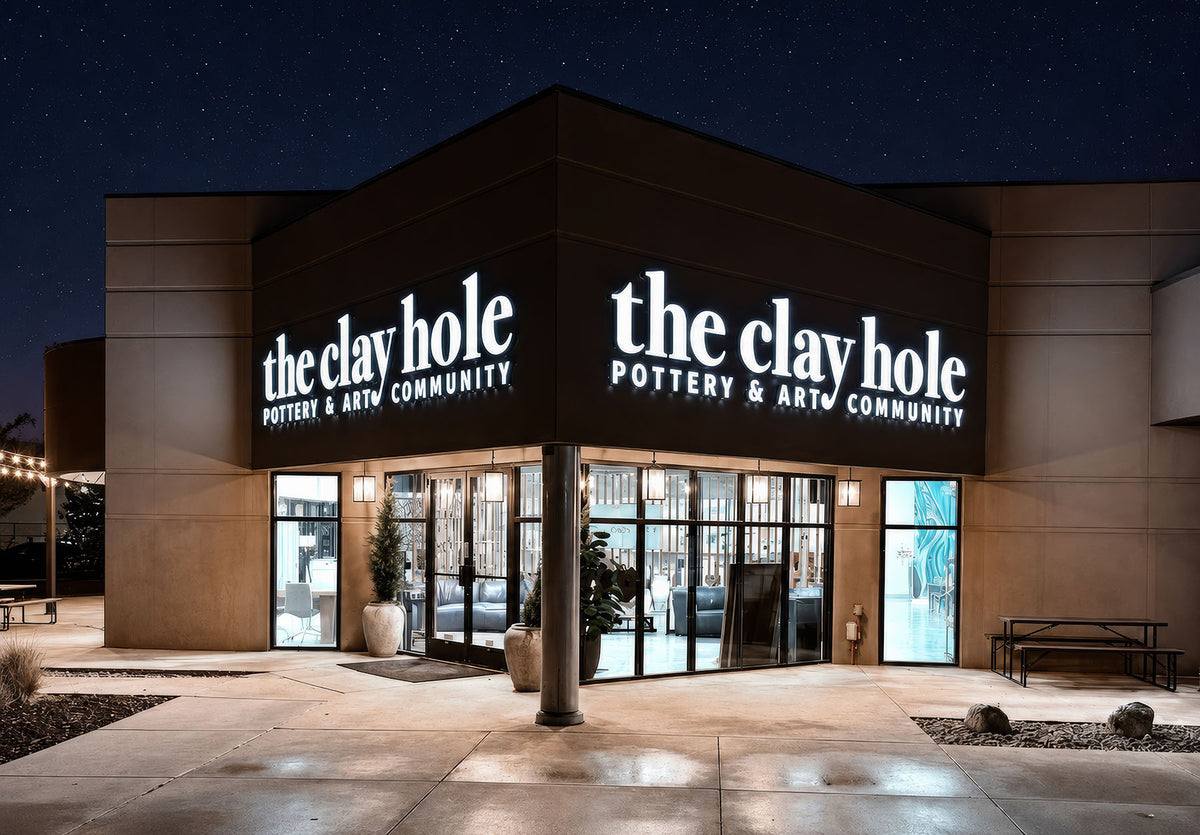
We know so many people would love to see the greatest pottery studio on the planet! Since drop-in tours really derail our team, our classes and our projects, we did the next best thing and photographed the whole place for you. We know you’ve heard a lot about it… welcome to The Clay Hole.
These photos were taken before our doors ever opened
We shot this photo tour before The Clay Hole had welcomed a single member. It is a fun time capsule, and the studio has grown up a lot since then. For the best and most current look at the place, take the new 360° virtual tour and wander through it yourself.
A few things that have changed since these photos
- There are no vending machines. Two big drink fridges took their place.
- Eight more pottery wheels have joined Spin Class, which now has 24 wheels in three groups of eight.
- The pick-up and drop-off tables that sit empty in these photos are busy every single day.
- The student and member shelves that were bare before opening are now full of pots in progress.
- There is a dipping glaze station out on the floor now.
- Plenty of other layouts, furniture, tools and corners have evolved as the studio found its rhythm.
Enjoy the old photos for what they are. When you want to see The Clay Hole as it really looks today, the virtual tour is the one to take.
A million dollars of studio, sitting right off the freeway in Draper
That figure is real, and every dollar of it is in the building waiting for you to use. Here is what is inside.
What are you most excited to make?
Tap what you love most and we’ll tell you what is waiting for you, then take you straight to it.
The orientation video every new member watches
Same tour, moving, with the explanations attached. It is the video we send members before their first class, so it covers the rules and the where-does-this-go questions as well as the rooms.
Nothing loads from YouTube until you press play. If you’d rather watch it there, open it on YouTube.
Walking in
The first thing most people say is that it doesn’t look like a pottery studio. It looks like somebody spent a great deal of money on a pottery studio, which is closer to the truth.
The front of the building holds the Information Center, clay and glaze information, whatever demos and workshops are coming up, and the merch. It is also where you will be standing for a good chunk of your first day, because a real instructor walks every new member around in person. The real thing is even better.
The wheels
Twenty-nine of them. Twenty-four electric and one kick wheel in the main throwing area, plus four more in the Black Level overflow room.
They are first come, first served, always. On a normal night thirty to fifty people are in the building and about a quarter of them are at a wheel, so there is nearly always one open and waiting for you. Every wheel has a custom-built ware platform beside it so your pieces have somewhere to live while you work.
Want a wheel lesson on night one? Come a few minutes early
First wheel lessons start right at the beginning of class, so arriving on time means you get one on your very first night. We are flagging it here because we want that first night to be brilliant.
The Clayground
The giant community tables through the middle of the building. This is where most of the studio actually is on any given night, seventy-five to eighty percent of a class is here, hand-building, sculpting, glazing and working with molds.
More than 150 molds and forms, which is how a complete beginner walks out with a pristine platter on day one. Slab rollers. Extruders. And the odd things we bought because they make the work better: hanging infrared heat lamps for drying, student lockers, a wall extruder.
How the extruders work by level
Handheld extruders open up at Purple Level, and the big wall extruder comes with Black Level. The slab rollers, the worktables and every one of the molds are open to all members, whatever color you are on.
Glaze
More than 650 commercial glazes and more than 150 underglazes, from Amaco, Mayco, Coyote, Spectrum, Laguna, Georgies and Speedball. The collection on its own is worth over $100,000, and it is the single most common reason people give for joining.
Most are brush-on. Seven are dipping glazes, for people who would rather not brush. Those need a certification before you touch them, and there is now a dipping station on the floor that these photographs predate entirely.
Your glaze collection grows as you do
Each membership level unlocks more of the collection, and the very highest-end glazes come with Black Level. Green Level members start with our basic glazes and have plenty to play with. Pick the level that fits what you want to make.
Kilns and shelves
Four kilns, one of them a 41½ cubic foot bell lift. That capacity is the whole reason pottery here usually goes into a kiln within a few days instead of waiting weeks for a load to fill.
Then 150 feet of drop-off and pickup tables, so your work is easy to set down and easy to spot when it comes out of the kiln. Fewer hands on a piece means it gets back to you in one piece. And every member gets a private shelf, running from 24 by 12 by 8 inches at Green Level up to 48 by 16 by 16 at Black Level.
Tools
Thousands of them. We are not rounding up, and we have never managed a precise count.
Which tools you can reach into depends on your level: Green Level members bring a basic set of their own, and every level above that opens up more of the studio’s. Equipment works differently, all 29 wheels, the worktables, the slab rollers and the kilns are open to every member, whatever color you are on.
The Artists Workshop
A whole separate room for the art forms beyond pottery. Stained glass, jewelry making, tie dye, terrariums, metal work.
Where it stands today: the room is built and the workshops do happen, though they run occasionally rather than on a set schedule. Come for the pottery, and treat every workshop that lands as a lovely bonus.
The social side
A pottery studio you want to stay in is a very different thing from a pottery studio.
The Friend Zone is the soft end of the building: big leather seats, group games, or the whole corner to yourself if that is the evening you are after. There is a dart board. There is a board game table with dozens of games on it. Our own work area sits out in the open on purpose, so you can watch somebody who knows what they are doing and quietly steal the technique.
Coffee and cocoa are always on. Cold drinks and snacks are on the honor system, and both live in two big drink fridges now, which took over from the vending machines you can spot in one of these photos.
The real tour is even better
Every new member gets walked around the building in person by an instructor on their first day. Shelf assigned, questions answered, the whole thing done in one go.
It was built to bring people together. It was built to build.
Nearly every part of this studio is here because somebody wished for it, and now it exists in Utah. Memberships start at $145 a month, which works out at roughly $33 to $36 for a three-and-a-half hour instructed session with four instructors on the floor.
These photographs show the studio as it stood when they were taken. We are always adding and rearranging, so where a photo has been overtaken by something newer we have said so right on it.