
 Pottery Date Night
 Bring All Your Friends Free Week
 Give a Month of Pottery
 Private Pottery Parties

 The Welcome Booklet
 Your First Ten Sessions
 The Pottery Process
 Finding the Studio
 Your Classes Never Expire
 The Four Tables
 Who’s Who
 The Rewards Program
 Flux Glazes
 The Calculators
 Kiln Tracker
 Holiday Kiln Deadlines

 Beginner’s Tool Set
 Fingernail Clippers
 Mayco Clay Mender
 Epoxy for Kintsugi
 Applicator Bottles
 Large Bead Rack
 Raku Workshop
 Nighttime Raku
 Horsehair and Feather Raku
 The Clay Hole T-Shirt
 Embroidered Crewneck
 Zip-Up Hoodie
 Pre-Made Bisqueware
 Glaze Catchers
 Kiln Cookies
 Clay Cubby Rental
 The Glaze Bible, Printed
 The Book of Molds, Printed
 Printable Pottery Guides
 Free Printable Trackers
 Gifts for Potters
 Christmas Pottery Ideas
 Mother’s Day Gift Ideas
 Pottery Date Night
 Studio Calendar
 2027 Studio Events
 What Should I Do Today?
 How to Throw on the Pottery Wheel
 How to Make a Pinch Pot
 How to Tap Center a Pot
 The Five Stages of Clay
 Is Pottery Hard to Learn?
 Pottery Wheel Practice Drills
 20 Easy Hand-Building Projects
 Everything That Sounds Wrong

 A Beautiful Piece, Every Time
 Slab Roller Tips
 Any Dish as a Slump Mold
 Slab Roller & Slab Mold Certification
 The Pottery Skill Tree
 Clay & Pottery Calculators
 Logging Your Pottery and Glazes
 The Pottery Dictionary
 Why Did My Pottery Do That?
 The Pottery Cone Chart
 Pottery Myths, Fact-Checked
 Is Handmade Pottery Food Safe?
 Incredible Ceramic Artist Videos
 How Dan Throws Giant Pots
 How to Dry Your Pottery
 The Pottery Wheel Introduction
 Pottery by Zodiac Sign
 Personality and the Pottery Wheel
 Pottery for Engineers
 ADHD, Hyperfocus, and Never Running Out
 Hobbies for Burnout
 Screen-Free Hobbies for Adults
 Every Addiction I Ever Had Lost to Art
 Functional Pottery Is Engineering
 How Do We Compare?
 Pottery Classes by City
 Every Pottery Studio in Utah
 Pottery in Draper
 Featured Members
 The Signature Wall
 Making Friends as an Adult Is Brutal
 The Clay Hole Commandments
 2027 Pottery Contests
 2027 Studio Parties
 Gallery Night

 Scream It Into the Void
 Destroy the Glaze Wall
 Daily Affirmation Cards
 Everything That Can Go Wrong
 Subscribe to Our Newsletters
 Contact The Clay Hole
 Corporate Team Building

 Glaze Combinations
 Glazes We Do Not Carry
 Making Glaze Test Tiles
 The Mega Glaze Tool
 How to Use the Mega Glaze Tool

 Glaze Brushing Techniques
 How to Use Underglaze
 How to Use Dipping Glazes
 Glaze Problems, Causes and Fixes
 The Dipping Glaze Guide

 Making a Glaze Catcher
 Fused or Sharp After Firing
 The Signature Wall
 His Viral Videos
 His Own Ceramics
 Meet Mud
The microwave kiln, explained
It is a real product, it does a real thing, and almost everything written about it online is either breathless or dismissive. Here is the middle: what the device physically is, the one number that decides what it can and cannot do, what it is genuinely good at, what “microwave raku” actually involves, and why there is not one sitting in our studio.
A small fiber chamber with a silicon carbide coating that you run inside a microwave. It tops out around 1,650°F, which is roughly cone 010. That single number explains what it can do, what it cannot, and why it belongs outside.
- Peaks near 1,650°F
- Roughly cone 010
- Designed for glass
- Beads, not mugs

Six lines that cover it
- The microwaves never touch your pot. They heat a black silicon carbide coating inside a small fiber chamber, and that coating radiates heat onto whatever is sitting under it.
- The chamber is between 2¾ and 6¼ inches across and under 2½ inches tall. Beads, pendants, test tiles, tiny thrown pieces. Nothing larger than the biggest one commonly sold fits.
- It was built to fuse glass. Firing clay in one is potters borrowing a glass tool, which works, within limits.
- It has no thermocouple, no controller and no ramp. You set a timer, write down what happened, and calibrate to your own microwave over many firings.
- Clay that comes out of it is porous and decorative. Do not put food in anything fired in one. For food, fire in a normal glaze firing and check the glaze in the Food Safe Lookup.
- It puts out fumes and it gets to red heat inside a kitchen appliance, so it belongs outdoors, in a microwave that nobody heats food in anymore.
If you want to make tiny fired things at home and you are willing to run it outside on a dedicated appliance, it is a fun and legitimate tool. If you are hoping it replaces a kiln, it does not come close, and the next section is the reason why.
It is not firing in the microwave
The name does most of the damage. Nothing about a microwave oven is capable of firing clay on its own. Microwave energy excites water molecules, and by the time a pot is anywhere near a firing temperature there is no water left in it to excite. A pot sitting bare on the turntable would sit there getting nowhere.
What a microwave kiln adds is a middleman. It is a two-piece container, a base and a hood, made of white insulating ceramic fiber. The inside of the hood is coated with a black silicon carbide compound. Silicon carbide couples with microwave energy extremely well and converts it straight into heat, and because it is wrapped in fiber, that heat has nowhere to go except inward.
So the sequence is: the magnetron heats the coating, the coating glows, and the glowing coating radiates onto your piece. Your work is being fired by an incandescent lining, the same way it would be in any small electric kiln. The microwave is just an unusual way of powering the element.
Everything awkward about these kilns follows from the middleman. The heat comes from one surface rather than from elements all round, so the chamber is never even. There is no thermocouple in the loop, so nothing measures the temperature or shuts anything off. And the whole assembly sits inside an appliance that was designed to warm a burrito, with a vent hole in the top of the kiln pointing straight at the appliance ceiling.
The three sizes
Every brand sells roughly the same three. The chamber is the part that matters, and it is smaller than people picture.
| Size | Chamber | Realistically holds |
|---|---|---|
| Small | 2¾ in across, 1¾ in tall | One pendant or a few beads |
| Medium | 4½ in across, 1¾ in tall | A test tile, or a small flat piece |
| Large | 6¼ in across, 2⅜ in tall | One thrown piece the size of a shot glass |
Sizes as published by Spectrum Glazes and the three main brands sold in the United States: MicroKiln, MagicFuse and Fuseworks. The large one is about the footprint of a drink coaster and shallower than a deck of cards.
Everything comes back to 1,650 degrees
1,650 degrees is the whole story
A microwave kiln peaks at roughly 1,650°F, which is about cone 010. Manufacturers rate them for clays and glazes formulated between cone 018 and cone 010. That ceiling is not a limitation somebody could engineer around with a better microwave. It is what a fiber box with a silicon carbide lining does.
What the gap actually costs you
It cannot reach a normal bisque
We bisque to cone 05, which is 1,888°F. A microwave kiln lands 238 degrees short of that. Work fired in one is not bisqueware in the sense anybody means the word, and it will not behave like bisqueware when you try to glaze it.
It is more than 500 degrees below our glaze firing
Our glaze firings go to cone 5½, meaning cone 5 with a twelve minute hold. That is where a stoneware body actually vitrifies and where our glazes melt into a durable, washable surface. Nothing in this conversation is within reach of that.
It is under a standard raku glaze
Most commercial raku glazes are formulated for cone 06, or 1,828°F, and get pulled from a raku kiln around 1,800 to 1,900°F. A microwave kiln sits 178 degrees below that, which is why microwave work uses specific low melting glazes rather than whatever is on the raku shelf.
Nothing that comes out is vitrified
Vitrification is the point at which clay particles fuse and the body stops being porous. At cone 010 a stoneware or porcelain body has barely started. The piece is fragile, it absorbs water, and it is decorative for good. That is a material fact, not a technique problem.
That is 238 degrees below the bisque firings we run, and more than 500 degrees below our glaze firings at cone 5½. Nothing fired in one of these is vitrified, which means it stays porous and stays decorative. That is a property of the material, not something a longer firing fixes.
It is a glass tool, and it is a good one
This is the part that gets skipped by people who dislike these kilns. The microwave kiln was not designed as a budget pottery kiln that fell short. It was designed to fuse small pieces of glass, and at that job it is genuinely excellent. Fused glass wants about 1,400 to 1,500°F, just under what these kilns reach.
What the tool was actually built for
Compatible glass, a sheet of fusing paper, a short firing, then a long undisturbed cooling so the piece anneals instead of cracking. That is the whole workflow, and it produces finished jewelry in an evening.
A long course on fusing glass jewelry in a microwave kiln. For this page, the short demo at 2:53 and How The Kiln Works at 14:10 are the parts that matter, and most of the rest is projects. It shows the real scale: everything that comes out of a microwave kiln is roughly this size, whatever material goes in.
The manufacturer showing its own product
Paragon is a serious kiln company, and this is their demonstration of firing raku pottery in their MagicFuse chamber. It is from 2009 and shot in a home kitchen, and we would take the whole thing outdoors. The chapters cover what Paragon calls a bisque firing, glazing, a glaze firing and a raku reduction.
Notice how much of the runtime is setup, drying and cooling rather than firing.
Where it earns its place in a pottery studio
There is a real use here that has nothing to do with replacing a kiln, and it is the one the ceramics press has recommended for years: it is a fast test chamber for low fire surfaces.
- Testing low fire decoration. China paints, overglaze enamels and commercial decals all mature well under cone 010. You can fire a sample in about five minutes instead of waiting on a kiln load. Lusters give off worse fumes, and one of the makers linked on this page says never to fire luster in a microwave, so we would not.
- Egyptian paste. A self glazing body that matures in this range, and one of the few clay bodies genuinely at home in a microwave kiln.
- Beads, pendants and small jewelry components. The chamber size stops being a problem the moment the work is jewelry sized.
- Test tiles for underglaze color. Not a match for how the color will look at cone 5½, but useful for checking coverage and brushwork.
- Small models. Firing a maquette for a larger piece, quickly, to see how a form reads once it is hard.
Published guidance from Ceramic Arts Network, testing on a low powered microwave: about three minutes for an overglaze, five for glaze pens and underglazes, four to five for Egyptian paste, five for a small porcelain piece. Your own microwave will need its own numbers.
The same move, at a tenth the scale
Raku is not a temperature or a clay body. It is a sequence: bring glazed work up fast, pull it out glowing, drop it into something that catches fire, smother the flames, and let the oxygen starved smoke do the rest. Microwave raku is that exact sequence performed on a piece the size of a walnut. Everything that makes raku raku still happens. It just happens very small.
A one minute look at the small format
The maker has been firing pottery this way since 2020 and says in the description that loads of people have been taught. The video shows miniature work thrown on a small wheel and fired in the chamber, which is the right order of operations: the kiln decides the scale, so the making has to start there.
This is a one minute clip. The description warns never to fire luster in a microwave and says the maker cannot guarantee that anything is food safe, which is the right way to think about all of this.
The full sequence, start to finish
A full microwave raku firing with two makers. The description says an 800 watt second hand microwave, heated in five minute steps while they check for the glow.
That lift is the moment to pay attention to. You are carrying a closed box containing something at red heat, so the landing surface goes within one step.
Glaze behavior at this scale
Metallic raku glazes are used in microwave kilns, which surprises people who have been told never to put metal near a microwave. Metal in a microwave can still spark, so follow the instructions that came with your kiln before you try one.
This short clip shows a pinch pot with a rainbow raku glaze fired in a microwave kiln, and the result is lovely.
The reduction step is fire. A glowing piece goes into paper, sawdust or leaves and that material ignites immediately. There is smoke, there is flame, and there are fumes coming off the glaze. Doing that indoors is not a smaller version of doing it outdoors, it is a different and much worse decision. The makers we would follow fire outside.
Six things you will read that are not true
None of these come from the makers who actually use these kilns well. They come from product listings, roundup articles and the comment section underneath a good video.
“A kiln for under fifty dollars”
It is a firing chamber with a cone 010 ceiling and no controller. Calling it a kiln in the same sentence as a kiln that fires stoneware is the whole problem. A small programmable kiln that fires stoneware properly starts around ten times the price for a reason.
“Fire your mugs at home”
The largest chamber commonly sold is 6¼ inches across and 2⅜ inches tall. A mug does not fit, and if it did, the temperature would not finish it. The practical ceiling is a piece you could close your hand around.
“Food safe once it is glazed”
No. The body never vitrifies at this temperature, so it stays porous and absorbs whatever it holds. Add a reduction step and you have a carbon rich crackled surface as well. Raku is not food safe at full size either. This is decorative work. For something you will eat or drink from, fire it in a normal glaze firing and check the glaze in the Food Safe Lookup on our site.
“Perfect for apartments”
It is the opposite. The one setup requirement nobody can design around is ventilation. Glazes and overglazes give off fumes at temperature, and the reduction step is an open fire. The published guidance is to vent properly or fire outside.
“Just set it and forget it”
There is no thermocouple, no controller and no ramp. The small and medium chambers will not take a pyrometer or even a cone pack. You are running a stopwatch and keeping notes, and the numbers are specific to your microwave’s wattage.
“Buy it once”
The silicon carbide coating degrades with use, so firing times drift longer as it ages. The fiber shell develops micro cracks and loses heat retention. Add kiln fiber paper for every firing, and a second microwave you are willing to retire from food.
What gets cut out of the videos
A microwave raku video runs a few minutes. A real firing, including the part where you sit and wait, runs closer to an hour. Here is what lives in the gap, mostly drawn from the published guidance rather than from anybody’s enthusiasm.
- The cooling is most of the time. The kiln stays closed for 20 to 30 minutes after it comes out, and 35 to 40 minutes for anything at the larger end. Opening early thermal shocks the piece. The base and the top of the hood stay hot long after that, and want six inches of clear space all round.
- It has to leave the microwave immediately. There is a vent hole in the top of the hood and it points at the appliance ceiling. Leaving a finished kiln sitting in there is how people cook the inside of their microwave.
- The coating is fragile. The black lining inside the hood chips off if you knock it, and it is the only reason the thing heats at all. It is a consumable surface on a device people treat as indestructible.
- Fumes are not optional. Overglazes in particular put out noticeably more fume and discolor the inside of the chamber. Ceramic Arts Network’s own instructions say to vent properly or fire outside, and to wear a respirator for the fiber dust when brushing the base clean. For that dust we say an N95 or better and safety glasses.
- You are the temperature controller. No probe fits in the small or medium chamber. You calibrate by firing, writing down the time and the result, and firing again. Every number anybody gives you online is for their microwave.
- Green work has to be genuinely bone dry and genuinely thin. Anything else steams and blows apart, and the faster the ramp the less forgiving it gets. A five minute firing is a brutally fast ramp by any kiln standard.
The counterweight, and it is a fair one
This is a metal clay maker who fires copper clay in one, finds that it works, and still argues against buying one. The reasons are in the chapters called Safety precautions, at 7:18, and Risks and final verdict, at 9:53.
That is worth sitting with. A device that reaches red heat inside a household appliance should come with documentation and a maker you can ask, which is why the named brands matter.
If you are getting one, the named brands are MicroKiln, MagicFuse and Fuseworks, and MagicFuse is made by Paragon, an established kiln manufacturer. That is a meaningfully different purchase from an unbranded listing, and it is the one place we would tell somebody not to shop on price.
The microwave stops being a microwave
This is the part that gets waved past fastest, and it is the one with the clearest practical answer.
A microwave oven is designed to put its energy into a load that absorbs it. A plate of food is a good load. A small ceramic fiber box is a poor one by comparison, and whatever energy does not get absorbed reflects around the cavity and back into the magnetron. Manufacturers warn against running these appliances with little or no load for exactly this reason, because running one with a light load can shorten the life of the magnetron.
Then there is the heat. The kiln reaches red heat and vents through a hole in its top, a few inches under the appliance ceiling. Everything in that cavity was specified for steam and splatter, not for radiant heat off a glowing box.
And there is the contamination question. Glazes, overglazes and lusters give off fumes during firing, and those fumes condense somewhere. That somewhere is the inside of an appliance people otherwise put food in.
Get a second microwave that is only ever a kiln. A used one is inexpensive, and once it is dedicated you have solved the magnetron wear, the interior heat and the food contamination in one purchase. Then put it somewhere with real air.
What a dedicated setup looks like
- A second hand microwave, labeled clearly, that nobody heats food in again. Higher wattage reaches temperature faster.
- Outdoors, or in a garage or shop with the door open and real cross ventilation. Not a kitchen, not a spare room, not a balcony under a window somebody else has open.
- A heatproof landing spot within one step of the door. A kiln brick, a paver or a tile, cleared of everything else before you start.
- Nothing flammable within six inches in any direction, including above.
- A metal reduction can with a metal lid, if you are doing the raku step, sitting ready and open before the kiln comes out.
Two questions, and you have your answer
Can you fire it outdoors on a microwave nobody cooks in, and are you happy making things you could close your hand around? Two yeses and it is a good buy. One no and it will sit in a cupboard.
What it actually looks like done well
The maker has fired pottery this way since 2020. Watch this one for scale more than technique: miniature work is thrown because the chamber decides the size, and that is the right order of operations.
If the work in this video is the kind of work you want to make, the tool fits. If you were picturing mugs, it does not.
MicroKiln, MagicFuse and Fuseworks are the established brands, and MagicFuse is made by Paragon, a real kiln manufacturer. Plenty of unbranded listings ship with no manufacturer and no instructions at all, which is a strange thing to accept in a device that reaches red heat inside a household appliance.
The discipline, in the order it happens
The discipline, start to finish
This is the part to keep open on your phone. It is written for somebody who already owns a microwave kiln and wants to use it without hurting themselves, their house or the piece.
Keep this open on your phone. Written for somebody who already owns one and wants to use it without hurting themselves or the piece.
Before you switch anything on
- Set up outdoors, or in a garage or shop with the door open. Never a kitchen.
- Use the dedicated microwave, not the food one.
- Heatproof landing surface cleared and within one step. Brick, paver or tile.
- Welding gloves or kiln gloves rated for high heat, safety glasses, and tongs if you are reducing. Not oven mitts, not a tea towel.
- Six inches of clear space above and around wherever the kiln will land.
- Work is bone dry. If you are firing green, it is thin and it is dry all the way through, not dry on the outside.
- Glazed work has dried overnight. A damp glaze steams.
- Reduction can open and loaded with combustibles before anything is hot, with its lid within reach.
The firing
-
Paper down, piece on
Cut kiln fiber paper to the base and set your piece on it. This is what stops the work fusing to the fiber. You do not use kiln wash in one of these.
-
Test fit the hood
Put the hood on before it is hot and confirm the piece touches nothing. Anything contacting the coating damages the coating and ruins the piece. Handle the hood by its outside only.
-
Fire to your own number
Start well short of what you think you need and add time in short increments across several firings. Three to eight minutes covers most of the range, but the correct number is a property of your microwave’s wattage and nobody else’s.
-
Look for the glow, then stop
An even orange glow at the vent hole is the signal. Stop there. There is no upside to pushing further and no thermocouple to stop you.
-
Take it out immediately
Both hands, gripping hood and base together so it cannot separate, straight onto the heatproof surface. This protects the appliance and it protects you.
-
Either reduce now, or walk away
If you are doing the raku step, that happens in the next few seconds, outdoors, into the waiting can. If you are not, leave the kiln closed and do not touch it.
-
Wait it out
20 to 30 minutes closed for small work, 35 to 40 for larger. It stays hot well past that. Nothing about this step can be shortened.
-
Write down what you did
Time, wattage, what was in there, what came out. Two or three firings of notes is the difference between a tool you control and a tool you are guessing at.
Never
- Never run it in a kitchen or any room you cannot ventilate properly.
- Never open the hood to check on it mid firing.
- Never leave it running unattended, and never leave the room.
- Never do the reduction step indoors, in a garage with the door shut, or anywhere near anything that burns.
- Never put food back in a microwave you have fired glazes in.
- Never fire a piece that is not fully dry, and never fire something thick because it seems dry.
- Never brush the fiber base clean without an N95 or better and safety glasses on.
- Never treat somebody else’s firing time as yours.
Read that list back. Outdoors, kiln gloves, tongs, a metal can with a lid, combustibles ready, a heatproof landing surface, nothing flammable nearby. That is the outline of a raku setup. Raku at a size worth keeping also takes a bigger kiln and people who know the sequence, which is what our raku workshops are for.
Why there is not one in the studio
Members ask about these regularly, usually after a video comes across a feed, and the answer has three parts. None of them is that the tool is beneath us.
The temperature does not meet ours anywhere. Every clay body we stock, every glaze in our glaze firings and every piece of advice we give is built around bisque at cone 05 and glaze at cone 5½. A cone 010 chamber is not a smaller version of that. It is a different material outcome, with different glazes, producing porous decorative work. Sitting it in the middle of a studio built around vitrified stoneware would confuse more than it taught.
The reduction step cannot happen in the building. The interesting half of microwave raku is pulling a glowing piece into burning paper. That is an open flame with smoke and glaze fumes, and it is an outdoor operation at any scale. We already run raku the proper way, outdoors, as a workshop with people who know the sequence.
The scale does not fit what our members make. If most of the work here were beads and pendants we still would not keep one in the building. Testing overglazes is a genuinely good use, as we said above, but lusters and overglazes give off fumes, and that is an outdoor job. It is not what people are making. They are making mugs, bowls, planters and lidded jars, and every one of those needs a firing this device cannot give.
Enjoy it, fire it outside, and bring the tiny things in to show us. It is a real format with real makers doing real work in it. Just do not expect it to change what happens to the pot you threw on Tuesday.
What the wish underneath usually is
Almost nobody actually wants a microwave kiln. They want one of four things that a microwave kiln appears to offer, and three of those four have better answers.
You want the raku surface
Then you want raku, at a size worth the effort, with a kiln that reaches the temperature the glazes were formulated for. We run raku workshops, and the raku firing guide walks through the whole sequence. There is also naked raku and horsehair and feather if you are after specific surfaces.
You want it back fast
Small work fires fast here too, and bisque firings cost nothing. Glaze firings are priced by size, with a $4.80 minimum, so a pendant costs the minimum and a mug costs very little. The wait is a queue, not a limitation of the equipment.
You want to make tiny things
Then make tiny things and fire them properly. Miniature pottery covers throwing and handbuilding at small scale, and ceramic jewelry covers pendants, beads and findings. Both come out vitrified at cone 5½ instead of porous at cone 010.
You want to test a surface quickly
This is the one where the microwave kiln genuinely wins, and only for low fire decoration. For anything you plan to actually use, a test tile in a normal firing is the only test that tells you the truth, because the result you care about happens more than 500 degrees above where a microwave kiln stops.
Raku at the size it was meant to be
Worth watching straight after the microwave videos, because the sequence is much the same and the scale is not. The chapters cover glazes, at 1:56, and reduction chambers, at 5:31. The glazes are being taken to the temperature they were formulated for, on full size pieces.
He also demonstrates how different glazes behave in reduction, which is the part that makes raku worth learning rather than just watching.
The ones that come up every time
Can I bring microwave kiln work into the studio to be refired?
Talk to us first rather than putting it on a shelf. Work fired at cone 010 has not matured, and low fire and raku glazes never go through our glaze firings, because they melt hundreds of degrees lower and run onto the shelf, which is a problem for everything sharing it. Show the piece to staff, who decide where anything goes.
Can I use our clay in a microwave kiln?
You can fire it, but you will not get what our clay is for. Our bodies are formulated to vitrify at cone 5½. Fired to cone 010 they come out porous and comparatively weak, because that is what any stoneware body does when it is stopped more than 500 degrees early. If you are firing at that temperature by choice, use a body and glazes actually formulated for the low fire range.
Why can it fire glass but not pottery?
Because glass fusing happens in exactly the range these kilns reach. Compatible fusing glass softens and joins somewhere around 1,400 to 1,500°F, which is comfortably inside a cone 010 ceiling. Clay vitrification for the bodies most potters use sits hundreds of degrees higher. The kiln is not failing at pottery, it is succeeding at the job it was designed for.
Is the smoke dangerous?
Treat it as something to keep out of, which is why the published instructions say to vent properly or fire outside. Glazes and especially overglazes give off fume at temperature, and the reduction step burns paper or sawdust in an oxygen starved container, which produces a lot of smoke very quickly. Fiber dust from the kiln base is a separate issue and wants an N95 or better and safety glasses when you brush it clean.
Will it damage my microwave?
Over enough firings, probably. A small fiber box is a light load, and a microwave running with a light load reflects energy back into the magnetron, which shortens its life. The vent hole also directs heat at the appliance ceiling. Both are wear, and a second microwave you have retired from food keeps that wear, and the food question, away from your kitchen appliance.
How long does the kiln itself last?
There is no published figure. It degrades rather than fails. The silicon carbide coating loses efficiency, so the same result needs a longer firing, and the fiber develops micro cracks and holds heat less well. The clearest signal is your own notes: when the time you wrote down last year no longer produces last year’s result, that is the kiln aging.
Is a small electric kiln a better buy?
For pottery, yes, and it is not close. A small programmable kiln gives you a controller, a thermocouple, real ramp rates and a chamber a mug fits in. It costs roughly ten times as much and it needs somewhere to live and a circuit to run on. The microwave kiln is only the better buy if what you want is glass, jewelry scale work, or a fast low fire test chamber.
So is this page telling me not to buy one?
No. It is telling you what you are buying. Bought as a small format for tiny fired objects, fired outdoors on a dedicated appliance, it is a real tool with real makers doing lovely work in it. Bought as a way to avoid needing a kiln, it will disappoint you within a month and it will sit in a cupboard.
Where to go from here
Three places to go next
A real tool, at its real size
A real tool, at its real size
The microwave kiln deserves neither the hype nor the sneering. It is a clever little device that does one thing well, a second thing acceptably, and a third thing not at all. Somebody firing beads and pendants outdoors on a retired appliance is doing real ceramics and getting real results. Somebody expecting it to stand in for a kiln has bought the wrong object, and no amount of technique will fix that, because the problem is more than 500 degrees wide.
Know which one you are before the box arrives. That is the whole point of this page.
It does one thing well, a second thing acceptably, and a third thing not at all. Fire it outside, keep the work small, and know that the gap between it and a real glaze firing is more than 500 degrees wide.
There is a much longer version of this page if you want the physics, the videos and the full argument. The toggle is at the top.
Which version would you like to print?
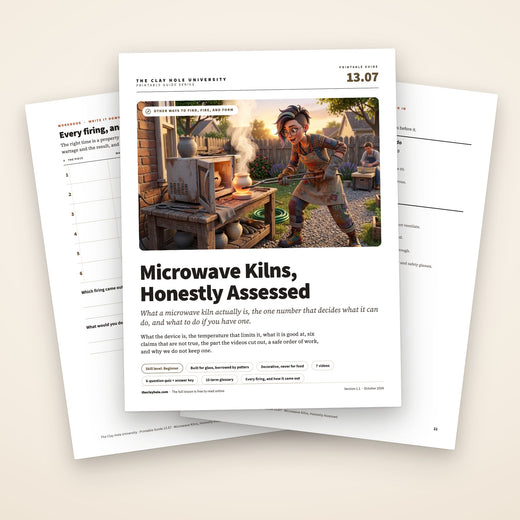
Videos come out as a labeled box with the title and channel to search for, since paper does not play them.