
 Pottery Date Night
 Bring All Your Friends Free Week
 Give a Month of Pottery
 Private Pottery Parties

 The Welcome Booklet
 Your First Ten Sessions
 The Pottery Process
 Finding the Studio
 Your Classes Never Expire
 The Four Tables
 Who’s Who
 The Rewards Program
 Flux Glazes
 The Calculators
 Kiln Tracker
 Holiday Kiln Deadlines

 Beginner’s Tool Set
 Fingernail Clippers
 Mayco Clay Mender
 Epoxy for Kintsugi
 Applicator Bottles
 Large Bead Rack
 Raku Workshop
 Nighttime Raku
 Horsehair and Feather Raku
 The Clay Hole T-Shirt
 Embroidered Crewneck
 Zip-Up Hoodie
 Pre-Made Bisqueware
 Glaze Catchers
 Kiln Cookies
 Clay Cubby Rental
 The Glaze Bible, Printed
 The Book of Molds, Printed
 Printable Pottery Guides
 Free Printable Trackers
 Gifts for Potters
 Christmas Pottery Ideas
 Mother’s Day Gift Ideas
 Pottery Date Night
 Studio Calendar
 2027 Studio Events
 What Should I Do Today?
 How to Throw on the Pottery Wheel
 How to Make a Pinch Pot
 How to Tap Center a Pot
 The Five Stages of Clay
 Is Pottery Hard to Learn?
 Pottery Wheel Practice Drills
 20 Easy Hand-Building Projects
 Everything That Sounds Wrong

 A Beautiful Piece, Every Time
 Slab Roller Tips
 Any Dish as a Slump Mold
 Slab Roller & Slab Mold Certification
 The Pottery Skill Tree
 Clay & Pottery Calculators
 Logging Your Pottery and Glazes
 The Pottery Dictionary
 Why Did My Pottery Do That?
 The Pottery Cone Chart
 Pottery Myths, Fact-Checked
 Is Handmade Pottery Food Safe?
 Incredible Ceramic Artist Videos
 How Dan Throws Giant Pots
 How to Dry Your Pottery
 The Pottery Wheel Introduction
 Pottery by Zodiac Sign
 Personality and the Pottery Wheel
 Pottery for Engineers
 ADHD, Hyperfocus, and Never Running Out
 Hobbies for Burnout
 Screen-Free Hobbies for Adults
 Every Addiction I Ever Had Lost to Art
 Functional Pottery Is Engineering
 How Do We Compare?
 Pottery Classes by City
 Every Pottery Studio in Utah
 Pottery in Draper
 Featured Members
 The Signature Wall
 Making Friends as an Adult Is Brutal
 The Clay Hole Commandments
 2027 Pottery Contests
 2027 Studio Parties
 Gallery Night

 Scream It Into the Void
 Destroy the Glaze Wall
 Daily Affirmation Cards
 Everything That Can Go Wrong
 Subscribe to Our Newsletters
 Contact The Clay Hole
 Corporate Team Building

 Glaze Combinations
 Glazes We Do Not Carry
 Making Glaze Test Tiles
 The Mega Glaze Tool
 How to Use the Mega Glaze Tool

 Glaze Brushing Techniques
 How to Use Underglaze
 How to Use Dipping Glazes
 Glaze Problems, Causes and Fixes
 The Dipping Glaze Guide

 Making a Glaze Catcher
 Fused or Sharp After Firing
 The Signature Wall
 His Viral Videos
 His Own Ceramics
 Meet Mud
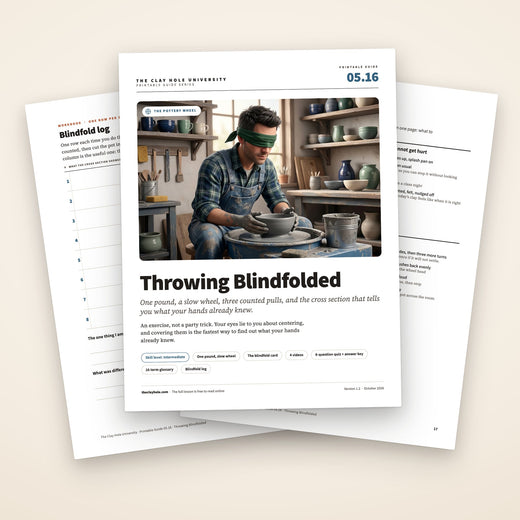
The pottery wheel · Throwing blindfolded
An exercise, not a party trick.
Your eyes lie to you about centering. They say the clay is true while your hands can still feel the knock. Covering them for one small pot is the fastest way to find out what your hands already knew, and most people center better for weeks afterwards.
This page is the setup, the safety list, the four things to feel for, and the tick lists you will be working from memory, because once the blindfold is on you cannot read anything. Six fixes and four videos of other people’s hands.
This is the short version: the setup, the pulse, the three pulls and the cross section, each with a tick list. The reasoning and the questions are in the comprehensive version.
Read it, then watch it
Why this is written down and filmed, both.
This is the one page in the University where video is the point and the page is the setup. You cannot read your way to feeling a wobble. But you can read the safety list, the amount of clay, the wheel speed and the four things to feel for, and have them in your head before the blindfold goes on, because once it is on you cannot look anything up. The videos are for watching other people’s hands do what yours are about to do.
Use both, in this order
Read the setup and the four feelings. Watch one video for the hands. Do it once, cut the pot in half, look. The tick list is short because you will be doing it from memory.
The whole idea
Your eyes lie about centering. Cover them once and find out what your hands knew.
One pound of clay, a slow wheel, elbows braced, someone next to you who knows. Center until the pulse in your hands stops. Open where the clay pushes back evenly. Three counted pulls. Blindfold off, cut it in half, look.
The five-minute version
The whole exercise in six moves.
If you already center reliably and you just want the shape of it, this is the shape of it. Everything below is these six moves, slowed down and with the places they fail marked.
Before the blindfold
What you need at the wheel.
Six things, and one of them is a person. The one to take seriously is the last: sharp tools off the tray, because you will reach for them.
One pound of clay, a real blindfold, a splash pan, a spotter, a wire, and no sharp tools in reach.
Step one
Set up so that nothing can go wrong that matters.
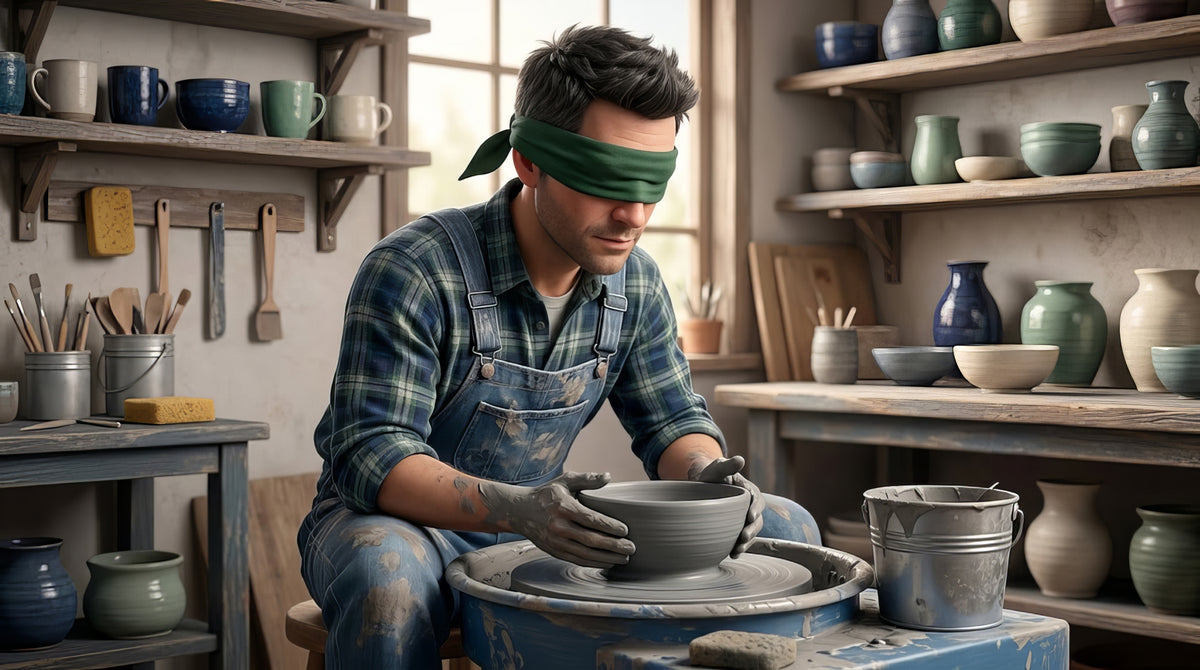
It is a spinning wheel and you cannot see it. So: one pound of clay, wedged. Hair tied back, sleeves rolled, necklaces and apron strings off. Splash pan on. Every sharp tool off the tray. The wheel slower than you normally throw. Your foot on the pedal so you can stop it without looking. The person at the next wheel told.
Then center it with your eyes open, once, so you know what today’s clay and today’s wheel feel like when it is right. Feel it while you look at it: put both hands on the centered lump and notice that there is nothing to notice, no pulse, no knock, just clay turning under still hands. That is the feeling you are about to try to find blind. Then take it off center on purpose with a nudge, stop the wheel, and put the blindfold on.
On a class night, ask the instructor first. Open studio has no instructor on the floor, so whoever is at the next wheel is your spotter: show them where the pedal is before you start.
Step two
Center by the pulse, and hold longer than you want to.
An off-center lump knocks against your hands once every turn. That knock is the whole signal. Elbows on your thighs, hands locked together, a steady wheel speed, and press in and slightly down until the knock fades. Keep pressing three more turns. Ease off slowly.
Two things go wrong. The first is easing off the moment the knock seems to fade, which is exactly when your hands are still steadying a lump that will wobble again without them. Hold. The second is pressing gently because you cannot see what you are doing; blindfolded potters are timid, and timid never centers. Press as hard as you would with your eyes open, with your elbows doing the work.
If it will not settle, cone it: hands squeezing in and up to a tall cone, then a hand on top pushing it back down, once. The cone is easier to feel than a low lump, and coming back down from it usually lands centered. Our coning lesson is the sighted version.
Step three
Open where it pushes back evenly, then three counted pulls.
The thumb finds the middle by pressure. Press a thumb down slowly on top of the lump. If the clay pushes back harder on one side, you are off center; move toward the softer side. When it pushes back evenly, go down, stop a thumb’s width short of the wheel head, and pull the thumb toward you.
Then pull, and count out loud. Fingers inside, knuckle or fingertip outside, pressed toward each other at the base, then lifted together slowly up the wall. After each pull, feel the wall between finger and thumb at the rim: is it the same thickness as the last time? Three pulls and stop. Sighted, three pulls is the norm and maybe four, and you check the rim by eye each time; blind, the fourth pull is where it thins to nothing without warning. Stop short, thick and honest.
Everything on slowly, everything off slowly. A hand snatched away from a spinning pot is what sends it across the room. Stop the wheel with the foot before the blindfold comes off, every time, so that the first thing you see is a still pot and not a moving one.
Step four
Look, cut it in half, and write down what your hands knew.
The cross section is the report card. Blindfold off. Look before you touch. Then wire it in half top to bottom: where the wall is thick, where it is thin, how thick the floor is, whether the base is centered.
Then the useful part, which is comparing what you saw to what you felt. If you felt a knock and told yourself it was centered, that is the lie your eyes have been telling you at every wheel session, and now you know its shape. If the wall is thick at the bottom, that is where your hands stop trusting each other on a pull. Most potters find one specific thing, and it is the thing they fix over the next month with their eyes open.
Then wedge it up. Keeping a blindfolded pot is allowed, but the pot was never the point, and the second time you do this, in a week or two, it will be better than the first by more than any other exercise on the wheel.
Watch it done
Now watch four videos of people doing this with their eyes covered.
Watch this one, then go weigh out a pound.
None of these potters work here or know we exist. Between them they cover a potter throwing blind, a short project video, the hardest version of a TV challenge, and one potter at one wheel. Nothing but the still frame loads until you press play.
Eight minutes of a potter throwing with their eyes covered. The other four videos are in the comprehensive version.
When it goes wrong
Six ways it goes wrong, and what to do about each.
The three failures that happen on the first try.
Pick the one that looks like your wheel. All six are things your hands would have told you about if you had been listening, which is the point.
It never centered and you could feel it the whole time
Your eyes were telling you it was centered before, and they were wrong more often than you knew. Blindfolded, the wobble in your hands is the only signal, and most people press too gently and let go too soon.
Elbows on your thighs, wheel at the slow speed you set, press until the pulse stops, then hold three more turns before easing off. Cone once if it will not settle.
Stop the wheel, blindfold off, look. You will see exactly the wobble your hands reported. Recenter sighted, then go again.
The clay came off the wheel
Uneven pressure, or hands lifted suddenly, or a fast wheel under a hand that pushed sideways. Blindfolded, your hands do things they would never do with a pot in view.
Slower wheel than you think. Hands moving slowly on and slowly off, never snatched away. Fingers and thumbs braced against each other so one hand cannot push without the other.
It is on the floor, and it is a lesson, and it is also why you use one pound of clay and not four.
The walls are thick in one place and thin in another
You lost count, or you lost the wall. Blindfolded, the only way to know how thick a wall is, is to feel it between finger and thumb, and the only way to know how many pulls you have made is to count.
Count every pull out loud. Feel the wall between finger and thumb after each one. Stop at three.
Take the blindfold off and look at it cut in half. The cross-section is the whole lesson, and it is more useful than a finished pot.
It collapsed on the last pull
Too thin, too wet, or too tall for a blind pull. The last pull is where sighted potters check the rim, and without the check the rim goes on thinning until it flares and folds.
Less water; a sponge inside the base after every pull. Three pulls. Stop while it is still short and thick and call that a finished exercise.
Wedge it up and go again. The exercise is the point; the pot is a by-product.
You panicked and pulled your hands away
Everyone does, the first time the wheel is spinning and the world is dark. Hands come off fast, and fast is what wrecks pots.
Stop the wheel with the pedal before you do anything else. Breathe. Then start it slowly. Hands go on slowly, come off slowly, every time, whatever is happening on the wheel.
Blindfold off, deep breath, and back on with the wheel at half speed. It gets ordinary surprisingly fast.
Water, slurry and clay everywhere
That is the exercise. Blindfolded, you cannot see where the water is going, and neither can the person at the next wheel.
Less water in the bucket, a sponge rather than a pour, and a splash pan that is actually on. Tell the person next to you before you start.
Wipe it up wet, as always. Never sweep dry clay. A messy exercise done once is worth more than a tidy one never done.
How it works here
At The Clay Hole, tell your neighbor first.
This page is written for potters everywhere. A few things are specific to our building.
Three things to know here
Any electric wheel, first come, first served; the kick wheel opens at Purple Level. Tell the person next to you, and on a class night ask the instructor first. Wipe the wheel and the floor down wet afterwards; a blindfolded potter floods the wheel, and dry clay dust is silica.
The wheels
Every Level can use the electric wheels, first come, first served. The kick wheel opens at Purple Level. Pick one at the end of a row if you can, with a wall on one side, so a pot that gets away has fewer places to go. Open studio needs two instructed classes first, one if you came in experienced.
The neighbor and the instructor
Tell whoever is next to you before the blindfold goes on. On a class night, ask the instructor; it is the kind of thing they will want to watch, and they are the best spotter in the building. Nobody minds. Everybody wants to try it afterwards.
Cleanup
A blindfolded potter uses more water and spreads it further. Wipe the wheel, the splash pan and the floor down wet when you finish. Never sweep dry clay; it is silica and everybody breathes it.
Clay
One pound from your own bag. Keep the scraps to wedge up and use again; reclaiming happens at home, not here. Our eight clay bodies all work; a smoother body gives a clearer pulse in the hands than a groggy one, which is a small argument for B-Mix on the day you try this.
Questions people actually ask
The ones that come up every week.
Why would anyone do this?
Because your eyes lie about centering. They tell you the clay is centered when your hands can still feel a wobble, and they tell you a wall is even when it is not. Covering them for one pot makes you listen to your hands, and most people find their centering improves for weeks afterwards. It is an exercise, not a party trick, and it is on the syllabus at good pottery schools for that reason.
Should I be able to center already?
Yes. This is an intermediate exercise for someone who centers reliably with their eyes open and wants to know what their hands actually know. If centering is still a struggle sighted, our centering lesson comes first, and this page waits for you.
Is it safe?
It is a spinning wheel and you cannot see it, so treat it that way. Small clay, one pound. Hair tied back, sleeves up, nothing loose. Splash pan on. Wheel slower than usual. Tools out of reach so you cannot knock a needle into your lap. Someone next to you who knows what you are doing. Foot on the pedal so you can stop it without looking. Do all of that and the main thing you are likely to hurt is the pot.
How much clay?
One pound, no more. Enough to feel, small enough that a mistake stays on the wheel. A four pound lump that gets away from a blindfolded potter is a four pound lump on the floor and possibly on a neighbor.
What am I actually feeling for?
Centering: a pulse or knock in your hands once a revolution that fades to nothing. Opening: the thumb finding the middle by where the clay pushes back evenly. Pulling: the wall between finger and thumb getting thinner, and the same thickness the whole way up. Rim: a fingertip resting on it feeling no rise and fall. All four are things you have been feeling all along and letting your eyes overrule.
What do I do with the pot?
Cut it in half with a wire and look at the cross section. That is the exercise's report card: where the wall is thick, where it is thin, where the base is. Then wedge it up. Keeping a blindfolded pot is allowed but missing the point.
Can I do this at The Clay Hole?
Yes, on any electric wheel, with the safety rules above and a word to whoever is next to you. On a class night, ask the instructor first; it is the kind of thing they will want to watch. Open studio has no instructor on the floor, so show whoever is at the next wheel where the pedal is before you start.
Related lessons
Six lessons that sit next to this one.
Three to read next.
Blind throwing is every basic wheel skill with the lights off. These are the lights.
That is the whole exercise
Small clay. Slow wheel. Feel the pulse. Count the pulls. Cut it in half.
Your first blindfolded pot will be lopsided, thick at the bottom and honest. That is the report card, and it will tell you one specific thing your eyes have been hiding. Fix that thing with the lights on and come back in two weeks.
If you want the reasoning, the four feelings in full and the answers to the questions everybody asks, switch to the comprehensive version at the top. Otherwise, go weigh out a pound.
Written for potters everywhere. Where our studio does things differently, the page says so.
Which version would you like to print?
Both print clean, with the videos turned into labeled boxes you can search for later.