
 Pottery Date Night
 Bring All Your Friends Free Week
 Give a Month of Pottery
 Private Pottery Parties

 The Welcome Booklet
 Your First Ten Sessions
 The Pottery Process
 Finding the Studio
 Your Classes Never Expire
 The Four Tables
 Who’s Who
 The Rewards Program
 Flux Glazes
 The Calculators
 Kiln Tracker
 Holiday Kiln Deadlines

 Beginner’s Tool Set
 Fingernail Clippers
 Mayco Clay Mender
 Epoxy for Kintsugi
 Applicator Bottles
 Large Bead Rack
 Raku Workshop
 Nighttime Raku
 Horsehair and Feather Raku
 The Clay Hole T-Shirt
 Embroidered Crewneck
 Zip-Up Hoodie
 Pre-Made Bisqueware
 Glaze Catchers
 Kiln Cookies
 Clay Cubby Rental
 The Glaze Bible, Printed
 The Book of Molds, Printed
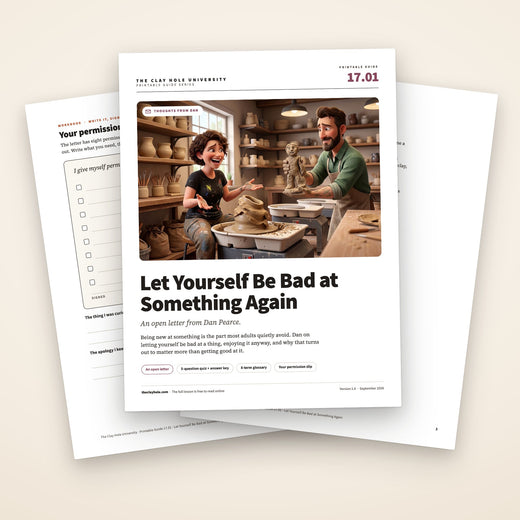
 Printable Pottery Guides
 Free Printable Trackers
 Gifts for Potters
 Christmas Pottery Ideas
 Mother’s Day Gift Ideas
 Pottery Date Night
 Studio Calendar
 2027 Studio Events
 What Should I Do Today?
 How to Throw on the Pottery Wheel
 How to Make a Pinch Pot
 How to Tap Center a Pot
 The Five Stages of Clay
 Is Pottery Hard to Learn?
 Pottery Wheel Practice Drills
 20 Easy Hand-Building Projects
 Everything That Sounds Wrong

 A Beautiful Piece, Every Time
 Slab Roller Tips
 Any Dish as a Slump Mold
 Slab Roller & Slab Mold Certification
 The Pottery Skill Tree
 Clay & Pottery Calculators
 Logging Your Pottery and Glazes
 The Pottery Dictionary
 Why Did My Pottery Do That?
 The Pottery Cone Chart
 Pottery Myths, Fact-Checked
 Is Handmade Pottery Food Safe?
 Incredible Ceramic Artist Videos
 How Dan Throws Giant Pots
 How to Dry Your Pottery
 The Pottery Wheel Introduction
 Pottery by Zodiac Sign
 Personality and the Pottery Wheel
 Pottery for Engineers
 ADHD, Hyperfocus, and Never Running Out
 Hobbies for Burnout
 Screen-Free Hobbies for Adults
 Every Addiction I Ever Had Lost to Art
 Functional Pottery Is Engineering
 How Do We Compare?
 Pottery Classes by City
 Every Pottery Studio in Utah
 Pottery in Draper
 Featured Members
 The Signature Wall
 Making Friends as an Adult Is Brutal
 The Clay Hole Commandments
 2027 Pottery Contests
 2027 Studio Parties
 Gallery Night

 Scream It Into the Void
 Destroy the Glaze Wall
 Daily Affirmation Cards
 Everything That Can Go Wrong
 Subscribe to Our Newsletters
 Contact The Clay Hole
 Corporate Team Building

 Glaze Combinations
 Glazes We Do Not Carry
 Making Glaze Test Tiles
 The Mega Glaze Tool
 How to Use the Mega Glaze Tool

 Glaze Brushing Techniques
 How to Use Underglaze
 How to Use Dipping Glazes
 Glaze Problems, Causes and Fixes
 The Dipping Glaze Guide

 Making a Glaze Catcher
 Fused or Sharp After Firing
 The Signature Wall
 His Viral Videos
 His Own Ceramics
 Meet Mud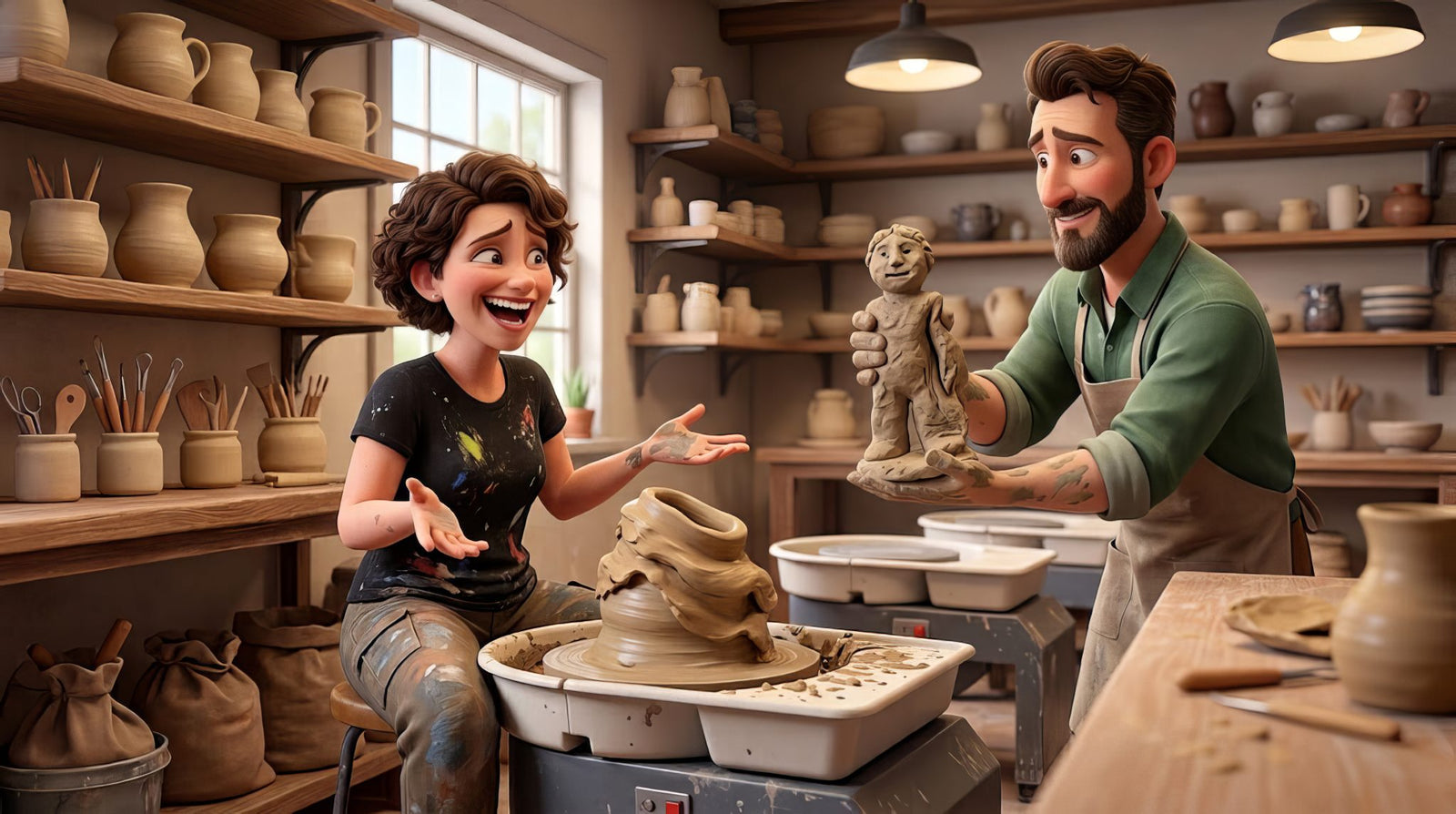
Let Yourself Be Bad at Something Again
An open letter from Dan Pearce, founder of The Clay Hole.
To the person who has had this tab open for a while now,
Here is the whole thing in one breath, since you asked for it short. I would rather you read the long one, but I am not going to pretend I do not understand.
Somewhere in our twenties, most of us quietly stopped doing anything we were not already decent at. Not on purpose. It just got embarrassing to be a beginner in front of people who know us as competent.
So we stayed competent. And a little bored.
Being bad at something is not the toll you pay to get into a hobby. It is the hobby. It is the one part you never get back, and you only get it once per thing.
You will probably be bad at pottery for a while. You might quit in six weeks. Both of those are fine, and neither one of them is a reason not to start.
The most common word in my studio
The most common word in my studio is not a pottery word, and it took me a while to notice how often I was hearing it. It is “sorry.”
Somebody sits down at a wheel for the first time, makes a lump that leans hard to the left, and apologizes. To me. To the wheel. Every so often to the clay, which does not care.
I have watched a woman who runs a surgical team apologize to a bowl.
Nobody asks them to do it. There is no rule about it. They get ninety seconds into being visibly not good at something, the reflex fires, and out it comes.
Sorry, I’m terrible at this.
I say the same thing back every single time, and it always sounds like a line, and it is not one. You are supposed to be terrible at this. Being terrible at this is the whole assignment for tonight.
But here is the part that gets me.
Nobody apologizes for being bad at something they have never seen done well. They apologize for being bad at something they have watched somebody else be great at.
So the apology was never really about the pot.
It is about the gap.
When we quietly stopped being new
I do not think anybody warned us about this part.
Somewhere in our twenties we quietly stopped being new. No announcement, no ceremony. We just started sorting the world into can and cannot, and then we built an entire life out of the can pile.
And it works. Being competent is one of the better feelings available to a human being and I am not going to sit here and pretend that it is not.
But look at what it costs.
By thirty-five, most of us have arranged a whole week in which we are never, at any point, visibly bad at anything in front of another person. We go to the restaurant we know. We order the thing we always order. We do the workout we are already good at. We pick up the phone the second a room goes quiet. We hold firm opinions about food we have never once cooked.
That is not a character flaw. That is just what happens when nobody ever tells you that you are allowed to stop.
I did it too. For a long stretch, the only new thing I would let myself try was a new thing I was fairly sure I would be good at, which is not trying a new thing.
That is shopping.
And here is what actually changed, because it is not us. When you were eight, being bad at something was Tuesday. Everybody around you was bad at everything. You fell off the bike, you got back on the bike, and nobody wrote it down anywhere.
At forty you are bad at exactly one thing inside a life where you are good at everything else, and somehow that one thing turns into evidence. About you. Personally.
Nobody wrote it down that time either. You did that part yourself.
What getting good cost me
Okay. Confession.
I am very good at throwing pottery now. Extremely good. World class, some would say, and by some I mean me, out loud, alone in my truck.
Fine. I am good. I have made a lot of pots and most of them come out roughly the way I meant them to, which is the entire definition of good and also, it turns out, the entire problem.
Because the best year I ever had making pottery was the year I was worst at it.
Everything was a surprise. A cylinder that did not collapse was a miracle. A lid that fit was a lid that fit, and I carried it around the house showing people, and my kids were polite about it in the way kids are polite when a grown man is holding up a lid.
I do not get that anymore. Not like that. I get satisfaction now, and craft, and the quiet good feeling of a thing coming out the way I drew it. All real. All worth having.
But I traded astonishment to get it, and nobody warned me that was the trade.
You have astonishment right now. A whole warehouse of it, sitting there unopened, and the only key that fits is being bad at something.
What being bad at something buys you
So let me tell you what being bad at something actually buys you, since I am the one asking you to go do it.
It buys you a room where nobody is grading you. The most generous crowd you will ever sit in is a room full of people who are currently bad at the same thing you are. Nobody in it is keeping score of your work except you, and you are a famously unreliable judge of your own pots.
It buys you two hours where your phone is genuinely inconvenient. Wet hands. That is the whole mechanism. It is the cheapest attention reset I know of, and it works because your fingers are covered in mud, not because you had some breakthrough about screen time.
It buys you proof that you can still learn something. There is a quiet fear that turns up somewhere in your thirties, that the learning part is finished and the rest is maintenance. Being bad at a thing, and then being slightly less bad at it three weeks later, is the only cure I have found that works. Reading about it does not.
And then, honestly? Not much else.
It will not fix your life. It is not therapy and I would be a jerk to sell it as therapy. It is a couple of hours a week where you are bad at something and it does not matter to a single person. That is the entire product.
It happens to be worth a great deal.
The part where you quit
Now the other thing. The one you are actually worried about.
You are not scared of being bad at pottery. You are scared that you will get excited, pay for the thing, go three times, and then it will sit there being a monument to a version of you who did not show up.
You have a guitar. Most people have a guitar.
So let me be straight with you, because pretending otherwise would be insulting. Some of the people who start will stop. That is not a Clay Hole problem, that is a hobby, and any studio owner who tells you nobody ever leaves is doing arithmetic I would love to see.
But look at the actual downside.
If you try this and you hate it, you are out one month and a few evenings, and you have learned something genuinely useful about yourself, which is that you do not like pottery. That is the worst case. Nobody’s life got worse.
I made leaving easy on purpose, too. Canceling is three taps inside your own account. No phone call, no retention conversation, nobody whose job it is to talk you out of it.
Yes, that costs me money. Somebody who can leave in three taps leaves faster than somebody who has to call and be talked at. I built it that way anyway, because I would rather have a room full of people who want to be there than a spreadsheet full of people who forgot.
And if money is the actual reason, say the money part out loud. More people leave over that than every other reason combined. There is a lower Level, there is sharing a shelf with somebody, there is the Heroes Discount if you teach or serve or nurse or study, and there is pausing for a month instead of quitting outright. None of that helps anybody who does not ask, and asking is not embarrassing. It is a text message.
Anyway. The thing that actually stops people is not quitting.
It is never starting, so they never have to find out.
A guitar in the corner is a story about one month of your life. A guitar you never bought is a story about you.
Four things people text me
While I have you, here are the four things people text me right before they start.
I have zero artistic talent. Neither did most of the room on their first night, and a good number of them still say it about themselves a year later while holding something genuinely lovely. Pottery is not a talent contest for a long while. It is a hands contest, and hands learn.
Am I too old for this? The oldest person in a class is almost never the worst one in it, and that surprises people every single time. Patience beats reflexes here, and slowing down is the hardest thing to teach a twenty-two-year-old. Being older is an advantage. I would take it.
I do not have time. Probably not six nights a week. You almost certainly have one. And one fixed night beats five flexible ones, because a flexible night is a night that gets traded away for something urgent, and there is always something urgent. Pick the night before you pick the hobby.
What does it actually cost? The Green Level is $145 a month and includes four classes. There are three Levels above it, and what changes as you go up is glazes, tools, shelf size and class days. What does not change is the electric wheels, the tables, the instructors in every class, and the people sitting next to you.
A permission slip
One more thing and then I will let you go. I am not your dad and you do not need my permission for any of this. But some people find a thing easier to do once somebody has said it out loud, so I wrote it down for you.
One more thing before you go. You do not need my permission for any of this, but here it is in writing anyway.
What I actually want for you
I am going to drop the jokes now, because this is the part I mean the most.
You are going to be old one day. Everybody is. And what I hear from the people who got there ahead of me is never about the things they did badly. It is about the things they were curious about and never let themselves start, because starting meant being seen not knowing how.
That is the whole regret. A small, ordinary, stupid fear, and it eats decades.
I am not telling you pottery is the answer. Pottery is mud. It is a hobby. Some weeks it is a frustrating hobby and you will drive home annoyed about a rim that would not behave.
But being a beginner on purpose, as a grown adult, in a room full of other people who are also beginners, is one of the few things I know of that hands you back a piece of yourself.
You had it when you were seven. You were bad at absolutely everything and it was the best time of your life.
Nobody took it from you. You put it down.
Pick it back up. It honestly does not have to be here.
But if you have read this far, some part of you already picked a thing.
P.S. If any of that landed, three more from the university that sit right next to it: the one about feeling like a fraud, the one about how pottery runs in forty directions and the wheel is only one of them, and the pinch pot, which is the easiest possible way to find out whether any of this is for you.
P.S. That was the short version, and the long one has the stories in it. If you would rather read something else, three more from the university that sit right next to this: the one about feeling like a fraud, the one about how pottery runs in forty directions, and the pinch pot.
P.P.S. And if you want the boring practical version of all this, the membership page lays out all four Levels side by side, including the parts that are identical at every one of them.
Which one would you like to print?
The whole letter runs about five pages. The short version fits on one.