
 Pottery Date Night
 Bring All Your Friends Free Week
 Give a Month of Pottery
 Private Pottery Parties

 The Welcome Booklet
 Your First Ten Sessions
 The Pottery Process
 Finding the Studio
 Your Classes Never Expire
 The Four Tables
 Who’s Who
 The Rewards Program
 Flux Glazes
 The Calculators
 Kiln Tracker
 Holiday Kiln Deadlines

 Beginner’s Tool Set
 Fingernail Clippers
 Mayco Clay Mender
 Epoxy for Kintsugi
 Applicator Bottles
 Large Bead Rack
 Raku Workshop
 Nighttime Raku
 Horsehair and Feather Raku
 The Clay Hole T-Shirt
 Embroidered Crewneck
 Zip-Up Hoodie
 Pre-Made Bisqueware
 Glaze Catchers
 Kiln Cookies
 Clay Cubby Rental
 The Glaze Bible, Printed
 The Book of Molds, Printed
 Printable Pottery Guides
 Free Printable Trackers
 Gifts for Potters
 Christmas Pottery Ideas
 Mother’s Day Gift Ideas
 Pottery Date Night
 Studio Calendar
 2027 Studio Events
 What Should I Do Today?
 How to Throw on the Pottery Wheel
 How to Make a Pinch Pot
 How to Tap Center a Pot
 The Five Stages of Clay
 Is Pottery Hard to Learn?
 Pottery Wheel Practice Drills
 20 Easy Hand-Building Projects
 Everything That Sounds Wrong

 A Beautiful Piece, Every Time
 Slab Roller Tips
 Any Dish as a Slump Mold
 Slab Roller & Slab Mold Certification
 The Pottery Skill Tree
 Clay & Pottery Calculators
 Logging Your Pottery and Glazes
 The Pottery Dictionary
 Why Did My Pottery Do That?
 The Pottery Cone Chart
 Pottery Myths, Fact-Checked
 Is Handmade Pottery Food Safe?
 Incredible Ceramic Artist Videos
 How Dan Throws Giant Pots
 How to Dry Your Pottery
 The Pottery Wheel Introduction
 Pottery by Zodiac Sign
 Personality and the Pottery Wheel
 Pottery for Engineers
 ADHD, Hyperfocus, and Never Running Out
 Hobbies for Burnout
 Screen-Free Hobbies for Adults
 Every Addiction I Ever Had Lost to Art
 Functional Pottery Is Engineering
 How Do We Compare?
 Pottery Classes by City
 Every Pottery Studio in Utah
 Pottery in Draper
 Featured Members
 The Signature Wall
 Making Friends as an Adult Is Brutal
 The Clay Hole Commandments
 2027 Pottery Contests
 2027 Studio Parties
 Gallery Night

 Scream It Into the Void
 Destroy the Glaze Wall
 Daily Affirmation Cards
 Everything That Can Go Wrong
 Subscribe to Our Newsletters
 Contact The Clay Hole
 Corporate Team Building

 Glaze Combinations
 Glazes We Do Not Carry
 Making Glaze Test Tiles
 The Mega Glaze Tool
 How to Use the Mega Glaze Tool

 Glaze Brushing Techniques
 How to Use Underglaze
 How to Use Dipping Glazes
 Glaze Problems, Causes and Fixes
 The Dipping Glaze Guide

 Making a Glaze Catcher
 Fused or Sharp After Firing
 The Signature Wall
 His Viral Videos
 His Own Ceramics
 Meet Mud
Glazing · Glazing on the wheel
Let the wheel do the moving while your hand stays still.
An even coat wants a steady hand, and many of us struggle with that. A pot turning under a still brush gets the same pressure and speed all the way round, so coats come out even and bands come out level. On a potter’s wheel the pedal holds the speed, the head takes any pot, and both hands are free. It is the fastest route to glazing that looks practiced.
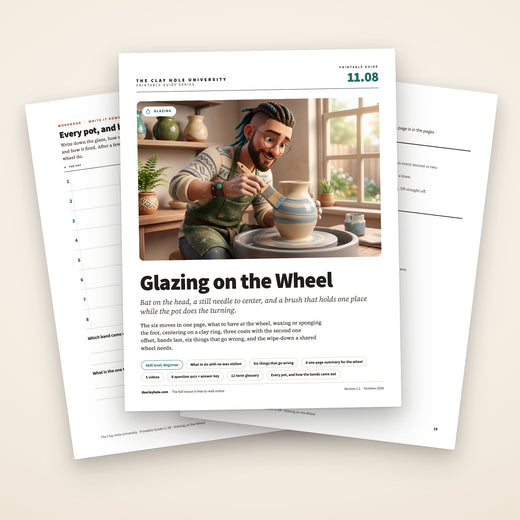
Four steps with a tick list at each: waxing and centering on a bat, the still-hand coat at the slowest pedal, three coats, and bands last with the wheel wiped down. Six fixes, most of them about speed, center and the splash pan, and five videos.
This is the short version: wax, bat, center, slow pedal, brace, one revolution per pass, three coats, bands last, wipe it wet, each with a tick list. The reasoning and the questions are in the comprehensive version.

Read it, then watch it
Why this is written down and filmed, both.
Glazing on the potter’s wheel is one idea and a few habits. The idea, that the wheel moves and the hand does not, fits in a sentence. The habits, a bat on the head, a clay ring, centering with a needle, the slowest pedal you can hold, a braced elbow, one revolution per pass, are a list, and lists are what a page is for. What a page cannot show is the pedal held at a crawl and a hand that does not move while a band goes on, and those are the videos.
Use both, in this order
Read the idea. Watch a pot glazed on a wheel head. Do it on a bisque cup you do not care about, on a bat, with the tick list open and a wet sponge ready for the wheel when you finish.
The whole idea
The wheel moves. The hand does not.
A bat on the wheel head, a ring of soft clay on the bat, the waxed bisque pot centered on it with a needle held still off the rim. The slowest turn the pedal will hold, an elbow braced on the splash pan rim, a loaded brush held still against the pot for one full revolution, then moved one brush width. Three coats, each dried. Bands last. Wheel head, bat and pan wiped down wet when you finish.
The five-minute version
The whole technique in six moves.
If you already throw and brush glaze and you just want the shape of it, this is the shape of it. Everything below is these six moves, slowed down and with the places they fail marked.
Before the pot goes on
What you need at the wheel.
Six things, and the bat is the one that keeps the splash pan clean. The last one is a pot you do not care about.
A potter’s wheel, a bat, a ring of soft clay, a needle tool, wax and a loaded brush and a damp sponge, and a bisque cup to practice on.
Step one
Wax the foot, put a bat on the head, and center the pot on a ring of clay.
Wax first, bat second, center third. A pot on a turning wheel drips and a low band lands where the brush wanders, so the foot gets waxed and left to go matte before anything else, or sponged bare if your Level has no wax station. Then a bat on the wheel head, because glaze that drips onto a bare head runs into the splash pan, and the pan’s slurry is what gets scooped into reclaim. A bat catches every drip and goes to the sink.
Then the centering, which is the part everybody skips. Press a ring of soft clay onto the bat a little smaller than the foot, set the pot on it, and run the wheel slowly with the pedal. Hold a needle tool perfectly still just outside the rim. Wherever the rim swings toward the needle, nudge the pot away from that side. Two or three nudges and the rim runs true, and every band you lay from now on is level because the pot is. Then press the clay ring firmly up against the foot so the pot cannot creep when the brush touches it. Florian Gadsby’s tap-centering video below is for leather hard pots before trimming; a bisque pot gets the clay ring and the needle instead, but watching the rim for the wobble is the same eye.
A wide bowl sits on the ring upside down or right way up depending on which face you are glazing; a tall vase wants a taller ring and a slower wheel. A foot ring drops over a slightly smaller coil so it is held on the inside. For a pot with no flat foot, a chuck, a bisque cylinder centered on the bat, does what the ring does.
Step two
The slowest pedal you can hold, a braced elbow, and the brush held still for one revolution.
The brush is a fence the pot turns past. Pedal down to the slowest turn it will hold, one revolution every second or two; heel on the floor with the toes just touching is the easiest way to keep it there. Elbow braced on the rim of the splash pan or on your knee, brush loaded from your cup of glaze and touched once to the rim of the cup, the brush touched to the pot at the top and held there while the pot makes one full turn under it. Lift straight off, move down one brush width, again.
The hand does nothing but hold still, and the pedal does nothing but hold slow. That is the whole advantage of a powered wheel: a banding wheel slows down as you go, and your flicking hand is not free; a potter’s wheel holds the same speed for the third coat as the first, with both of your hands free, one to brace and one to paint. The moment the hand starts moving round the pot, the coat gets streaky, because a moving hand changes pressure and speed at every point and a wheel does not. Reload every revolution or two. Wait for the turn.
Speed is the thing to watch. A potter’s wheel will go far faster than glaze can stay on a pot, and throwing speed flings wet glaze off the rim and the belly into the pan. If anything is leaving the pot, the pedal is too far down.
Step three
Three coats, each dried, the second offset. The inside off the wheel.
The wheel does not change the count. Three coats of a brush-on glaze, as at the glaze table, except that every coat here goes round the pot, so the half width offset does the job that crossing the coats does there, per our glaze brushing lesson. What changes is that each coat is even, and the overlaps between brush widths are the only places it is not.
So the second coat is offset: start it half a brush width lower than the first, so its overlaps land on the first coat’s thin places. The third goes back to the first position. Stop the wheel between coats and let each lose its shine, a few minutes on the first coat and longer on each one after, because a brush on a still-wet coat pulls it along the pot instead of adding to it. On a batch of mugs, glaze the first coat on all of them, then the second on all of them, and the drying takes care of itself.
The inside is not a wheel job. Stop the wheel, lift the pot off the ring, pour glaze in, swirl once with the pot tilted, pour it back into your cup in one motion, and set it rim-down on two sticks for a minute. Then back on the ring for the outside. An inside coat brushed on a turning pot pools at the bottom every time.
Step four
Bands last, onto dry glaze. Then the head, the bat and the pan, wiped down wet.
A band is one revolution with a loaded brush. Dry glaze underneath. A round or flat brush loaded, the elbow braced, the pedal at a crawl, the brush touched to the pot at one height and held there for one full turn, then lifted straight off. The line is as crisp as the hand is still, and on a powered wheel the hand has nothing else to do.
For a crisp edge, tape or latex either side of where the band will go before the band goes on, and peel it once the band has gone matte, per our resists lesson. For a second color, wait for the first band to lose its shine. For a wide band, two adjacent turns with the brush moved down a width; for a thin one, the edge of a flat brush. Underglaze bands use the same still hand, but they go on raw clay (leather hard or bone dry) before the bisque firing, never on bisque here and never over glaze, and a needle held still against a turning underglaze band at leather hard is a sgraffito line in one revolution, since bone dry clay chips and makes dust. The wheel also cleans: a damp sponge held still against the turning foot takes a stray bead off in a single turn.
Then the wheel. Lift the pot off, peel the clay ring off the bat and bin it rather than reclaim it, take the bat to the sink and rinse it, and wipe the wheel head and the inside of the splash pan down wet. The splash pan slurry on a shared wheel is what gets scooped into reclaim, and glaze in reclaim is glaze in the next person’s pot. A glazing wheel is a throwing wheel again the moment someone else sits down, and it should look like one.
Watch it done
Now watch four potters at the wheel.
One video, and what it shows.
None of these potters work here. Between them they cover glaze poured onto a pot, a plate brushed on the wheel, a different way to add glaze to thrown pottery, tap centering for trimming, and a long glazing session with one chapter at the wheel. Nothing but the still frame loads until you press play.
Four minutes of a potter glazing pots on the wheel, according to the description. It looks like glaze is poured over a round pot rather than brushed, so it shows the wheel used as a turntable, not the still brush method. The other four videos are in the comprehensive version.
When it goes wrong
Six ways it goes wrong, and what to do about each.
The three failures that happen on the first pot.
Pick the one that looks like your pot. The first three are center, hand and pedal. The last three are the inside, the splash pan and the foot.
The bands wobble up and down
The pot is not centered on the wheel head, or the clay ring let it creep, or your hand followed the pot instead of holding still. A band is only as true as the center of the wheel and the stillness of the hand.
Center the pot first: pedal slow, a needle held still just off the rim, nudge the pot away wherever the rim swings toward it, then press the clay ring down firmly. Brace the elbow on the splash pan rim or your knee and let the wheel bring the pot to the brush.
While the glaze is wet, a damp brush held still against the turning pot takes a wobbly band off in one revolution. Recenter and go again.
The coat is streaky, thin in places and thick in others
A brush that ran dry mid-revolution, a hand that moved up the pot faster than the wheel could turn under it, or pressure that changed part way round. On a turning pot the brush should never be doing the work.
Load the brush fully. Hold it still against the pot for one complete revolution before moving by one brush width. Same pressure the whole way round; the pedal, not the hand, sets the pace.
Let the coat dry, then a second coat with the brush offset by half a width so the overlaps land on the thin places.
Glaze flew off the pot and into the splash pan
Too fast. Throwing speed throws wet glaze off the rim and the belly, and a potter’s wheel will go that fast if the pedal is asked.
The slowest turn the pedal will hold, one revolution every second or two. Fast enough to be even, slow enough that nothing leaves the pot.
Wipe the splash pan and the wheel head down wet before anything else. Flung glaze in a shared splash pan is somebody else’s reclaim.
Glaze ran down the inside in drips
The inside was brushed on the turning wheel and pooled at the bottom, or too much was poured in and swirled too slowly. The inside of a pot on a wheel is a bowl of wet glaze that wants to collect.
For the inside, stop the wheel: pour glaze in, swirl once with the pot tilted, pour it back into your cup in one motion, and set it rim-down on two sticks for a minute. Then the wheel for the outside.
A wet drip smooths with a damp finger or a soft brush. A dry one is rubbed level with a finger, never scraped or sanded, because the dust from dry glaze should not be breathed. If it needs more than that, ask staff.
Glaze got into the splash pan slurry
The pot was glazed straight on the wheel head, drips ran into the pan, and the pan’s slurry is what gets scooped into reclaim. Glaze in reclaim is glaze in somebody’s next pot.
Glaze on a bat, not on the bare head. Drips land on the bat, the bat goes to the sink, and the splash pan stays clay. Wipe the head and pan down wet regardless when you finish.
Scoop the contaminated slurry out and bin it rather than reclaiming it, wipe the pan wet, and tell the studio team if any went into a reclaim bucket.
Glaze got on the foot
The bottom band was laid too low, or the brush touched the foot on the way past, or a drip ran down while the wheel turned.
Wax the foot first and let it go matte; with no wax station at your Level, sponge the foot bare instead. A waxed foot sheds a low band and a drip both. Sponge the beads off the wax while the glaze is wet.
Sponge it off with a barely damp sponge before it dries; a dry foot gets the same barely damp sponge, never a scraper or sandpaper, and staff will help if it will not come off. Every pot goes into our kilns with a naked bottom, so this gets fixed one way or another.
How it works here
At The Clay Hole, any electric wheel can be a glazing wheel.
This page is written for potters everywhere. A few things are specific to our building, so you know before you start.
Three things to know here
Glazing on the throwing wheels is welcome, and that is what this page is for; put a bat on the head so drips never reach the splash pan. Bats are free on the racks at every Level. Needles and most brushes are studio tools from Yellow up, Green Level Members bring their own, and the glaze wall needs the free brush-on certification. Wipe the head and the pan down wet and rinse the bat before you leave, because the pan’s slurry is somebody’s reclaim.
The wheels
Every Level can use the electric wheels, first come, first served, on any class night or open studio. The kick wheel opens at Purple Level and has no pedal, so this page is for the electric wheels. Bring the pots, a cup of glaze spooned from the jar, and a bat from the rack, sit down like you would to throw, and hold the pedal at a crawl. A batch of mugs is faster here than at the glaze table, and the speed stays where you put it.
Tools and glaze by Level
Bats are free on the racks and open to every Level. Needle tools and most brushes are studio tools for Yellow, Purple and Black Level Members; Green Level Members bring their own. Hake and fan brushes and the wax stations are Purple and Black for brush-on work, with wax open to every Level when dipping. Green and Yellow Level Members have no wax station for brush-on work, so sponge the foot bare instead and leave an eighth to a quarter of an inch of bare clay above it. The glaze wall needs the free brush-on glaze and underglaze certification.
Leaving the wheel
A bat under everything, so drips never reach the pan. Clay ring binned. Bat rinsed at the sink. Head and splash pan wiped down wet. Brushes washed by hand and back in the same bin. Glaze in the splash pan is glaze in the reclaim, and a contaminated jar is on whoever did it.
Firing
Bisque is cone 05 and free. The glaze firing is cone 5½ at 5 cents a cubic inch, $4.80 minimum. Every piece goes in on a cookie with a naked bottom, which the wax, or a sponge held against the turning pot, gives you.
Questions people actually ask
The ones that come up every week.
Why glaze on the potter’s wheel?
Because an even coat wants a steady hand, and many of us struggle with that. A pot turning under a still brush gets the same pressure and speed all the way round, which a brush moving round a still pot cannot do. The potter’s wheel adds three things a hand-spun wheel cannot: a pedal that holds one slow speed for as long as you like, a wheel head big enough for any pot in the building, and both hands free, one to brace and one to hold the brush. Coats come out even, bands come out level, and a batch of mugs goes faster.
Potter’s wheel or banding wheel?
Either works; this page is the powered one. A banding wheel sits on the glaze table, spins with a fingertip and puts the pot at chest height, and it is the right tool for one small pot at the glaze wall. The potter’s wheel is the right tool for a batch, a big piece, or any time you want the speed held for you. At The Clay Hole any of our electric wheels can be a glazing wheel for an evening; the only rule is that it is wiped down wet afterwards.
How do I center a bisque pot on the wheel head?
Put a bat on the head first, so drips land on the bat and not in the splash pan. Press a ring of soft clay onto the bat a little smaller than the foot, set the pot on it, and run the wheel slowly. Hold a needle tool perfectly still just outside the rim: wherever the rim swings toward the needle, nudge the pot away from that side. Two or three nudges and it runs true. Then press the clay ring firmly against the foot so it cannot creep. Florian Gadsby’s tap-centering video is for leather hard pots before trimming; a bisque pot gets the clay ring and the needle, but watching the rim for the wobble is the same eye.
How fast?
The slowest turn the pedal will hold, about one revolution every second or two. That is far slower than throwing speed, and a potter’s wheel will happily go faster than glaze can stay on a pot. If glaze is leaving the rim, it is too fast. Some potters find the pedal easier to hold at a crawl with a heel on the floor and the toes just touching.
How many coats?
Three, for a brush-on glaze, each laid as full revolutions with the brush moved by one width at a time, each allowed to lose its shine before the next. The wheel does not change the number; it changes how even each one is. Our glaze brushing lesson is the table version of the three-coat method.
Can I do the inside on the wheel?
Stop the wheel for the inside. Pour glaze in, swirl once with the pot tilted, pour it back into your cup in one motion, and let it drain rim-down for a minute. An inside brushed on a turning pot pools at the bottom every time. Then back on the wheel for the outside.
What do I do with the wheel afterwards?
Wipe the head, the bat and the splash pan down wet before you leave it, and rinse the bat at the sink. The splash pan slurry on a shared wheel is what gets scooped into reclaim, and glaze in reclaim is glaze in somebody else’s next pot. A glazing wheel is a throwing wheel again the moment the next person sits down, and it should look like one.
Related lessons
Six lessons that sit next to this one.
Three to read next.
Glazing on the wheel is the brushing lesson with a pedal under it and the trimming lesson’s centering in front of it. These are the pages on either side.
That is the whole technique
Wax. Bat. Center. Slow pedal. Brace. One revolution. Three coats. Bands last. Wipe it wet.
Your first band will wobble because the pot was not centered, and your second will be level because you held a needle off the rim for ten seconds first. That is the whole lesson, and it takes one evening at a wheel you already know how to sit at. A batch of mugs glazed this way looks like someone else’s work, in the good way.
If you want the reasoning, the centering detail for odd shapes, the sgraffito trick and the answers to the questions everybody asks, switch to the comprehensive version at the top. Otherwise, go wax a foot and find a bat.
Written for potters everywhere. Where our studio does things differently, the page says so.
Which version would you like to print?
Both print clean, with the videos turned into labeled boxes you can search for later.