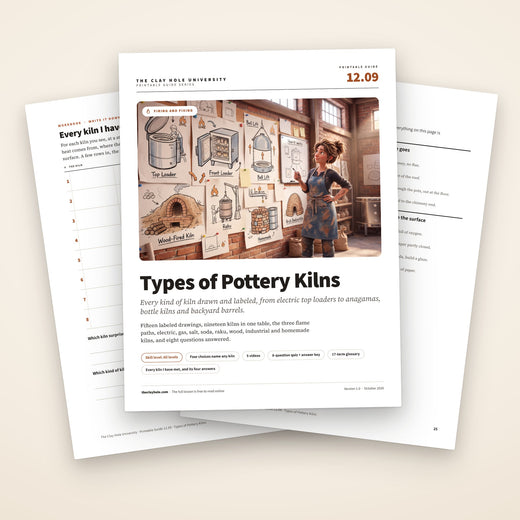
Types of Pottery Kilns, Explained
Top loaders, front loaders, bell kilns and car kilns. Gas, salt, soda and raku. Anagamas, climbing kilns and train kilns. Beehive, bottle and tunnel kilns, and the ones people build in a backyard. All of them drawn and labeled, and all of them down to the same four choices.
Every kiln is an insulated box that holds heat. What makes one kind different from another is where the heat comes from, where the flame goes, how you get the pots in, and what the fire does to the surface. Answer those four and you can name any kiln you meet.

Jump to a section
A box that keeps heat in, and four choices
Every kiln ever built is the same thing underneath: an insulated box that lets heat build up faster than it leaks away, until clay turns to ceramic and glaze turns to glass.
What makes one kind different from another is four choices. Where the heat comes from: electricity, gas, wood, or something stranger. Where the flame goes, if there is one: straight up, down through the pots, or sideways. How the pots get in: through a lid, a door, a body that lifts away, or a floor that rolls out. And what the fire does to the surface: nothing at all in an electric kiln, color changes from starving the flame of air in a gas kiln, ash or sodium vapor building up a glaze in wood, salt and soda kilns.
Every name on this page, from top loader to anagama, describes one or two of those choices. Learn the four and the names stop being a list to memorize.
Four questions that name any kiln
- Where does the heat come from? Coils glowing in the walls is electric. Burner ports and a gas line is gas. A firebox with a woodpile beside it is wood.
- Is there a flame, and where does it leave? No flame and no flue means electric. A flue in the roof is updraft. An exit low in the wall into a separate chimney is downdraft. Fire at one end and a chimney at the other is crossdraft.
- How do the pots get in? A lid on top is a top loader. A door is a front loader. A body that winches up off its floor is a bell or top hat kiln. A floor that rolls out on rails is a car kiln.
- What is it for? Salt and soda kilns have ports for charging sodium and pots on wads. Raku kilns are light and open hot. Wood kilns are long, often climb a hill, and fire for days.
Then find it in the table further down this page, with its heat source and where you are likely to meet one.
Three things people get wrong
An electric kiln cannot fire reduction
Reduction means starving a flame of oxygen, and an electric kiln has no flame. The atmosphere inside is full of air from start to finish. Copper reds and celadons that depend on reduction need a fuel kiln, which is why a glaze photographed out of a gas kiln can look very different out of an electric one.
Raku is a way of firing, not a kind of clay
A raku kiln is built for speed: light fiber that heats and cools fast, and a shell that opens while the pot glows. The famous colors come afterward, in a can of burning paper, not from the kiln itself.
Wood kiln is not one design
An anagama fires for days as one long tunnel up a hill. A noborigama is a staircase of separate chambers. A train kiln is long, low and level and fires in about a day and a half. The shape decides how long you fire, how much ash lands and what the pots look like.
A kiln is a box that keeps heat in
Everything else on this page is one of four choices made on top of that.
- Heat has to arrive faster than it leaves. Clay needs well over a thousand degrees to become ceramic and stoneware glazes need well over two thousand. Every kiln is an argument with heat loss, won by insulation and by putting in heat faster than the walls let it out.
- Choice one: where the heat comes from. Electric coils in the walls, gas or propane burners, wood, oil, coal in the old industrial kilns, or a microwave heating a small black box. Each fuel brings its own costs, its own atmosphere and its own amount of fuss.
- Choice two: where the flame goes. An electric kiln has no flame at all. A fuel kiln sends its flame up and out the roof (updraft), up, over and back down through the pots to leave at the floor (downdraft), or sideways from one end to the other (crossdraft). The path decides how evenly it fires.
- Choice three: how the pots get in. Through a lid on top, a door in front, a whole body that lifts off its floor, or a floor that rolls out on rails. This is mostly about backs, budgets and the size of the work.
- Choice four: what the fire does to the surface. In an electric kiln the air stays full of oxygen and the fire does nothing to the glaze but melt it. A fuel kiln can be starved of air to change colors. Wood ash and sodium vapor build a glaze right on the pot. Raku pulls the pot out glowing.
- A kiln's name usually describes one choice. Top loader is choice three. Downdraft is choice two. Salt kiln is choice four. Anagama is a shape that settles three of them at once. Read every name below as an answer to one of these questions.
The sentence worth keeping
Heat source, flame path, way in, and what the fire does to the surface. Every kiln ever built is a set of answers to those four questions.
Nineteen kilns, sorted
Each one by what makes it that kind, what heats it, and where you are likely to meet one.
| Kiln | What makes it that kind | Heat | Where you meet one |
|---|---|---|---|
| Top loader | The lid is the door | Electric | Most electric kilns made today |
| Front loader | A door, a steel frame, elements on every side | Electric | Schools and busy shared studios |
| Bell or top hat | Walls and roof lift off a fixed floor | Electric, or propane for raku | Large, awkward or fragile work |
| Car or shuttle | The floor rolls out on rails | Gas, usually | University ceramics programs and industry |
| Updraft gas | Flame straight up and out of the roof | Natural gas or propane | Smaller gas kilns and many raku kilns |
| Downdraft gas | Flame up, over, down, and out at the floor | Natural gas or propane | Universities and potters firing reduction |
| Salt and soda | Sodium vapor glazes the pots in the kiln | Gas or wood | Outdoors, with a tall chimney |
| Raku | A light shell that opens while the pot glows | Propane | Workshops, outdoors |
| Dragon kiln | A long, thin kiln up a steep slope | Wood | Southern China, where one still fires |
| Anagama | One long tunnel climbing a hill | Wood | Wood firing groups, firing for days |
| Noborigama | Separate chambers stepped up a hill | Wood | Japan, since the 1600s |
| Train kiln | Long, low and level, fire at one end | Wood | American wood firings, about a day and a half |
| Groundhog kiln | Long, low and partly buried | Wood | The American South |
| Beehive | Round and domed, fireboxes all around | Fuel fired | Old brickworks and pottery works |
| Bottle kiln | An oven inside a bottle-shaped chimney | Coal | Stoke-on-Trent, now as museums |
| Tunnel kiln | The ware moves through, the fire stays still | Gas | Factories making brick, tile and dinnerware |
| Pit and barrel | A hole or a drum, with the fuel in with the pots | Wood and sawdust | Backyards and outdoor workshops |
| Trash can kiln | A steel can lined with ceramic fiber | Propane | Home raku |
| Microwave kiln | A small silicon carbide box inside a microwave | A microwave oven | Tiny pieces, outdoors |
Top loaders and front loaders
The kiln most potters fire in. No flame, no chimney, no fuel: just coils in the walls, a switch, and a box full of air.
- The heat is radiant. Current through coiled resistance wire makes it glow, and the glow heats the pots directly. Nothing burns, so nothing uses up the oxygen inside.
- So every electric firing is oxidation. The atmosphere stays full of air from start to finish. That is predictable and repeatable, and it is also why reduction effects are out of reach in an electric kiln.
- Most electric kilns are top loaders. They are simpler and cheaper to build: rings of soft insulating brick, each in a thin steel jacket, stacked on a floor slab with a hinged lid on top.
- Front loaders cost more and last longer. A heavy steel frame, a door that swings open like an oven, and elements in the walls, the door and the floor. Easier on the back, and built for schools and shared studios that fire constantly.
- The fumes still have to go somewhere. Clay and glaze give off carbon monoxide, sulfur oxides and other gases as they fire. A downdraft vent under the kiln pulls them out through small holes in the floor and lid and sends them outdoors. Our lesson on putting a kiln in your garage covers venting, power and clearances.
- Test kilns are the same thing, small. A little electric kiln for test tiles, beads and one urgent piece, fired on its own schedule.
The top loader
The kiln in most home studios and many community studios. Here is what is inside one.

- Hinged lid lifts up. The whole top is the door. You load by leaning over the wall and setting shelves in from above, bottom shelf first.
- Coiled elements in brick grooves. Coils of resistance wire sit in channels cut into the brick and glow when current runs through them. The heat reaches the pots by radiation, with no flame and no fuel.
- Thermocouple reads the heat. A probe through the wall, reaching at least an inch into the chamber, tells the controller how hot it is in there.
- Shelves stacked on posts. Kiln shelves on posts turn one round chamber into several floors of pots, none of them touching an element or the wall.
- Peephole and plug. A hole through the wall with a removable plug, so you can see the witness cones without opening the lid.
- Soft insulating firebrick. Light, porous brick that holds heat in remarkably well, built up in sections, each in its own thin steel jacket.
- Digital controller. Runs the whole firing: how fast to climb, when to hold, when to stop. Older kilns use a Kiln Sitter instead, a mechanical switch that shuts the kiln off when a small cone inside it bends.
The front loader
Same heat, different way in, and a much heavier build.

- Heavy steel frame. Angle iron at every edge. It is a large part of why a front loader often costs about twice as much as a top loader of the same size, and why it lasts.
- Elements on the walls. The same coiled elements in brick grooves as a top loader.
- Elements in the door too. Without them the door would be a big cold wall, and the front of the load would fire cooler than the back.
- Door swings open on hinges. The whole front opens like an oven, so every shelf is in reach at once.
- Loaded standing up. The chamber starts around waist height. Nobody bends over a wall, which is why schools and busy shared studios favor them.
- Elements in the floor. Heat from below keeps the bottom shelf from lagging behind the rest.
- Control box and controller. The same job as on a top loader: the firing schedule, run from a keypad.
When the kiln moves instead of you
Two designs solve the same problem from opposite directions: getting large or fragile work into a kiln without anyone reaching over a wall.
The bell or top hat kiln
The floor stays put and the whole kiln body winches up off it. Bell kilns for studio work are built electric, and the top hat raku kiln further down this page is the same idea run on propane.

- Winch raises and lowers it. A hand crank or a motor lifts the whole kiln body on a cable.
- Walls and roof lift as one. The body is a shell with no floor of its own. It comes down over the load like a cover.
- Elements ride up with it. The heat lives in the part that moves, so the floor is only a floor.
- Steel lifting frame. Strong enough to carry the whole body, and tall enough to lift it clear of the tallest piece.
- Load from every side. With the body raised, the load is open all the way round. Large, awkward and fragile pieces get placed without anyone reaching over a wall.
- The floor never moves. A piece is set down once and never shifted again. The body lowers around it.
The car kiln
The body stays put and the floor rolls out. Common in university ceramics programs and in industry, where the same floor carries a whole load in and out.

- The kiln body stays put. Walls, roof and door are one fixed box.
- Door swings open. The front opens wide enough for the whole floor to pass through.
- The floor is a cart. A thick refractory deck built on a low steel cart with wheels.
- Loaded out in the open. Shelves and pots go on in full light, from every side, with nothing overhead.
- Burner ports along the sides. This one is gas fired, which is how the car kilns in many university ceramics programs are built.
- Rolls out on rails. Push it in, close the door, fire. A shuttle kiln is the industrial version, with doors at one or both ends and more than one car.
Where the flame goes
Once there is a flame, its path through the kiln decides how evenly the pots fire. There are three paths, and every fuel kiln on this page uses one of them.
- Updraft is the oldest and the simplest. Burners or a fire under the floor, a hole in the roof, and the flame goes straight through. Quick to build and quick to heat, and the top tends to run cooler than the bottom. Many smaller gas kilns and raku kilns are updraft.
- Downdraft takes the long way round. The flame goes up behind a short bag wall, over under the roof, back down through the pots, and out through an opening low in the wall into a separate chimney. The longer path spreads the heat, which is why many high-fire gas kilns are downdraft.
- Crossdraft goes from one end to the other. A firebox at one end, a chimney at the far end, and the flame crosses the load sideways. High-fire wood kilns are almost always crossdraft or downdraft.
- The chimney is the engine. In a downdraft or crossdraft kiln, hot gas rising in the chimney pulls the flame through the load. A taller chimney pulls harder, which is why the old kilns have such tall stacks.
Reading a kiln from outside
No chimney: electric. A flue in the roof: updraft. A chimney standing beside the kiln: downdraft or crossdraft, and the end the chimney stands at tells you which way the flame runs.
The three paths side by side. The dashed arrows are the flame.

- Burners under the floor. Updraft: the fire comes in at the bottom.
- Heat exits through the roof. The flame does what heat wants to do, straight up and out. Simple to build and quick to heat, but it tends to run cooler at the top.
- Bag wall sends flame up. Downdraft: a short inner wall sends the flame up the side first, away from the nearest pots.
- Pulled down through the pots. The chimney pulls the flame back down through the load instead of letting it escape.
- Exits at floor level. It leaves low, through the floor or the bottom of the back wall, into the chimney. That longer path is why a downdraft fires more evenly.
- Fire at one end. Crossdraft: a firebox at one end of a long chamber.
- Chimney at the other. The flame crosses the load sideways to reach it. Most high-fire wood kilns are crossdraft or downdraft.
The studio gas kiln
Natural gas or propane, a door, an arched roof, and a chimney that lets you control the air.
- Two fuels, the same kiln. Natural gas is cheaper but only reaches populated areas through a pipe. Propane comes in a tank and goes anywhere, at a higher price. Both burn cleanly and leave no ash.
- Many high-fire gas kilns are downdraft. Burners at the floor behind bag walls, the flame pulled up, over and down, out through a flue at floor level into the chimney.
- The damper is the steering wheel. Close it partway and less air reaches the burners. The flame runs short of oxygen and takes it from the clay and glaze instead, which is reduction: the copper reds, celadons and toasted clay surfaces that an electric kiln cannot make.
- Cones still decide when it is done. A gas firing is watched, not just programmed, so every gas kiln has spy holes for seeing the cones.
- Arches carry the roof. An arched roof of firebrick holds itself up. A sprung arch pushes outward on the walls and is held in by a steel frame; a catenary arch, the hanging chain shape turned upside down, carries its own weight and needs little or no bracing.
- Oil exists, rarely. Oil fired kilns work, but oil flames are hard to keep lit at lower temperatures and burn smokier. Wood is the only solid fuel still common among potters.
A front-loading gas downdraft kiln with its near wall cut away.

- Chimney pulls the draft. Hot gas rising inside the chimney pulls air in through the burners and the flame through the load. The chimney is the engine of the kiln.
- Damper sets how hard it pulls. A sliding plate in the chimney. Push it in and less air comes through, the fire runs short of oxygen, and the kiln goes into reduction.
- Arched firebrick roof. An arch carries its own weight. A catenary arch, the shape of a hanging chain turned upside down, needs little or no bracing.
- Spy hole for watching cones. Cones decide when a gas firing is done, so there is always a way to see them.
- Bag wall shields the pots. A short wall that stops raw flame from cooking the nearest pots and pushes it up into the chamber instead.
- Gas burner at the floor. Natural gas or propane. Both burn clean and leave no ash.
- Exit flue at floor level. Where the flame leaves, low and at the back, after it has been through every shelf.
Salt and soda kilns
A gas or wood kiln that glazes the pots with vapor instead of a bucket. The kiln has to be built for it, and once it has been, its walls keep giving off sodium in every later firing.

- Charging port for salt or soda. Near the top of the firing, salt or soda goes in through small ports, usually sprayed or dropped onto the hottest brick over the firebox rather than onto the pots.
- Sodium vapor rides the flame. The sodium turns to vapor and reacts with the silica in the clay surface. The glaze is made out of the pot itself.
- Draw rings show the progress. Small rings of clay hung where they can be hooked out mid firing and read to see how much glaze has built up.
- Every pot stands on wads. Small pads of refractory clay under every pot. Without them the vapor glazes pot and shelf together.
- Walls and shelves get glazed too. The vapor glazes everything it touches, which is why a salt or soda kiln slowly wears out from the inside.
- Floor flue pulls the vapor through. A downdraft path drags the vapor past every pot on its way out.
- Tall chimney, outdoors. Salt sends hydrogen chloride up the flue. Soda sends carbon dioxide and steam instead, which is the whole reason soda exists.
Salt has to be near cone 6 or hotter before it gives up its sodium, and the chlorine half of it leaves as hydrogen chloride, which is why salt kilns are shut down in many urban areas. Soda ash does the same job and sends carbon dioxide and steam up the chimney instead. Sodium also destroys electric elements, so there is no electric version. Our lesson on salt and soda firing goes all the way through it.
Raku kilns
Small, light, fast and fired outdoors. The kiln's whole job is to get a glaze molten and then let go of the pot while it is still glowing.

- Pulley and cable lift the shell. The shell goes straight up and the whole load is exposed at once.
- Light shell lined with fiber. Ceramic fiber heats fast and cools fast, which is what a firing that opens while it glows needs.
- Long tongs and heavy gloves. The pot comes out glowing, with the glaze still molten.
- Brick base stays on the ground. The pots sit on a shelf over firebrick and never move until they are pulled.
- Propane burner at the base. One or two burners pointed in at the bottom.
- Can of paper for reduction. The pot goes straight into a metal can of newspaper and shavings and the lid goes on. The reduction happens in the can, not in the kiln.
Most raku kilns are a lightweight fiber shell that lifts off or hinges open, sitting on a base, with one or two propane burners at the bottom. A steel trash can lined with ceramic fiber blanket is the homemade version, and brick updraft and front loading raku kilns hold their heat longer at the cost of speed. Raku firing covers the firing itself, and our page on microwave kilns covers the smallest raku kiln there is.
The anagama, and where it came from
Wood kilns fire for a day and a half to well over a week, and the wood ash that rides the flame becomes part of the glaze.
- It started in southern China. The dragon kiln was a long, thin kiln built up a steep slope, fired from the bottom with more fuel added through stoke holes along its length. Some were more than 400 feet long by the twelfth century, and the largest could fire tens of thousands of pieces at once.
- Korea took it, then Japan. Korean potters brought the climbing kiln to Japan around the fifth century, where it became the anagama: one long tunnel up a hill, firebox at the bottom, chimney at the top.
- The ash is the point. Wood ash flies with the flame, lands on the pots and melts into glaze. The pots nearest the fire get the heaviest deposits, the far end the lightest, and no two pots come out alike.
- The slope does work. Building up a hill makes the whole kiln part of the chimney, and helps pull the fire through a long chamber.
- It takes a crew. A firing runs from about two days to twelve or more, with someone feeding the fire around the clock. Our lesson on wood-fired pottery covers what it is like to be on that crew.
An anagama in section, built into a hillside.

- Chimney at the top. The tunnel ends in a chimney at its high end.
- One long tunnel chamber. No dividing walls. The firebox and the pots share one space.
- Ash settles on the pots. Wood ash rides the flame and lands on the pots, where it melts into glaze. Heaviest nearest the fire, lightest at the far end.
- Built up a hillside. The rising slope works as part of the chimney and helps pull the fire through.
- Stoked with wood for days. Firings run from about two days to twelve or more, with a crew feeding the fire around the clock.
- Firebox at the bottom. The fire burns at the low end, with nothing between it and the first pots.
Chambers and trains
Two later designs that answer the anagama's two hard problems: how much wood it burns, and how long it takes.
The noborigama
A staircase of separate chambers up a hill, in use in Japan since the 1600s. Each chamber is stoked through its own ports, and each one rides on the heat of the one below. Shigaraki has the largest one still working in Japan.

- Chimney at the top. After the last chamber.
- Separate chambers, stepped uphill. Each one sits higher than the one below it, with a wall between them.
- Each chamber has stoking ports. Once the lower chamber reaches temperature, stoking moves up to the next.
- Flame passes to the next. Low openings in each dividing wall carry the fire from one chamber into the one above.
- Heated by the chamber below. Exhaust from the lower chambers preheats the upper ones, so each needs only the extra wood to finish. That is the whole efficiency of the design.
- Firebox at the bottom. Where the firing starts.
The train kiln
Long, low and level, with the firebox at one end and the chimney at the other. Popular in American studios because it fires in roughly a day and a half instead of a week and still gives real ash at the firebox end.

- Chimney at the far end. Standing on its own at the end of the chamber.
- Long, low ware chamber. Built on level ground, packed with shelves.
- Flame travels sideways. Crossdraft, from the firebox straight through the load to the chimney.
- Firebox at one end. All the wood goes in here.
- Most ash near the firebox. The pots at the firebox end carry the heaviest ash. The far end comes out quieter.
Two more names worth knowing. A groundhog kiln is the long, low, partly buried wood kiln of the American South, fire at one end and a short chimney at the other, still used for alkaline glazed stoneware. A Bourry box is not a whole kiln but a firebox design: the wood lies across bars and burns from underneath, so it needs stoking every fifteen or twenty minutes instead of every three.
Beehive, bottle and tunnel kilns
The kilns that fired the bricks, tiles and dinnerware of the industrial age. You will meet the first two as ruins and museums, and the third every time you buy a plate.
The beehive kiln
A round brick downdraft kiln with a domed crown and fireboxes all around the base. Common in brickworks and pottery works through the late 1800s and early 1900s. A firing ran four to five days and the whole cycle about two weeks.

- Domed brick crown. The round roof that gives the kiln its name and turns the heat back down.
- Flame rises up the wall. From each firebox the heat climbs the inside face of the wall to the dome.
- Pulled down through the load. The draft drags it back down through the stacked ware.
- Fireboxes all around the base. Set into the outer wall, so the heat comes in evenly from every side.
- Openings in the floor. The gas leaves through the floor, not the roof.
- Flue runs underground. A channel under the floor carries it away.
- Chimney stack. A tall stack beside the kiln provides the pull.
The bottle kiln
The coal fired kilns of Stoke-on-Trent in England, an oven inside a bottle-shaped brick chimney called a hovel. A biscuit firing took about three days. The Clean Air Act of 1956 ended them; the last firings were in 1963, and 47 still stand, some open as museums.

- Smoke leaves the hovel top. The open neck of the bottle.
- Brick hovel makes the draft. The bottle shape is a chimney wrapped around the kiln. It creates the updraft and keeps the weather off.
- The oven inside. The kiln itself is a round brick chamber with a domed roof, inside the hovel.
- Iron bands hold the oven. Bands around the walls hold the brickwork together as it heats and cools.
- Saggars protect the ware. Lidded fireclay boxes, stacked in columns, that kept smoke and ash off the ware. Placers carried them in on their heads.
- The clammin, the way in. The doorway, just wide enough for a placer carrying a saggar.
- Coal firemouths around the base. Fires stoked from outside. One firing burned about fourteen tons of coal.
The tunnel kiln
The kiln that replaced both. Instead of loading, firing, cooling and unloading, a tunnel kiln never stops: the ware rides through on cars while the fire stays in the middle. Roller hearth kilns do the same on rollers for tile and tableware.

- Cars enter cold. Ware on flat kiln cars rolls in at one end.
- Preheating zone. The ware warms steadily as it moves toward the middle.
- Firing zone, the only hot part. Only the central part of the tunnel is fired. The ware moves through the fire; the fire never moves.
- Cooling zone. Past the middle, the ware cools steadily.
- Cooling heat preheats new ware. Heat given off by cooling ware is used to warm the ware coming in, which is what makes a tunnel kiln so efficient.
- Cars leave near room temperature. No kiln ever has to cool down and be reloaded. It runs continuously.
Homemade kilns
From a hole in the ground to a steel can with a burner in it. The pit is the oldest way to fire pottery, the trash can is the easiest kiln to build, and every one of them belongs outdoors.

- The ground is the insulation. A pit is the oldest way to fire there is, older than any kiln. The earth holds the heat, and most of it still escapes out the top.
- Wood stacked over the top. The fuel is in with the pots. Pits run roughly 1,200 to 1,800 F, unevenly.
- Packed in sawdust and shavings. A barrel firing smolders slowly, at around 1,100 to 1,400 F, the gentlest of the family.
- Lid with a small gap. Enough air to keep it burning, not enough to let it roar.
- Vent hole in the lid. A trash can kiln is a real kiln in miniature: a flue in the lid lets the burner's gases out.
- Lined with ceramic fiber blanket. The steel can is only the case. The fiber does the insulating.
- Propane burner port near the base. The shelf sits above the port so the flame swirls around the pot instead of hitting it.
Pit fired pottery was made for thousands of years before anyone built a kiln. A pit or a barrel stays far below glaze temperature, so the clay stays open and takes in smoke and carbon instead of sealing. Our lessons on primitive firing and pit firing go through both, and a saggar firing gets similar marks inside a closed box in an ordinary kiln.
The kilns that fire your work here
Everything above is the whole field. This is the part that touches your pots.
- The kilns that fire your work are electric. We run four of them, including a large bell lift kiln for the pieces that do not fit anywhere else.
- So every firing here is oxidation. Reduction colors need a fuel kiln, and we do not run one. A glaze photographed out of a gas reduction kiln can look very different out of ours.
- Bisque goes to cone 05, glaze to cone 5½. Cone 5½ is cone 5 with a twelve minute hold, which lands between cone 5 and cone 6.
- The studio team loads and unloads. Your work goes on the drop-off tables and comes back on the pick-up tables, and our page on the tables explains how. The kiln schedule shows when each load goes in and comes out.
- Raku runs outdoors, at workshops. Announced on the calendar one at a time, and the raku certification comes first. Our raku workshops page has what is coming up.
The ones that come up at the tables
Which kind of kiln should I buy for home?
Electric, for most people starting at home. A top loader costs less; a front loader costs about twice as much for the same size and spares your back. Before choosing either, read our lesson on putting a kiln in your garage: the power, the venting and the clearances decide more than the kiln does.
Can an electric kiln fire reduction?
Not in the usual sense. Reduction means starving a flame of oxygen, and an electric kiln has no flame, so the air inside stays oxygen rich. Some potters create local reduction inside a sealed box with combustibles, which is what a saggar firing is, but a whole kiln in reduction needs fuel.
Why can't I salt fire in an electric kiln?
Sodium vapor destroys the elements, and an electric kiln has no flame to carry the vapor through the load and no chimney to send the byproducts away. Salt and soda kilns are fuel kilns, built for it and fired outdoors.
Is a raku kiln just a small gas kiln?
It is built for a different job. A raku kiln is made of light fiber so it heats and cools fast, fires to a low temperature, and opens while the pot is glowing. The reduction happens afterward in a can of burning paper, not in the kiln.
What is a test kiln?
A small electric kiln for test tiles, small pieces and the one item that cannot wait for a full load. It works exactly like a big one and fires on its own schedule.
Why do old kilns have such tall chimneys?
The chimney is what pulls the flame through the kiln: hot gas rising inside it draws fresh air in through the fireboxes. Taller pulls harder, and a common rule of thumb puts a chimney at about three times the height of the kiln's chamber.
Do wood kilns always need a crew?
The big ones do. An anagama fires for days with someone stoking around the clock, and even a train kiln runs about a day and a half. A Bourry box firebox is kinder on a small crew, because it needs stoking every fifteen or twenty minutes instead of every three.
Are bottle kilns still used?
No. The Clean Air Act of 1956 gave them seven years to stop, and the last firings in Stoke-on-Trent were in 1963. Forty-seven still stand there as listed buildings, and some are open to visit, including at the Gladstone Pottery Museum.
Where to go next
What a Firing Actually Does
What happens to clay and glaze inside any of these kilns, from water leaving to glass forming.
Read it →Loading and Unloading a Kiln
Shelves, posts, spacing and the order a load goes in, in the kind of kiln you are most likely to use.
Read it →Wood-Fired Pottery
What it is like to fire one of the wood kilns on this page, and how to prepare work for it.
Read it →Salt and Soda Firing
The atmospheric kilns in full: the chemistry, the clay, the wadding and the chimney.
Read it →Raku Firing
The firing the raku kiln exists for, start to finish.
Read it →Can I Put a Kiln in My Garage?
Power, venting, heat and clearances for anyone thinking about an electric kiln at home.
Read it →Four answers to the same question
Every kiln on this page, from the coal fired bottle ovens of Stoke-on-Trent to a trash can with a burner in it, is somebody’s answer to the same problem: get a box hotter than it wants to be, and keep it there long enough for clay to change. The answers differ in fuel, flame path, way in and what the fire is allowed to do to the surface, and that is all.
Next time a kiln has an unfamiliar name, ask the four questions and it will tell you what it is. And when you want to see what the electric ones do to your own work, come and make something. Your pots go in one of ours.
Heat source, flame path, way in, and what the fire does to the surface. Every kiln is a set of answers to those four questions, and the table above sorts them all.
For every kiln drawn and labeled, with the history and the videos, switch to the Comprehensive Version at the top of the page.
Which version would you like to print?
Videos come out as a labeled box with the title and channel to search for, since paper does not play them.