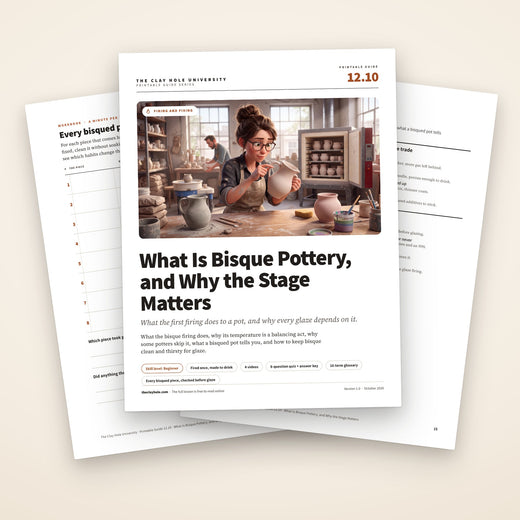
What Is Bisque Pottery, and Why the Stage Matters
Bisque is pottery that has been fired once and has no glaze on it yet. It comes out of the kiln hard, permanent and full of tiny open pores, and every one of those three things is there on purpose. Here is what the bisque firing does to a piece, why its temperature is a balancing act, and what all of it means for the minute before you glaze.
Bisque is pottery fired once, with no glaze yet. It is permanent, strong enough to handle, and thirsty: its open pores pull the water out of glaze so the coat stays put. Keep it clean and keep it dry, and it does the rest.

Jump to a section
Fired once, made to drink
The bisque is the first firing, and it does its work before any glaze is involved. It drives the last water out of the clay mineral itself, so the piece can never turn back into mud. It burns out the carbon and sulfur hiding in the clay while the surface is still bare. And it stops before the pores close.
Those open pores are the point. Dip or brush a bisque pot and the wall pulls the water out of the glaze, leaving an even layer of solids that is dry enough to handle in seconds. A pot that cannot drink cannot hold a good coat.
So the bisque temperature is a balance: hot enough to make the piece strong and clean, cool enough to leave it thirsty. Ours is cone 05. Everything you do with a bisque pot comes down to keeping it clean and keeping it dry, so the thirst is still there when the glaze arrives.
Three things people get wrong
A wet pot is not a clean pot
Soaking or scrubbing bisque fills the pores with water, and a full pore cannot drink. The glaze goes on thin and patchy. Rinse for a second or two, or wipe with a barely damp sponge, and let any piece that got soaked dry right through before it sees glaze.
Glaze does not heal a crack
A crack that shows after the bisque was made or opened by that firing, and the glaze firing runs far hotter. Show the studio team before you glaze a cracked piece. The crack is also telling you something about drying or joining for next time.
Bisque is not a finished pot
It is hard enough to look done, and it is porous and unsealed. Water soaks straight into the wall. It is a stop on the way to the glaze firing, which is where the body tightens and the glass forms.
What bisque actually is
Bisque, bisqueware and biscuit all name the same thing: a piece that has been through one firing and has no glaze on it yet.
- It is no longer clay. Partway up the bisque firing, the water locked inside the clay mineral itself is driven out, and that change cannot be reversed. Drop a bisque pot in a bucket and you get a wet bisque pot, never mud. The temperatures are walked through in our lesson on what a firing actually does.
- It is hard, and it is not tough. Bisque is far stronger than bone dry, strong enough to hold, dip and brush. It is still a thin ceramic shell. A rim knocked on a table edge chips, and a dropped mug breaks.
- It is mostly a sponge. The particles have fused where they touch and left open space between them. Digitalfire puts typical bisque at more than fifteen percent porosity, and that space is there for the glaze.
- It is not watertight. Pour water into a bisque cup and the wall drinks it. Nothing about the piece is sealed until it has been glazed and fired again.
- It looks a lot like bone dry. Same shape, similar color, both pale and chalky. The tells (a ring when tapped, no mark from a fingernail, a wet fingertip that vanishes into it) are laid out in our lesson on the five stages of clay.
- It is about the size of the bone dry piece. A bisque firing barely shrinks a pot: Digitalfire measured mugs at exactly the same height before and after a cone 06 bisque. The big shrink comes in the glaze firing, when the body tightens up.
The sentence worth keeping
Bisque is the one stage of a pot that exists for the next step rather than for itself. It is built to be glazed.
Why it is called bisque
A baker’s word, borrowed by potters.
Biscuit comes from the old French pain bescuit, twice-cooked bread. Merriam-Webster gives its pottery sense as earthenware or porcelain after the first firing and before glazing. Bisque is the same word, shortened and altered, and it has been in English print in that sense since 1782.
The name had a grander life before it reached studio shelves. The Victoria and Albert Museum dates the launch of white, unglazed biscuit porcelain at the French factory now known as Sèvres to 1751, and its sculptors modeled whole figure groups in it under the direction of Etienne-Maurice Falconet. With no glaze to hide anything, every flaw showed, which the museum notes made biscuit porcelain extremely expensive to produce.
In a working studio the word means something humbler: the stop between bone dry and glaze. The idea underneath has not changed. Bisque is fired ceramic with nothing on it.
Three jobs, one firing
The bisque firing is a quiet piece of preparation. It does three things to your piece, and every one of them is for the glaze that comes next.
It makes the piece permanent
The water bound into the clay mineral leaves and does not come back. That matters the moment glaze arrives, because glaze is mostly water: raw clay falls apart in a dipping bucket, and a bisque pot drinks the water and stays exactly as it was. It also leaves the piece strong enough to hold, dip with tongs, brush and sand, where bone dry clay is the weakest a pot will ever be.
It burns the clay clean
Clay carries carbon, from plant matter and from minerals, and sulfur in several forms. Steve Davis, writing for Ceramic Arts Network, puts organic carbon burning out between 300 and 600°F, mineral carbon between 1,292 and 1,652°F, and sulfur between 1,292 and 2,102°F. Whatever leaves now leaves through bare, open clay.
It leaves the piece thirsty
The firing stops before the pores close. When glaze touches that open wall, the wall pulls the water in and the glaze solids are left on the surface as an even layer, typically dry enough to handle within a few seconds. That suction is what lets a coat stay put on a vertical wall.
Why it pays to burn it clean now
Gas still in the body when the glaze firing starts has to escape through glaze that is already melting over it. Davis traces many pinholes and blisters to exactly that: carbon and sulfur the bisque did not finish. They only show after the glaze firing, long after anyone could do anything about them.
Why the bisque temperature is a balancing act
Every degree that makes bisque stronger and cleaner also closes a few more pores. Choosing the temperature means choosing where to stand on that trade.
Digitalfire states it from both sides: bisque should be fired as high as possible, and low enough to leave the absorbency that makes glazing easy. Here is what each end of that looks like.
| Bisque fired | What you get | What it costs |
|---|---|---|
| Lower: cone 06, about 1,800°F | A very thirsty pot that takes glaze fast | Less strength, and more gas left behind for the glaze firing to deal with |
| Ours: cone 05, about 1,888°F | Hard enough to handle, still porous enough to drink glaze | A trade in both directions, made on purpose |
| Higher: cone 04, about 1,950°F, and up | A stronger, cleaner body | Less suction: dips take longer, coats go on thinner, and they dry more slowly |
| Fired to full density first | The bone china route: the body goes to maximum density, then the glaze firing runs lower, by as little as 100°C | Almost no suction, so the glazes need additives to make them gel and stick |
- Low is the usual choice. Digitalfire calls a low bisque typical for pottery, and keeps the vitrifying bisque for bone china and some kinds of stoneware.
- Glazing habits are tuned to the bisque. A dip time or a coat count assumes a pot that drinks a certain amount. If you ever glaze at another studio, its bisque may drink differently, and your usual dip can give you a different coat. Our lesson on dipping glazes covers it.
- Cones, not degrees. The Fahrenheit numbers above shift with how fast a kiln climbs. Potters name the cone because a cone measures heat and time together. The whole range is on our pottery cone chart.
- The climb matters as much as the peak. Davis recommends going slowly through the window where carbon and sulfur burn out, and longer still for thick work, dense loads and high-iron clays. Here that part belongs to the studio team, who load and fire every kiln.
Why we fire twice when some potters fire once
Skipping the bisque is a real technique with a long history. It is also a whole system of its own, not a shortcut.
- Once-firing is real, and old. Glaze goes on unfired ware and the piece goes through the kiln once. Digitalfire notes that industry does it for tile, sanitaryware and porcelain insulators to save energy and money, and that some cultures have never fired any other way.
- The glaze has to shrink with the pot. Raw clay is still drying and shrinking when glaze goes on it, so a glaze made for single firing carries extra raw clay to shrink along with it. Too much, and the coat cracks as it dries and crawls in the kiln.
- The pot has to survive the water. Unfired clay drinks the water out of glaze too, and softens as it does. Digitalfire warns against wetting one area over and over or dipping several water-rich layers, and handling fragile unfired ware is a challenge of its own.
- The gas has to get out anyway. Everything the bisque would have burned off now has to leave during the glaze firing, through a coat that is starting to melt.
- So it is a system, not a shortcut. Clay, glaze, application and firing all get chosen together. Digitalfire says it in so many words: once-firing is not a shortcut to skipping bisque firing.
- A shared studio runs on bisque. Here, glaze only ever goes on bisque. Members share the same buckets and jars, and a bisque pot is what lets one way of glazing work for every one of them.
Neither road is the wrong one
Plenty of fine potters single fire everything they make, and it suits a potter who controls the clay, the glaze and the kiln. In a studio built around shared glazes, the bisque is what keeps every bucket and every result predictable.
What a bisqued pot tells you
The bisque is the first time a piece has been through heat, and it reports back. Look before you reach for a glaze.
Cracks are messages
Tap the rim with a fingernail: an intact piece tends to ring clear, and a cracked one often sounds dull or broken, as Lakeside Pottery describes it. Then look, around handles and across the floor. A crack that shows now was made or opened by the bisque, the glaze firing runs far hotter, and glaze does not weld a crack shut. Show the studio team before you glaze it, and note where it starts, because that points back at drying, joining or thickness.
Feel the surface
A burr from trimming, a sharp rim or a rough foot is ceramic now and will show straight through glaze. This is the last easy moment to fix it: a wet scouring pad or wet sandpaper, over a bucket, in safety glasses and an N95 or better. Our scouring and sanding lesson has the tools.
Do not measure it yet
What you are holding is close to its final shape and not its final size. The bisque barely shrank it, and the glaze firing will tighten it further. Measuring for a gift box, a stand or a lid made of something else is a job for after the glaze firing.
Bisque at The Clay Hole
The bisque firing here is free, every time, at every Level. Everything else about it works like this.
- Bone dry goes on the bisque table. Our team loads, fires and unloads every kiln. Your part is a piece that is truly dry, signed, and put where it will be loaded.
- We bisque to cone 05. Hard enough to handle, porous enough to drink glaze, and the bisque our dipping glazes and dip times are set up for.
- Underglaze goes on before the bisque, never after. Paint it on leather hard or bone dry clay, and the bisque sets it before any glaze touches it. Color added to bisque needs a bisque firing of its own before glaze goes over it, so ask a main instructor first.
- Glaze only ever goes on bisque. And a kiln cookie goes under every glazed piece, every time.
- A crack goes to the studio team. They decide whether and where a cracked or patched piece fires.
Keep it clean, keep it thirsty
Every habit here protects one of two things: a surface the glaze can grip, and pores with room left to drink.
- Look it over first. Cracks go to the studio team. Burrs and sharp spots get sanded wet, over a bucket, in safety glasses and an N95 or better.
- Clean, dry hands, and no lotion. Hold the piece by the foot and the body, never by a handle, and touch the surfaces you will glaze as little as you can.
- Wax while it is dry, if you are waxing. Wax does not bond well to damp bisque, so it goes on first and dries completely. Our dipping glazes lesson has the details.
- Then a quick rinse or a barely damp wipe. Seconds, never a soak. The job is to lift dust, not to wet the wall.
- Let a soaked piece dry before it sees glaze. As Digitalfire notes, bisque that is damp from washing has weaker suction. A piece that sat in water takes a thin, patchy coat until it has dried right through.
- Glaze it with the bottom bare. Zero glaze on the foot, stop an eighth to a quarter of an inch up the side, and a kiln cookie under it, every time.
Thin walls fill up fast
Glaze poured inside a thin piece can soak the wall right through, and Digitalfire’s advice is to let it dry before the outside coat goes on. A cup with a thin wall may need a rest between the inside and the outside.
What bisque is not
Not watertight, not finished
Hard enough to look done, and still the porous middle of the process. A bisque vase leaks into its own wall, and nothing is sealed until the glaze firing tightens the body and forms the glass. Food safe is a property of a finished pot, never of bisque.
Not clay any more
No joining, no carving, no reshaping. Score and slip is over, and so is reclaiming. A bisque shard stays a shard, however long it sits in water.
Not as tough as it feels
Bisque survives careful handling and not much more. Rims chip on table edges, and handles snap when a piece is lifted by them.
The ones that come up at the tables
Are bisque, bisqueware and biscuit the same thing?
Yes. Biscuit is the older word, bisque is a shortened form of it, and bisqueware simply means the pieces. A bisque firing is the firing that makes them.
Can I glaze a piece that has not been bisqued?
Not here. Raw clay softens as it drinks the water out of glaze and falls apart in a dipping bucket, and single firing needs its own glazes and its own handling. Every glaze in the studio goes on bisque.
How long can bisque wait before I glaze it?
As long as you like. Fired ceramic does not spoil. It does collect dust on a shelf, which is what the quick rinse or the barely damp wipe is for.
My bisque got soaked. Can I glaze it today?
Let it dry right through first. A wet wall has little suction left, so glaze goes on thin and patchy until the water has gone. A thin piece dries faster than a thick one.
Why is my bisque a different color from the clay I used?
Because the firing burned out the organic matter in the raw clay and changed the iron in it. Bisque often comes out a slightly different color than the clay went in, and that is normal.
Does a piece shrink in the bisque?
Very little. Digitalfire measured mugs at exactly the same height before and after a cone 06 bisque. Most of the firing shrinkage is still ahead, in the glaze firing.
Can I tell bisque from bone dry just by looking?
Not reliably. Both are pale and chalky. Tap it (bisque rings, bone dry thuds), try a fingernail (bone dry leaves powder, bisque takes no mark) or touch it with a wet fingertip (bisque drinks the water at once). Our five stages lesson has all the tells.
What does the bisque do to underglaze?
It fixes the color to the surface for good, which is exactly why underglaze goes on first. Once it has been through the bisque, it will not lift off on a glaze brush or into a shared bucket.
Where to go next
The Five Stages of Clay
Where bisque sits in the life of a pot, from wet clay to finished stoneware, and what to do at each stage.
Read it →What a Firing Actually Does
Every milestone of both firings, in the order the kiln reaches them.
Read it →How to Use Dipping Glazes
Where a thirsty bisque does its best work, with our order for wax, rinse and dip.
Read it →How to Use Underglaze
Why color goes on raw clay here, and what the bisque does to it.
Read it →How to Rescue Pottery at Any Stage
What can and cannot be saved once a piece is bisque, from chips to cracks.
Read it →Scouring, Sanding and Grinding, Stage by Stage
The right tool for bisque, used wet, and why it matters for your lungs.
Read it →Built to be glazed
Bisque is easy to walk past. It is the pale, quiet stage between the pot you made and the pot you glazed, and nobody puts one on a shelf to admire it. It is also the stage that decides whether the glaze has anything to hold onto.
Fired once, it is permanent, clean and thirsty, and every habit on this page is about keeping it that way until the glaze arrives. Come make something with us, and when it comes back from the bisque, give it a minute of attention before you reach for a brush.
Bisque is pottery fired once, with no glaze yet: permanent, strong enough to handle, and full of pores that pull glaze onto the surface. Keep it clean, keep it dry, check it for cracks, and glaze it with the bottom bare and a cookie underneath.
For the full story, including where the word comes from, why the bisque temperature is a balancing act and why some potters skip it altogether, switch to the Comprehensive Version at the top of the page.
Which version would you like to print?
Videos come out as a labeled box with the title and channel to search for, since paper does not play them.