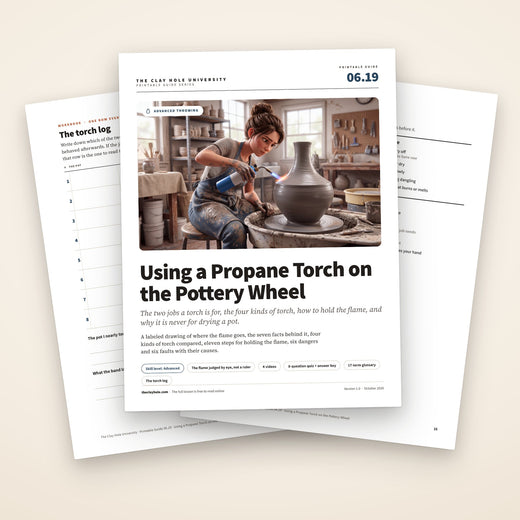
Using a Propane Torch on the Pottery Wheel
A torch is the fastest way to take water out of one band of a thrown wall, and that is exactly why it is so easy to misuse. It has two real jobs on the wheel: holding up a shoulder that has to carry a sharp angle or an impossible lean, and stiffening a flared rim so thin and wet it would fold if you tried to collar it. This page covers those two jobs, the torches potters use, how to hold the flame, and every way it goes wrong.
A torch firms one band of wet clay in seconds. It has two jobs on the wheel, a shoulder that has to hold a sharp angle and a soaked flared rim that has to be stiff enough to collar in, and nothing else. Short bursts, flame always moving, inner cone off the clay.

Jump to a section
Heat takes the water out of one band, fast
Wet clay is soft because water sits between its particles and lets them slide. Drive some of that water off and the particles pack closer and stop sliding. A torch does that to the band of wall it touches in seconds, which is why a shoulder that was sagging can suddenly hold a crisp angle.
The danger is the same speed. The skin dries ahead of the clay behind it, and clay that dries unevenly cracks. Hold the flame still and you crack it. Take it too far and the rim is too stiff to collar. Use it on a whole soaked pot and you have hidden a water problem instead of fixing it.
So the torch is a small, precise tool for two jobs, used in short moving bursts, and put down the moment the wet shine goes matte.
Two jobs, and only two
At The Clay Hole a torch goes on a pot on the wheel for one of these two reasons. Anything else is a job for time, a sponge, a rib, or a different lesson.

- The inner cone never touches. Keep the tip of the bright, sharp cone near the nozzle off the clay, and let the soft outer flame brush the wall.
- Job one: the shoulder band. A shoulder that has to carry a sharp angle or lean out further than wet clay can hold gets firmed, and only that band, so it can take the turn.
- The top stays soft. Everything above the shoulder still has to be thrown, so the flame stays off it.
- Short bursts, always moving. A few seconds at a time, sweeping, with the wheel turning, so the heat lands evenly round the whole pot.
- Job two: the thin, soaked flare. A flared neck or rim so thin and wet that collaring would buckle it gets firmed first, just enough to take the squeeze. Then you collar it in.
- Never at the splash pan. The flame crosses the wall at a glancing angle and never points down past the pot at the pan, the bat or the wheel head.
What it is never for
A pot that is soaked all over, drying a piece faster so you can trim it, add a handle or take it home, or anything else that is really a water problem. The torch hides that problem for one pot and teaches your hands to keep making it. It is also hard on the equipment: plastic splash pans and bats melt, and a scorched wheel is a wheel somebody else has to use tomorrow.
Holding the flame, step by step
Our torches are marked Owner Only. Dan okays each member who uses one, so start there.
- Check it is one of the two jobs. A shoulder that needs to hold an angle, or a soaked flare that needs to take a collar. If the whole pot is wet, sponge and rib instead.
- Scrape the slip off first. A rib takes the slurry off the wall so the flame firms clay, not a skin of mud.
- Wheel turning slowly, flame blue. A clean flame is blue and hisses. A lazy yellow one is not burning properly: stop.
- Inner cone off the clay. The soft outer flame brushes the band you mean to firm, at a glancing angle, never pointed at the splash pan.
- Short bursts, always moving. About ten seconds, sweeping in small circles, then look. Stop when the wet shine goes matte, before it steams.
- Let it settle, then go easy on water. Give it a moment, then carry on with ribs and barely damp hands. Fresh water undoes it.
- Flame off before it leaves your hand. The nozzle stays hot after it goes out, so set it down away from anything that burns or melts.
What the flame actually does to a wet wall
Seven facts. The right way to hold a torch, and every way it goes wrong, follows from them.
- Water is what lets clay move. It sits between the flat clay particles and lets them slide past each other. As it evaporates, the particles pack closer and the clay shrinks and stiffens. A typical plastic pottery clay shrinks about six percent drying.
- A flame removes it from one place. A propane flame burns at about 3,600 F in air. Swept across a thrown wall it drives water out of the surface it touches in seconds, and that band can suddenly hold a shape it would have slumped out of a moment before.
- The skin dries ahead of the core. The outside of the wall loses water faster than the clay behind it. Clay that dries unevenly sets up stress, and stiffening clay relieves stress by cracking. Too much heat in one spot gives surface cracks for exactly this reason.
- Even beats slow. Fast but even drying cracks less than slow but uneven drying. That is why the wheel keeps turning and the flame keeps moving: speed is not the problem, a hot spot is.
- It softens again a little. After the flame, water moves out from the core toward the drier skin, and the band loses some of its stiffness. A pause before you carry on lets the wall settle at one even firmness.
- Thin, soaked clay wrings. Under a collar, a thin wet wall does not move as one piece: it folds, twists and tears, and no grip fixes that. A brief flame gives a thin flare just enough body to take the squeeze as one piece, which is the whole reason for the second job.
- Firm is not leather hard. Collaring and shaping move clay, and clay that has gone leather hard has stopped being willing to move. Pressure then cracks the wall instead of shaping it. The target is the wet shine just gone matte, still plastic underneath.
The sentence worth keeping
The torch firms one band in seconds, where time or a fan works on the whole pot. That precision is the reason to use it, and the reason it only belongs on the band that needs it.
When you should never reach for it
Each of these is a real reason people pick up a torch. Each one has a better answer.
The whole pot is soaked
The wall sags everywhere, the floor has a puddle in it, and every pass makes it worse. That is a water problem. Sponge the inside floor dry, use a rib on the outside, wet your hands instead of the pot, and count your pulls. A torch on this pot hides the habit that made it.
You want it dry sooner
To trim tonight, add a handle, or take it home. Drying belongs to time, a covered shelf, and the right stage. Forcing it with a flame dries the outside ahead of the inside, which is the recipe for cracks you find days later.
It is already firm
More heat on clay that is already stiff only dries it toward leather hard, and leather hard clay cracks when you try to collar or shape it. If the band is holding, it is done.
Inside a narrow form
A flame pointed into a narrow pot starves for oxygen. It burns badly, sputters, and fills the form with hot, dirty air. Heat the outside of the band you need.
Anywhere but the band
The floor, the base, the rim above a shoulder you still have to throw. Heat on a part that does not need it is a part that now dries out of step with the rest of the pot.
Because a video made it look fun
Plenty of potters torch every piece out of habit. They are throwing on their own wheels with their own pans. In a shared studio the equipment and the people around you count too, which is why it is two jobs here.
The kinds of torch, and what each one is for
Potters use four. Every one of them burns hundreds or thousands of degrees hotter than clay needs, so the real differences are how much flame you get and how easily you control it.
| Torch | Fuel and flame | What it is like | Where it fits |
|---|---|---|---|
| Handheld trigger torch | Propane, about 3,600 F in air, from a 14.1 ounce cylinder screwed onto the torch | One hand, instant on and off with a trigger, a bushy swirl flame on models like the Bernzomatic TS8000. The flame goes out when you let go, unless the flame lock is on. | The everyday torch at the wheel for member-size pots. Leave the flame lock off. |
| The same torch on MAP-Pro | MAP-Pro, about 3,730 F in air, same size cylinder | Sold for brazing and soldering large copper pipe, where the extra heat matters. The TS8000 runs on either fuel. | Nowhere it beats propane on clay. Hotter only means a hot spot arrives sooner. |
| Butane micro torch | Butane, about 3,150 F in air, refilled from a small can | The kitchen or jeweler’s torch. A small, narrow flame and a small tank. | Miniatures and small necks. Too little flame to cover a full-size shoulder evenly. |
| Weed burner | Propane from a full-size tank, through a regulator and a long hose; around 100,000 BTU an hour on a common model | A two-inch bell on a long wand. A big, wide flame. | Very large pots thrown in sections, where each lower section has to carry the next. Far more heat than an ordinary pot can take. |
A heat gun is not a torch
It blows hot air instead of burning gas, it has no flame you can see, and it is still hot after it is switched off. The hanging heat lamps and the heat guns have their own lesson and their own rules; this page is about the flame.
How to hold the flame
Distance is judged by the flame, not a ruler, because every torch throws a different flame. The bright inner cone never touches the clay. The soft outer flame does the work.
- Get to the point where you need it. The shoulder is formed and about to take its angle, or the flare is thrown and too wet to collar. Not before: heat on a wall you are still pulling only gets in the way.
- Scrape the slurry off. A rib, metal if you have one, takes the slip off the outside so the flame works on clay. Sponge any standing water out of the floor while you are there.
- Slow the wheel. Turning slowly, so every part of the band passes through the flame for the same short time.
- Light it and read the flame. A clean propane flame is blue with a sharp inner cone and a steady hiss. Yellow, orange or lazy means it is not burning completely, which means soot and carbon monoxide. Turn it off and find out why.
- Inner cone off, outer flame on. Bring the torch in until the soft outer flame brushes the band. The tip of the bright inner cone stays clear of the clay the whole time.
- Aim across the wall. A glancing angle, aimed at the band, never down past the pot at the splash pan, the bat or the floor of the pot, and never into the opening.
- Short bursts, sweeping. About ten seconds at a time, moving in small circles or up and down the band. Then take the flame away and look.
- Stop at matte, before steam. The wet shine turns dull and the clay goes a shade lighter. That is enough. A wall that steams has gone further than the job needs.
- Let it settle, then go easy on water. Give the band a moment to even out. Touch it lightly: firm but still plastic. Then make the shoulder in one pass with a dry rib, or collar the flare in with only as much water as your fingers need to glide.
- Again only if it needs it. A second short burst is fine if the band softens back. If it keeps softening, the pot is too wet overall, and that is a different fix.
- Flame off, then put it down. Turn it off before it leaves your hand. The nozzle stays hot after the flame is out, so it goes down away from towels, sponges, plastic and people.
What enough looks like
Matte, a shade lighter, firm to a light touch, not steaming. If the band feels like a pot ready to trim, you went past it.
The dangers
A torch is an open flame at about 3,600 F in a room full of people, water, plastic and cloth. Six things to know.
Burns
A clean blue flame can be nearly invisible in a bright room, so it is easy to sweep it across a hand or an arm. Never point it at anyone, your own face included. The nozzle stays hot after the flame goes out.
Fire
Towels, rags, paper, aprons and loose sleeves all burn. Tie back hair and anything that dangles. Keep the flame and the hot nozzle well away from anything that can catch, and never leave a lit torch, even for a second.
Melted equipment
Plastic splash pans and plastic bats melt, and wooden bats scorch. It happens when the flame points past the pot, and when a hot torch gets set down on the pan. Glancing angle, every time.
Bad air
Propane burned without enough oxygen makes carbon monoxide. A yellow flame is the warning. Use a torch only in a well-ventilated space, never a confined one, and never pointed into a narrow pot where it starves.
The cylinder
Keep it roughly upright: tipping the cylinder more than about 60 degrees can make the torch flare. Cylinders stay below 120 F, away from heat. Propane is heavier than air, so swap cylinders only where it is ventilated and nothing is lit.
Your pot
The least dangerous and the most common. A hot spot cracks the surface, an over-dried flare cracks when you collar it, and a band dried ahead of the rest of the pot can crack later as it dries. Keep it moving.
What goes wrong at the wheel, and why
Fine cracks where the flame was
The flame sat in one place. The surface shrank faster than the clay behind it and cracked to relieve the stress. Next time, keep it moving and the wheel turning.
The rim cracked when you collared it
Too much heat. The flare went past firm toward leather hard, and stiff clay cracks instead of moving. Next time stop at the first sign of matte, and collar gently with three small squeezes rather than one big one.
The shoulder went soft again
Water moved out from the core into the dried skin. Normal, and the reason for the pause. One more short burst, a moment to settle, then the single pass with a dry rib.
It firmed up and still slumped
The band held but the wall below it was soaked, or there was water standing in the floor. The torch cannot fix a pot that is wet all over. Next time, sponge between pulls and fewer passes.
Black marks on the bat or pan
The flame went past the pot. A glancing angle across the wall keeps it on the clay. A scorch on a plastic pan is a melt waiting to happen: tell the studio team.
An S crack or a split days later
The torched band dried ahead of the rest of the pot, and the difference kept growing on the shelf. Dry the finished piece slowly and evenly, covered, so the rest can catch up.
Torches at The Clay Hole
Our torches are studio torches, and every one of them is marked Owner Only.
- Owner Only means exactly that. Dan okays each member who uses a torch, personally. It protects the studio, everyone’s safety and the equipment, and it means the person holding a flame next to you knows what they are doing.
- Two jobs. A shoulder that has to hold a sharp angle or a gravity-defying lean, and a flared neck or rim so thin and soaked it has to be stiffened to collar it in. Nothing else.
- Not for drying. Not a soaked pot, not to trim sooner, not to take a piece home tonight. Those are water and time problems, and they have better answers.
- The equipment is shared. Splash pans, bats and wheels are used by the next person. Keeping the flame off them is part of the deal.
- The lamps and heat guns are different tools. They have their own lesson, their own place and their own rules.
Not one of the two jobs
Then the answer is already on the wheel with you: a sponge on a stick, a rib, wet hands instead of a wet pot, fewer passes, and a pot left to firm on its own.
Three ways it goes wrong
Using it to dry a pot
A soaked pot or a piece you want to trim sooner is a water and time problem. The torch hides it for one pot and keeps the habit going. Sponge, rib, fewer passes.
Holding it still
The surface dries ahead of the clay behind it and cracks. Keep the wheel turning and the flame moving, in bursts of about ten seconds.
Going past matte
Firm is the goal, not leather hard. A flare dried too far cracks when you collar it. Stop when the shine goes dull, before it steams.
The ones that come up at the wheels
Why not just use it to dry a pot faster?
Because a flame dries the outside ahead of the inside, and uneven drying is what cracks pots. It also hides the real problem. A pot too wet to stand up was thrown with too much water or too many passes, and drying it with a torch means the next one will be just as wet.
How far away should the flame be?
Read the flame, not a ruler. The tip of the bright inner cone stays clear of the clay and the soft outer flame brushes the wall. Every torch throws a different size of flame, so the same number of inches would be too close on one and useless on another.
How long do I torch for?
Bursts of about ten seconds, flame moving, then look. You are done when the wet shine on that band goes matte and the clay lightens a shade. A wall that starts to steam has had more than the job needs.
Is MAP gas better because it is hotter?
Not for clay. Propane already burns thousands of degrees hotter than a wet wall needs. MAP-Pro is sold for brazing and big copper pipe, where the extra heat helps. On a pot it only means a hot spot arrives sooner.
Can I torch the inside of a pot?
Not a narrow one. The flame starves for oxygen inside it, burns dirty and sputters. Heat the outside of the band you need firmed. On a wide open flare the outside is where the flame belongs anyway.
Why did the shoulder go soft again a minute later?
Water moved from the wetter clay inside the wall out into the dry skin. Give it a moment after each burst so the band settles at one firmness, and use one more short burst if it needs it.
Is a heat gun the same thing?
Same physics, different tool, different rules. A heat gun blows very hot air with no visible flame, and it stays hot after it is switched off. Our heat lamps and heat guns have their own lesson, linked at the bottom of this page.
Why are the torches Owner Only?
Because an open flame in a busy studio puts the building, the people and the shared equipment at risk all at once. Dan okays each member who uses one himself, so everyone holding a torch here knows the two jobs and how to keep the flame where it belongs.
Where to go next
Throwing sharp shoulders
The thick-topped cylinder, collaring dry and the single pass with a dry rib that the first job is for.
Read it →How to collar in on the pottery wheel
The hand positions, the speed and why a collar folds, for the second job and every other one.
Read it →What to check when throwing goes wrong
The water problem the torch is not for, and the six point check that fixes it.
Read it →The hanging heat lamps
The other heat tools in the studio, the lamps and the heat guns, and their own rules.
Read it →Gooseneck and skinny neck pots
Tall, narrow and flared forms, thrown in pieces and joined.
Read it →Clay Hole University
Every lesson and guide in one place, from the first day at the wheel through firing.
Start there →A small flame for a small job
A torch is the most dramatic tool in the room, and used well it is one of the most boring. Ten seconds on a shoulder, a pause, one pass with a dry rib. Ten seconds on a soaked flare, a pause, three small squeezes. Then it goes down and stays down.
Everything else people use it for, the soaked pot, the rush to trim, the habit of torching every piece, is a water problem or a patience problem wearing a flame. Fix those at the sponge and the clock, and the torch is left with the two jobs nothing else can do.
Two jobs: a shoulder that has to hold an angle, and a soaked flare that has to take a collar. Short moving bursts, inner cone off the clay, stop at matte, flame off before it leaves your hand. Our torches are Owner Only.
For what the flame does to the clay, the four kinds of torch and everything that goes wrong, switch to the Comprehensive Version at the top of the page.
Which version would you like to print?
Videos come out as a labeled box with the title and channel to search for, since paper does not play them.